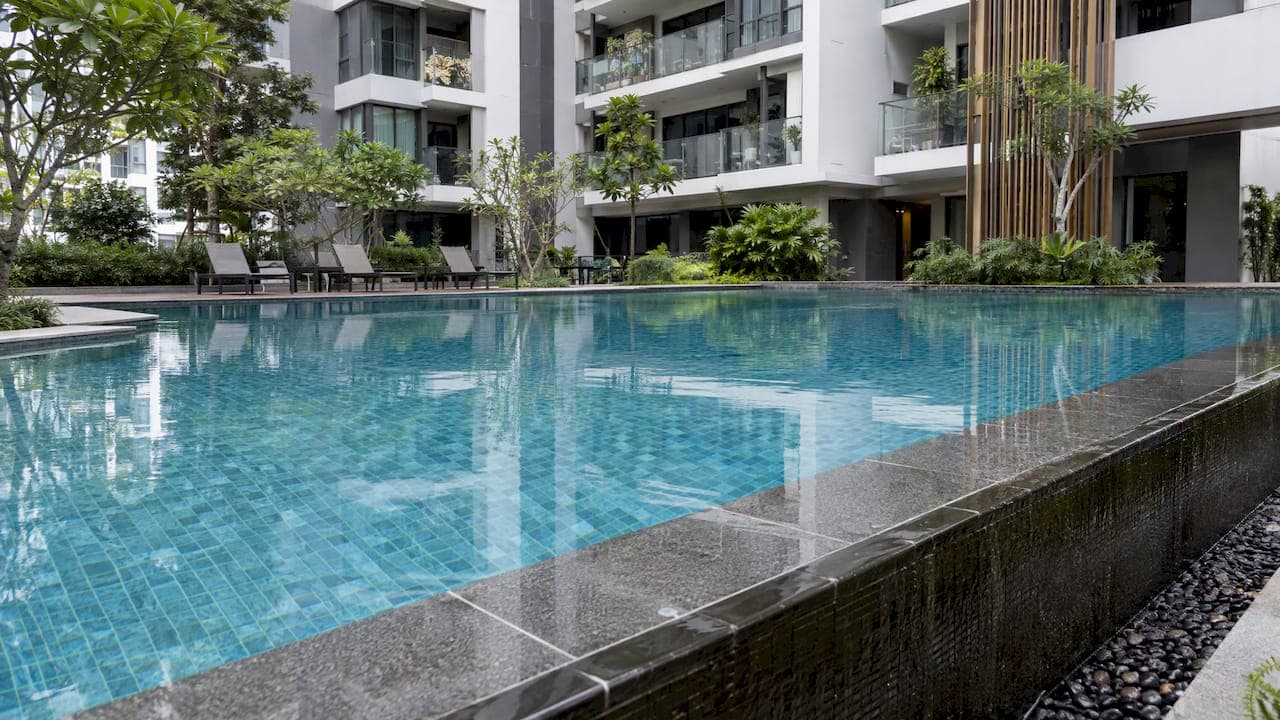
In a Singapore condo, a water feature is any shared pool, spa pool, water playground, fountain, pond or cascade that the management corporation (MCST) has to run. Each one adds to your monthly fees, and several are licensed by the National Environment Agency (NEA). This guide covers the main types, the rules that govern them and the questions to ask before you buy. It also covers why the most photogenic features are often the most expensive to keep.
TL;DR
- Condo water features fall into two groups: licensed recirculating facilities (swimming pools, spa pools, water playgrounds) and decorative ones (fountains, ponds, cascades). Both groups carry running costs.
- NEA licenses pools, water playgrounds and multi-use spa pools, and sets daily and monthly water quality checks. Mosquito control applies to decorative water too.
- Costs show up in the maintenance fee and the sinking fund. Compare the fee against the facility list, and check the sinking fund balance on any resale unit.
- You generally cannot add your own water feature to a balcony or terrace without MCST approval.
- At Aurea, 802 Beach Road, the resort-style amenities are spread across four levels, including multiple pools. Ask for the full facility schedule at the showflat.
Table of Contents
- The main types of water features in Singapore condos
- What NEA requires of pools, playgrounds and spa pools
- Fountains and ponds: small features, weekly duty
- What water features do to your monthly fees
- Can you add a water feature to your own unit?
- Perspective: how we look at water features at Aurea
- A buyer's checklist for condo water features
- Aurea's amenities and unit options
- FAQ
- Sources
The main types of water features in Singapore condos
Readers often search for "pool types" when they mean the whole family of water amenities. In practice there are two groups, and the difference matters for cost and compliance.
Licensed aquatic facilities
NEA defines three kinds of licensable aquatic facility. According to the GoBusiness licence directory, these are:
- Swimming pools: artificial pools with a water recirculation system, used for swimming, diving, wading or dipping. Lap pools, leisure pools, wading pools for toddlers and infinity-edge pools all belong here.
- Water playgrounds: play areas with artificial water features on a recirculation system, including interactive water fountains. Children's splash zones in condos fall under this.
- Multi-use spa pools: pools that use hydrojets or air-induced bubbles. This covers jacuzzis and spa pools on pool decks.
The same page notes that a licence is not required for a pool or spa pool in a private house for the owner's own use. A shared condo facility is a different matter, and the management has to hold the licence.
Decorative water features
These include reflecting ponds, fountains, water walls, cascades and koi or lotus ponds. They are mainly there for look, sound and cooling. Some recirculate water and some are simple basins. They sit outside the NEA pool licence in most cases, but they are still subject to drainage rules and mosquito control, covered below.
Quick comparison
| Feature | What it is for | Main upkeep concern |
|---|---|---|
| Lap or leisure pool | Exercise and family swimming | Chemical balance, filtration, retiling over time |
| Infinity or vanishing-edge pool | Views and visual impact | Catch basin, hydraulics, higher build and upkeep cost |
| Wading or children's pool | Toddlers and young kids | Strict hygiene and licensing, frequent testing |
| Water playground | Splash play | Licensed facility, interactive fountains need water quality control |
| Spa pool or jacuzzi | Soaking and relaxation | Higher disinfectant range, Legionella checks |
| Fountain, pond, cascade | Atmosphere and cooling | Algae, scale, mosquito control, pump electricity |
What NEA requires of pools, playgrounds and spa pools
The NEA licensing requirements for aquatic facilities, version 4.0 updated July 2026, set out the standards that management must meet. The design criteria address public health first, so the water must stay safe for users whatever the landscaping looks like.
The figures that matter most to a resident:
- Daily on-site tests: pH of 7.2 to 7.8 for chlorine-based systems. Free chlorine of 1 to 3 ppm for pools and playgrounds, and 3 to 5 ppm for spa pools.
- Monthly laboratory tests: turbidity of 0.5 NTU or less, a heterotrophic plate count of 200 cfu/ml or less, and E. coli below 1 cfu/100 ml.
- Quarterly Legionella testing: below 1 cfu/100 ml for features that generate aerosols, such as spa pools.
A licence is valid for three years and is then renewed, according to GoBusiness. NEA has also tightened its oversight of higher-risk facilities, such as spa pools and water playgrounds, because they can spread waterborne disease if poorly managed.
For a buyer, the takeaway is practical. Testing and lab work are recurring costs paid from the management fund. A development with several pools, a spa pool and a water playground has more to test, more to document and more to pay for than one with a single pool.
Fountains and ponds: small features, weekly duty
A decorative fountain looks harmless, but standing water breeds mosquitoes. NEA's guidance for condominium estates lists weekly checks for mosquito breeding around the estate, and ponds, fountains and other water-bearing receptacles are part of that routine. NEA's scope of works for mosquito control also notes that mosquitoes breed in stagnant water, so keeping water moving and clean is the baseline.
A decorative water feature is therefore never "set and forget". Someone has to clean catch basins, treat algae, clear mineral scale and inspect the feature on a schedule. In Singapore's climate, algae and scale form quickly, which is why a feature that looks effortless on a rendering needs steady maintenance in real life.

Where the water goes
Discharge is regulated too. Under PUB's June 2020 requirements, overflow from indoor and outdoor water features goes to the stormwater drainage system, while washing and cleaning water must go to the sanitary sewer. Where an indoor feature has no stormwater outlet, overflow may go to the sewer through a floor trap. Management corporations need drainage that respects this split. If you want a broader view of how maintenance obligations are handled in practice, this guide to keeping building exteriors in good order is a useful read, though it comes from an Australian context and Singapore's own rules apply to you.
What water features do to your monthly fees
Every pool and fountain ends up on your maintenance bill. A strata and MCST guide from LovelyHomes gives typical monthly contributions of S$280 to S$450 for outside-central-region condos, S$420 to S$680 for the rest of central region, and S$780 to S$1,400 for core central region luxury projects. These are indicative ranges from that source, not a quote for any specific development.
The contribution splits into two funds:
- Management fund: daily operations such as pool chemicals, cleaning, water testing, security and electricity for pumps.
- Sinking fund: long-term capital work such as pool retiling, pump replacement and structural repairs. The same guide says it typically makes up 25 to 30 percent of the total contribution.
We cover the mechanics in our own explainer on the sinking fund for condos. The short version: if the sinking fund is thin when a pool needs resurfacing, the MCST may call a one-off special levy.
Resort-style condo guidance from LiveFree makes the same point from the buyer's side. Resort-style amenities lift appeal, but they are often the costliest assets to sustain. Infinity pools and extensive water gardens are long-term capital commitments, and buyers are advised to sanity-check the monthly fee against the facility list.

Infinity edges and cascades
Vanishing-edge pools deserve a special mention. A technical article on infinity pools describes them as among the most technically demanding products in residential architecture: they cost more to build, more to maintain and more to get right. That is not a reason to avoid one. It is a reason to ask how the fee is set and whether the sinking fund assumes this kind of equipment.
Can you add a water feature to your own unit?
Usually not without permission. A balcony fountain or terrace pond may alter the facade, add load, or introduce waterproofing and drainage risks. Condo renovation guidance notes that work touching these areas often needs MCST approval, and structural changes require certification from a Professional Engineer. Waterproofing works and relocating plumbing are also on the list of work that is typically restricted or needs special approval.
A leak from your balcony into the unit below becomes your liability. Our overview of MCST rules for Singapore condo owners walks through what to submit and who signs off. If you are planning any fit-out project, a general home renovation checklist can help you sequence trades, though the approval rules here are Singapore's own.
Perspective: how we look at water features at Aurea
We think water amenities should be judged by how often you will use them and what it costs to keep them working, not by how they look in a brochure.
Aurea at 802 Beach Road is a 188-unit development with 2 to 5 bedroom layouts and two penthouses. Its resort-style amenities are spread across four levels: multiple pools, clubhouses, fitness decks and children's facilities. That mix is deliberate. Different households use water differently. Families want children's facilities near the pool deck. Professionals want somewhere to unwind after work without leaving the building. Spreading the amenities across levels also avoids crowding everything onto one deck.
We would also say this to any buyer, at any project, ours included: ask the questions in the checklist below. A pool is only an asset if the management corporation can afford to look after it for decades. We wrote about the same trade-off in urban resort living and in our piece asking whether one gym can serve 600 units, because capacity and upkeep are the same question from two angles.
— Velisa
A buyer's checklist for condo water features
Take this to a showflat or a resale viewing.
- Get the facility list. Count the pools, spa pools, water playgrounds and decorative features. Each one carries testing, cleaning and equipment costs.
- Match the fee to the list. Compare the projected or actual monthly contribution with similar developments. A long list of features with a very low fee deserves a question.
- Ask for the sinking fund balance (resale units). Look at what has been set aside, and whether major works such as retiling or pump replacement are expected soon.
- Ask who runs the water. Find out which contractor handles testing and cleaning, and whether the facility licence is current.
- Check the layout of the pool deck. Note the position relative to bedrooms, shading through the afternoon, and where the children's pool sits relative to adult swimming areas. Our west sun viewing checklist helps with the light and heat part.
- Visit at a busy hour. A weekend morning shows you how crowded the pools get. Our showflat checklist shows what else to measure and verify.
- Look at the developer's record. Facilities are only as good as how they are delivered and handed over. See our three checks on developer track records.
Aurea's amenities and unit options
Aurea is a 99-year leasehold condominium by GMC Property Pte. Ltd., with a link bridge to The Golden Mile, walking access to several MRT stations and completion set for 2029. Published price ranges are:
| Unit type | Published price range |
|---|---|
| 2 Bedroom | S$1,770,000 to S$2,075,800 |
| 3 Bedroom | S$2,639,900 to S$3,058,600 |
| 4 Bedroom | S$4,080,510 to S$4,512,990 |
| 4 Bedroom Premium | S$5,186,105 to S$5,723,390 |
| 5 Bedroom and Penthouse | No published price |
If the resort-style amenities across four levels are what you are weighing, see the unit types and register your interest at Aurea and ask for the full facility schedule alongside the floor plans.
FAQ
What are the different types of pools in Singapore condos?
Common types are lap pools, leisure pools, wading pools for children, infinity-edge pools and spa pools or jacuzzis. NEA treats swimming pools, water playgrounds and multi-use spa pools as licensable aquatic facilities. Which ones a condo has depends on the development, so check the facility list.
Do condo pools need a licence?
Shared condo swimming pools, water playgrounds and multi-use spa pools are licensable aquatic facilities. According to GoBusiness, the licence is valid for three years, and a licence is not needed for a pool in a private house used by the owner only. The management corporation is responsible for holding it.
Do water features raise maintenance fees?
Yes. Pools and fountains need chemicals, testing, cleaning, pump electricity and eventually major repairs, which are paid from the management and sinking funds. A development with many features usually has a higher contribution than a basic one, so compare the fee with the facility list.
Can I install a fountain on my balcony?
Probably not without approval. MCST bylaws often restrict additions that affect the facade, load or waterproofing, and structural work needs a Professional Engineer. Ask your MCST before buying or installing anything.
Sources
- NEA licensing requirements for aquatic facilities
- GoBusiness: Aquatic Facility Licence
- NEA on higher-risk aquatic facilities
- NEA: mosquito control in condominium estates
- NEA: scope of works for mosquito control
- PUB: specific requirements for water discharge
- LovelyHomes: strata title and MCST guide
- LiveFree: resort-style condo facilities guide
- Pools and Bathrooms: infinity pools
- Goodrich Global: condo renovation rules
- Solshine: apartment exterior maintenance guide
- Sorted Home Solutions: home renovation checklist