
An urban resort living condo combines hotel-grade amenities, low-density site planning, and city-center access in a single residential package. Think multiple pools, spa facilities, landscaped grounds, and concierge services — all within walking distance of MRT stations, malls, and business districts. If that brief matches what you're looking for, the most direct next step is booking a site visit through an appointed agent so you can verify the facilities in person before committing.
The category suits three distinct buyer profiles:
- Owner-occupier families who want private pools, children's play areas, and clubhouse space without leaving the development
- Urban professionals who prioritize location, privacy, and on-site wellness facilities over raw square footage
- Yield-focused investors targeting premium rental demand from expatriates and corporate tenants who expect resort-grade living standards
Key Takeaways
A genuine urban resort condo delivers low-density site planning, hotel-grade amenity depth, and city-center transit access — and the best examples, like Aurea at 802 Beach Road, combine all three in a single development.
| Point | Details |
|---|---|
| Definition and category | Resort-style condos combine hotel-grade amenities, low-density planning, and urban transit access in one development. |
| Top amenities to verify | Confirm pool dimensions, gym equipment quantity, sinking fund balance, and maintenance records before committing. |
| Price signals | Freehold tenure, architect pedigree, and low unit count per land area are the strongest psf premium drivers. |
| Investor yield reality | Gross yields in prime districts typically run 2–3%; net yield and capital appreciation over a long hold are the real return drivers. |
| Owner-occupier fit | Families and professionals who use on-site facilities daily get the clearest value from the higher maintenance fees. |
| Aurea at 802 Beach Road | 188 units, 2–5 bedrooms, four levels of resort amenities, link bridge to The Golden Mile, completion 2029. |
This article is general information, not a substitute for advice from a qualified financial advisor. Consult a qualified financial professional about your own circumstances before acting on anything here.
Table of Contents
- What does an urban resort condo actually include?
- Amenity checklist: what to verify before you sign
- Price expectations and what drives psf in resort-style condos
- Unit types, sizes, and what to look for on a floorplan
- Location and connectivity: what actually matters
- How to evaluate a resort-style condo before committing
- Urban Resort Condominium (32 Cairnhill Road): a development snapshot
- How Aurea maps to the urban resort brief
- Sustainability and environmental features in resort-style condos
- Market risks that affect resort-style condo values
- How resort-style condos compare to other condo types
- Rental yield and return on investment for resort-style condos
- When an urban resort condo is the right choice
- Aurea: resort-style living at 802 Beach Road
- Sources
What does an urban resort condo actually include?
The term "urban resort" is a marketing descriptor, not a regulated classification. What separates a genuine resort-style condo from a standard development with a pool comes down to the depth and quality of its facilities, not just their presence.
Expect the following in a property that earns the label:
- Aquatic facilities: lap pools of generous length, infinity-edge pools, children's splash pools, and hydrotherapy or spa pools
- Wellness amenities: steam rooms, saunas, fully equipped gymnasiums with branded equipment, and dedicated yoga or stretching decks
- Social and entertainment spaces: multiple clubhouses, function rooms, BBQ pavilions, and sky terraces with city views
- Landscaping and green buffers: mature tree planting, water features, and generous setbacks that create acoustic and visual separation from the street
- Service infrastructure: 24-hour security, concierge or management staff, and in some cases valet parking
Two design elements separate the top tier from mid-range resort condos: private lift lobbies that open directly into individual units, and low-density site planning. Sophisticated buyers prioritize low-density layouts because fewer units per land area translates to less competition for shared facilities, quieter common areas, and stronger long-term desirability. A development with 40 units on a 5,000 sqm site feels categorically different from one with 200 units on the same footprint, even if both brochures list the same amenity count.
Amenity checklist: what to verify before you sign
Brochure photography is optimized for appeal, not accuracy. A site visit with a specific checklist closes that gap.
On the brochure, confirm:
- Pool dimensions (length, depth at both ends) and filtration system type
- Gym equipment brands and quantity relative to unit count
- Number of distinct clubhouses and their booking policy
- Security setup: 24-hour guardhouse, CCTV coverage zones, visitor management system
- Maintenance contractor name and contract duration
During the site visit, check:
- Pool water clarity and smell (a strong chlorine odor often signals reactive rather than preventive treatment)
- Drainage condition around pool decks and gym changing rooms
- Visible maintenance backlog: peeling paint, cracked tiles, or rust on railings are early warning signs
- Service access corridors and waste management areas — these reveal how seriously management takes upkeep
- Clubhouse booking calendar: ask to see recent utilization rates to gauge whether facilities are oversubscribed
Pro Tip: Ask the property manager for the last two years of maintenance records and the current sinking fund balance. A healthy sinking fund (typically 10–15% of total maintenance collected) signals that the management corporation is planning ahead rather than deferring repairs.
Red flags worth walking away from: maintenance fees with no itemized breakdown, amenity areas that are locked or "under renovation" during a scheduled visit, and a developer with no completed projects you can inspect independently.
Price expectations and what drives psf in resort-style condos
Resort-style condos command a premium over standard developments in the same district, and that premium is driven by a predictable set of factors.
Urban Resort Condominium (32 Cairnhill Road) — sample listing context:
EdgeProp data confirms the development is freehold with a TOP of 2013. PropertyGuru's project listing and active resale listings show units currently available across 3-bedroom and 4-bedroom configurations, with psf figures reflecting the Cairnhill/Orchard fringe premium.
| Pricing driver | Effect on psf |
|---|---|
| Freehold tenure | Significant premium vs. 99-year leasehold in same district |
| MRT proximity (within 500m) | Adds measurable value, especially for investor-held units |
| Low unit count / low density | Reduces facility congestion; supports higher asking prices |
| High floor with unobstructed view | Floor premium typically increases with height |
| Developer reputation and architect | Kerry Hill Architects pedigree commands a design premium |
Recurring costs are the part buyers underestimate. Resort facilities are expensive to maintain. Expect monthly maintenance fees for a full-facility development to run higher than a standard condo of comparable size. The sinking fund contribution sits on top of that. Before budgeting, ask for the current maintenance fee schedule broken down by unit type, not just the headline per-sqft figure.
For city-fringe condo comparisons and how psf stacks up across districts, the linked guide covers the broader market context.
Unit types, sizes, and what to look for on a floorplan
Resort-style condos typically concentrate their unit mix at the larger end: 3-bedroom and 4-bedroom layouts dominate, with penthouses at the top of the stack. Smaller 1- and 2-bedroom units appear less frequently because the target buyer profile skews toward families and premium tenants who need the space to justify the maintenance fees.
PropertyGuru listings for Urban Resort Cairnhill show 3-bedroom units around the low two-thousands in square feet and 4-bedroom units slightly larger, reflecting spacious layouts. Penthouse sizes are noted in developer materials as the largest configurations in the stack.
For families evaluating 4-bedroom layouts, the floorplan checklist matters as much as the gross area:
- Column-free living areas: structural columns inside the living or dining zone waste usable space and complicate furniture placement
- Balcony depth: a balcony shallower than 1.5m is decorative, not functional; look for at least 2m depth for outdoor dining
- Private lift lobby: a direct lift that opens into your unit's foyer is a genuine privacy and security upgrade
- Household shelter location: ideally positioned as a storeroom or helper's room, not cutting into the main living area
- Service yard: check that it fits a washer-dryer stack and has a window or ventilation; a sealed service yard is a daily inconvenience
Larger units in resort condos tend to attract corporate tenants on two- to three-year leases, which stabilizes rental income. Smaller units in the same development often see higher turnover and shorter tenancies.
Location and connectivity: what actually matters
Transit access and immediate surroundings affect both daily livability and long-term value. For resort-style condos, the calculus is slightly different from a standard apartment: on-site amenities partially substitute for nearby retail, so a 10-minute walk to an MRT station is more tolerable when you have a full gym, pool, and clubhouse at home.
Location checklist:
- MRT proximity: within 500m is the gold standard; 500m–800m is acceptable with strong on-site facilities; beyond 1km starts to affect rental demand from car-free tenants
- Nearby malls: access to a major mall within 1–2 MRT stops covers daily grocery and F&B needs
- Schools: proximity to reputable primary schools matters for owner-occupier families and for the resale market
- Hospitals: within 2km of a major hospital is a practical consideration for families and older residents
- Noise sources: check for flight paths, expressway proximity, and planned construction on adjacent sites
SRX's location map for Urban Resort Condominium shows the Cairnhill Road site's proximity to Orchard Road retail, Newton MRT, and the surrounding residential enclave. The Cairnhill area benefits from low traffic density on its residential streets while remaining within a short drive of the CBD.
A slightly longer walk to MRT becomes acceptable when the development offers a genuine lifestyle substitute: a resort condo where you spend weekend mornings at the pool rather than at a mall café changes the calculus entirely.

How to evaluate a resort-style condo before committing
A structured approach prevents the most common buyer mistakes: overpaying for amenities you won't use, underestimating recurring costs, or missing tenure and legal issues that affect exit value.
- Pre-visit research: pull the developer's track record, the architect's portfolio, the TOP date, and the unit count from official sources (cos.sg, EdgeProp, URA). Cross-check the tenure against the title search.
- Brochure review: map every listed amenity against the checklist above. Note what is described vaguely ("landscaped gardens") versus specifically ("50m lap pool with UV filtration").
- On-site inspection: visit at two different times — a weekday morning and a weekend afternoon — to gauge actual facility usage and noise levels.
- Financial calculation: model the total cost of ownership including stamp duty, legal fees, monthly maintenance, sinking fund, and property tax. For investors, calculate gross and net yield against realistic rental comparables, not asking rents.
- Legal and tenure checks: confirm freehold or leasehold status, remaining lease (for leasehold), and any encumbrances on the title. For new launches, review the sale and purchase agreement with an independent lawyer.
Questions to ask the agent or developer:
- What is the defects liability period and what does it cover?
- Can you provide the last 24 months of maintenance fee collection and expenditure?
- What is the current sinking fund balance per unit?
- Are there restrictions on short-term rentals (Airbnb-style) in the house rules?
- Has the development undergone any major common-area repairs in the past five years?
Red flags:
- Maintenance fees quoted as a single number with no itemized breakdown
- Sinking fund balance below three months of projected major repair costs
- Developer with no completed projects available for independent inspection
- Oversupply of similar-grade units in the same submarket, which compresses rental yields
Investor priorities: net yield after all recurring costs, tenant profile (corporate vs. short-stay), lease duration norms, and exit liquidity (how quickly comparable units have sold). For a deeper look at CBD condo investment returns, the linked guide covers district-level yield data.
Owner-occupier priorities: school proximity, facility quality relative to family size, noise and privacy, and the practical usability of the unit layout day-to-day.
Urban Resort Condominium (32 Cairnhill Road): a development snapshot
Urban Resort Condominium at 32 Cairnhill Road is one of the cleaner on-market examples of the resort-style category. COS's product page confirms the key specs:
- Developer: Jubilee Realty Pte. Ltd.
- Architect: Kerry Hill Architects
- Tenure: Freehold
- TOP: 2013
- Site area: 5,000 sqm
- Unit mix: 3-bedroom and 4-bedroom configurations, plus penthouses
Kerry Hill Architects is the same practice behind Amanjiwo and Aman Tokyo, which explains the resort-hospitality aesthetic that runs through the building's design language. That pedigree is a genuine differentiator in the Cairnhill market.
| Spec | Detail |
|---|---|
| Tenure | Freehold |
| TOP | 2013 |
| Architect | Kerry Hill Architects |
| Developer | Jubilee Realty Pte. Ltd. |
| Site area | 5,000 sqm |
| 3-bedroom size | low two-thousands in square feet |
| 4-bedroom size | ~2,530–2,551 sqft |
Mapped against the earlier checklist: the development's freehold status, low unit count relative to site area, and architect-led design all score positively. The Cairnhill location sits within the Newton/Orchard corridor, giving residents walkable access to Orchard Road retail and Newton MRT. The main trade-off is the resale price point, which reflects all of the above.
How Aurea maps to the urban resort brief
Aurea at 802 Beach Road is a new launch development by GMC Property Pte. Ltd. that applies the resort-living model to a Beach Road address, with a 2029 completion target. The project offers 188 units across 2- to 5-bedroom layouts, plus two exclusive penthouses.
How Aurea's features map to the buyer checklist:
- Multi-level resort amenities: facilities spread across four levels, including multiple pools, fitness decks, children's facilities, and clubhouses — meeting the depth-of-amenity standard the category demands
- Accessibility: multiple MRT stations within reach, consistent with the transit-proximity criterion
- Unit mix breadth: 2- to 5-bedroom layouts accommodate families, professionals, and investors targeting different tenant profiles
- Unique connectivity: a link bridge to The Golden Mile adds a retail and F&B convenience layer that most resort condos lack
- Developer credentials: GMC Property Pte. Ltd. with ERA Realty Network Pte Ltd as the appointed marketing agent
For buyers comparing penthouse configurations or families evaluating larger layouts, Aurea's unit mix covers both ends of the spectrum.
This information is factual and based on publicly available project details. Prospective buyers should seek independent financial and legal advice before making any purchase decision.
Sustainability and environmental features in resort-style condos
Green building credentials have moved from a nice-to-have to a pricing signal in the premium condo segment. Developments pursuing the Building and Construction Authority's Green Mark certification typically incorporate rainwater harvesting for landscape irrigation, energy-efficient chiller systems for pool filtration, LED lighting across common areas, and low-VOC materials in interior finishes.

Beyond certification, the most tangible sustainability features for residents are the ones that affect daily comfort: cross-ventilation design that reduces air-conditioning reliance, mature tree canopies that lower ambient temperature in outdoor amenity areas, and solar panels on rooftop facilities that offset common-area electricity costs. A development that has invested in these systems tends to have lower utility-driven maintenance fee increases over time, which matters for long-term holding costs.
When reviewing a brochure, look for the specific Green Mark tier (Certified, Gold, GoldPlus, Platinum) rather than generic "eco-friendly" language. The tier is verifiable through BCA's public register.
Market risks that affect resort-style condo values
The premium that resort-style condos command is real, but it is not immune to market cycles or urban development shifts.
Supply risk is the most immediate concern. When several high-amenity developments launch in the same submarket within a short window, rental yields compress as tenants gain negotiating power. The Orchard/Cairnhill corridor has historically absorbed supply well, but any buyer should check URA's pipeline data for upcoming launches in the target district before committing.
Interest rate sensitivity hits larger units harder. A 4-bedroom resort condo at a high psf carries a mortgage that is acutely sensitive to rate movements. Investors who modeled yields at 2021-era borrowing costs and held through the rate cycle that followed learned this the hard way.
Urban development adjacency cuts both ways. A new MRT line or integrated development nearby can lift values significantly. A new expressway, data center, or industrial facility on an adjacent site does the opposite. Check URA's Master Plan for the surrounding parcels before signing.
Leasehold decay does not apply to freehold developments like Urban Resort Condominium, but it is a material risk for 99-year leasehold resort condos, particularly those past the 30-year mark where bank financing becomes harder to secure for buyers. For a detailed breakdown of tenure implications, the linked guide covers the freehold vs. leasehold trade-off in practical terms.
How resort-style condos compare to other condo types
The resort-style condo sits at one end of a spectrum. Understanding where it sits relative to alternatives helps buyers decide whether the premium is justified for their situation.
Traditional condominiums offer a pool, gym, and BBQ area at a lower psf. The trade-off is facility depth: a standard condo's gym might have 10 machines for 300 units; a resort condo's gym has 30 machines for 60 units. The per-resident experience is categorically different, and that gap shows up in rental premiums.
Serviced apartments provide hotel-style management and flexible lease terms, but residents don't own the asset. For investors, a serviced apartment is an operating business investment; a resort condo is a property investment with a lifestyle overlay. The capital appreciation profile is different, and so is the exit market.
Executive condominiums (ECs) are government-subsidized and carry eligibility restrictions and a minimum occupation period. They can offer good facilities at lower entry prices, but the buyer pool is constrained, which affects resale liquidity. For buyers who qualify, an EC near an MRT can deliver strong value, but it is a different product category from a private resort condo.
The resort-style condo makes the most sense when the buyer genuinely values the amenity depth, can absorb the higher maintenance fees, and is targeting either long-term owner-occupation or a premium rental segment that will pay for the lifestyle.
Rental yield and return on investment for resort-style condos
Resort-style condos in prime and city-fringe districts tend to attract corporate tenants on longer leases, which reduces vacancy risk and stabilizes rental income. The trade-off is that the entry price is higher, so gross yields are typically lower than mass-market condos in the same city.
Gross rental yields for premium condos in the Cairnhill/Orchard corridor tend to be modest, with net yields after maintenance fees, property tax, and agent commissions reflecting typical returns for prime districts. These figures are not high by regional standards, but the investment thesis for this segment is usually capital appreciation over a long holding period rather than yield maximization.
For investors, the key variables are: how long you plan to hold, whether you are financing with a mortgage (and at what rate), and whether the tenant profile in that submarket is stable. Corporate tenants from multinational companies tend to be the most reliable payers and the most likely to renew, which matters more than a marginally higher headline yield from a less stable tenant base.
Best RCR condos and Esplanade-area developments offer useful yield comparisons for buyers weighing district-level trade-offs.
When an urban resort condo is the right choice
The buyers who get the most from this category share a specific profile: they use the amenities regularly, they value privacy over proximity to street-level retail, and they are holding for at least seven to ten years. That last point matters more than most buyers acknowledge upfront.
The resort-style premium is real at purchase and real at resale, but only if the market has had time to absorb the entry cost. Buyers who purchased freehold resort condos in prime districts during the 2010s and held through the 2020s cycle generally saw that thesis play out. Buyers who needed to exit within three to five years of purchase often found the premium harder to recover, particularly if they bought near a market peak.
For families, the calculus is more straightforward. Private pool access, a safe play area, and a clubhouse for weekend gatherings are daily-use amenities that justify the maintenance fees in a way that a rarely-used gym does not. For professionals without children, the honest question is whether you will actually use the facilities enough to justify the cost difference over a standard condo in the same location.
The one caution that applies universally: model the recurring costs conservatively. Maintenance fees for resort facilities tend to increase over time as equipment ages and replacement cycles hit. A development that looks affordable at purchase can become a significant monthly commitment a decade in if the sinking fund was underfunded from the start.
Aurea: resort-style living at 802 Beach Road
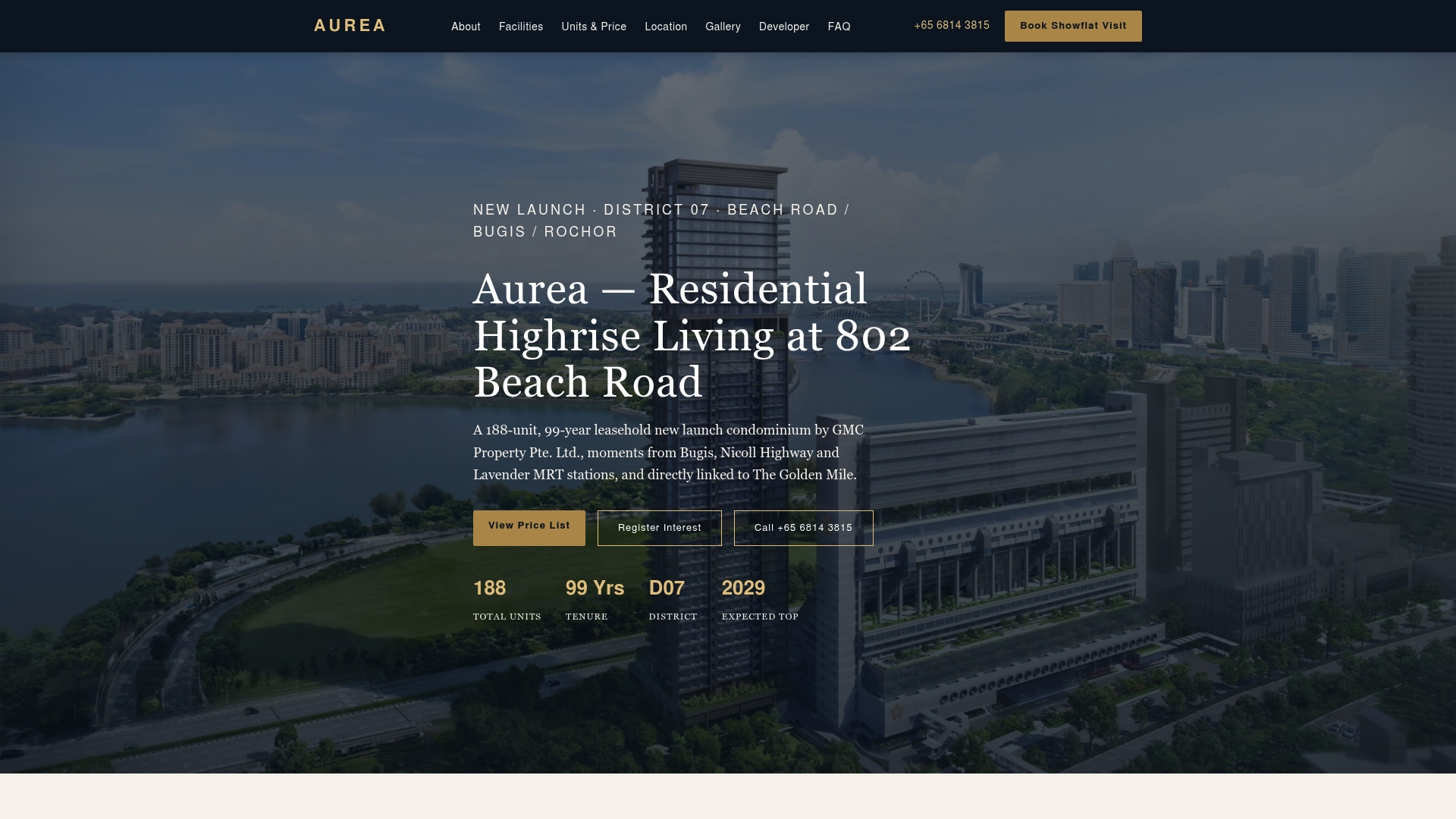
Aurea at 802 Beach Road is a new launch that delivers the resort-living brief at a Beach Road address, with completion set for 2029. The development's 188 units span 2- to 5-bedroom layouts and two penthouses, with resort amenities across four levels: multiple pools, fitness decks, children's facilities, and clubhouses. The link bridge to The Golden Mile adds a retail and dining connection that most comparable developments don't offer.
For buyers who want to see the floor plans, unit availability, and pricing in detail, the appointed marketing agent ERA Realty Network Pte Ltd can arrange a viewing. Request the Aurea e-brochure or schedule a site visit directly through the project page. As with any property purchase, independent financial and legal advice is recommended before signing.
Sources
- Urban Resort Condominium - Price, Reviews & Availability ...
- URBAN RESORT CONDOMINIUM - Singapore
- Urban Resort Condominium Condo Location Map
- Urban Resort - Condos And Commercial Spaces In Singapore