
A condo sinking fund is the MCST's long-term reserve for major capital works, and it exists under the Building Maintenance and Strata Management Act (BMSMA). It pays for the expensive, infrequent stuff. Lift overhauls. Repainting the whole facade. Waterproofing a roof that's started leaking into the penthouse.
Before you buy a unit or vote at your next AGM, do one thing first: request the current sinking fund balance and the 5-year capex plan. That single document tells you more about a development's financial health than any glossy brochure ever will.
Recent reporting on Channel NewsAsia found one household paying $292 a month in total fees, with $60 of that going straight into the sinking fund. It's just rarely explained to buyers before they sign.
Start with these checks:
- Ask the managing agent for the latest audited MCST accounts.
- Request the 5-year capital expenditure plan and compare it against the current sinking fund balance.
- Check AGM minutes for any recent or proposed special levies.
Key Takeaways
A healthy sinking fund depends on realistic capex planning, transparent audited reporting, and owners who actually read the documents before voting.
| Point | Details |
|---|---|
| Request key documents early | Get audited accounts, AGM minutes, and the 5-year capex plan before buying or voting. |
| Know the legal minimum | BMSMA sets the sinking fund at least 10% of the management fund budget. |
| Watch for repeat levies | Frequent small special levies usually signal an underfunded original budget. |
| Match balance to capex plan | A large balance means little without a realistic plan for upcoming major works. |
| New launches start from zero | Developer estimates differ from actual MCST figures set after the estate is formed. |
Table of Contents
- What Is a Sinking Fund in a Condo, and How Does It Differ From the Maintenance Fund?
- How Are Sinking Fund Contributions Calculated for Each Unit?
- What Does the Sinking Fund Actually Pay For?
- How Do You Check a Condo's Sinking Fund Before Buying or Voting?
- What Happens When a Sinking Fund Runs Short?
- How Can MCSTs and Owners Keep a Sinking Fund Healthy?
- How Do New Launch Estimates Compare to Actual MCST Sinking Fund Figures?
- Sinking Fund Editorial Take: What Buyers Keep Getting Wrong
- Where to Verify Sinking Fund Information in Singapore
- Sources
What Is a Sinking Fund in a Condo, and How Does It Differ From the Maintenance Fund?
Every MCST in Singapore runs two separate pots of money, and confusing them is one of the most common owner mistakes. The management fund (sometimes called the maintenance fund) covers day-to-day running costs: security guards, pool cleaning, gardening, lift servicing, utilities for common areas. It gets spent down and replenished every year.
The sinking fund is different. It's a reserve built up over years specifically for big, irregular capital works, and DollarsAndSense's breakdown of the two funds makes clear it should never be treated as a backup for operating shortfalls. Under the BMSMA, the sinking fund contribution must be at least 10% of the management fund budget for the preceding year. That's a floor, not a target. Many well-run estates contribute well above it once their buildings pass the ten-year mark.
| Feature | Management Fund | Sinking Fund |
|---|---|---|
| Purpose | Daily operations and recurring upkeep | Major capital works, replaced infrequently |
| Spending frequency | Monthly and ongoing | Every few years, in large lump sums |
| Typical examples | Cleaning, security, utilities | Lift replacement, repainting, waterproofing |
| Legal minimum | Set by MCST budget | At least 10% of management fund |
| Planning horizon | Annual | 5 to 15 years |
A few practical distinctions worth remembering:
- The management fund runs on an annual budget cycle; the sinking fund is planned in decades.
- A near-empty management fund means late-paid vendors; a near-empty sinking fund means a special levy is coming.
- Both funds are decided and approved at general meetings, but the sinking fund's budget usually attracts far less owner attention until something breaks.
How Are Sinking Fund Contributions Calculated for Each Unit?
Your contribution isn't a flat fee split evenly among neighbors. It's based on share value, a proportion assigned to each unit under the strata title, typically reflecting size, floor, and sometimes view or layout. A five-bedroom penthouse carries a larger share value than a compact two-bedroom unit, and pays a proportionally larger slice of both funds.
Here's how it typically plays out:
- The MCST council proposes an annual sinking fund budget ahead of the AGM, based on projected capital works.
- Owners vote on the budget at the AGM, usually requiring a majority resolution to approve or amend it.
- The approved total is divided across all units according to each unit's share value.
- Owners receive quarterly or monthly invoices reflecting their proportional contribution.
Say a development has a total share value of 10,000 points across all units, and your unit carries 60 points.
Pro Tip: Before your first AGM as an owner, ask the managing agent for a breakdown of share value versus contribution, not just the final dollar figure. It's the only way to sanity check whether your unit is being charged fairly relative to similar layouts.

What Does the Sinking Fund Actually Pay For?
Big, expensive, and unavoidable. That's the pattern behind almost every sinking fund payout. The fund exists precisely because these costs don't fit neatly into an annual maintenance budget.
Common capital works include:
- Lift replacement or major modernization, typically needed every 15 to 20 years.
- Full exterior repainting, usually every 5 to 7 years depending on climate exposure.
- Waterproofing of roofs, decks, and common area terraces.
- Swimming pool resurfacing and filtration system overhauls.
- Major mechanical and electrical (M&E) works, including generators, water pumps, and fire safety systems.
Older estates feel this pressure hardest. A development past its 15 or 20 year mark often faces several of these projects converging within a short window, with lift, facade, and waterproofing all needing attention around the same time. That's part of why some MCSTs are now managing multi million dollar sinking fund reserves while still scrambling to keep pace with repair costs that have climbed faster than contributions.
For buyers, this matters more than the show flat ever will. A newer development, still under its Defects Liability Period, faces none of this yet. An estate turning 18 years old is a different proposition entirely, and its sinking fund balance deserves scrutiny before you make an offer.
How Do You Check a Condo's Sinking Fund Before Buying or Voting?
Don't take the agent's word for it. Request the documents directly, and read them yourself.
- Ask for the last two years of audited MCST accounts, not just a summary sheet.
- Request the 5-year capex plan, which should list upcoming major works and their estimated costs.
- Review recent AGM minutes for any special levy resolutions, whether passed or merely proposed.
- If you're buying a resale unit, instruct your conveyancing lawyer to run an MCST search as part of the transaction, which confirms contribution rates, arrears, and recent resolutions.
- Compare the current sinking fund balance against the capex plan's total projected spend for the next five years.
Watch for these red flags: a sinking fund balance that's been shrinking year over year without a corresponding capex explanation, repeated small special levies (a sign the original budget was set too low), missing or qualified audit opinions, and capex costings that look suspiciously round or outdated. DollarsAndSense's guide on checking sinking fund balances before purchase is worth reading in full if you're evaluating a resale unit.
Pro Tip: At the AGM, ask the council directly: "What percentage of the 5-year capex plan is currently funded?" A confident, specific answer is a good sign. A vague one is not.
One more thing worth checking before wiring any levy payment: verify the request through official MCST channels, not just an email. ScamShield has flagged a rise in fraudulent payment requests impersonating property managers.
What Happens When a Sinking Fund Runs Short?
When reserves fall short of what a capital project needs, the MCST calls a general meeting and proposes a special levy, a one time additional charge split across owners by share value, same formula as regular contributions. Approval typically requires a majority resolution at that meeting.
- Special levies reported in Singapore estates can range widely, from modest amounts to larger sums per unit in older developments facing major works.
- Owners who don't pay face interest charges on the arrears, and the MCST can pursue legal claims to recover the debt.
- Persistent underfunding tends to compound: one levy often signals the underlying budget was never realistic to begin with.
A depleted sinking fund doesn't just mean a surprise bill. It means the MCST is planning capital works reactively instead of proactively, and owners end up paying more in emergency levies than they would have through steady, predictable contributions.
How Can MCSTs and Owners Keep a Sinking Fund Healthy?
Healthy sinking funds don't happen by accident. They happen because someone on the council insisted on planning five years ahead instead of one.
- Commission an independent condition survey every few years to catch deterioration before it becomes an emergency.
- Maintain a rolling 5-year capex plan and update it annually as costs and building condition shift.
- Benchmark your reserve against several times the annual sinking fund budget rather than just meeting the 10% legal minimum.
- Publish audited accounts and capex projections to owners well before the AGM, not as a rushed handout on the night.
- Engage a professional managing agent, and encourage council members to take advantage of BCA training resources aimed at strata governance.
Pro Tip: If you're an owner, not a council member, you can still push for transparency. Ask at every AGM for the capex plan to be tabled as a standing agenda item, not an afterthought raised only when something has already broken.
Transparency isn't just good governance. It's the difference between a predictable annual contribution and a five figure surprise levy nobody saw coming.
How Do New Launch Estimates Compare to Actual MCST Sinking Fund Figures?
Developer-published fee estimates, the kind you'll see in a sales gallery or a project brochure, are projections based on comparable developments, not audited figures. The actual sinking fund contribution gets set by the MCST once the estate is formed and the council starts approving real budgets against real capex needs.
That gap matters for anyone evaluating a new launch:
- Developer estimates typically assume a stabilized, fully tenanted building; early years often run leaner before major works loom.
- Once the MCST is formed, contributions are recalculated based on actual share value and the council's own capex projections, not the developer's initial figures.
- Buyers comparing new launch versus resale condos should factor in that a new development starts its sinking fund from zero, giving the MCST years to build reserves before major works are due.
- For budgeting purposes, it helps to read a maintenance fee breakdown alongside any cash downpayment planning guide so the full cost picture is clear before you commit.
Aurea, located at 802 Beach Road, is still years from its first capex cycle, with completion set for 2029. That timeline gives its eventual MCST a genuine head start on reserve building compared to estates that inherited aging infrastructure on day one. If you're weighing that kind of runway against a resale unit's existing sinking fund position, Aurea's latest updates are worth a look before you decide.
Sinking Fund Editorial Take: What Buyers Keep Getting Wrong
Most advice on this topic stops at "check the sinking fund balance," as if a single number tells the whole story. It doesn't. A $2 million reserve sitting against a capex plan that needs $3.5 million in the next four years is worse than a $500,000 reserve backed by a fully costed, realistic five-year plan. The number without the plan is close to meaningless.
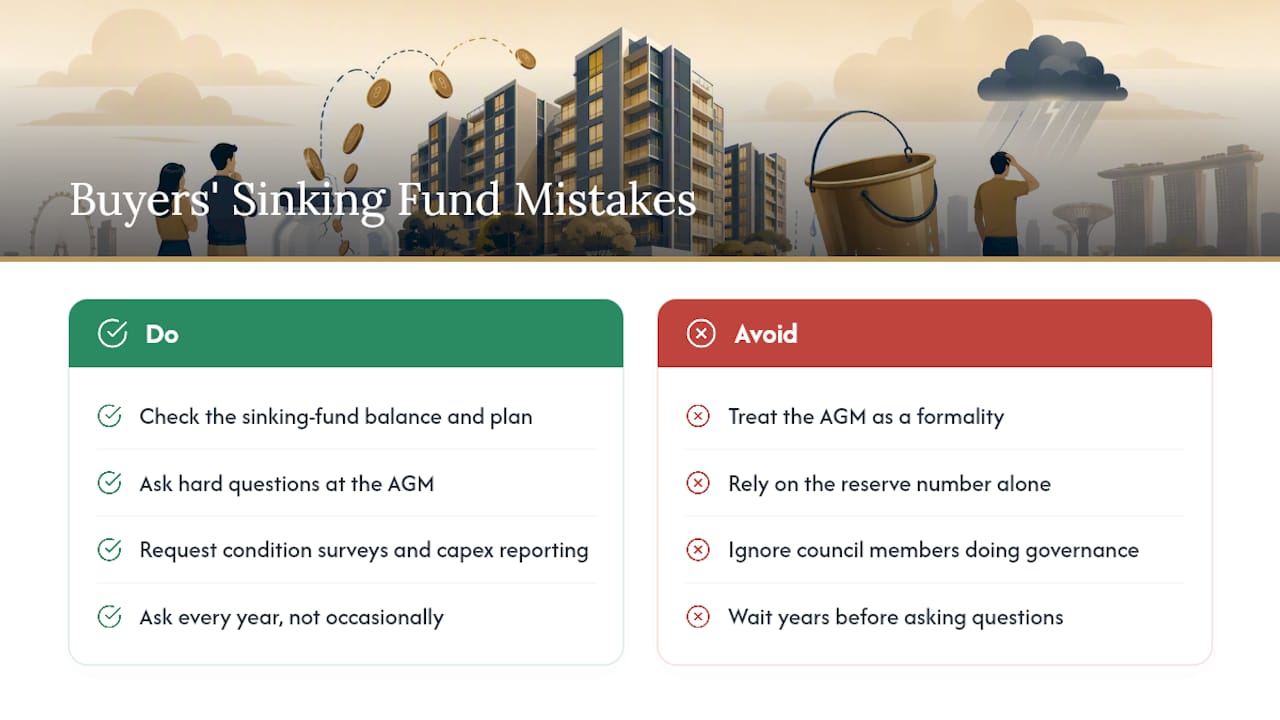
The bigger failure I see is owners treating AGMs as a formality rather than the one moment they have real leverage. Council members who push for condition surveys and transparent capex reporting are doing unpaid governance work that directly protects your resale value. Reward that, don't ignore it.
If you take one thing from current reporting on strata pressure in Singapore, it's this: the estates struggling hardest aren't the oldest ones, they're the ones where nobody asked hard questions for a decade. Ask now. Ask every year. That habit costs you nothing and saves you thousands.
— Velisa
Where to Verify Sinking Fund Information in Singapore
- BCA's resources on ageing condos and strata management for regulatory context and training initiatives.
- DollarsAndSense's guide to management versus sinking funds for a plain-language breakdown of fund uses.
- Channel NewsAsia's reporting on sinking fund pressure and calls for mandatory council training.
- Property agents, including those featured on myEracareer's industry insights, can offer practical, ground-level context on strata governance.
This article is general information, not a substitute for advice from a qualified financial advisor. Consult a qualified financial professional about your own circumstances before acting on anything here.
Sources
- Managing million-dollar sinking funds, costly repairs: Do condo councils need mandatory training?
- Management Fund Vs Sinking Fund: A Guide for Strata Property Owners
- Feedback on ageing condos and sinking funds/BMSMA review