
What are condo maintenance fees?
Condo maintenance fees are mandatory monthly payments every unit owner makes to their condominium association. They fund the shared costs of running the building: cleaning, security, landscaping, utilities for common areas, insurance, and the reserve account that covers major future repairs. Think of them as your proportional share of keeping the whole property functional and financially healthy.
Fees are apportioned by unit size or share value as defined in the building's Declaration. Larger units pay more. The split typically divides between two buckets: an operational fund for day-to-day expenses and a reserve (or sinking) fund for long-term capital work.
- Every unit owner pays, no exceptions
- Amounts are set by the condo association or homeowners association (HOA)
- Fees cover shared property only, not individual unit costs
- Both operational and reserve contributions are included in the monthly total
What do condo fees actually cover?
The coverage is broader than most buyers expect. Your monthly payment funds two fundamentally different categories: current operations and future capital replacements.
Operational expenses typically include:
- Security services: guards, CCTV systems, access control
- Cleaning and janitorial work in hallways, lobbies, and common areas
- Landscaping, lawn care, and seasonal snow removal
- Utilities for shared spaces: lighting, elevator power, HVAC
- Pool and gym maintenance, including water treatment and equipment servicing
- Building insurance covering common property and shared liabilities
- Property management fees, accounting, and administrative costs
- Concierge or front-desk staffing in full-service buildings
Reserve fund contributions cover:
- Roof replacement
- Elevator overhauls and eventual full replacement
- Parking structure resurfacing and waterproofing
- Major plumbing or electrical infrastructure work
- Facade repainting and exterior repairs
Owners remain responsible for their own unit's interior repairs, personal property insurance, and individual utility bills where separately metered.
How condo maintenance fees are calculated
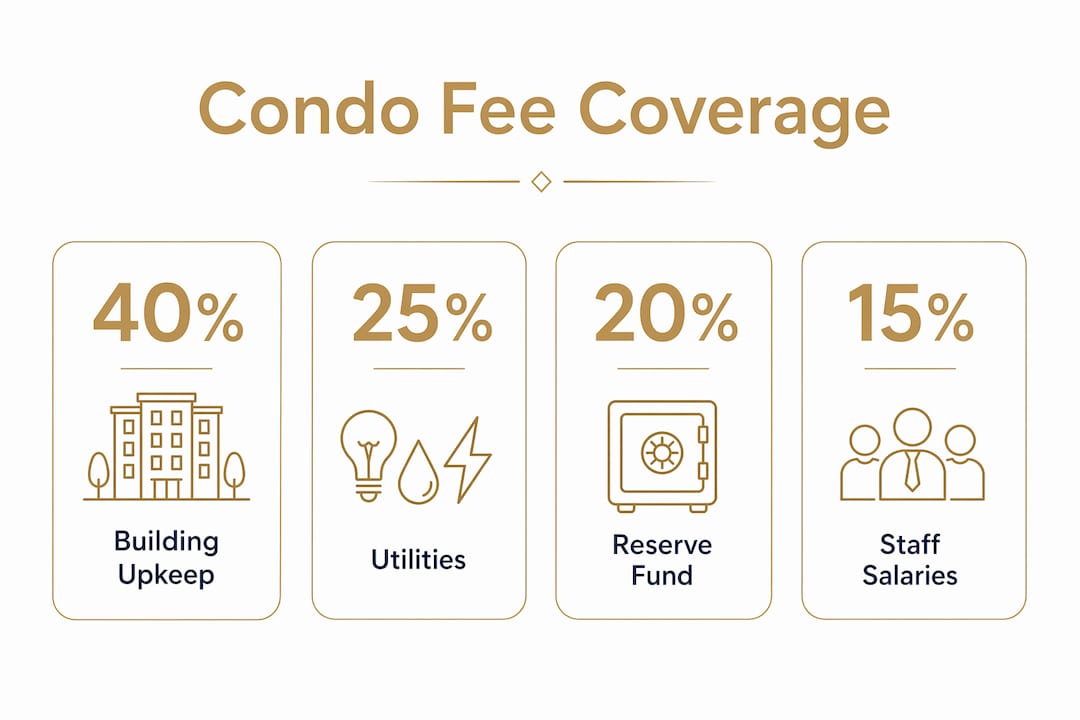
The math starts with the building's annual operating budget plus the reserve study's recommended annual contribution. Divide that total by the number of units (weighted by share value or square footage), and you get each owner's monthly fee. Larger or premium units carry a higher share.
Several factors push fees up or down. Building age matters most: older properties have more components nearing end of life, which drives reserve contributions higher. Amenity count is the second biggest lever. A pool alone costs $12,000–$25,000 per year to maintain, plus reserve contributions for eventual resurfacing. Add a gym, a parking structure, and a rooftop deck, and each one adds both an operating line and a reserve line.

Staffing is the third major driver. A building with 24-hour concierge and security carries labor costs that a self-managed low-rise simply does not. Individual staff members can cost upward of $55,000 annually in wages and benefits. Owners vote on the annual budget at the AGM, where they can question allocations and influence the final numbers.
Typical cost ranges for US condo fees
Typical national condo maintenance fees vary widely depending on building type and location. Condo fees generally increase with building size, amenities, and service levels, with garden-style units typically costing less and luxury full-service buildings costing more.
Location impacts fees significantly, with coastal markets often experiencing substantially higher costs due to factors like increased insurance premiums. A $150 monthly fee on a 30-year-old building with amenities is almost certainly a warning sign, not a bargain.
Pro Tip: Before buying, request the reserve study, the current reserve fund balance, and the last three years of financial statements. A low fee on an older building usually means reserves are underfunded, not that the building is cheap to run.
Why condo maintenance fees increase over time
Fees tend to increase annually due to inflation and maintenance needs, with occasional larger jumps indicating significant deferred repairs or reserve shortfalls.
- Labor costs: Security and cleaning staff wages rise with minimum wage increases and market rates
- Insurance premiums: In high-risk markets, property insurance has increased sharply. Post-Surfside legislation in Florida accelerated reserve requirements and insurance costs statewide
- Aging infrastructure: More components reach end of life simultaneously in older buildings, requiring larger reserve contributions
- Deferred maintenance: Boards that kept fees artificially low for years eventually face steep corrections
- Emergency repairs: Unexpected failures, like a pipe burst or elevator breakdown, can force fee increases or special assessments
Unlike a fixed mortgage payment, condo fees can rise with inflation and aging infrastructure. Owners who budget only for today's fee are underestimating the true long-term cost of ownership.
Risks of low fees and consequences of non-payment
Low fees can be misleading, often associated with underfunded reserves and deferred maintenance that may result in substantial special assessments for major repairs in the future.
Fannie Mae requires that at least 10% of gross assessments go to reserves for a project to be warrantable. Buildings below that threshold may lose financing eligibility, which affects every buyer in the complex.
Non-payment carries its own consequences. Unpaid fees can result in liens on the property, court-ordered collection actions, and damage to credit ratings. Boards have the legal authority to pursue foreclosure in many states. Beyond the individual owner, widespread non-payment forces the association to raise fees on everyone else or cut services.
- Underfunded reserves lead to special assessments
- Non-payment triggers liens, court actions, and potential foreclosure
- Low fees in older buildings depress resale value and restrict buyer financing options
- Deferred maintenance visibly degrades the property, reducing appeal for all owners
Expert guidance for budgeting condo ownership costs
Reviewing three years of meeting minutes and financial statements before purchase is the single most useful thing a prospective buyer can do. Fee trends, reserve fund health, and upcoming capital projects are all visible in those documents. A building with a healthy reserve and a steady 3–7% annual fee increase is far less risky than one with flat fees and a depleted reserve account.
Fees set deliberately low at launch to avoid owner resistance are a known industry pattern. The problem compounds over time: once a low contribution rate is established at the first AGM, raising it significantly becomes politically difficult. By year 15 or 20, the building is playing catch-up, and the increases required are far steeper than gradual adjustments would have been.
Pro Tip: Request a detailed reserve fund report and a multi-year capital expenditure plan, not just the current fee schedule. A low monthly fee with a depleted reserve is a liability, not a deal.
For buyers considering family-oriented amenities like pools, playgrounds, and fitness centers, factor in that each amenity adds both an operating cost and a reserve contribution to the monthly fee.
How condo maintenance fees are paid
Most associations collect fees monthly, though some smaller townhome complexes collect quarterly or annually. Payment methods vary by association: many accept ACH bank transfers, online portals, checks, or automatic debit. Late payments typically trigger a penalty fee, and associations begin collection proceedings after a defined grace period.
The annual budget is approved at the AGM, and the new monthly rate takes effect at the start of the fiscal year. Owners receive advance notice of any rate change.

Who sets and manages condo maintenance fees?
The elected board of directors (or HOA board) sets the annual budget and proposes the fee level. Owners vote on it at the AGM, where a majority approval is required. The board then engages a property management company to handle day-to-day operations, vendor contracts, and financial reporting.
Fees are democratically set and adjusted by owner vote. Boards that override owner input or fail to present transparent financials can be challenged at general meetings. Owners always have the right to review audited financial statements and the reserve fund study.
How to budget for condo maintenance fees
Treat the monthly fee as a floor, not a ceiling. Budget for annual increases of at least 3–7%, and set aside a personal contingency for potential special assessments. A building with a well-funded reserve reduces that risk, but no reserve eliminates it entirely.
Smart condo features in newer developments can reduce operational costs over time through energy efficiency, but they also add technology maintenance lines to the budget. New buildings generally have lower fees initially because nothing needs replacing yet. That changes as the building ages.
Factor the full monthly cost into your mortgage qualification calculation. Lenders include HOA fees in debt-to-income ratios, so a $400 monthly fee meaningfully affects how much mortgage you can carry.
Key Takeaways
Condo maintenance fees run $200–$400 per month nationally, but older buildings, luxury amenities, and coastal markets push fees well above that range, and underfunded reserves are the single biggest financial risk for buyers.
| Point | Details |
|---|---|
| National average fee range | $200–$400/month for most buildings; high-rises and luxury buildings reach $600–$3,000+ |
| Two-fund structure | Fees split between an operational fund (daily costs) and a reserve fund (future capital repairs) |
| Low fees are a warning sign | A low fee on an older building almost always means reserves are underfunded, not that costs are low |
| Non-payment consequences | Unpaid fees can result in liens, court actions, foreclosure, and credit damage |
| Budget for increases | Annual increases of 3–7% are normal; sudden jumps of 25–50% signal a reserve crisis |