
MCSTs are statutory management bodies created under the Building (Strata Management) Act, and every unit owner becomes a member automatically at purchase. By-laws passed at general meetings bind all owners, funded through management and sinking fund contributions. When disputes arise, the path runs from internal written notice, through mediation, to the Strata Titles Board.
TL;DR:
- Share value determines both payment contributions and voting power, with larger units like penthouses often having more influence during meetings.
- The sinking fund's minimum contribution level is set by law, but many owners fund multiple years' worth to cover future major repairs effectively.
- Passing or amending by-laws requires a supermajority vote based on share value, and enforcement includes warnings, fines, and legal action if needed.
- Disputes should be resolved through written notices and mediation first, with the Strata Titles Board as the final adjudicator for unresolved conflicts.
- Active owner involvement, such as attending AGMs and reviewing strata plans, significantly increases influence and helps prevent common governance issues.
Table of Contents
- What Is an MCST Under Singapore Strata Law?
- How Does the MCST Manage Money and Levies?
- What Are MCST By-Laws and How Do They Get Changed?
- Where Does Your Unit End and Common Property Begin?
- When Are AGMs Held and How Does Voting Work?
- How Do You Resolve a Dispute With Your MCST?
- What Should Owners Actually Do to Stay Ahead of Problems?
- Why Getting Involved in Your MCST Actually Pays Off
- Sources
What Is an MCST Under Singapore Strata Law?
An MCST, or Management Corporation Strata Title, comes into existence the moment a strata title plan for a development is lodged with the Singapore Land Authority. You don't apply to join one. Buying a unit in a condominium automatically makes you a member, with rights and obligations spelled out in the Building (Strata Management) Act 2004, commonly shortened to BMSMA.
The Act governs how MCSTs form, what powers they hold, and how decisions get made. Alongside it, the Building and Construction Authority's Strata Management Guides translate the legal text into workable procedures: how to identify common property, how councils should run meetings, and what records an MCST must keep.
Your standing in the MCST isn't measured by headcount. It's measured by share value, a number assigned to your unit at the strata plan stage that reflects its relative size and type. Share value determines both how much you pay toward the estate's upkeep and how much voting weight you carry at general meetings. If you've ever wondered why a penthouse owner's vote sometimes counts for more than a one-bedroom owner's, this is the reason.
How Does the MCST Manage Money and Levies?
Every MCST runs two separate pools of money, and confusing them is one of the most common owner mistakes. The management fund covers day-to-day costs: security, cleaning, lift servicing, utilities for common areas. The sinking fund exists for big-ticket, long-term items like repainting the façade, replacing pumps, or major repairs after the defects liability period ends.
The BMSMA sets a statutory minimum contribution level for the sinking fund, and market practice in older estates often points toward holding multiple years' worth of annual contributions in reserve, according to guidance summarized by LovelyHomes. That's not a legal floor, just a sensible planning target many councils aim for.
Contributions to both funds are calculated using your unit's share value, and the annual budget setting those amounts gets approved at the AGM. If the ceiling fan installation on level 22 turns into a $40,000 rewiring job nobody budgeted for, the council can raise a special levy. Larger or unusual levies sometimes need Commissioner of Building Control approval before going ahead.
Unpaid contributions aren't just an awkward conversation. The MCST can charge interest, and, if the debt drags on, pursue recovery through the courts, with details on fees and procedures set out in the Building Maintenance (Strata Management) Regulations 2005.
What Are MCST By-Laws and How Do They Get Changed?
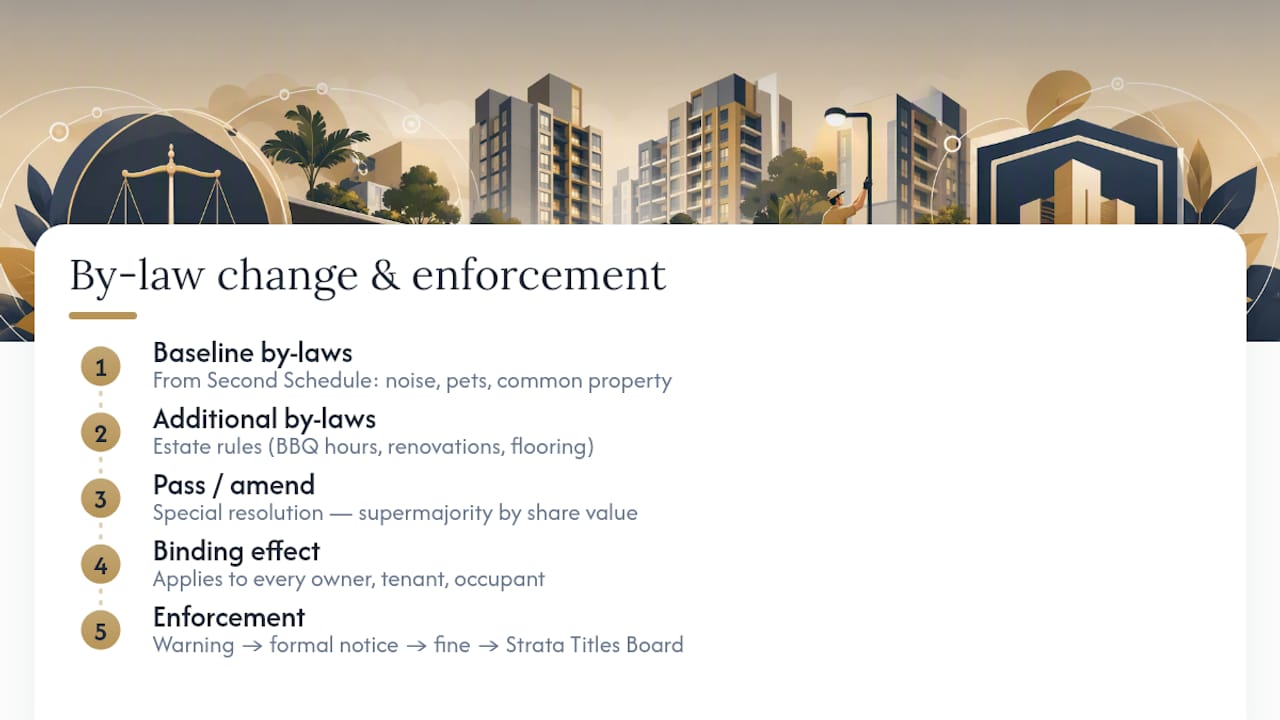
Every MCST starts with a set of prescribed by-laws lifted directly from the Second Schedule of the BMSMA. These cover the basics: noise, pets, use of common property, and rules that apply whether or not the MCST ever bothers to add its own.
Beyond that baseline, MCSTs can pass additional by-laws tailored to the estate, restricting barbecue pit hours, setting renovation windows, or banning certain flooring materials in upper floors to control noise transfer. Passing or amending one of these requires a special resolution, meaning approval by a substantial supermajority of share value at a general meeting. That threshold matters practically: a handful of large-share-value owners voting together can shape rules for the entire estate, while a scattered group of smaller owners has to organize to match that weight.
Once passed, by-laws bind every owner, tenant, and occupant, whether or not they showed up to vote. Enforcement typically starts with a warning, moves to a formal notice, and can end in a fine. Statutory fine caps apply per breach under the BMSMA framework, and where breaches are serious or ongoing, either side can bring the matter to the Strata Titles Board for a binding order.
Where Does Your Unit End and Common Property Begin?
The strata title plan is the actual boundary document. It defines your unit's interior, the boundaries of common property like corridors and the pool deck, and any limited common property that's shared but restricted, such as a private lift lobby serving only a few units. Guidance from BCA's SMG1 on the concept of strata living is the first place to check before assuming a wall, ledge, or balcony is yours to modify freely. Our own breakdown of strata area versus floor area walks through how these boundaries get drawn in practice.
Renovations touching structural walls, the façade, or anything visible from outside usually need MCST approval, and structural work almost always needs a professional engineer's assessment before the council will sign off, a point covered in SMG10 on by-laws. Once the developer's defects liability period ends, typically 12 months after handover, ongoing maintenance responsibility for your unit shifts fully to you. Before you touch a hammer, confirm the strata plan boundaries, get MCST sign off in writing, use a licensed contractor, and keep any PE reports on file.
When Are AGMs Held and How Does Voting Work?
The first AGM must happen within about a year of the MCST's formation. After that, BCA guidance requires at least one AGM per calendar year, with no more than 15 months between meetings. Miss that window and the council is technically in breach.
Share value drives everything at the AGM: how contributions get split, and how much your vote counts on budgets, by-law changes, and council elections. Notices must go out with a set lead time, a quorum has to be met before business proceeds, and owners who can't attend may appoint a proxy. Minutes get displayed on the estate noticeboard and kept on file, so if you missed a meeting, the record is usually accessible rather than lost.
How Do You Resolve a Dispute With Your MCST?
Skipping straight to legal action is the most common mistake owners make, and it usually backfires. The Strata Titles Board's own guidelines expect proof that you tried to resolve things internally first.
Step 1: Written notice. Send a dated letter or email to the management council laying out the issue and what you want resolved. Keep a copy.
Step 2: Mediation. The BMS Mediation Unit, or community and Singapore mediation centers, offer a voluntary route that resolves a large share of disputes without ever reaching adjudication, often over noise, unauthorized renovations, or unpaid levies.
Step 3: Strata Titles Board. If mediation fails, either party can file with the STB, which can issue binding orders on by-law disputes, fund arrears, and works enforcement.
Before filing, assemble your evidence: meeting minutes, written notices, invoices, photos of the issue, and any prior correspondence with the council.
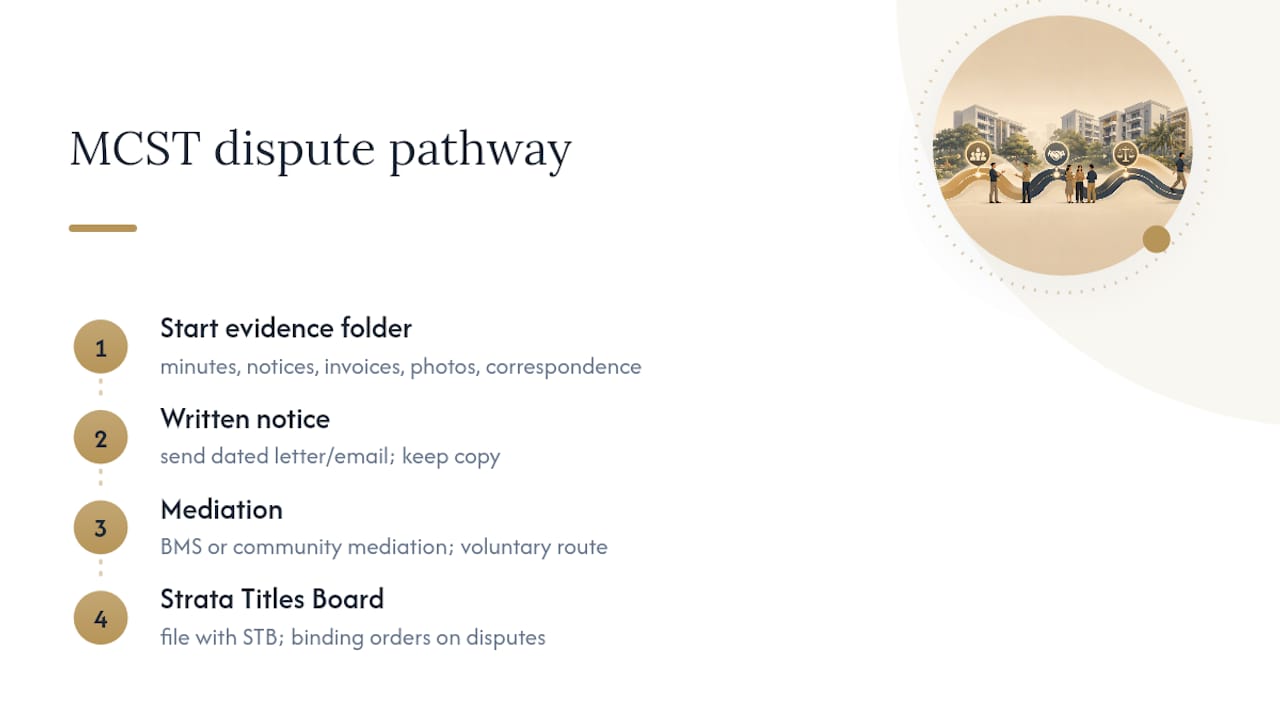
Pro Tip: Start your evidence folder the day a dispute begins, not the week before your STB hearing. Boards weigh documented, contemporaneous records far more heavily than a reconstructed timeline.
What Should Owners Actually Do to Stay Ahead of Problems?
Most owner frustration with an MCST comes from disengagement, not bad governance. Fixing that takes less effort than people assume.
- Attend AGMs and check the strata roll and share value figures before you vote on budgets or by-laws.
- File renovation applications with a licensed contractor's details and PE reports attached from the start.
- Ask the MCST for its PDPA policy and DPO contact before handing over personal data for resident directories or visitor logs, an obligation spelled out in the PDPC's advisory for management corporations.
- Keep a running personal folder of minutes, notices, invoices, and photos, useful for renovation disputes and general levy questions alike.
Pro Tip: If your estate has small enclosed private spaces like yards or patios, check MCST approval requirements before ordering materials. Our guide to condo yard renovations covers the most common rejection triggers.
Why Getting Involved in Your MCST Actually Pays Off
Owners who show up to AGMs and read the fine print end up with more influence over their estate than they expect. It's not complicated: share value determines your vote, and votes at general meetings decide the by-laws you'll live under for years.
Start with three things. Attend the next AGM, even if it's just to listen. Request a copy of the strata title plan for your unit. Confirm who the MCST's Data Protection Officer is before you hand over any personal information. For anyone buying into a new development, our showflat checklist and the latest project updates from Aurea are worth a look before your first council meeting.
— Velisa
This article is general information, not a substitute for advice from a qualified lawyer. Consult a qualified legal professional about your own circumstances before acting on anything here.
Sources
- Building (Strata Management) Act 2004 (BMSMA)
- Strata Management Guides | Building and Construction Authority
- Strata Titles Board – guidelines
- Advisory Guidelines for Management Corporations (PDPC)
- Building Maintenance (Strata Management) Regulations 2005