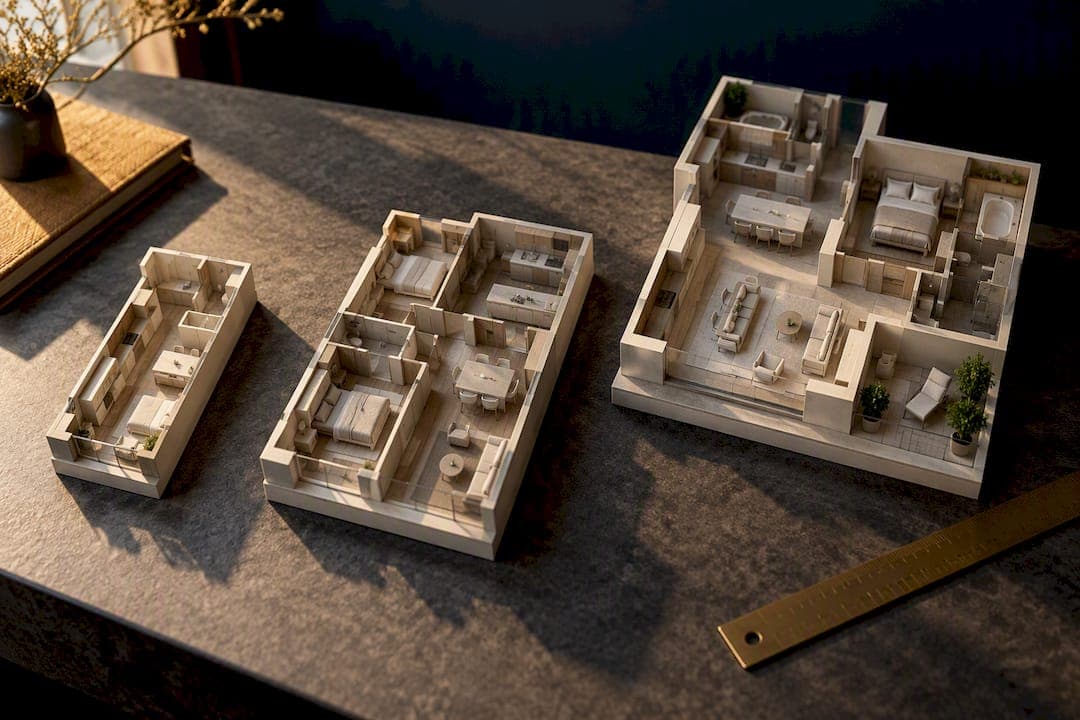
Unit mix is the breakdown of unit types, sizes, and bedroom counts inside a development, expressed as counts or percentages. In Singapore, it drives three things a buyer feels directly: your monthly maintenance fees, who your neighbors will be, and how much competition you'll face when you sell. A project's mix is not a footnote in the brochure. It's a mechanical driver of your ownership costs.
TL;DR:
- Developments with mainly larger units tend to have higher share values and maintenance fees, while those with mostly smaller units feature lower fees but more units sharing costs.
- A skewed unit mix toward one bedroom or two bedroom units increases rental turnover and attracts investors, whereas a family-oriented mix with larger units offers more stable resale values.
- Carefully examine the unit mix table for dominant bedroom bands, vacant size ranges, and potential scarcity or surplus in specific segments to assess future value and demand.
- Developers often inflate bedroom counts by marketing utility rooms or studies as bedrooms, so verify room dimensions and legal registration before committing.
- A focused unit mix aligned with market demand generally leads to more stable resale prices and rental income, unlike a diverse but unfocused mix that may create internal competition.
Table of Contents
- What Does Unit Mix Actually Include?
- How Does Unit Mix Affect Your Maintenance Fees?
- Who Will Your Neighbors Be, and How Does That Affect Resale?
- How Do You Read a Unit Mix Table in 10 Minutes?
- What Does the National Unit Mix Snapshot Look Like?
- What Tricks Do Developers Use, and What Should You Check?
- How Do Developers Actually Decide on Unit Mix?
- Where Can You Verify These Figures Yourself?
- Why Most Advice on Unit Mix Misses the Point
- Sources
- FAQ
What Does Unit Mix Actually Include?
Unit mix, in its formal sense, describes how many units of each type a development holds, from compact one bedders to five bedroom units and penthouses. It's a standard term in commercial real estate valuation and underwriting, used to judge demand and compare one project against another.
Bedroom count alone tells you almost nothing about livability. A "3 bedroom" unit at 850 square feet and one at 1,100 square feet carry the same label but feel like different products entirely. Developers sometimes count a study or a flexi room as a bedroom, which inflates the number without adding real floor area. Floor area, ceiling height, and layout efficiency matter more than the label on the floor plan.
In Singapore new launches, sales galleries usually present unit mix as a table: unit type, size range in square feet, number of units, and percentage of total stock. That table is worth reading closely, because it's the fastest way to size up a project before you set foot in a showflat.
How Does Unit Mix Affect Your Maintenance Fees?
Maintenance fees in a Singapore condominium are apportioned by share value, and share value is tied to strata floor area. Bigger unit, bigger share value, bigger monthly bill. That part is intuitive. What surprises many buyers is how the overall unit mix shifts the math for everyone in the building.
If a development leans heavily toward larger units, average share values rise across the board, and so does the average conservancy contribution. If it's dominated by compact one and two bedders, share values compress and per-unit fees often sit lower, but there are more units splitting the cost of shared facilities like pools, gyms, and lift maintenance.
Here's a simple way to think about it: your share of the total maintenance budget roughly equals your unit's floor area divided by the building's total strata area, multiplied by the total conservancy budget. Two identically sized units in different developments can carry different fees purely because the surrounding unit mix changes the denominator.
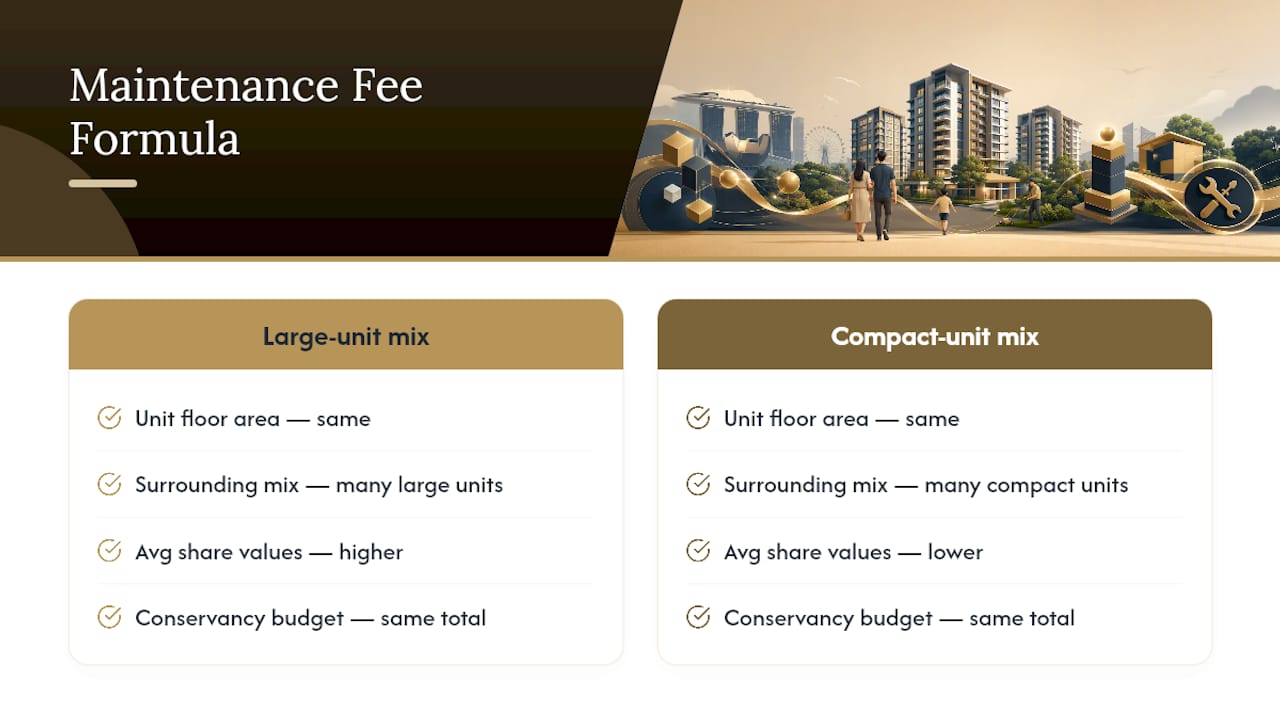
This is also why appraisers weigh unit mix when modeling income potential. A skewed mix changes not just what owners pay, but what a building can plausibly earn in rental income across its unit types.
Who Will Your Neighbors Be, and How Does That Affect Resale?
A development weighted toward 4 and 5 bedroom units tends to attract families and long-term occupants who plan to stay for years. A project stacked with 1 and 2 bedroom units usually draws young professionals and investors, and that mix comes with higher turnover, which means more move-ins, more lift bookings, and a different pace of community life.
Neither profile is better. It's about fit and predictability. If you want quiet, stable neighbors and don't mind a higher share value, a family-heavy mix suits you. If you want liquidity and rental demand from a churn-heavy tenant pool, a smaller-unit mix works in your favor as a landlord.
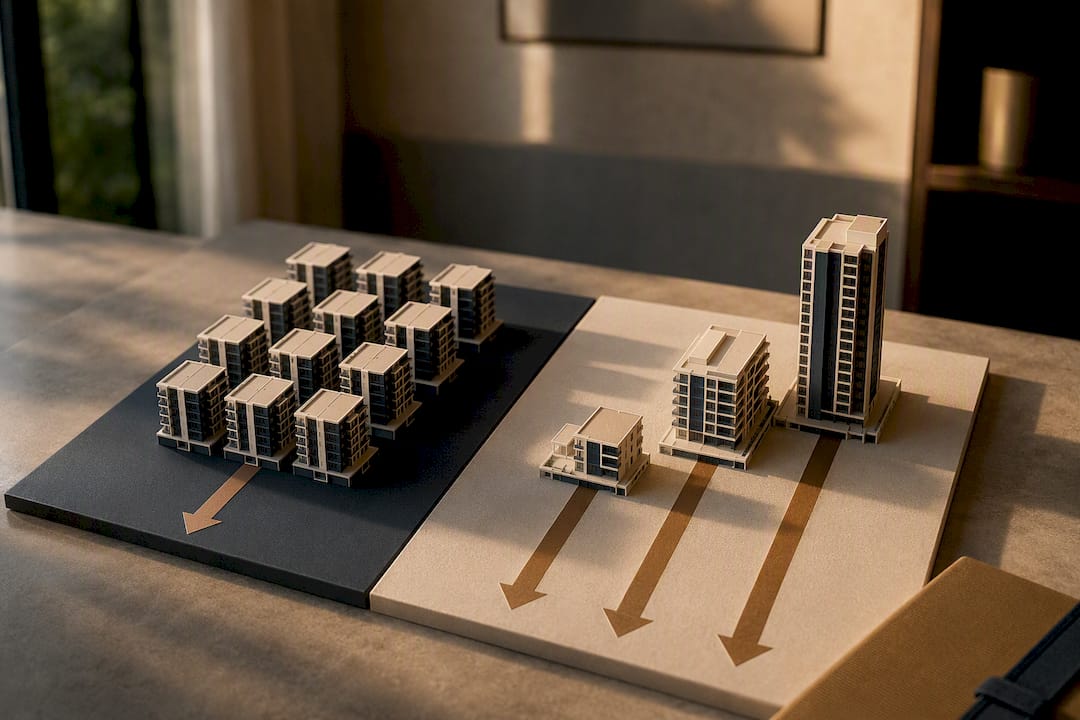
Uniform mixes create their own resale risk. When a building has dozens of nearly identical 2 bedroom units, they compete against each other at resale and at rental listing, which compresses rents and pushes prices toward a race to the bottom. A development with real variety, or with a genuine gap in one size band, can make your specific unit type scarcer and more defensible when it's time to sell.
How Do You Read a Unit Mix Table in 10 Minutes?
Sales staff will hand you a unit mix chart the moment you walk into a showflat. Here's how to actually use it.
- Scan the percentages first. Note which bedroom bands dominate the project, and which are thin or missing entirely.
- Cross check bedroom labels against floor area. A "3 bedroom" at the low end of its size range may have one genuinely small room.
- Map unit types to the site plan. Units stacked near lift lobbies, refuse chutes, or loading bays often sit in the smaller, cheaper bands for a reason.
- Estimate the share-value impact. Ask the agent for the strata area and share value of your target unit, then compare it against the building's total.
- Spot the gaps. A missing size band could mean scarcity value for you later, or it could mean the developer expects weak demand there.
Pro Tip: Bring a tape measure or a measuring app to the showflat. Marketed room dimensions and usable floor space after built-in wardrobes and structural columns are often two different numbers, and no brochure will tell you that gap.
If you're comparing specific layouts, our breakdowns of 3 bedroom condo layouts and 2 bedroom layouts walk through what "usable" actually looks like on paper.
What Does the National Unit Mix Snapshot Look Like?
Singapore's private non-landed housing stock skews toward small and mid sized units, which gives you a useful yardstick when judging a new launch. EdgeProp's snapshot of private non-landed units shows the general shape of the market across bedroom bands.
| Bedroom Band | General Market Position |
|---|---|
| 1 Bedroom | Sizeable minority share, popular with investors |
| 2 Bedroom | Among the largest bands nationally |
| 3 Bedroom | Among the largest bands nationally |
| 4 Bedroom | Smaller share, family-oriented demand |
| 5 Bedroom and up | Smallest share, niche demand |
If a new launch skews heavily toward 1 bedroom units against that broader pattern, expect more investor buyers and higher rental turnover. If it leans toward 4 and 5 bedroom stock, expect a calmer, more family-oriented building with fewer units competing at resale in that band.
What Tricks Do Developers Use, and What Should You Check?
Bedroom counts get inflated more often than buyers realize. A windowless study, a walk-in closet with a door, or a utility room can all get labeled a "bedroom" on the floor plan, even though none of them function as one. Dual-key units carry their own quirk: they're marketed as one unit but legally and structurally split into two lockable sections, which changes both livability and rental strategy.
Before you commit, check these:
- Request the actual strata area schedule, not just the marketing brochure.
- Measure or verify room dimensions against building code minimums for a habitable bedroom.
- Confirm windowing and natural ventilation for every room marketed as a bedroom.
- Ask whether any "bedroom" is actually a dual-key sublet or a converted utility space.
Pro Tip: Ask the agent directly, "Is this room legally registered as a bedroom on the approved plans?" It's a simple question that developers can't dodge, and it separates marketing language from fact.
Our notes on study rooms marketed as bedrooms and utility rooms buyers should inspect cover this pattern in more depth.
How Do Developers Actually Decide on Unit Mix?
There's no universal formula developers follow. Mix decisions come down to site size, surrounding demographics, and how lenders underwrite the project based on projected absorption across unit types. A site near a business district skews smaller and investor-friendly. A site near schools and established neighborhoods skews larger and family-oriented.
A development's mix, ranging across several unit sizes including penthouses, can reflect an intention to serve multiple buyer types rather than focusing on one. That range matters at resale too: a development with genuine variety across bands gives you more paths to exit, whether the next buyer wants a starter home or space for a growing family.
Where Can You Verify These Figures Yourself?
For the national snapshot, EdgeProp's unit mix breakdown is the primary source. For the formal definition and valuation context, see Credaily's glossary entry. For rent and turnover mechanics, REI Prime's explainer covers the investor angle in detail.
Why Most Advice on Unit Mix Misses the Point
Most guides treat unit mix as a curiosity, a chart to glance at before moving on to price per square foot. That's backward. Price per square foot tells you what you're paying today. Unit mix tells you what you'll be paying every month for as long as you own the unit, and who you'll be selling to when you eventually leave.
The conventional wisdom says bigger unit mix diversity is always better. It isn't. A tightly focused mix, if it matches the site's real demand, produces a more stable tenant base and steadier resale demand than a scattershot mix trying to please everyone. The mistake buyers make isn't ignoring unit mix. It's reading the percentages without asking why the developer chose them.
If you take one thing from this: check the share value schedule before you check the finishes. Fittings can be upgraded. A share value ratio that saddles you with outsized maintenance costs for the next decade cannot.
— Velisa
This article is general information, not a substitute for advice from a qualified financial advisor. Consult a qualified financial professional about your own circumstances before acting on anything here.
Sources
- What Is The Unit Mix Of All Private Properties In Singapore
- Unit Mix
- Unit Mix in Real Estate Investing | REI Prime
- Why Unit Mix Matters in Multi-Family Property Appraisals
FAQ
What Does "Unit Mix" Mean?
Unit mix means the distribution of unit types and sizes within a development, usually shown as counts or percentages by bedroom band. It's a standard term used in real estate valuation to judge demand and compare buildings against each other.
What Are Some Examples of Mixed-Use Buildings in Singapore?
Mixed-use buildings in Singapore combine residential units with retail, office, or hotel components in a single development, often anchored around an MRT station. Aurea, connected by a link bridge to The Golden Mile at Beach Road, follows this pattern by pairing residential unit mix with direct access to retail and transit.
What Happens to an EC After 10 Years?
An Executive Condominium becomes fully privatized after 10 years from its completion date, allowing owners to sell to foreigners and companies without restriction. Before that, resale is limited mostly to Singapore citizens and permanent residents under HDB rules.
Can a Married Couple Own Two HDB Flats?
Generally, a married couple can only own one subsidized HDB flat at a time under normal ownership rules, unless they meet specific exceptions like retaining an existing flat while a spouse buys a resale flat under certain schemes. Private property ownership, including a unit at a development like Aurea, doesn't carry the same one-flat restriction, though it can affect eligibility for HDB purchases separately.
How Does Unit Mix Affect Bedroom Count Reliability?
Bedroom counts alone aren't fully reliable because developers sometimes label studies, utility rooms, or dual-key sections as bedrooms without matching floor area to genuine livability. Always cross check the strata area schedule and actual room dimensions rather than relying on the marketed bedroom number.
Ready to see a unit mix built for both families and professionals in one address? Explore the 2 bedroom, 3 bedroom, 4 bedroom, and larger layouts at Aurea, with 2 bedroom units from $1,770,000, 3 bedroom units from $2,639,900, and 4 bedroom units from $4,080,510, set at Beach Road with direct link bridge access to The Golden Mile.