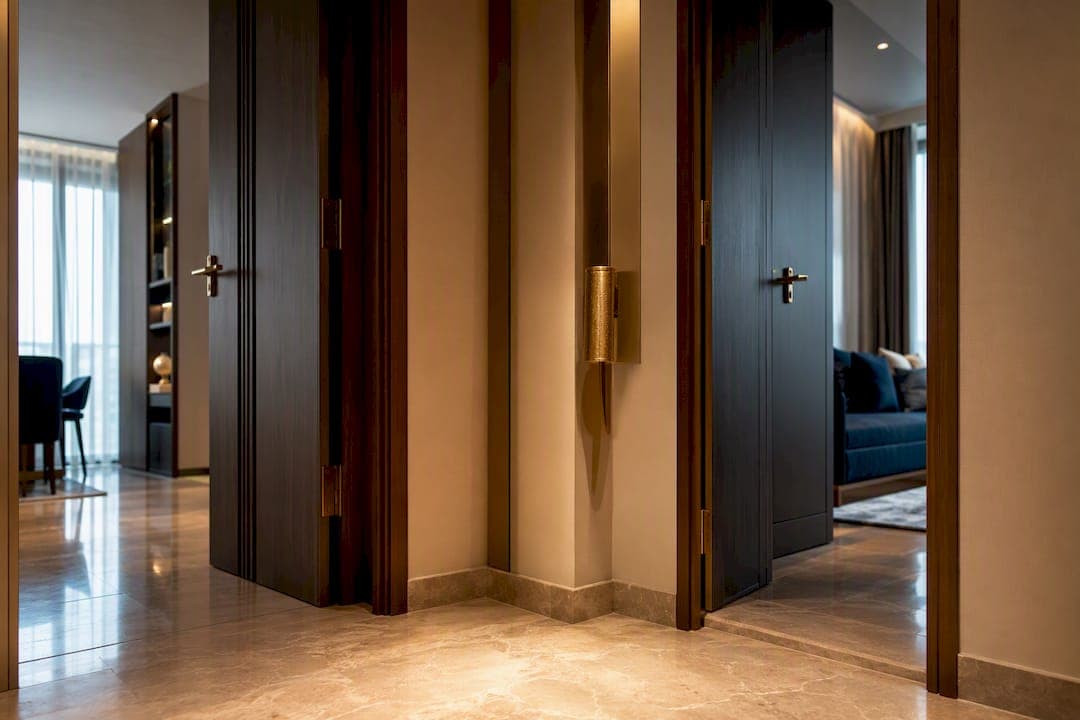
A dual-key condo is a single strata-titled unit split into two self-contained living spaces, a main unit and a smaller sub-unit, each with its own entrance, bathroom, and kitchenette. In Singapore, that single strata title matters more than the floor plan: IRAS treats the whole unit as one residential property for Additional Buyer's Stamp Duty purposes, no matter how many keys or tenants live inside it.
TL;DR:
- A dual-key condo counts as one property for ABSD purposes, regardless of how many tenants or entrances it has, which limits tax benefits for multiple ownerships.
- The layout typically features a larger main unit connected to a smaller, independent sub-unit through separate lockable doors, sharing only common areas like the foyer and facilities.
- Buyers should verify that the strata title explicitly includes both units as one lot, as resale value and subletting options depend on clear legal delineation.
- Dual-key units generally command a premium per square foot and have lower resale volumes, making them more suitable for income-focused investors than quick-flip buyers.
- These units are most advantageous for multigenerational families, tenants seeking privacy, or investors aiming for multiple rental streams from a single purchase.
Table of Contents
- What Is a Dual-Key Condo, Exactly?
- Main Unit vs Sub-Unit: How the Layout Actually Works
- Singapore's Legal and Tax Rules on Dual-Key Units
- Weighing the Pros and Cons Before You Buy
- Who Actually Benefits From a Dual-Key Layout?
- Real Examples and Pricing Patterns in Singapore
- A Practical Checklist for Evaluating a Dual-Key Unit
- Where Dual-Key Fits in Singapore's 2026 Market
- Considering Your Options at Aurea
- Sources
- FAQ
What Is a Dual-Key Condo, Exactly?
A dual-key unit is not two apartments glued together on paper. It is one legal property with a shared foyer or lobby that branches into two separate, lockable doors: one leads to the main unit (typically two or three bedrooms), the other to a compact studio or one-bedroom sub-unit with its own kitchenette and bathroom.
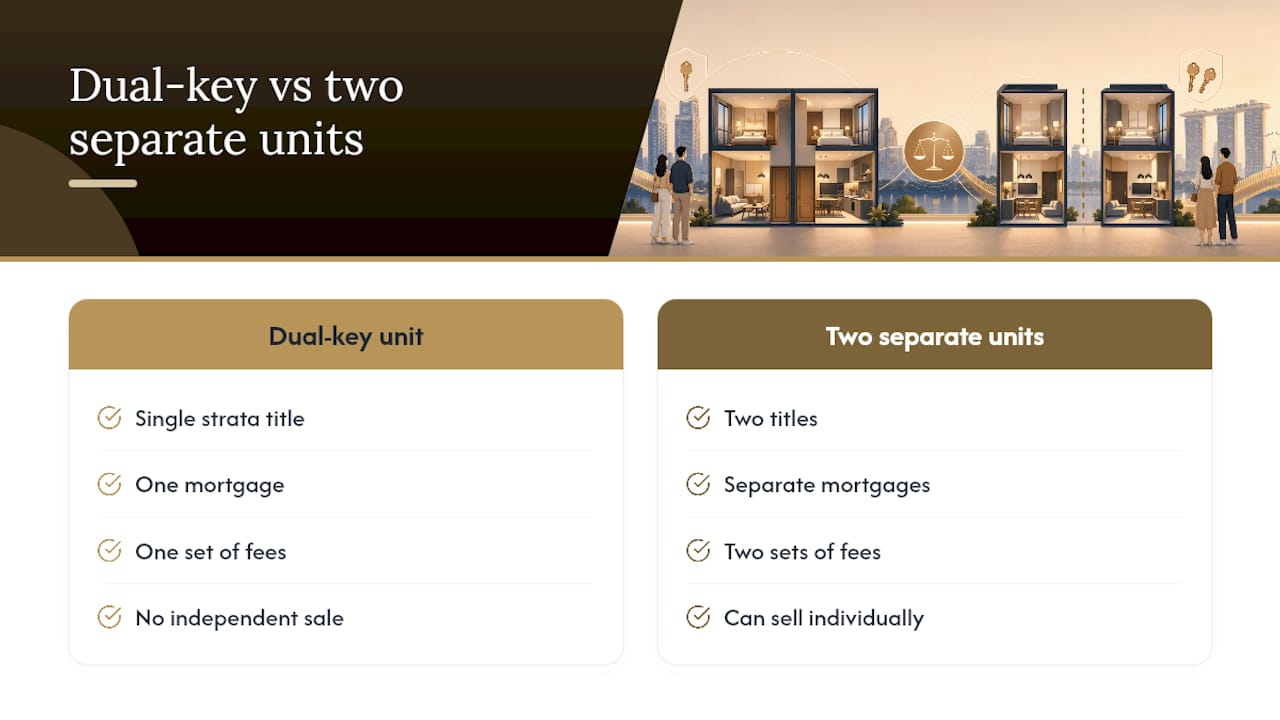
Because the whole thing sits under one strata title, you buy it, mortgage it, and eventually sell it as a single asset. You cannot split the title later and offload the sub-unit to a different buyer, even though it functions like an independent apartment day to day. That single-title structure is what separates a dual-key condo from actually purchasing two separate units in the same building, which would give you two titles, two sets of maintenance fees, and full flexibility to sell either one alone.
Compared with a regular condo layout, the design trade-off is straightforward: you gain the ability to house two households or income streams under one roof, but you give up the freedom to divide ownership. OhmyHome's breakdown of dual-key structures confirms this is the defining feature buyers need to understand before anything else.
Main Unit vs Sub-Unit: How the Layout Actually Works
Most Singapore dual-key layouts follow a handful of recognizable patterns. The most common split pairs a larger main unit with a smaller, fully independent sub-unit:
- 2-bed + studio: a two-bedroom main unit with a standalone studio, common in 3-bedroom dual-key configurations.
- 3-bed + 1-bed: a family-sized main unit paired with a proper one-bedroom sub-unit, often marketed toward multigenerational buyers.
- Shared foyer access: both doors open off one internal lobby, so residents cross paths briefly but never share living space.
- Separate corridor access: rarer, but some projects position the sub-unit door on a different corridor section entirely, maximizing privacy.
Bedrooms, bathrooms, and kitchens stay private to each half. What's shared is usually limited to the entrance foyer and, obviously, the building's common facilities like pools and gyms. For landlords, this matters enormously: a tenant in the sub-unit never needs to walk through the main unit to get in or out, which makes subletting genuinely workable rather than an awkward compromise. If you're weighing this against a 3-bedroom layout built around open-plan living, the privacy math tips clearly toward dual-key when renting is part of the plan.
Singapore's Legal and Tax Rules on Dual-Key Units
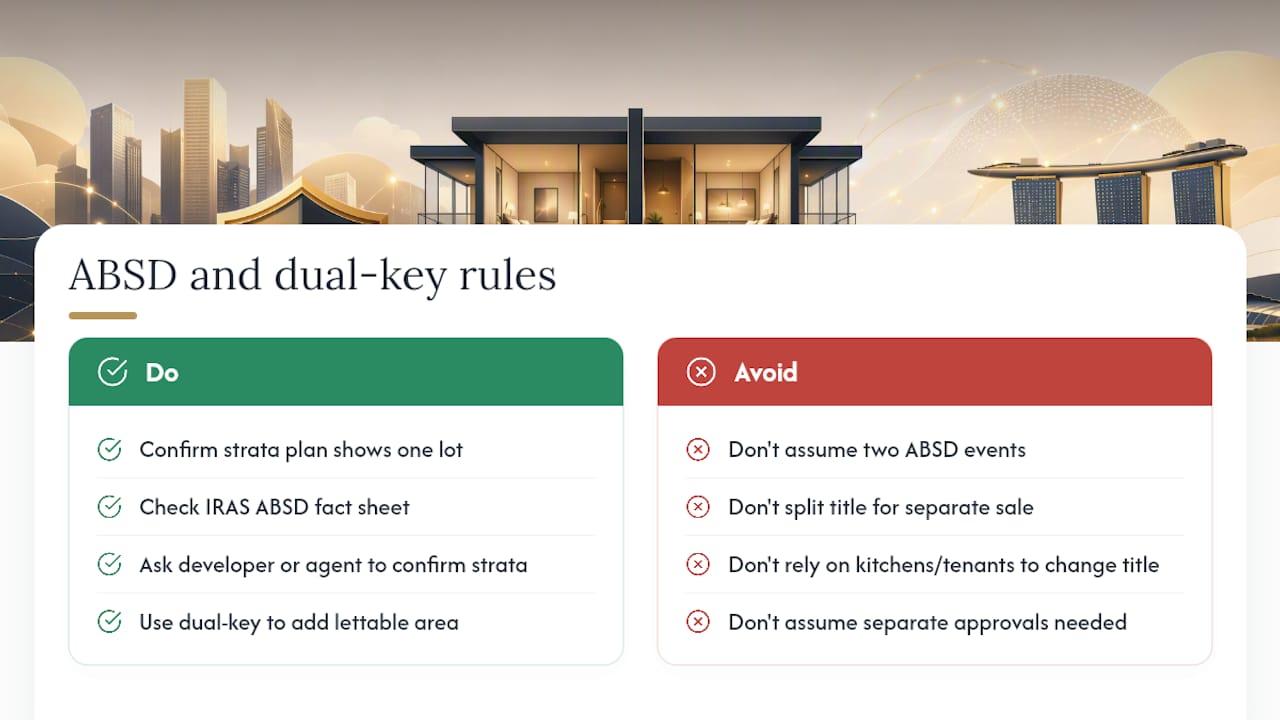
The single most important fact for any buyer: a dual-key condo counts as one residential property for ABSD purposes, full stop. IRAS looks at the strata title, not the number of doors, kitchens, or tenants inside it. Buy a dual-key unit as your first property and you pay first-timer ABSD rates on the whole unit, exactly as you would for a standard one-bedroom apartment.
By the numbers: IRAS's own guidance confirms that ownership counting for ABSD runs strictly on strata title, which means a dual-key unit, despite functioning as two homes, triggers a single ABSD event rather than two. Review the IRAS ABSD fact sheet directly before making assumptions about your specific tax position.
This has a practical upside for buyers already owning one property. Adding a second home normally means absorbing a second, higher ABSD tier. A dual-key unit lets you add rentable floor area, essentially two lettable spaces, without paying the ABSD rate you'd owe if you bought two separate condos.
The flip side is permanence. Because there is only one title, you cannot sell the sub-unit to a relative, an investor, or anyone else independently of the main unit. Whoever eventually buys the property buys both halves together, whether they want the sub-unit or not.
On planning, current market guides confirm URA treats the dual-key configuration as an accepted architectural layout under a single strata lot, which is why developers can market and sell these units without special approvals beyond standard planning submission. Always ask the developer or agent to confirm the strata plan explicitly shows both units as part of one lot, not two, before signing anything.
Weighing the Pros and Cons Before You Buy
Dual-key ownership rewards buyers who understand exactly what they're trading away, and what they're gaining.
The advantages:
- One ABSD event instead of two, even though you effectively control two lettable spaces.
- The sub-unit can be rented out independently, generating a second income stream without a second mortgage.
- Genuine privacy for elderly parents, adult children, or tenants who don't want to share a kitchen or living room.
- Combined rental income from both halves can outpace what a single equivalent-sized unit would fetch.
The disadvantages:
- Developers typically charge a per-square-foot premium for the dual-key configuration versus a comparable regular layout, often at a modest markup.
- The resale buyer pool shrinks. Not every buyer wants or understands a dual-key setup, which can extend your time on the market.
- Mortgage valuation can be trickier, since banks sometimes value the unit closer to a standard layout despite the added functionality.
Rental math worth checking: market analysis on dual-key living arrangements suggests these units can be easier to rent out in parts, and the combined rent from both halves often helps cover mortgage payments more comfortably than a single regular unit, though resale returns can trail regular units of similar size. Comparative reviews of dual-key units also note they run slightly larger in floor area than similar bedroom-count regular units, which partly explains the premium pricing.
The honest takeaway: dual-key units are built for cash flow, not for quick flips. If your investment thesis depends on rental income during the holding period, the math tends to work in your favor. If it depends on a fast, easy resale, look elsewhere.
Who Actually Benefits From a Dual-Key Layout?
Not every buyer profile gets equal value from this structure. Three groups tend to benefit most, and one group should generally steer clear.
- Investors chasing combined yield. If renting out the main unit and sub-unit separately produces more total rent than one larger regular unit would, the premium you paid on entry pays for itself faster.
- Multigenerational families. Parents in the sub-unit, adult children or a young family in the main unit, everyone under one roof with real privacy and no shared bathroom.
- Owner-occupiers needing flexible space. Use the sub-unit as a home office, guest suite, or space for a live-in helper, with the option to convert it to rental income later if plans change.
- Avoid dual-key if: you prioritize a fast, straightforward resale, or you want the legal option to sell one half separately down the road. Neither is possible under a single strata title.
Real Examples and Pricing Patterns in Singapore
Dual-key layouts have shown up across a range of Singapore developments over the past decade, not just in one price segment. Project floor plan pages are the most reliable way to see exact dimensions.
- The Minton's 3-bedroom dual-key floor plan shows how a family-sized main unit pairs with a compact, fully self-contained sub-unit, useful as a benchmark for sizing expectations.
- Developers commonly price the dual-key premium into the overall per-square-foot rate rather than as a separate line item, making comparison by psf against regular 3-bedroom units in the same project helpful to understand relative pricing.
- Market commentary on dual-key transaction activity notes lower resale volumes relative to regular units, which reinforces the smaller buyer pool point raised earlier.
Always request the current floor plan directly from the developer or listing agent. Marketing brochures sometimes show an idealized version that doesn't match the finalized strata plan.
A Practical Checklist for Evaluating a Dual-Key Unit
Walking into a showflat without a checklist is how buyers miss the details that matter most six months after signing the Option to Purchase.
- Confirm the strata title explicitly covers both the main unit and sub-unit as one lot, not two.
- Ask for the monthly strata (maintenance) fee and whether it's billed once for the whole unit or split.
- Verify access: does the sub-unit have a genuinely separate lockable door, or just a connecting internal door?
- Check tenancy rules in the condo's house regulations, some buildings restrict subletting to minimum lease terms.
- Request recent transaction comparables for dual-key units specifically, not just the project's overall average psf.
- Ask the agent or developer for the as-built floor plan, not the marketing render, before finalizing your decision.
Pro Tip: Ask specifically about the sub-unit's minimum tenancy period allowed under the condo's by-laws. Some developments cap short-term subletting at six months or longer, which changes your rental strategy completely if you were planning shorter-term leases.
Where Dual-Key Fits in Singapore's 2026 Market
Dual-key units solve a specific problem well: getting rental income and family privacy out of a single purchase without tripping a second ABSD tier. They solve very little for buyers chasing quick capital appreciation or an easy exit. That's the trade-off, and pretending otherwise does readers a disservice.
Watch resale volumes closely over the next few years. As more dual-key stock ages into the resale market, buyer familiarity should improve, which could narrow today's liquidity gap. If you're comparing layouts, it's worth looking at how developments like Aurea structure their unit mix across bedroom counts to see how flexible layouts are being positioned for 2026 buyers.
— Velisa
Considering Your Options at Aurea
If a dual-key layout doesn't fit your household, or you'd rather have flexible bedroom counts without splitting a title, Aurea is worth a direct look. Located at 802 Beach Road, Aurea offers 188 units ranging from 2 to 5 bedrooms plus two penthouses, with resort-style amenities spread across four levels and a link bridge straight to The Golden Mile.
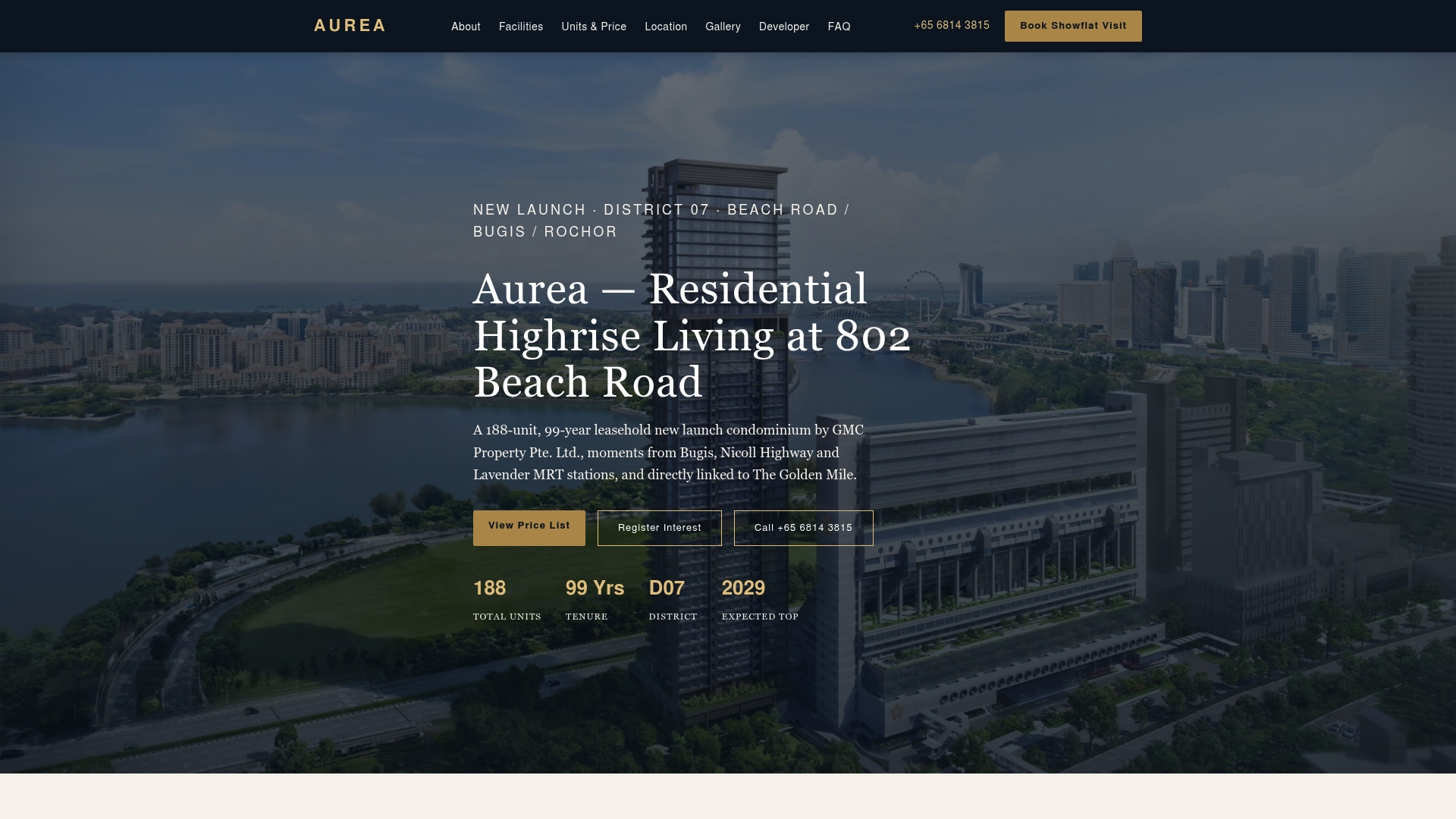
Unit layouts at this condominium development are designed for a range of household sizes, with expected completion in the coming years and convenient access to nearby MRT stations. Whether you're weighing a dual-key setup elsewhere or want to compare a straightforward multi-bedroom layout instead, it's worth reviewing Aurea's floor plans side by side with any dual-key unit you're considering. Visit the Aurea development page to check current unit availability and schedule a viewing appointment. As with any private property purchase, confirm strata details, pricing, and unit specifications independently before committing.
Sources
For the legal groundwork on ABSD counting, go straight to the IRAS ABSD fact sheet. For layout basics, OhmyHome's dual-key guide and 99.co's pros-and-cons breakdown both offer solid grounding, alongside rental yield fundamentals from Aesthetic Havens if you're modeling returns.
This article is general information, not a substitute for advice from a qualified financial advisor. Consult a qualified financial professional about your own circumstances before acting on anything here.
- A beginner's guide to dual-key condo units — OhmyHome
- 99
- Dual Key Condo Singapore: Live and Rent Math | Winfred Quek
FAQ
Is a Dual-Key Condo a Good Investment?
It depends on your goal: dual-key units tend to perform well for rental income because you can let the main unit and sub-unit separately, but resale returns often trail regular units of similar size, so they suit income-focused investors better than flippers.
What Is a Dual-Key Concept Condo?
A dual-key concept condo is a unit built around two self-contained living spaces, a main unit and a smaller sub-unit, that share one entrance foyer but function independently, all under a single strata title.
Is a Dual-Key Layout Allowed for HDB Flats?
Dual-key configurations are a private condominium feature; HDB flats do not offer this layout, since HDB's design and subletting rules are structured differently from private strata-titled developments.
What Does "Dual Key" Actually Mean?
"Dual key" refers to a unit with two separate lockable entrances leading to two independent living spaces within one legally titled property, letting residents or tenants live separately while owning or renting as a single unit.