
In Singapore condos, "yard" on the floor plan almost never means a private garden. It refers to a small service yard, usually tucked beside the kitchen, typically 2 to 5 square meters. It's built for laundry, storage, and utility work: washing machines, cleaning supplies, sometimes the aircon compressor. If you're picturing a patch of grass, adjust your expectations before you view your next unit.
TL;DR:
- Most service yards in Singapore condos are tiny, usually 2 to 5 square meters, and designed for laundry, storage, or utility functions only.
- Renovation approvals are necessary for anything affecting the building's exterior or shared infrastructure, and fixed points like drains and compressors limit customization.
- Proper ventilation, drainage, and appliance placement are critical, with recommendations to prioritize airflow, moisture control, and accessible plumbing over purely aesthetic finishes.
- Vented dryers require exterior venting, while condensing dryers are better suited for deep units without external access, and stacking appliances demands ceiling height and vibrations considerations.
- When evaluating units, check practical features such as daylight, airflow, compressor location, existing plumbing, and potential noise or privacy issues to avoid costly modifications later.
Table of Contents
- What Does a Service Yard Look Like in a Singapore Condo?
- Who Controls Changes to a Condo Yard: You or the MCST?
- Fixed Elements That Limit What You Can Do With a Yard
- Smart Layout Ideas for a 2 to 5 Square Meter Yard
- Dryer or No Dryer? Choosing Appliances for a Small Yard
- Keeping a Small Yard Dry, Ventilated, and Mold-Free
- Your Renovation Checklist Before You Touch a Service Yard
- What to Check About the Yard When Viewing a Unit
- Noise and Privacy in a Condo Service Yard
- Making a Condo Yard Safe for Kids
- What Buyers Should Actually Prioritize in a Yard
- See How Aurea's Floor Plans Handle the Service Yard
- Sources
What Does a Service Yard Look Like in a Singapore Condo?
Walk into any high-rise condo unit built in the last two decades and the yard sits directly off the kitchen, usually behind a door or half wall that keeps cooking smells and laundry noise separate from living areas. This differs from HDB flats, where the service yard is often more open, sometimes exposed to the outside air through a full-height grille, and from ground-floor condo units, which occasionally get a proper enclosed utility room instead of a compact yard.
Condo yards tend to run narrow and rectangular. A 2 square meter yard might measure roughly 1 meter by 2 meters, just enough for a stacked washer and dryer with a slim walkway. A 5 square meter yard gives you room for a full-size washing machine, open shelving, and maybe a small folding counter. Shape matters as much as size: an L-shaped yard wastes corner space unless you plan for it, while a straight galley layout uses every centimeter along the wall.
Proximity to other zones shapes what you can do with the space:
- Most yards connect directly to the kitchen, sharing a plumbing stack for the sink and washing machine.
- Many sit adjacent to a balcony or open-air riser, which is where drainage and ventilation openings usually live.
- Some newer layouts, including certain dumbbell layout configurations, push the yard toward the service core, away from bedrooms, which cuts down on noise transfer.
- A handful of larger units place the yard near a secondary bathroom, letting both share a drainage line.
If you're comparing units on a floor plan, check where the yard sits relative to the kitchen and main door. A yard buried deep in the unit, far from any window, will fight you on ventilation no matter how good your design plan is.
Who Controls Changes to a Condo Yard: You or the MCST?
Everything inside your unit's walls, floor, and ceiling generally falls under your ownership and control. The moment a change touches something visible from outside, shared, or structural, the Management Corporation Strata Title, or MCST, gets a say. Renovations that affect the exterior appearance or structural elements of a condominium, such as altering a balcony or yard's look from the outside, are strictly regulated by the MCST and usually require formal approval before work begins.
For a yard specifically, that means:
- Repainting interior walls or swapping cabinets rarely needs approval since it stays within your private space.
- Installing external louvers, changing window grilles, or altering anything visible from the building facade almost always needs MCST sign-off.
- Enclosing an open-air yard with glass or solid panels, which changes the building's exterior look, typically triggers a formal application.
- Relocating plumbing or drainage that connects to shared risers requires notifying management, since you're touching common infrastructure.
Before any tools come out, pull your Sale and Purchase Agreement and the development's house rules. These documents spell out what counts as limited common property versus what's genuinely yours to modify. Contact your managing agent or MCST office directly, and ask for the renovation guidelines document most developments issue to owners. Local renovation guides consistently point to checking MCST rules first, because skipping this step is the single most common reason renovation works get rejected or flagged after the fact.
Pro Tip: Take photos of your yard's current exterior appearance before renovating. If a dispute arises later about what changed, you'll have proof of the original state.
Fixed Elements That Limit What You Can Do With a Yard
Before you design anything, map out what's already bolted down. Every Singapore condo service yard has a handful of fixed points that dictate where cabinetry, appliances, and storage can actually go.
- Floor drain and trap: usually positioned near the yard's outer edge, it needs clear access for cleaning and can't be boxed in permanently.
- Water tap and washing machine point: fixed to a wall, often with limited flexibility to relocate without touching shared plumbing.
- Air-conditioning compressor: frequently sits in the yard itself, either on a ledge or floor-mounted unit.
- Gas meter or piping: present in some older or gas-connected developments, and it restricts what can be built directly around it.
- Electrical points: outlets for the washer, dryer, or lighting, positioned during construction and expensive to move.
The compressor deserves particular attention. Blocking its airflow with an enclosure or overhead cabinet can cause the unit to overheat, run inefficiently, and in some cases void the manufacturer's warranty. Any carpentry near a compressor needs a gap for intake and exhaust airflow, plus room for a technician to service it without dismantling your cabinets.
Gas meters and drains work the same way: they're not decorative obstacles, they're access points that inspectors and repair technicians need to reach. Build your storage plan around them rather than trying to hide them entirely, and you'll avoid a costly redo when the meter reader or plumber can't get through.
Smart Layout Ideas for a 2 to 5 Square Meter Yard
A tight yard rewards vertical thinking over floor-space thinking. Interior designers increasingly treat these spaces as a volume to fill upward, not just a footprint to arrange, and that shift in mindset unlocks a surprising amount of storage in a space that looks impossibly small on paper.
Start with the structural choices:
- Vertical cabinetry running floor to ceiling captures storage that a standard base cabinet wastes.
- Pocket doors slide into the wall instead of swinging out, which matters enormously in a yard under 3 square meters where a swinging door eats circulation space.
- Fold-down surfaces attached to the wall give you a folding counter or ironing station that disappears when not in use.
These structural moves matter more than they sound, because pocket doors and fold-down surfaces are specifically recommended over swinging doors in narrow yards to prevent door-swing obstructions in cramped layouts.
For the laundry function itself, a retractable ceiling laundry rack solves the classic Singapore problem: air-drying clothes without permanently claiming floor or wall space. Pull it down when you need it, push it up when you don't. Pair that with a countertop spanning stacked appliances, and you get a folding or prep surface that didn't exist in the original layout.
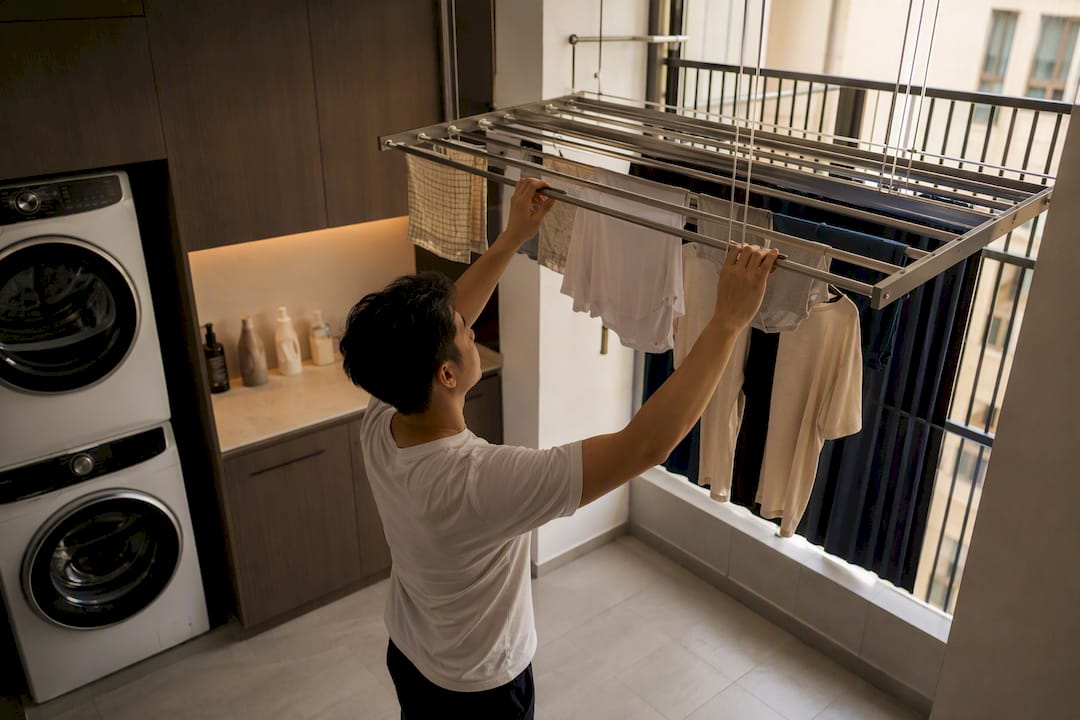
Beyond laundry, service yards increasingly double as multifunctional utility hubs. Some homeowners install a small pet wash station with a handheld sprayer and a floor drain nearby. Others carve out a narrow herb garden on a wall-mounted shelf near a window, taking advantage of whatever daylight the yard gets. A few squeezes in a coffee counter with a bar fridge, treating the yard as an overflow kitchen zone. Each of these repurposing ideas needs the same underlying support: a drain within reach, and enough ventilation that moisture doesn't linger.
On finishes, match the material to Singapore's humidity. Matte porcelain tile resists slipping when wet and shrugs off splashes from both laundry and occasional rain if your yard is semi-open. Waterproof vinyl works too, provided it's rated for wet areas and installed with proper edge sealing.
Pro Tip: If your yard has any exposure to the outdoors, choose a floor finish with a slip-resistance rating suited to wet conditions, not a standard indoor tile. The difference shows up the first time it rains sideways.
Dryer or No Dryer? Choosing Appliances for a Small Yard
The dryer question comes down to venting, not just space. A vented dryer pushes hot, humid air outside through ductwork, which works well if your yard has an exterior wall or riser to vent through. A condensing or heat-pump dryer skips the external duct entirely, collecting moisture in a tank or draining it, which makes it the better choice for yards buried deep in the unit with no venting path.
Stacking a washer and dryer saves floor space but raises other questions:
- Confirm your yard's ceiling height accommodates a stacked unit plus the stacking kit, usually adding several inches.
- Check that the floor and wall bracket can handle vibration from a spinning dryer, since a shaky mount over time loosens tile grout and cabinet joints.
- Verify the stacking kit is compatible with both appliance brands. Mismatched kits are a common installation headache.
For many Singapore households, skipping the dryer altogether and relying on a ceiling-mounted retractable laundry system works just as well, since air-drying remains effective in the local climate and these systems avoid venting complications entirely. It's a lower-cost, lower-maintenance route that some renovators overlook simply because a dryer feels like the default choice.
Keeping a Small Yard Dry, Ventilated, and Mold-Free
Moisture is the enemy of a small enclosed yard, and Singapore's humidity makes this a year-round issue rather than a seasonal one. Good airflow and the right slope on your floor prevent the mold and mildew problems that plague poorly designed yards.
For ventilation, louvred windows or a properly sized exhaust fan matter more than most renovation budgets account for. An exhaust fan should be sized to the yard's volume, not just bolted in as an afterthought; a fan too small for a 5 square meter enclosed yard will run constantly and still lose the moisture battle.
On flooring, prioritize function over looks:
- Matte porcelain tile handles wet feet and splashing without becoming a slip hazard.
- Vinyl flooring rated for wet areas works as a budget alternative, provided seams are sealed properly.
- Avoid glossy or polished finishes entirely. They look sleek in photos and turn dangerous the moment water hits them.
Drainage needs the same attention. The floor should slope gently toward the drain, and the trap needs to stay accessible for cleaning, not sealed under permanent cabinetry. One rule that gets ignored too often: dryer exhaust should never vent directly into the yard itself. It just recirculates hot, damp air into an already tight space and defeats the purpose of venting in the first place.
Your Renovation Checklist Before You Touch a Service Yard
Renovating a yard in a Singapore condo goes smoother when you sequence the paperwork before the demolition. Skipping steps here is how projects stall halfway through.
- Pull your strata documents and confirm whether your yard, or any part of it, counts as limited common property under MCST rules.
- Submit a renovation application to management for anything touching the exterior appearance, since approval requirements apply broadly to facade-facing changes.
- Hire a contractor who has specifically worked on condo service yards before, not just general renovation. The compressor clearances and drainage details are easy to get wrong.
- Confirm with your contractor exactly how the AC compressor and any gas meter will remain accessible once cabinetry goes in.
- Prepare a scaled layout drawing, a ventilation plan showing fan or window placement, and physical material samples before the first quote.
Pro Tip: Ask your contractor for photos of a previous condo yard project of similar size. A portfolio full of landed-house yards doesn't translate directly to a 3 square meter condo space with a fixed compressor in the corner.
What to Check About the Yard When Viewing a Unit
A floor plan tells you the square footage, not the livability. During a viewing, bring a tape measure and check these details before you fall for the finishes:
- Measure the actual usable floor area after accounting for the compressor, drain, and any built-in shelving left by the previous owner.
- Check for daylight and airflow. A yard with a window or open riser dries laundry faster and resists mold better than a fully enclosed one.
- Note privacy exposure. If the yard faces a neighboring block at close range, factor that into how you'll use the space.
- Inspect the drain for staining, standing water, or a musty smell, which signals a slope or ventilation problem.
- Locate existing tap points and confirm they match where you'd actually place a washing machine.
- Confirm exactly where the AC compressor sits and whether it leaves enough clearance for your planned storage.
Noise and Privacy in a Condo Service Yard
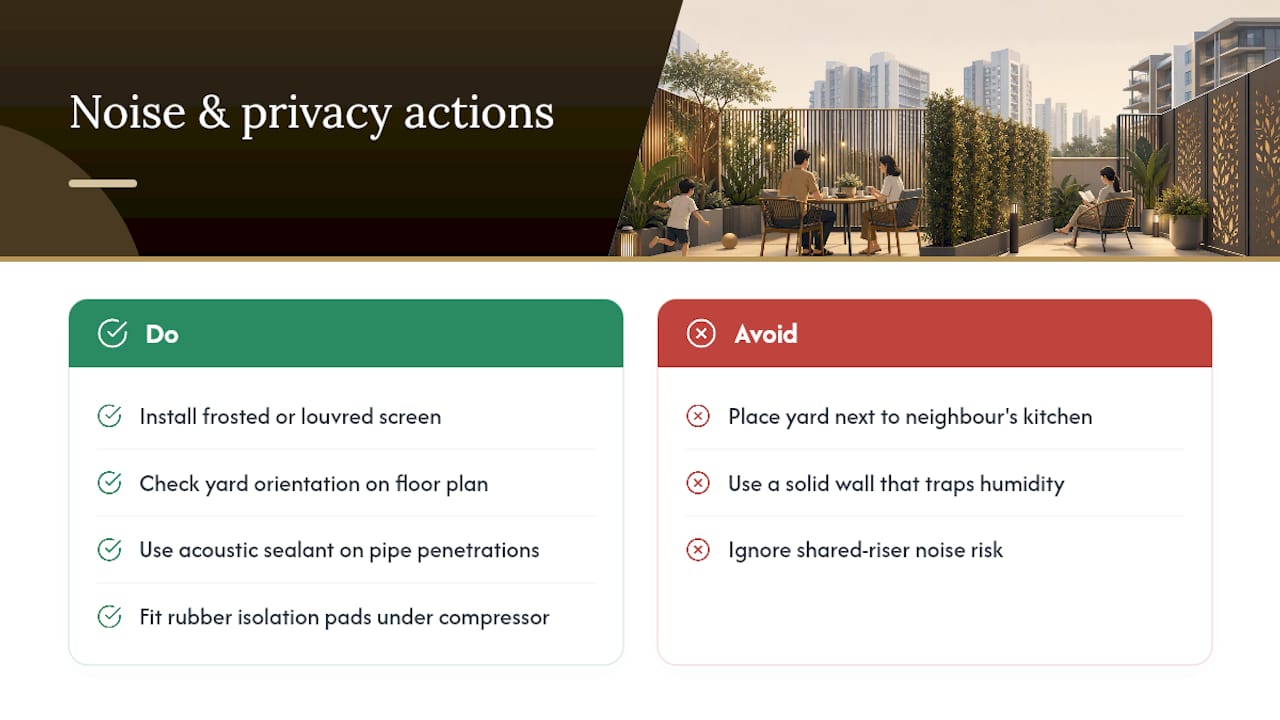
A yard positioned next to a neighbor's kitchen or yard means you'll hear their washing machine cycle, and they'll hear yours. In stacked developments, sound travels vertically too, so a compressor or drainage pipe running through a shared riser can transmit a low hum into the unit above or below.
Privacy works both ways in a yard, especially one with an open-air section facing another block. If your yard sits close to a neighboring facade, expect some visual exposure when you're doing laundry or storing items on open shelving. A frosted or louvred screen solves most of this without blocking airflow entirely, which matters more than a solid wall that traps humidity.
Units with yards oriented toward internal courtyards or facing away from adjacent blocks tend to offer more privacy by default. It's worth checking orientation on the floor plan alongside factors like sun exposure, since a unit's north south facing position affects both temperature and how exposed the yard feels to neighboring units.
If noise from a shared riser or compressor bothers you after moving in, acoustic sealant around pipe penetrations and rubber isolation pads under compressor feet reduce vibration transfer noticeably. It's a small fix that a lot of owners discover only after living with the problem for a few months.
Making a Condo Yard Safe for Kids
A service yard packs several hazards into a small footprint: standing water near a drain, a spinning washing machine, cleaning chemicals within easy reach, and sometimes a step-down threshold at the yard entrance. None of that mixes well with a toddler exploring the unit.
Start with the door. If your yard has a swinging or sliding door, a childproof latch positioned above a small child's reach keeps curious hands out when you're not supervising. Store cleaning products, including detergent pods, in a high cabinet with a lock, not on an open shelf at floor level where they're easy to grab and easy to mistake for candy.
Check the floor threshold too. Many yards have a slight step down from the kitchen for drainage reasons, and that lip becomes a tripping hazard for a toddler learning to walk. A beveled transition strip or a visual marker helps.
Electrical outlets near a water source need covers rated for damp locations, and any exposed wiring for a washing machine or dryer should sit clear of splash zones. If your yard has an open-air section with a low parapet or railing, confirm the height meets safety standards for young children climbing or leaning, and never store furniture nearby that a child could use to climb higher.
What Buyers Should Actually Prioritize in a Yard
Cosmetic finishes photograph well, but they're the easiest thing to fix after you move in. Ventilation and service access are not. A yard with a blocked airflow path or a poorly placed compressor stays a problem no matter how nice the tile looks, and fixing it later usually means tearing out work you already paid for once.
When Aurea's design team laid out unit floor plans, service yard placement got the same scrutiny as bedroom sizing, not an afterthought bolted onto whatever space was left. That's the standard buyers should hold every new-launch project to.
— Velisa
See How Aurea's Floor Plans Handle the Service Yard
Most new-launch condos treat the service yard as leftover space, squeezed in wherever the kitchen plumbing happens to land. Aurea's unit planning takes the opposite approach: yard placement, ventilation access, and utility layout get worked into the floor plan from the start, not adjusted around it afterward.

Across Aurea's 2 to 5 bedroom layouts and penthouses at 802 Beach Road, service yards sit close to natural airflow paths and keep compressor access clear, the kind of detail that matters far more once you're living with the space than it does on a showflat tour. With direct access to MRT stations and a link bridge to The Golden Mile, the development pairs everyday practicality with resort-style amenities across four levels.
If you're evaluating units and want to see exactly how the yard integrates with kitchen and utility zones, view the floor plans and latest updates on Aurea's landing page, or reach out to arrange a viewing appointment to walk through a yard-aware layout in person.
Sources
- Service Yard Design Ideas for Singapore HDB and Condo — Goodrich Global
- Renovating your first condominium property: here's what you need to know — Renonation
- 6 ways to maximise your service yard space and make it more functional — Qanvast