
The strata area printed on your unit's strata title plan is the figure that governs your purchase price, stamp duty, and Mgmt Corporation Strata Title (MCST) share value. Gross floor area, or GFA, is a different thing entirely: a site-level planning metric that the Urban Redevelopment Authority (URA) uses to control how much a developer can build on a plot of land. You never buy or sell GFA. You buy strata area.
Since June 1, 2023, URA, the Singapore Land Authority (SLA), the Building and Construction Authority (BCA), and the Singapore Civil Defence Force (SCDF) harmonized how floor areas get measured across the board. That change affects how architects calculate GFA, but it does not change how your strata area gets recorded on your title.
- Strata area = your legal, transactable unit size, tied to price, tax, and ownership share.
- GFA = a planning ceiling for the whole development, not a number you own.
- The Land Titles (Strata) Act governs how strata plans get registered and read.
Key Takeaways
Strata area determines what you pay, what you owe in stamp duty, and what share you hold in the MCST, while GFA only governs how much a developer could build on the site.
| Point | Details |
|---|---|
| Strata area drives cost | Purchase price, stamp duty, and MCST share value all calculate against certified strata area. |
| GFA is not a unit number | GFA controls site-level plot ratio for URA planning, never an individual unit's saleable size. |
| Middle-of-wall measurement | Since June 2023, floor areas across agencies measure to the middle of the wall under DC22-09. |
| Voids stay excluded | Double-height voids are excluded from strata area even though they sit inside your unit. |
| Always request certified plans | Ask for the SLA-lodged strata title plan before trusting a brochure floor plan figure. |
Table of Contents
- Strata Area vs Floor Area: Definitions and Which Agency Uses Each
- What the June 2023 Harmonisation Actually Changed
- How Strata Area Shapes Price, Stamp Duty, and MCST Shares
- How to Verify the Official Strata Area Before You Commit
- Reading a Real Floor Plan: A Practical Walkthrough
- What Aurea-sgcondo Recommends Before You Sign
- Understanding Strata Area vs Floor Area Matters More Than Fixating on GFA
- Frequently Asked Questions
- Sources
Strata Area vs Floor Area: Definitions and Which Agency Uses Each
Strata area is measured to the middle of the unit's boundary walls, following SLA's survey conventions, and gets recorded on the certified strata title plan lodged with the Registry of Titles. This is the number that shows up in your Option to Purchase, your Sale and Purchase Agreement, and your title deed. It is also the basis for your share value in the Management Corporation Strata Title, which determines your maintenance fee contribution and your voting weight at annual general meetings.
GFA works at a different scale. URA uses it to control plot ratio, meaning how much total floor space a developer can build relative to the size of the land parcel. A related term, Strata Gross Floor Area (SGFA), and BCA's Allowable Floor Area (AFA) used by SCDF for fire safety planning, are technical cousins of GFA that apply to specific regulatory checks rather than unit sales.
Net Lettable Area (NLA) belongs to commercial leasing, not residential strata sales, and measures usable space more strictly by excluding common corridors and structural elements. Comparing NLA to strata area gives you what agents sometimes call an efficiency ratio, the percentage of a unit's strata area that translates into genuinely usable floor space.
| Term | Who uses it | What it measures |
|---|---|---|
| Strata area | SLA, buyers, MCST | Unit ownership size on the title plan |
| GFA | URA | Total buildable floor space on a site |
| SGFA / AFA | BCA, SCDF | Technical planning and fire safety checks |
| NLA | Commercial landlords | Usable leasable space, mainly for offices and retail |
What the June 2023 Harmonisation Actually Changed
The joint circular from URA, SLA, BCA, and SCDF, known as DC22-09, standardized three practical rules that Qualified Persons (QPs) and developers now follow:
- Floor areas are measured to the middle of the wall, rather than varying by agency convention.
- Strata area is now counted fully within GFA calculations at the development level.
- Voids, the double-height or open-air gaps inside a unit, are excluded from strata area.
Before this, different agencies sometimes used slightly different measurement baselines, which created friction for architects submitting plans across multiple approval channels. The harmonisation was meant to cut that inconsistency and speed up approvals, and it mostly affects developers and QPs handling new submissions or Addition and Alteration (A&A) works on existing buildings, according to URA's own framing of the circular.
Pro Tip: If you're planning a renovation that adds a mezzanine, closes off a void, or extends a slab, check with a QP before you start. A change that seems purely cosmetic to you can shift the development's GFA calculation even if your certified strata area stays the same on paper.
How Strata Area Shapes Price, Stamp Duty, and MCST Shares
Every dollar figure tied to your purchase runs through strata area, not GFA. Here's where that shows up in practice:
- Price per square foot. Listings quote PSF against strata area. If you're comparing two units, confirm both agents are quoting against certified strata area and not an informal "saleable area" estimate, since inconsistent basis makes PSF comparisons meaningless.
- Stamp duty. Buyer's Stamp Duty and Additional Buyer's Stamp Duty get calculated on the purchase price, which itself is set against strata area. A larger strata area at the same PSF means a proportionally larger duty bill.
- MCST share value. Your unit's strata area, as recorded on the strata title plan, determines your share value in the management corporation. That share value sets your monthly maintenance contribution and your voting power at general meetings.
- Renovation approvals. A&A works that add covered space, even inside your own unit, can increase the development's overall GFA under URA's rules, potentially triggering a fresh planning approval, even when your unit's certified strata area does not change.
URA's GFA handbook makes clear that strata area sits inside GFA calculations at the project level, but the two numbers serve entirely separate purposes. One drives what you pay and own. The other drives what the developer was allowed to build in the first place. Confusing the two is the single most common misreading buyers make when they see a large GFA figure in a marketing brochure and assume it describes their own unit.
Before signing anything, budgeting for the full cost of ownership, including cash downpayment requirements, depends on knowing the certified strata area, not a rough marketing estimate.
How to Verify the Official Strata Area Before You Commit
Don't take a floor plan graphic at face value. Confirm the number through documents that carry legal weight.
- Request the certified strata title plan or strata subdivision plan. This is the document lodged with SLA and it carries the legally binding strata area figure.
- Check the unit floor plan attached to your sale documents. Look for the phrase "computed to middle of wall" and confirm any voids, balconies, or Private Enclosed Spaces (PES) are annotated separately.
- Ask for the developer's certified area statement. Reputable developers provide this alongside the Sale and Purchase Agreement.
- Escalate if numbers don't match. If the marketing brochure and the certified plan disagree, request an SLA search or a QP survey before you proceed.
Pro Tip: A simple line to your agent works well: "Can you send me the certified strata title plan showing the area computed to middle of wall, plus any void or PES annotations?" That single request filters out sales material that hasn't been checked against the registered plan. When you follow up directly with an agency, stick to official .gov.sg channels, a habit ScamShield recommends for any property-related document request.
Learning to read the plan itself matters just as much as knowing which document to ask for, and a guide to reading floor plans walks through the symbols and annotations you'll encounter.
Reading a Real Floor Plan: A Practical Walkthrough
Picture a three-bedroom unit plan at a development like Aurea, on Beach Road. The strata area sits printed near the unit number, usually in square meters and square feet side by side. Balconies and any PES get shown with dashed or shaded outlines and are typically annotated separately from the main living space, since their treatment under strata area rules differs from enclosed rooms.
- Locate the printed strata area first, before looking at layout.
- Check whether balconies or PES are included in that headline number or listed as a separate line.
- Compare the unit's layout against a three-bedroom floor plan reference to gauge how much of the strata area translates into usable rooms.
A unit's printed strata area tells you what you're legally buying. It doesn't tell you how that space feels once furniture, corridors, and structural columns take their share. That gap is what buyers actually walk through during a viewing.
This walkthrough is illustrative only. Final figures always depend on the certified strata plan and developer documentation, and a QP remains the right person to confirm anything before you sign.
What Aurea-sgcondo Recommends Before You Sign
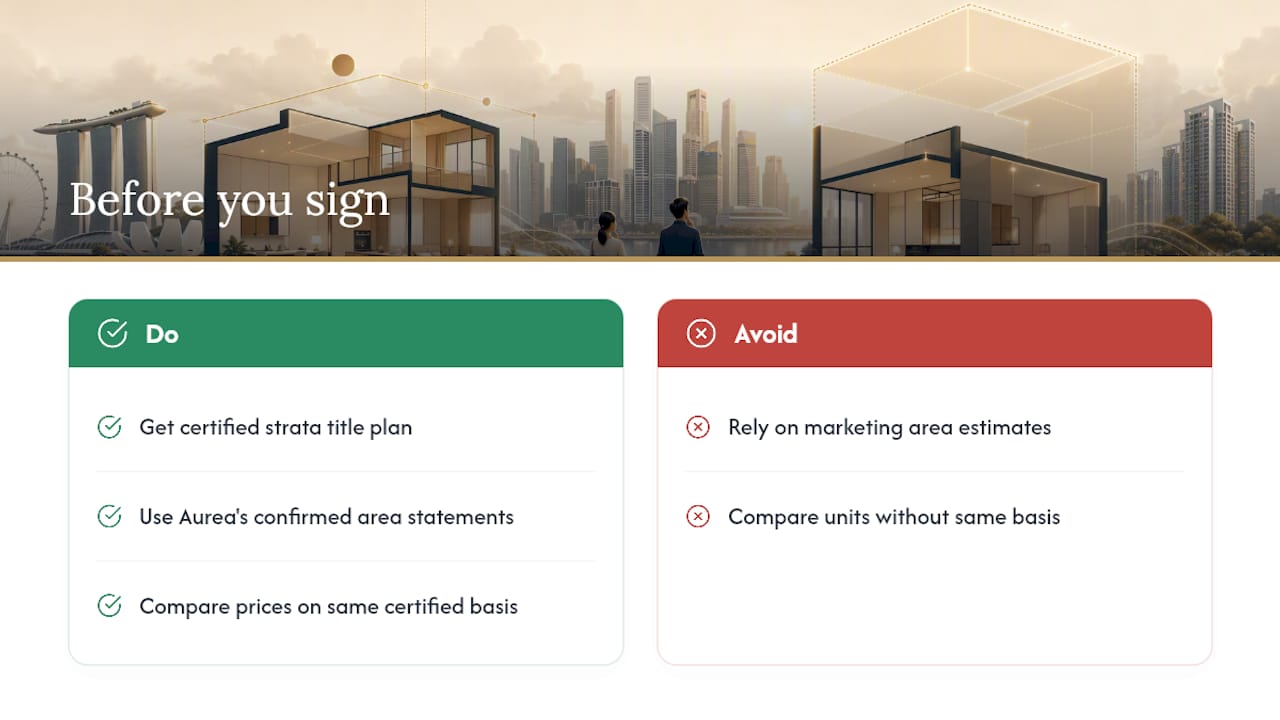
Get the certified strata title plan in hand before you compare prices across listings. Aurea, the residential development at 802 Beach Road offering 2 to 5 bedroom layouts and penthouses, publishes official area statements alongside its floor plans, giving buyers a documented strata area rather than a marketing estimate to work from. If you're weighing Aurea against other options in the central business district corridor, insist on the same certified basis for every unit you compare. Visit Aurea's latest updates to see current floor plans and confirmed area statements for available units.
Understanding Strata Area vs Floor Area Matters More Than Fixating on GFA
Singapore's harmonisation rules exist to make architects' and QPs' calculations consistent, not to change what you own. That distinction gets lost constantly in casual conversation, where people cite a project's GFA as if it describes unit size.
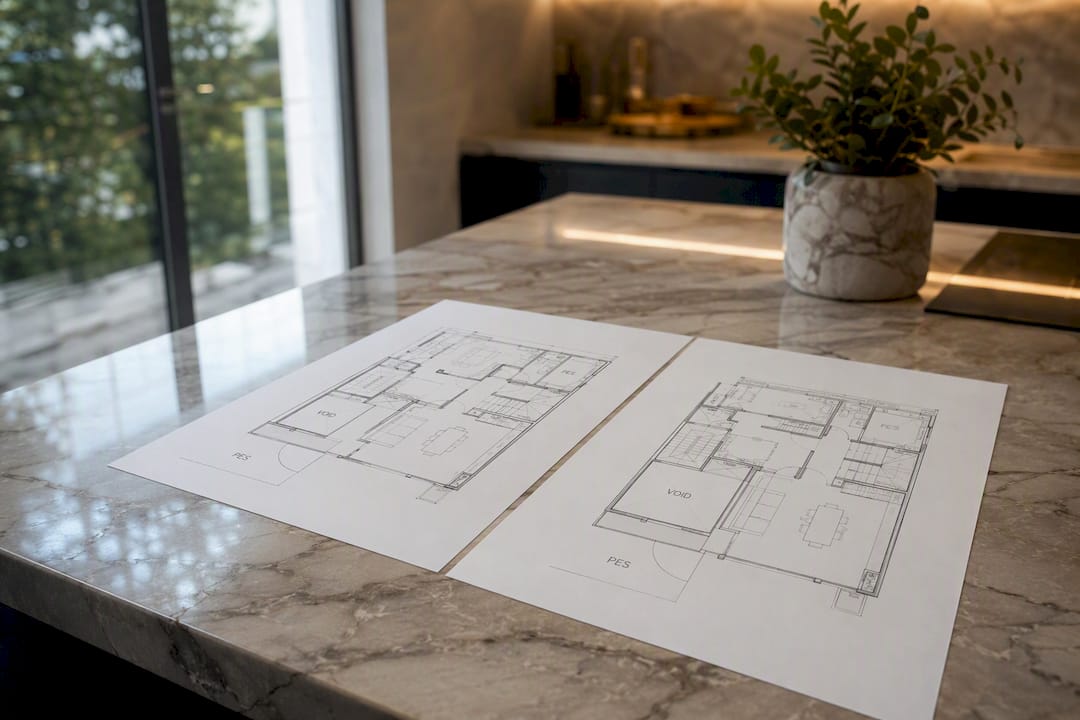
The conventional advice, "just check the floor plan," undersells the risk. A floor plan graphic in a brochure can look identical to the certified strata plan and still carry a different number if voids or PES got handled loosely in the marketing version. The habit worth building is asking for the certified document every single time, not just when something looks off.
Prioritize the strata title plan first, the MCST share value second, and treat GFA as background context you never need to act on directly. That order keeps your attention on the number that actually costs you money.
Frequently Asked Questions
What is vacant possession in a Singapore condo purchase? Vacant possession means the developer hands over your unit ready for occupation, with common facilities and your certified strata area matching what was represented in the sale documents.
Is strata area the same as usable floor area? Not quite. Strata area is the legal, registered size on your title plan, while usable area strips out walls, columns, and sometimes balconies, giving you an efficiency ratio below 100%.
Why does GFA matter to me if I'm just buying one unit? GFA shapes how many units and how much shared floor space a development can have overall, which affects density and amenities, but it never determines your individual purchase price.
Can strata area on my title plan ever change after purchase? It generally stays fixed once registered, though renovations that alter walls or create new voids should be checked against the certified plan and, where needed, verified with a QP.
Where do I find the certified strata area for a specific unit? Request the certified strata title plan from SLA's records or ask your developer or agent directly, and confirm the figure matches what's stated in your Sale and Purchase Agreement.
This article is general information, not a substitute for advice from a qualified financial advisor. Consult a qualified financial professional about your own circumstances before acting on anything here.
Sources
- URA — Gross floor area (GFA) handbook / guidance
- Land Titles (Strata) Act — Singapore Statutes Online