
For eligible Singaporean families prioritizing value, an Executive Condominium (EC) usually delivers the strongest 10-year wealth outcome. For buyers who need flexibility, a central location, or immediate rental income, a private condominium is the better fit.
The single biggest filter is the monthly household income ceiling. If your household earns above that, a private condo is your only option. If you qualify for an EC, the decision comes down to how long you can hold and how much liquidity you need.
- ECs typically launch 15–30% below comparable new-launch private condos in the same submarket, and eligible first-time families can add a CPF housing grant of up to S$30,000.
- The Minimum Occupation Period (MOP) starts from the Temporary Occupation Permit (TOP) date, not your purchase date. Construction delays push that clock back further.
- Full privatisation after several years is when foreign buyers can enter the market, and that re-rating event is where many EC owners capture their largest gains.
This article includes a 10-year numeric cost comparison and a short decision checklist near the end.
Table of Contents
- What is a private condominium in Singapore?
- What is an Executive Condominium (EC)?
- What ECs and private condos actually share
- Key differences that affect your buying decision
- Eligibility checklist: can you buy an EC?
- The EC privatisation timeline: what changes and when
- How financing, CPF grants, and all-in costs compare
- Which buyer profile fits an EC, and which fits a private condo?
- Decision checklist: questions to ask before you sign
- A 10-year cost snapshot: EC vs private condo
- Key Takeaways
- The EC vs condo choice is more nuanced than most guides admit
- Aurea-sgcondo: a private condo option for buyers who value flexibility
- Official sources and further reading
What is a private condominium in Singapore?
A private condominium is a strata-titled residential development held under private tenure from the day you sign. It carries no HDB-style eligibility conditions, no income ceiling, and no Minimum Occupation Period. Singapore citizens, Permanent Residents, and foreigners can all buy, subject to the applicable Additional Buyer's Stamp Duty (ABSD) rates.
Private condos span the full geographic spread of Singapore, from Outside Central Region (OCR) mass-market projects to prime Core Central Region (CCR) addresses. Tenure ranges from 99-year leasehold to 999-year and freehold, giving buyers options that simply do not exist in the EC scheme.
- Full market liquidity from day one: you can sell to any buyer, rent out the entire unit, or hold as an investment property without restriction.
- No income ceiling: households earning above S$16,000 per month, companies, and foreign buyers all qualify.
- Location and tenure flexibility: freehold and 999-year titles are available only through private condos, and CCR/RCR addresses are predominantly private.
Facilities across private condos vary widely by developer and price point, but most new launches include pools, gyms, function rooms, and 24-hour security managed by a Management Corporation Strata Title (MCST).
What is an Executive Condominium (EC)?
An EC is a hybrid product. The physical development is built to private-condo standards by a private developer, but it is sold under HDB eligibility rules and priced below the open market at launch. The scheme was designed for the "sandwich class" — households earning too much to qualify for a standard HDB flat but priced out of private condos without assistance.
The mechanics work like this: the government releases EC land at lower prices through the Government Land Sales (GLS) programme, developers pass part of that saving to buyers, and HDB imposes a staged set of restrictions that gradually lift over 10 years.
- 2026 policy context: — recent updates have adjusted MOP and privatisation timelines for newer launches. Buyers should confirm the exact schedule with HDB for any specific project, since the rules that apply are those in force at the time of purchase.
The CPF housing grant of up to S$30,000 for eligible first-time families is available for ECs but not for private condos, which amplifies the entry-price advantage further.
What ECs and private condos actually share
The day-to-day living experience between an EC and a private condo is closer than most buyers expect. Both are strata-titled developments managed by an MCST, and both are built by private developers to broadly similar construction and finish standards.
- Amenities: pools, gyms, BBQ pavilions, clubhouses, landscaped gardens, children's play areas, and 24-hour security are standard across both product types.
- Strata management: MCST governance, sinking funds, and conservancy fees apply to both. The administrative experience for residents is essentially identical.
- Unit layouts and finishes: many EC developments match or approach the specifications of OCR private condos. The gap in finish quality between an EC and a mass-market private condo in the same area is often smaller than buyers assume.
The differences that actually drive the purchase decision are almost entirely about policy, not bricks and mortar.
Key differences that affect your buying decision
Price and entry advantage
ECs typically launch at a 15–30% discount to comparable new-launch private condos in the same submarket. On a 1,000 sq ft unit, that gap represents a significant amount in purchase price before grants. Add the CPF housing grant for eligible first-time families (up to S$30,000), and the effective entry cost difference widens further.
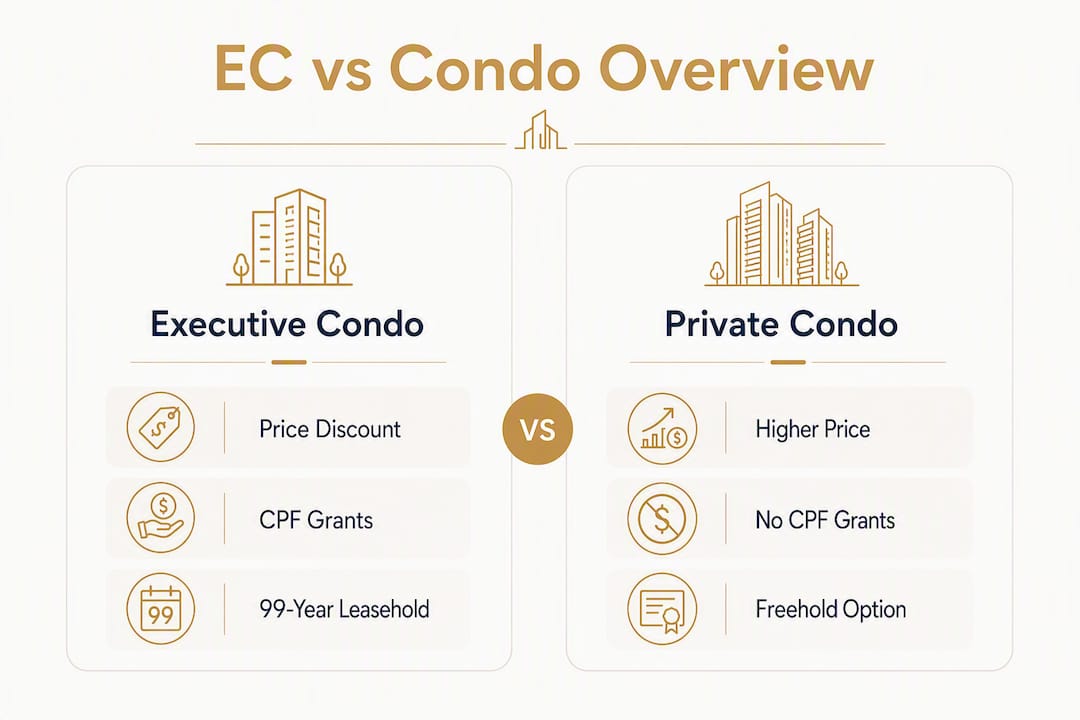
That discount is structural, not accidental. It reflects lower GLS land pricing, a restricted buyer pool, and targeted policy intent. The question is how much of it you capture after MOP and privatisation costs are factored in.
Eligibility to buy
Private condos have no eligibility conditions beyond citizenship or residency status and the applicable ABSD. ECs require:
- At least one Singapore citizen applicant
- A family nucleus (married couple, fiancé/fiancée scheme, or eligible family scheme)
- Household monthly income at or below S$16,000
- No current ownership of private property (and disposal of any private property at least 30 months before application, in most cases)
If your household income exceeds S$16,000 per month, a private condo is your only route. That is the single most definitive filter in the entire comparison.
Minimum Occupation Period and staged privatisation
This is where the two products diverge most sharply in practice.
- Years 0–5 (MOP): you must occupy the EC as your primary residence. You cannot sell the unit on the open market or rent out the entire unit. Room rentals are permitted.
- Years 5–10: after MOP, you may sell to Singapore citizens and PRs only. Foreigners are still excluded from buying.
- Year 10 (full privatisation): the EC becomes a fully private condominium. Foreign buyers may purchase, ABSD applies to them at standard private-condo rates, and the full market pool opens.
Pro Tip: The MOP clock starts from the TOP date, not your purchase date. If construction runs 18 months behind schedule, your effective lock-up extends by 18 months. Always confirm the developer's estimated TOP and build in a buffer when planning your exit.
Tenure: 99-year leasehold vs freehold
All ECs are 99-year leasehold. Private condos can be 99-year, 999-year, or freehold. For buyers focused on legacy planning or long-term asset preservation, freehold tenure is only accessible through private condos. In Singapore's leasehold vs freehold debate, the practical price premium for freehold is real but varies significantly by location and project age.
Financing differences
ECs bought from developers are subject to the Mortgage Servicing Ratio (MSR), capped at 30% of gross monthly income, in addition to the Total Debt Servicing Ratio (TDSR) of 55%. Private condos are subject only to TDSR. MSR is the tighter constraint for most buyers, and it directly limits how large a loan you can take on an EC purchase.

CPF grants are available for EC buyers (up to S$30,000 for eligible families) and not available for private condos. The Loan-to-Value (LTV) limit for both is typically 75% for a first housing loan from a bank.
Capital appreciation and liquidity
ECs can generate stronger percentage returns from a lower entry price, particularly for buyers who hold through full privatisation at Year 10. One analyst model found that an EC buyer starting S$400,000 cheaper than a comparable private condo buyer could see a net-worth gap of S$300,000 over 10 years, assuming similar percentage appreciation.

Private condos outperform when location, tenure, or timing favors them — particularly in CCR addresses or freehold projects where demand is less cyclical. For buyers who need to sell or rent freely within a short horizon, private condos' immediate liquidity usually outweighs the EC price discount.
Eligibility checklist: can you buy an EC?
Before you visit a showflat, run through these steps.
- Confirm your citizenship status. At least one applicant must be a Singapore citizen. PRs may co-purchase but cannot be the sole applicant.
- Establish your family nucleus. You must apply under an eligible scheme: Public Scheme (married couple or immediate family), Fiancé/Fiancée Scheme, or Orphans Scheme. Singles cannot buy a new EC directly.
- Check your household income. Add up the gross monthly income of all persons listed in the application. The ceiling is S$16,000. If you exceed it, stop here.
- Review your property ownership history. You must not own any private residential property at the time of application. If you previously owned private property, you must have disposed of it at least 30 months before applying.
- Check for previous HDB flat ownership. If you previously owned an HDB flat or received an HDB housing grant, a resale levy may apply. Confirm the amount with HDB directly.
- Confirm the TOP date. MOP starts from TOP, not the date you sign. Ask the developer for the estimated TOP and factor in potential delays.
A few common gotchas worth flagging:
- Singles are not eligible to buy a new EC launch directly, though they may purchase a resale EC after MOP.
- ABSD applies to future buyers of your EC after privatisation at the standard private-condo rates for their citizenship status.
- If you are near the S$16,000 ceiling and expect income growth, consider whether locking into an EC now limits your flexibility if a private condo becomes affordable within a few years.
The EC privatisation timeline: what changes and when
Understanding the staged timeline is the most practical thing you can do before committing to an EC.
- TOP to Year 5 (MOP): — you must occupy the unit. No whole-unit rental. No open-market resale. Room rentals are permitted under HDB rules.
Savvy EC owners treat Year 10 privatisation as a calculated re-rating event. Selling at MOP (Year 5) often means a constrained buyer pool and a price that does not fully reflect the asset's potential. Many investors model both a Year 5 and a Year 10 exit before committing to a purchase.
On renting: during MOP, you may rent out individual rooms with HDB approval but not the entire unit. After MOP, whole-unit rental is permitted. This matters for buyers who plan to upsize and want rental income from the EC while living elsewhere — that strategy is only viable after Year 5.
How financing, CPF grants, and all-in costs compare
The headline price gap between an EC and a private condo is only part of the story. The all-in cost picture includes grants, stamp duties, mortgage interest, maintenance, and taxes.
CPF housing grants: eligible first-time EC buyers can receive up to S$30,000 through the CPF housing grant scheme. Private condo buyers receive no CPF grants. This is a direct reduction in your effective purchase price and reduces the mortgage principal you carry.
MSR vs TDSR: for an EC bought from a developer, the MSR cap of 30% of gross monthly income applies alongside TDSR. On a S$12,000 household income, MSR limits your monthly mortgage repayment to S$3,600. TDSR (55%) is the only constraint for private condo buyers, giving them a larger effective loan ceiling for the same income.
All-in cost checklist:
- Purchase price (net of CPF grant for ECs)
- Buyer's Stamp Duty (BSD): tiered on purchase price, applies to both
- ABSD: depends on citizenship status and number of properties owned
- Renovation costs: budget S$50,000–S$100,000 for a typical 3-bedroom unit
- Monthly conservancy and maintenance fees: typically S$300–S$600/month for both product types, varying by project size and facilities
- Property tax: owner-occupier rates apply if you live in the unit
- Mortgage interest: model at current bank rates over your holding period
One analyst TCO model showed an EC 10-year all-in total cost of approximately S$1.968 million versus approximately S$2.761 million for a comparable private condo in an illustrative scenario. That S$793,000 gap reflects the compounded effect of a lower purchase price, the CPF grant, and lower stamp duty on a cheaper asset.
Pro Tip: Run your own numbers using your actual income, CPF balance, and the specific projects you are comparing. The illustrative gap above is based on assumed PSF values and appreciation rates — your outcome depends on the specific units, timing, and exit strategy you choose.
Which buyer profile fits an EC, and which fits a private condo?
EC buyer archetypes
The value-conscious upgrader family. A Singapore citizen couple with a combined income of S$12,000–S$15,000, currently in an HDB flat, planning to owner-occupy for at least 10 years. They qualify for the CPF grant, can absorb the MOP lock-up, and want condo-standard living without paying private-condo prices. For this buyer, the EC is almost always the stronger financial choice.
The long-term holder. A buyer who has modeled the Year 10 privatisation re-rating and plans to hold through full privatisation before selling. They are comfortable with the restricted buyer pool during Years 5–10 because they are not planning to sell in that window anyway.
Private condo archetypes
The investor needing immediate rental income. A buyer who plans to rent out the unit from day one, or who may need to sell within five years. The EC's MOP makes this impossible. A private condo delivers rental income from TOP and full resale flexibility at any point.
The foreigner or PR buying alone. Foreigners cannot buy new ECs. PRs cannot be the sole applicant. For these buyers, private condos are the only option.
The CCR or freehold buyer. A buyer who wants a central-district address, a freehold title, or a 999-year lease for legacy planning. ECs are built in OCR locations and are always 99-year leasehold. If location or tenure type is the priority, private condos are the only path.
The high-income household. Any household earning above S$16,000 per month. The income ceiling is a hard cutoff.
Decision checklist: questions to ask before you sign
- Confirm your eligibility and the TOP date. Run the eligibility checklist above. Then ask the developer for the estimated TOP and calculate your MOP end date, adding a buffer for construction delays.
- Compare PSF against local private comparables. Pull recent URA transaction data for private condos in the same submarket. If the EC is not at least 15% cheaper on a like-for-like basis, the liquidity trade-off may not be worth it.
- Model your 10-year total cost of ownership. Include purchase price net of grant, BSD, ABSD, renovation, monthly conservancy, mortgage interest at your actual loan amount, and property tax. Compare this against a private condo at the same budget.
- Check the developer's track record and the MCST budget. Ask for the preliminary MCST budget, estimated conservancy fees, and sinking fund contribution. A developer with no prior condo management experience and a suspiciously low sinking fund projection is a red flag.
- Ask the agent the right questions. What is the estimated conservancy fee per month? What does the displayed PSF include — are premium fittings or smart-home packages bundled in? What is the projected timeline from launch to TOP?
Red flags to watch for:
- A small developer with no track record managing MCST operations post-TOP
- Conservancy fees that seem unusually low relative to the facility count (they will rise)
- A sinking fund budget that does not account for major repairs in Years 10–15
- An EC location that does not align with your commute, schools, or lifestyle needs — the MOP means you are committed for at least five years from TOP
A 10-year cost snapshot: EC vs private condo
The table below uses illustrative assumptions to show how the entry discount and CPF grant compound over a 10-year hold. These figures are drawn from analyst models and are for comparison purposes only.
| Item | EC (illustrative) | Private condo (illustrative) |
|---|---|---|
| Unit size | 1,000 sq ft | 1,000 sq ft |
| Purchase price | —,000 | —,000 |
| CPF housing grant | (S$30,000) | Not applicable |
| Net purchase cost | — | —,000 |
| Property tax (10 yrs, owner-occupier) | ~S$15,000 | — |
Assumptions: 75% LTV bank loan, 3.5% blended interest rate, S$450/month conservancy for EC and S$500/month for private condo, owner-occupier property tax rates, no ABSD (first property, Singapore citizen). Figures are illustrative only and rounded.
One analyst model using similar parameters found a 10-year all-in TCO of approximately S$1.968 million for an EC versus S$2.761 million for a comparable private condo. The exact gap in your case depends on the specific projects, your loan terms, and your holding period.
For an eligible buyer who plans to hold through Year 10 privatisation, the entry discount compounds into a material net-worth difference. For a buyer who needs to sell at Year 5, the constrained buyer pool during MOP may compress the realized gain.
This is an illustrative example. Model your own numbers or consult a licensed mortgage advisor and property agent before making a purchase decision.
Key Takeaways
ECs deliver the strongest 10-year wealth outcome for eligible Singaporean families who can hold through privatisation; private condos suit buyers who need flexibility, central locations, or immediate rental income.
| Point | Details |
|---|---|
| Income ceiling is the first filter | Households earning above the income ceiling cannot buy an EC and must choose a private condo. |
| EC entry discount is structural | ECs typically launch 15–30% below comparable private condos, and eligible buyers can add a CPF grant of up to S$30,000. |
| MOP starts from TOP, not purchase | Construction delays extend your effective lock-up; always confirm the estimated TOP date before signing. |
| Year 10 privatisation is the re-rating event | Full privatisation opens the buyer pool to foreigners and typically lifts prices; selling at MOP often yields a lower return. |
| Aurea-sgcondo is a 99-year leasehold private condo | Located at 802 Beach Road, Aurea offers immediate private-tenure flexibility, no eligibility restrictions, and resort-style amenities for buyers who prefer private-condo benefits. |
The EC vs condo choice is more nuanced than most guides admit
Most articles frame this as a simple math problem: ECs are cheaper, therefore better value. That framing misses the most important variable, which is time.
The EC discount is real and structural, but it is not free. You are trading liquidity for price. During the MOP years, you cannot sell to the full market, you cannot rent out the whole unit, and your exit options are genuinely constrained. For a buyer whose life circumstances are stable and predictable, that trade is excellent. For a buyer who is not certain about their five-year plan, it is a meaningful risk that the PSF comparison alone does not capture.
What I find underappreciated is the income-ceiling trap. Buyers near the S$16,000 ceiling who expect rapid career progression sometimes lock themselves into an EC when a private condo would have been within reach two or three years later. The EC's lower price is compelling in the moment, but if your income trajectory means you will comfortably afford a private condo soon, the MOP lock-up may cost you more in flexibility than the grant saves you in cash.
The other thing most guides gloss over is the Year 10 re-rating. Selling at MOP is not the optimal exit for most EC owners. The buyer pool at Year 5 is still restricted to citizens and PRs, which suppresses price discovery. Holding through full privatisation, when foreign buyers can participate and the asset is reclassified as a private condo, is where the compounding of the original discount tends to pay off most clearly.
Private condos are not always the premium choice. In the OCR, a well-located EC that privatises cleanly can outperform a nearby private condo on a total-return basis. The private condo's advantage is flexibility and location range, not guaranteed appreciation.
Aurea-sgcondo: a private condo option for buyers who value flexibility
If you have worked through this comparison and decided that private-condo flexibility fits your situation better, Aurea at 802 Beach Road is worth a close look. It is a 99-year leasehold private condominium with no eligibility restrictions, no MOP, and no staged privatisation timeline. You can rent the unit from TOP, sell to any buyer including foreigners, and hold it as an investment property without constraint.
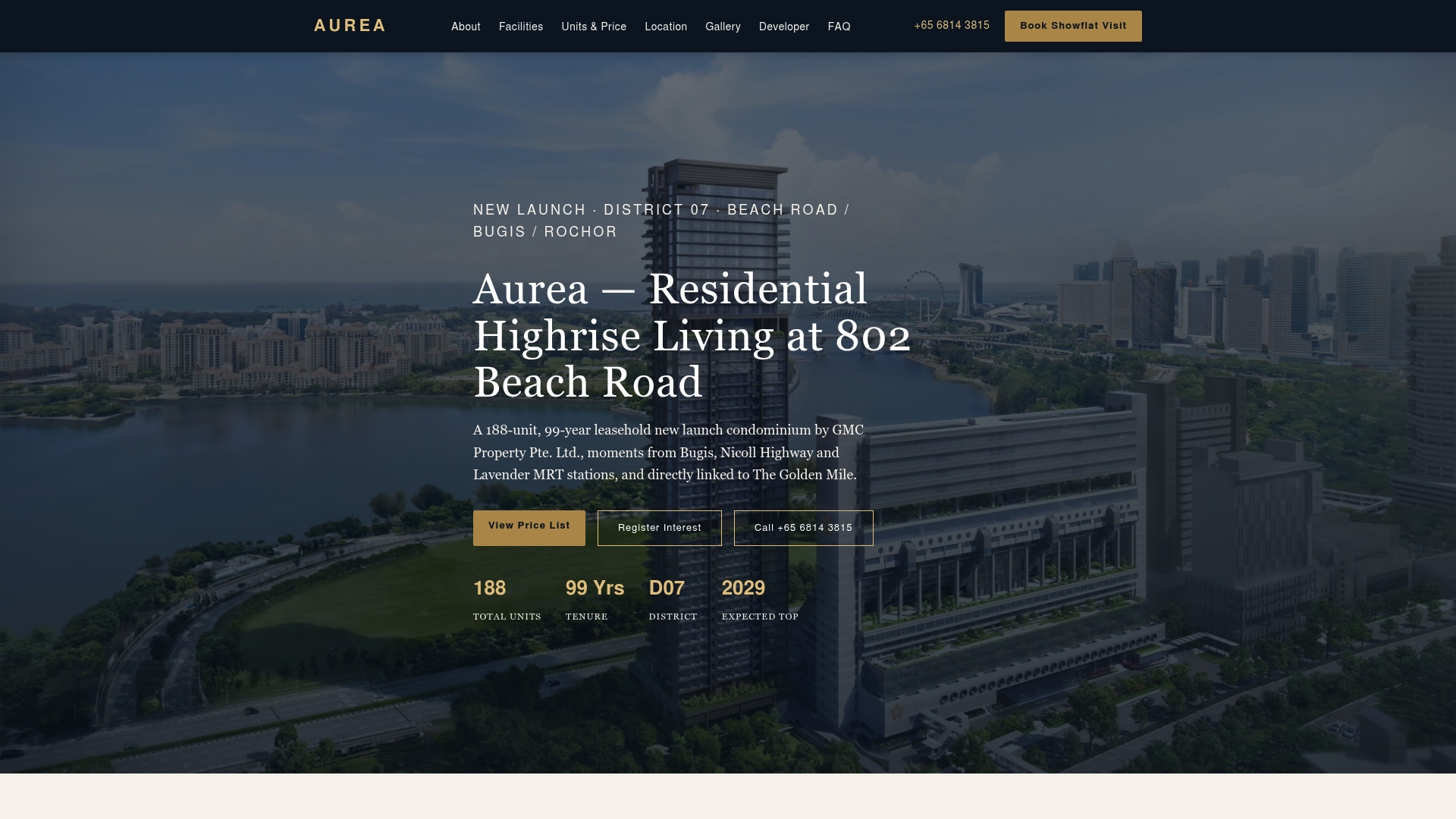
Aurea offers 188 units across 2-to-5-bedroom layouts and two penthouses, with resort-style amenities across four levels including multiple pools, fitness decks, and a direct link bridge to The Golden Mile. It sits close to multiple MRT stations in the Beach Road corridor, targeting families and professionals who want central-city living without the CCR price premium. The development is set for completion in 2029, with ERA Realty Network Pte Ltd handling sales appointments.
To see floor plans, check unit availability, or book a show suite appointment, visit Aurea's latest updates or contact the appointed marketing agent directly. Detailed financial modelling for your specific income and CPF position is available through the agent team.
Official sources and further reading
Verify all eligibility rules, MOP dates, and grant amounts directly with the relevant authorities before making any purchase decision. Policy details change, and the rules that apply to your purchase are those in force at the time of your application.
- HDB — Executive Condominiums: — the authoritative source for EC eligibility, MOP rules, privatisation timelines, and the staged buyer-pool restrictions. Always check the TOP date for your specific project here, since MOP starts from TOP.
This article is general information only and does not constitute financial, legal, or property advice. Eligibility rules, grant amounts, stamp duty rates, and MOP timelines are subject to change. Confirm current rules with HDB, CPF, and a licensed property agent before making any purchase decision.