
On a S$1.5M unit, that means at least tens of thousands of dollars in cash for the downpayment alone, plus Buyer's Stamp Duty of tens of thousands of dollars, putting your minimum day-one cash at a similar total before legal fees or any other costs.
Three rules determine how much cash you actually need:
- LTV ceiling: MAS caps the first housing loan at 75%, which forces a 25% downpayment minimum.
- Minimum cash rule: At least 5% of the purchase price must be paid in cash (not CPF) for a first loan; this rises to 10% for a second or subsequent loan.
- Stamp duties: BSD (and ABSD for second-property, PR, or foreign buyers) must be paid in cash within the statutory window and cannot be deferred.
Pro Tip: Get an In-Principle Approval (IPA) from your bank before paying any booking fee. If your loan falls through after you exercise the Option to Purchase, you forfeit the booking deposit. An IPA confirms your loan eligibility against TDSR and the bank's stress-rate test before you commit any cash.
Key Takeaways
| Point | Details |
|---|---|
| Minimum cash downpayment | 5% of purchase price must be paid in cash for a first housing loan; 25% total downpayment required. |
| BSD is a day-one cash item | BSD must be paid within 14 days of S&P signing; CPF reimbursement follows later, so cash must be available upfront. |
| TDSR often limits loans before LTV does | The 55% TDSR cap at a 4% stress rate can reduce your actual loan below the 75% LTV ceiling, requiring extra cash. |
| PPS reduces early cash pressure | New launches spread payments across construction milestones; day-one cash is 5% booking fee plus BSD only. |
| Aurea at 802 Beach Road | A 99-year leasehold new launch with PPS structure; ERA Realty agents can provide a buyer financing pack before you commit. |
Table of Contents
- ## 1. What the 25% minimum downpayment actually means for you
- ## 2. Cash vs CPF: what goes where and when
- ## 3. New-launch Progressive Payment Scheme vs resale: how cash timing differs
- ## 4. How TDSR and the bank stress-rate test can shrink your actual loan
- ## 5. Worked examples: full cash needed for S$1.0M, S$1.5M, and S$2.0M
- ## 6. Other upfront costs that require cash (beyond the downpayment)
- ## 7. How to prepare: your pre-purchase checklist
- What buyers consistently underestimate about condo cash planning
- Budgeting for a new launch? Here's how Aurea can help
- Sources
## 1. What the 25% minimum downpayment actually means for you
The 25% figure comes directly from MAS LTV rules.
The split works like this:
- 5% minimum cash: Must be paid in cash. CPF cannot substitute for this portion.
- 20% cash or CPF OA: The rest of the downpayment can come from your CPF Ordinary Account, subject to CPF withdrawal limits, or from cash if your CPF balance is insufficient.
- 75% bank loan: The maximum the bank will lend on a first housing loan.
Buyer status changes these numbers significantly. According to SmartCalculator's 2026 guide, the standard 5% cash + 20% CPF/cash split applies to a first-property purchase.
Note: "Loan count" refers to outstanding housing loans at the time of purchase, not the number of properties owned.
Foreigners cannot use CPF at all, so their entire downpayment must be funded in cash. Permanent residents can use CPF OA but face ABSD of 5% on a first residential property purchase), which must also be paid in cash.
## 2. Cash vs CPF: what goes where and when
Not every payment moment accepts CPF. The order and timing of payments matters as much as the amounts.
Where cash is mandatory:
- Booking fee / Option to Purchase (OTP): Typically 5% of the purchase price for new launches (or 1% for resale OTPs). This is paid in cash and forms part of the minimum cash downpayment.
- Minimum cash portion: The remaining cash component of the 5% minimum (after the booking fee) is due when you exercise the OTP or sign the Sale and Purchase Agreement.
- BSD and ABSD: Both must be paid within 14 days of signing the S&P Agreement (or within 14 days of the OTP exercise for resale). BSD is calculated on the purchase price under IRAS rules and cannot be deferred. ABSD must be paid in cash — CPF cannot cover it.
Where CPF OA can help:
CPF Ordinary Account funds can cover the 20% balance of the downpayment above the mandatory cash minimum, as well as legal fees and, in some cases, BSD — but only after the cash payment is made first. CPF reimbursement for BSD typically takes several weeks to process, so you need the cash upfront regardless.
Payment order for a resale purchase:
- Pay 1% OTP booking fee in cash
- Exercise OTP within 14 days (or extend): pay remaining cash downpayment (4% to reach 5% minimum)
- Sign S&P Agreement: pay 20% balance (CPF OA or cash)
- Pay BSD/ABSD within 14 days of S&P in cash (CPF reimbursement follows later)
- Bank loan disbursed at completion; legal fees settled
Pro Tip: Set aside your BSD cash separately from your downpayment funds the moment you sign the S&P. The 14-day window is tight, and CPF reimbursement for BSD can take four to six weeks after you submit the claim — you will need the full cash amount available before any CPF offset arrives.
## 3. New-launch Progressive Payment Scheme vs resale: how cash timing differs
The biggest practical difference between buying a new launch and a resale condo is cash flow timing. New launches use the Progressive Payment Scheme (PPS), where payments are staggered across certified construction milestones rather than paid in a lump sum at completion.
Typical PPS milestone tranches (Housing Developers Rules):
Source: Youhome.sg PPS guide. Percentages are statutory under Housing Developers Rules and cannot be renegotiated.
The bank loan is disbursed in matching tranches as each milestone is certified.
Worked PPS example — S$1.5M new launch, first-property Singapore citizen:
- Day 1 (booking): S$75,000 cash (5% of S$1.5M)
- Within 8 weeks (S&P): S$225,000 from CPF OA (15% balance of the 20% CPF/cash portion) + S$75,000 already paid
- BSD due within 14 days of S&P: S$44,600 cash (CPF reimbursement later)
- Subsequent milestones: bank loan tranches disbursed; no further cash from buyer unless CPF is exhausted
**Minimum cash needed at booking: downpayment plus BSD cash.
PPS clearly reduces the immediate cash pressure, but you still qualify for the full loan amount upfront. Buyers must secure a bank letter confirming full loan eligibility before paying the booking fee — PPS does not reduce the loan you must qualify for, only when the money moves.
For a detailed breakdown of managing staged payments and CPF drawdowns, the progressive payment schedule guide covers each milestone in practical terms.
## 4. How TDSR and the bank stress-rate test can shrink your actual loan
In practice, TDSR often cuts the loan size before LTV does.
That includes your new mortgage plus all existing debt: car loans, personal loans, credit card minimums, and any other outstanding commitments.
Short calculation example:
Assume gross monthly income of S$10,000 and no existing debt. The TDSR cap allows S$5,500 in total monthly debt payments.
The gap between what LTV allows and what TDSR permits is where buyers get caught. TDSR at the 55% cap and the 4% stress-test rate frequently bind before the LTV limit, meaning the buyer must either increase their downpayment to cover the shortfall or choose a lower-priced unit.
Checklist of lender questions and documents that affect final approval:
- Payslips and CPF contribution statements (last 3 months minimum)
- Notice of Assessment from IRAS (last 2 years for self-employed buyers)
- Outstanding loan statements for all existing debt
- Credit Bureau Singapore report (banks pull this; check yours first)
- CPF OA balance statement and projected contribution
- Confirmation of any variable income (commissions, bonuses) — banks typically haircut variable income by 30%
For a deeper look at how TDSR interacts with loan eligibility, the TDSR Singapore rules guide walks through the calculation in full.
## 5. Worked examples: full cash needed for S$1.0M, S$1.5M, and S$2.0M
The table below shows minimum day-one cash for three price points across three buyer types. ABSD rates reflect current IRAS ABSD rules.
*"Total day-one cash" = minimum cash downpayment + BSD + ABSD (where applicable).
A few things stand out.
What changes if LTV is reduced or ABSD applies:
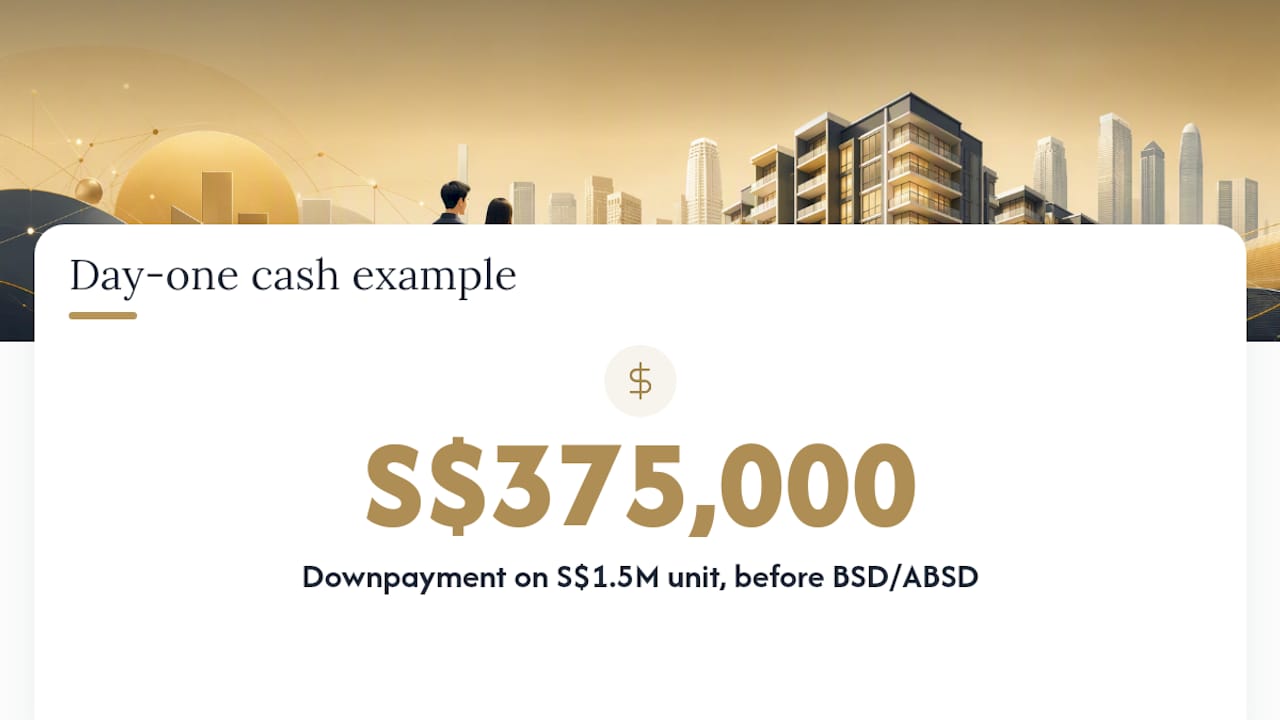
On a S$1.5M unit, that means S$375,000 in cash for the downpayment alone — before BSD or ABSD. Buyers in this position should also review decoupling property strategies to understand whether restructuring ownership before purchase can reduce ABSD exposure.
## 6. Other upfront costs that require cash (beyond the downpayment)
The downpayment is the largest item, but it is not the only one. Several other costs fall due in the weeks around signing and must be funded in cash or from CPF where permitted.
BSD (Buyer's Stamp Duty): Calculated on the purchase price using IRAS progressive bands. Due within 14 days of signing the S&P Agreement. CPF can reimburse BSD after payment, but the cash must be available first. Typical range: S$24,600 (S$1.0M) to S$99,600 (S$2.5M).
ABSD (Additional Buyer's Stamp Duty): Applies to PRs on first purchase, Singapore citizens on second and subsequent purchases, and all foreign buyers. Must be paid in cash — CPF cannot be used. Due within the same 14-day window as BSD. See IRAS ABSD guidance for current rates.
Conveyancing / legal fees: Typically S$2,500–S$3,500 for a straightforward purchase. CPF OA can cover legal fees subject to withdrawal limits. Payable at completion.
Valuation fee: Required by the bank before loan approval. Usually S$300–S$500 for a standard private condo. Paid in cash, typically upfront.
Loan processing / administrative fee: Some banks charge S$500–S$1,000 for loan processing. Others waive it. Confirm with your bank before committing.
Renovation deposit and move-in buffer: Not a statutory cost, but worth budgeting. Renovation for a new condo typically runs S$50,000–S$150,000 depending on unit size and finishes. A renovation loan vs personal loan comparison can help you decide how to fund this without depleting your cash reserves post-completion.
Cash buffer after completion: Financial advisers commonly recommend keeping three months of mortgage payments in liquid cash after you complete the purchase.
## 7. How to prepare: your pre-purchase checklist
Before you pay a single dollar in booking fees, work through this sequence.
Pre-purchase checklist:
- Get an IPA (In-Principle Approval): Submit income documents, CPF statements, and existing loan details to your bank. The IPA confirms your maximum loan amount under TDSR and the stress-rate test. Valid for 30 days typically.
- Check your CPF OA balance: Log into the CPF portal and confirm your available OA balance against the 20% downpayment requirement. Factor in the Valuation Limit for the property you are targeting.
- Calculate your BSD and ABSD liability: Use the IRAS stamp duty calculator before signing anything. Know your exact cash obligation and the 14-day payment deadline.
- Confirm ABSD status: Determine whether you are a first-time SC buyer (no ABSD), PR (5% ABSD on first property), or have an outstanding loan (higher LTV and ABSD applies).
- Run a TDSR simulation: Use your IPA figures to confirm the maximum loan. If the loan falls short of 75% LTV, calculate the extra cash you need to bridge the gap.
- Prepare BSD cash separately: Ring-fence the BSD amount in a separate account the moment you sign the S&P. Do not count on CPF reimbursement arriving before the 14-day deadline.
- Budget for legal fees and valuation: Add S$3,000–S$4,500 to your cash reserve for these items.
Questions to ask your bank:
- What stress rate are you using for the TDSR calculation? (Confirm it is 4% or the current MAS-prescribed rate.)
- What is the maximum loan tenure you will offer given my age and the property's remaining lease?
- Does Mortgage Servicing Ratio (MSR) apply to this purchase? (MSR applies to HDB loans and ECs, not private condos, but worth confirming if you are comparing options — see the bank vs HDB loan guide for context.)
- Will you disburse in PPS tranches for a new launch, and what documentation do you need at each milestone?
Questions to ask the developer or agent:
- What is the exact PPS schedule and milestone percentages for this development?
- When is the S&P signing deadline after OTP exercise?
- Is there a developer absorption scheme for BSD or ABSD, and if so, what are the conditions?
Timing matters. For new launches, you typically have 3 weeks to exercise the OTP after paying the booking fee, and 8 weeks after OTP exercise to sign the S&P. Missing either deadline forfeits your booking fee.
What buyers consistently underestimate about condo cash planning
Very few have done the full cash calculation before they pick up the pen.
The BSD timing gap is the most common budget shock. Buyers see S$44,600 on a S$1.5M purchase and assume CPF will cover it. It will — eventually. But the 14-day window means you need that cash liquid on signing day, not four weeks later when CPF processes the reimbursement. Buyers who have already committed their liquid savings to the downpayment find themselves scrambling.
The second underestimated item is the TDSR shortfall. A buyer earning S$12,000 a month with a car loan of S$1,200 has only S$5,400 of TDSR headroom. The gap is S$99,000 in extra cash they must find. Most buyers discover this at the IPA stage, which is exactly why getting the IPA before the showflat visit is the single highest-value step in this process.
CPF withdrawal limits catch buyers of older properties. If the remaining lease is under 60 years, CPF withdrawal is restricted and the buyer must fund more of the downpayment in cash. For new launches with 99-year leasehold tenure, this is rarely an issue — but it is worth confirming.
My recommendation: after completion, keep at least three months of mortgage payments in cash before you spend anything on renovation. The period between TOP and Certificate of Statutory Completion can surface unexpected costs, and a cash buffer of that size keeps you out of trouble without requiring a personal loan.
Budgeting for a new launch? Here's how Aurea can help
If you are planning a new-launch purchase and want to work through the cash and CPF numbers with a clear picture of what you are buying, Aurea at 802 Beach Road gives you a concrete starting point. Developed by GMC Property Pte. Ltd., Aurea offers 188 units from 2 to 5 bedrooms plus two penthouses, with 99-year leasehold tenure and resort-style amenities across four levels. The development is close to multiple MRT stations and includes a link bridge to The Golden Mile, with completion targeted for 2029.
That staged structure gives you time to coordinate CPF drawdowns and loan disbursements without the lump-sum pressure of a resale purchase. Appointed marketing agents from ERA Realty Network Pte Ltd can walk you through the financing pack, confirm the PPS schedule, and help you verify your IPA before you commit to a booking fee. Visit Aurea's project page to request a buyer financing pack or arrange a viewing.
Sources
The rules governing condo cash downpayments in Singapore come from three primary authorities. Use these sources to verify any figures before signing:
- Loan tenure and loan-to-value limits (MAS)
- Using your CPF to buy a home (CPF Board)
- New launch financing Singapore (Nexus Mortgage)
- Condo downpayment calculator + 2026 cash/CPF rules (SmartCalculator)
This article is general information, not a substitute for advice from a qualified financial advisor. Consult a qualified financial professional about your own circumstances before acting on anything here.