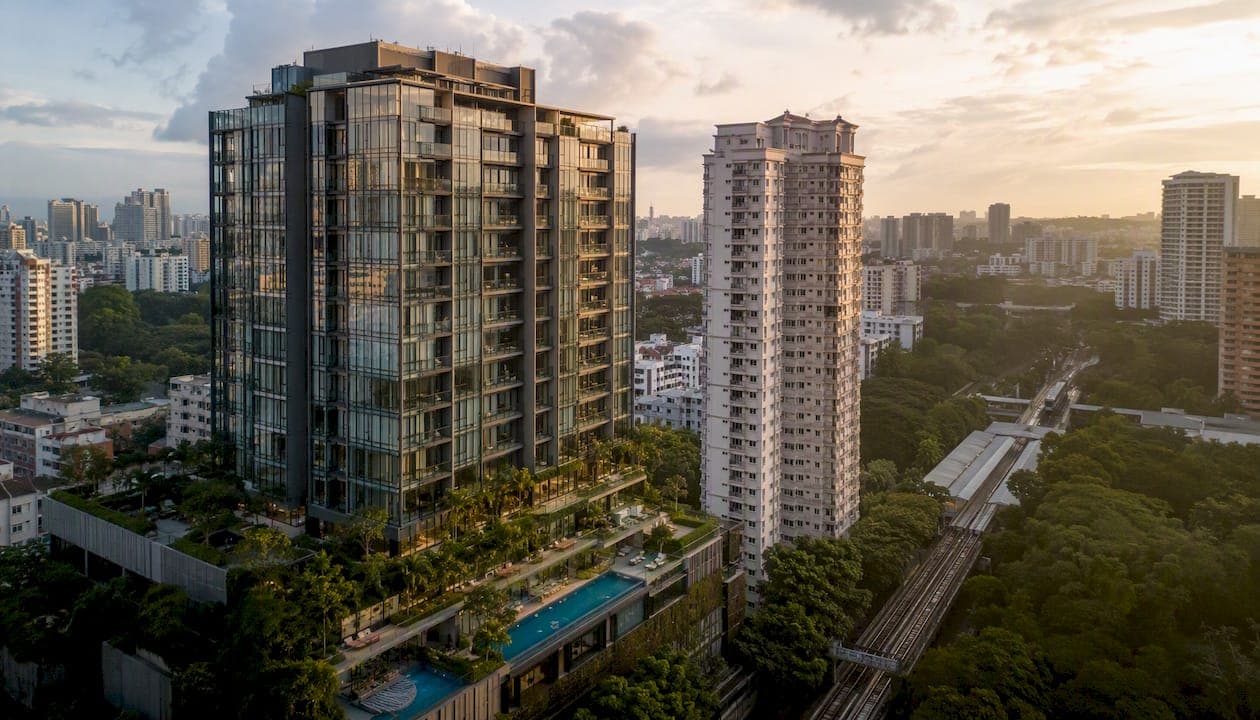
Pick a new launch if you want lighter early cashflow and a fresh 99-year lease. Pick a resale if you need immediate occupancy or rental income from day one. That is the short answer for most Singapore buyers in 2026, and the rest of this article gives you the math to test it against your own numbers.
Three regulatory anchors shape every decision here. Buyer's Stamp Duty (BSD)) and Additional Buyer's Stamp Duty (ABSD)) from IRAS determine your upfront cash requirement. MAS mortgage servicing ratio (MSR) and total debt servicing ratio (TDSR) rules cap how much loan you can carry. And CPF Ordinary Account withdrawal limits affect how much cash you actually need at each payment milestone.
| Dimension | New Launch | Resale |
|---|---|---|
| Typical PSF premium | 10–20% above resale | Baseline |
| Payment schedule | Progressive (PPS) | Lump-sum at completion |
| Time to occupancy | 3–5 years (TOP) | 8–12 weeks after OTP |
| Rental availability | Only from TOP | Immediate |
| Renovation cost | Low to nil | $20,000–$150,000 |
Quick decision checklist:
- Cashflow: Can you service your current housing costs plus progressive payments during construction?
- Timeline: Do you need to move in or collect rent within 12 months?
- Liveability: Does a 3–5 year wait for TOP fit your family's school or commute plan?
- Lease: Is a fresh 99-year lease a priority over a shorter remaining tenure?
Key Takeaways
New launch suits long-horizon buyers who want lighter early cashflow and a fresh lease; resale suits buyers who need immediate occupancy or rental income from day one.
| Point | Details |
|---|---|
| PSF premium reality | New launches typically carry a 10–20% PSF premium over resale, but URA's 2024 harmonisation narrows the usable-area gap. |
| Progressive payments save interest | PPS means you pay interest only on disbursed loan tranches, cutting monthly outflow materially during construction. |
| Resale wins on immediate yield | Resale buyers can collect rental income within weeks; new launch buyers wait until TOP, typically 3–5 years away. |
| ABSD is a cash-only cost | ABSD cannot be paid from CPF; on a $1.5M second property for a Singapore Citizen, that is $300,000 in cash upfront. |
| Aurea as a new-launch benchmark | Aurea at 802 Beach Road offers 2–5 bedroom units with resort amenities and a 2029 TOP, fitting the long-horizon new-launch profile discussed throughout this article. |
Table of Contents
- What makes new launch condos worth the premium?
- Why resale condos still win for many buyers
- How do the total costs actually compare?
- Timeline and financing mechanics you must plan for
- Which buyer type does each option actually suit?
- What should you check at a preview or resale viewing?
- Worked example: Aurea new launch vs a comparable resale
- What should you do next?
- Why the conventional wisdom on this choice is usually wrong
- Aurea at 802 Beach Road: the new-launch option worth modeling
- Where to verify the facts: authoritative Singapore sources
What makes new launch condos worth the premium?
The Progressive Payment Scheme (PPS) is the single biggest financial argument for buying new. Under PPS, you pay in tranches tied to construction milestones — typically 5% at booking, 15% on signing the Sale and Purchase Agreement, then 10% increments as each floor slab is completed. Your bank only draws down the loan in matching tranches, so you pay interest only on the portion disbursed. During a 3–4 year construction window, that can mean paying interest on 20–40% of the loan rather than 100%, which meaningfully reduces monthly outflow if you are still servicing a current home loan.
Beyond cashflow, a new launch resets the clock on lease tenure. A 99-year leasehold property bought at launch gives you the full term, which matters for CPF usage, future resale eligibility, and long-term capital value. Older resale units with 60 or fewer years remaining face CPF withdrawal restrictions and narrower buyer pools.
Developer warranty is another concrete benefit. Under the Housing Developers (Control and Licensing) Act, developers must rectify defects reported within the defects liability period (typically one year from TOP). You get a brand-new unit with modern layouts, current energy standards, and resort-style facilities you did not have to fund through years of sinking-fund contributions.
Capital appreciation potential is real but conditional. Early-bird buyers who enter at launch price often benefit from re-pricing as the project sells down — later phases and post-TOP transactions typically reflect higher PSF. That said, this is a projection, not a guarantee.
Pro Tip: At any preview, ask the developer's agent for the presales velocity — how many units sold in the first weekend. A project that moved fewer than 30% of units at launch often signals either pricing resistance or weak demand, both of which affect post-TOP resale liquidity.
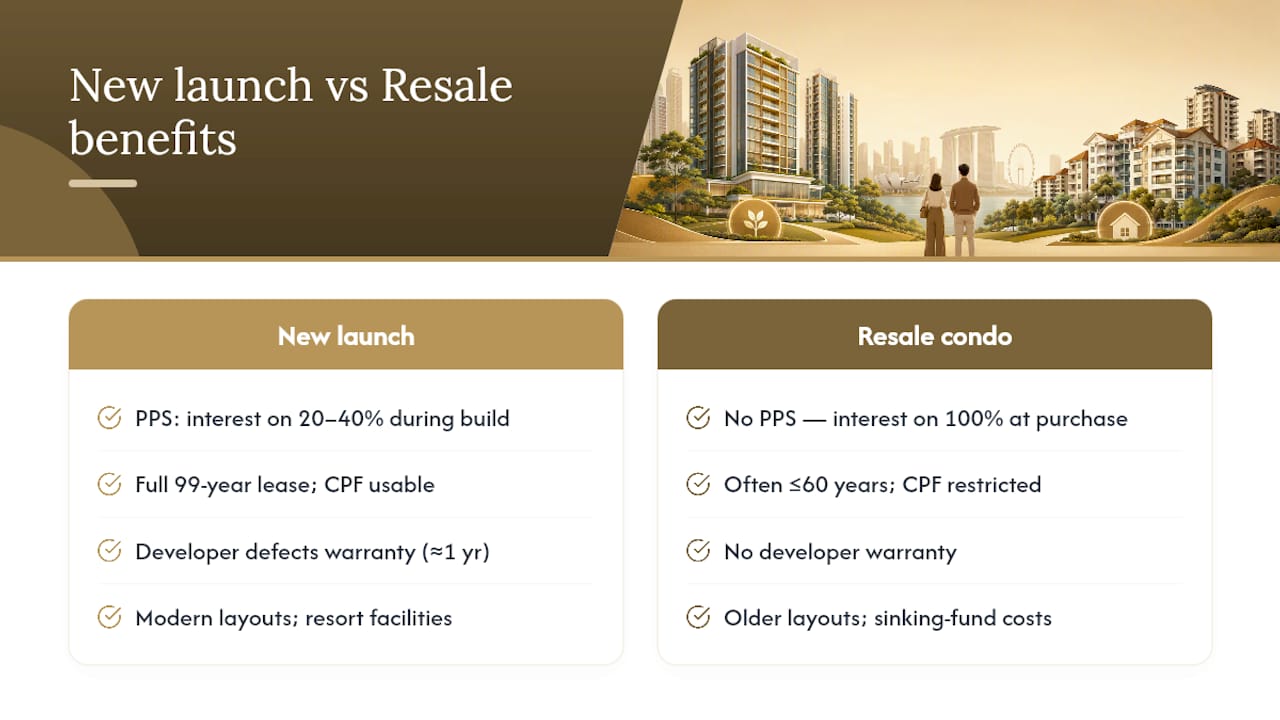
Why resale condos still win for many buyers
Immediate occupancy is the headline advantage, and it compounds quickly. A resale buyer who completes in 8–12 weeks can start collecting rent within the same quarter. For a buy-to-let investor, that means rental income from URA-tracked market rates starts covering mortgage costs from month one rather than sitting idle for three to five years.
Floor area is a second, often underappreciated, factor. New launch two-bedroom units in the Outside Central Region (OCR) have trended smaller in recent years, while comparable resale units from the 2000s or early 2010s often offer 100–120 square feet more for a similar quantum. StackedHomes analysis shows examples where new launch two-bedrooms are 18% smaller than resale equivalents in the same district, which narrows the PSF gap considerably when you measure cost per liveable square foot rather than strata area.
Price discovery on resale is transparent. URA's REALIS database publishes every caveat lodged, so you can see what the unit two floors up sold for six months ago. That data gives you genuine negotiating leverage — something you simply do not have at a developer's fixed-price launch.
Physical inspection is another edge. You can walk through the actual unit, check the condition of common areas, assess the maintenance culture of the estate, and speak to existing residents. A well-run MCST with a healthy sinking fund is worth real money over a 10-year hold.
Renovation costs are the honest trade-off. A resale unit typically needs between $20,000 and $150,000 in renovation depending on age and scope, per Delvin Goh's cost analysis. That is a real addition to your effective purchase price and must be factored into your total outlay calculation.
How do the total costs actually compare?
PropertyNet.SG's 2026 market summary reports typical PSF premiums of 10–20% for new launches over comparable resale units, with the gap widest in the Rest of Central Region (RCR) and narrowest in the Core Central Region (CCR) where resale stock is older and commands its own premium. One important nuance: URA's 2024 harmonisation removed certain non-liveable areas (air-conditioning ledges, planter boxes) from new-launch strata area reporting, which narrows but does not eliminate the PSF gap when you compare usable interior space.
Stamp duty worked example (Singapore Citizen, first property, $1.5 million purchase):
BSD is calculated on the purchase price using IRAS bands: 1% on the first $180,000, 2% on the next $180,000, 3% on the next $640,000, and 4% on the remainder above $1,000,000. On a $1.5 million purchase: ($1,800) + ($3,600) + ($19,200) + ($20,000) = $44,600 BSD. A Singapore Citizen buying their first property pays zero ABSD. A Citizen buying a second property pays 20% ABSD — on a $1.5 million purchase, that is an additional $300,000 in cash, which cannot be paid from CPF.
| Cost dimension | New launch (est.) | Resale (est.) |
|---|---|---|
| Purchase PSF (OCR 2BR) | $1,800 | — |
| Entry quantum (700 sqft) | $1.26M | — |
| Renovation | Nil–$20,000 | $20,000 to $150,000 |
| Time to first rental income | 3–5 years | 8–12 weeks |
| Progressive interest carry | Lower (partial drawdown) | Full from completion |
Progressive payment interest savings are material. If your loan is $1 million and the bank draws down only $300,000 in year one, you pay interest on $300,000 rather than $1 million — a difference of roughly $14,000–$18,000 per year at current rates, depending on your package. Over a 3-year construction period, that cumulative saving can offset a significant portion of the PSF premium.
Timeline and financing mechanics you must plan for
Understanding the payment and loan timeline is where most buyers underestimate complexity.
- Booking fee (new launch): 5% of purchase price, paid in cash on the Option to Purchase (OTP). No loan drawdown yet.
- S&P signing (8 weeks after OTP): 15% due. CPF Ordinary Account savings can be used here, subject to CPF withdrawal limits and the property's remaining lease.
- Progressive construction milestones: Loan drawdown begins in tranches. Monthly mortgage payments start on each disbursed tranche only.
- Resale OTP to completion: Typically 8–12 weeks. Full loan drawdown at completion; full monthly mortgage servicing starts immediately.
- CPF usage timing: For new launches, CPF can be deployed at each progressive milestone. For resale, the full CPF withdrawal (up to the Valuation Limit) is used at completion. Properties with fewer than 30 years of remaining lease cannot use CPF at all.
- Seller's Stamp Duty (SSD) window: SSD applies to sellers who dispose of residential property within 3 years of purchase (post-July 4, 2025 rules: 12% in year one, 8% in year two, 4% in year three). For new launch buyers, the SSD clock starts at the date of purchase, not TOP — so selling before TOP or within 3 years of purchase triggers SSD even if you have never occupied the unit.
- ABSD timing: ABSD is payable within 14 days of signing the S&P Agreement. For new launches, this is a large upfront cash outlay that cannot be deferred.
- Bridging accommodation: New launch buyers who sell their current home before TOP need to budget for rental accommodation during the construction period — typically 2–4 years of rent.
MAS MSR and TDSR rules apply to both property types. MSR caps HDB loan repayments at 30% of gross monthly income; TDSR caps total debt repayments at 55%. For private property, only TDSR applies. These limits determine your maximum loan quantum and are the same regardless of whether you buy new or resale.
Which buyer type does each option actually suit?
| Buyer profile | Better fit | Key reason | Biggest risk |
|---|---|---|---|
| Cash-constrained upgrader | New launch | PPS reduces monthly outflow during construction | Bridging rent if current home is sold early |
| Buy-to-let investor (5-year horizon) | Resale | Immediate rental income; 5-year hold framework favors resale | Renovation cost and older lease |
| Immediate-occupier family | Resale | Move in within 12 weeks; no school disruption | Condition risk; higher renovation budget |
| Long-horizon investor (10+ years) | New launch | Fresh lease; capital appreciation from launch pricing | Construction delay; ABSD cash outlay |
| HDB upgrader (first private property) | Either | No ABSD on first purchase; PPS helps if still in HDB | MOP timing must align with TOP or resale completion |
A family of four with school-age children in a specific catchment area almost always leans resale. Waiting several years for TOP while renting near the right school is expensive and disruptive. Conversely, a long-horizon investor who can absorb the ABSD and wait for TOP typically benefits from a fresh lease and the capital appreciation that tends to materialize as a project approaches and passes TOP.
The 5-year vs 10-year hold framework is a practical heuristic: if your exit horizon is 5 years, resale's immediate income and lower entry cost usually wins on total return. Beyond 10 years, the fresh lease and appreciation trajectory of a new launch tend to pull ahead.
What should you check at a preview or resale viewing?
For a new launch preview:
- Calculate PSF on usable interior area, not strata area. Ask for the floor plan and subtract air-con ledges, planter boxes, and void spaces.
- Run the progressive payment schedule against your current monthly commitments. Add estimated bridging rent if you plan to sell your current home.
- Check the developer's track record: previous project TOP dates vs. projected dates, and whether any project faced delays exceeding 12 months.
- Ask about the project account. Under the Housing Developers Rules, sale proceeds must be held in a designated project account and can only be withdrawn for construction costs — this protects buyers from developer insolvency.
- Verify the expected TOP date and build in a 6–12 month buffer for planning purposes.
For a resale viewing:
- Pull URA REALIS caveats for the same stack and floor range. Compare the asking price to the last 3 transactions.
- Request the MCST's latest annual general meeting minutes and the sinking fund balance. A sinking fund below three months of projected expenditure is a warning sign.
- Inspect the common areas, pool, and gym. Deferred maintenance signals future special levies.
- Check the remaining lease. Anything below 70 years starts to affect CPF usage and buyer pool size.
- Get a structural inspection for units older than 15 years, particularly for any visible water damage or spalling concrete.
Red flags that should pause any purchase:
- Developer with a prior project that missed TOP by more than 18 months without a clear explanation
- MCST sinking fund that has been drawn down for non-capital expenditure
- Asking price more than 15% above the last 3 caveats with no material renovation to justify it
- New launch presale velocity below 20% in the first month at a non-CCR location
Quick on-the-spot math:
- PSF-to-quantum: multiply usable sqft by PSF. A 700 sqft unit at $1,800 PSF = $1.26 million.
- Rough gross yield: annual rent divided by purchase price. $2,800/month rent on a $1.26 million unit = 2.67% gross yield.
Worked example: Aurea new launch vs a comparable resale
Aurea new-launch baseline:
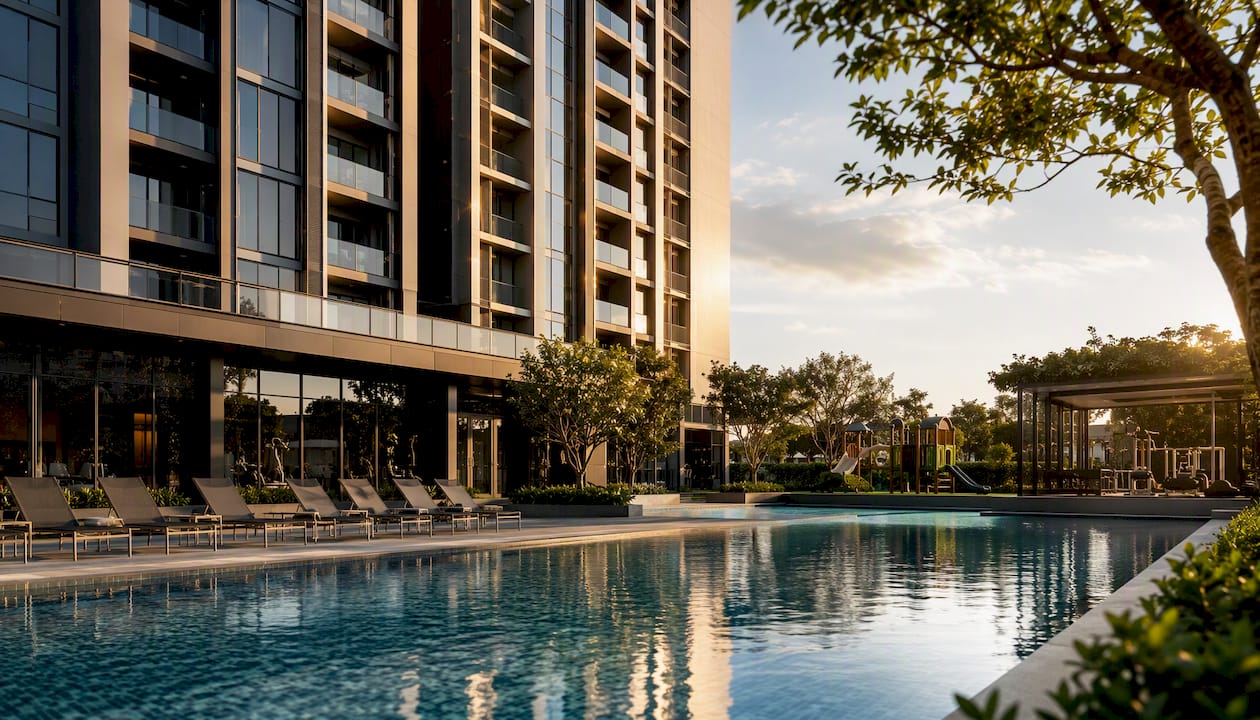
Aurea at 802 Beach Road is a 188-unit highrise developed by GMC Property Pte. Ltd., with 2–5 bedroom layouts and two penthouses. The development sits close to multiple MRT stations, includes resort-style amenities across four levels (pools, clubhouses, fitness decks, children's facilities), and offers a link bridge to The Golden Mile. Projected TOP is 2029. Tenure is 99-year leasehold.
Comparable resale scenario (illustrative, no specific project named):
A resale 3-bedroom unit in the Beach Road / Lavender corridor, approximately 1,100 sqft, at $1,900 PSF, purchase price $2.09 million. Renovation budget: $60,000. Immediate rental availability at $5,500/month based on URA rental comparables for the area.
| Item | Aurea (new launch, 3BR ~1,000 sqft) | Resale 3BR (~1,100 sqft) |
|---|---|---|
| Purchase price (est.) | — | $2.09M at ~$1,900 PSF |
| ABSD (SC, first property) | Nil | Nil |
| Renovation | — | $60,000 |
| Loan drawdown year 1 | ~30% of loan | Full loan |
| Rental income from year 1 | Nil (TOP 2029) | ~$5,500/month |
Key sensitivity variables: actual TOP date (a 12-month delay extends the interest-carry period), rental market at TOP (Beach Road corridor rents could shift materially by 2029), and renovation scope on the resale unit.
What this example shows: The total effective outlays are close. The new launch wins on monthly cashflow during construction if you are not paying bridging rent. The resale wins if you need income from year one or if rental rates soften by 2029.
What should you do next?
New launch suits you if your timeline is flexible, you want lighter early cashflow, and a fresh 99-year lease matters for your long-term plan. Resale suits you if you need to move in or collect rent within the year, or if a larger floor area for the same quantum is a priority.
Three practical next steps:
- Run your own BSD and ABSD calculation using the IRAS stamp duty tool) before committing to any viewing. The cash required at signing is often larger than buyers expect.
- For any new launch, verify the developer's track record on at least two prior projects. Check TOP dates against original projections.
- For any resale, pull URA REALIS caveats for the same project and request the MCST sinking fund balance before making an offer.
Ready to act this quarter?
- Confirm your TDSR headroom with your bank before signing any OTP.
- Check your CPF Ordinary Account balance and the property's remaining lease against CPF withdrawal rules.
- Schedule a showflat appointment or resale viewing with the worked-example math above in hand.
Why the conventional wisdom on this choice is usually wrong
Most articles frame new launch vs resale as a simple PSF comparison. That framing misses the point. The real decision variable is timing of cashflow, not price per square foot.
Buyers who fixate on the PSF premium often overlook that a new launch's progressive payment structure can make a nominally more expensive unit cheaper to carry month-to-month for the first three years, especially if they are still living in an HDB flat with a mortgage. Conversely, buyers who chase a resale "bargain" sometimes forget to add $80,000 in renovation, six months of vacancy during works, and the opportunity cost of a lease that has already burned 20 years.
The lease question is also more consequential than most buyers admit. A 99-year leasehold resale unit bought at year 30 of its lease gives you 69 years remaining. That sounds fine until you try to sell it in 20 years with 49 years left, at which point CPF restrictions and a narrower buyer pool will compress your exit price. A new launch resets that clock entirely.
What actually matters is running the full cashflow model across your specific hold horizon, not comparing PSF in isolation. The worked example in this article is a template, not a verdict. Plug in your own numbers, your own ABSD exposure, and your own rental assumptions before deciding.
Aurea at 802 Beach Road: the new-launch option worth modeling
If the new-launch profile fits your situation, the numbers in this article are worth running against a real project rather than a hypothetical. Aurea at 802 Beach Road delivers exactly the profile described: a 188-unit highrise by GMC Property Pte. Ltd., 2–5 bedroom layouts plus two penthouses, resort-style amenities across four levels, and a link bridge to The Golden Mile. Multiple MRT stations within walking distance keep the rental demand case strong at TOP in 2029.

The progressive payment schedule, fresh 99-year lease, and Beach Road location make Aurea a concrete starting point for the cashflow model this article walks through. Visit Aurea's project page to request a tailored worked example with your specific buyer profile, CPF balance, and financing assumptions. The sales team can provide an actual progressive payment schedule and current pricing so you can run the comparison with real numbers rather than estimates.
Where to verify the facts: authoritative Singapore sources
Use these primary sources to check every number before you sign anything:
Market analysis background used in this article:
- StackedHomes — second property new launch or resale for unit-size and PSF trade-off analysis.
- Delvin Goh — new launch vs resale Singapore for progressive payment interest savings and renovation cost bands.
This article is general information, not financial or legal advice. Stamp duty rates, CPF rules, and financing limits change; verify current figures with IRAS, CPF Board, MAS, and a licensed financial adviser before making any purchase decision.