
A bridging loan is a short-term, asset-backed credit facility that covers your downpayment, stamp duty, or both while you wait for sale proceeds from your existing property to arrive. In Singapore, banks typically cap the loan at around one-fifth to one-quarter of the new property's purchase price, with a maximum tenure of several months. The single most important constraint is not the rate or the fee — it's your exit strategy. If your existing property is hard to sell, most lenders will decline you regardless of income.
Used correctly, a bridging loan is a sensible, time-limited tool for buyers with a credible sale timeline and a marketable property. If your existing unit has weak demand, or if CPF funds and cash can cover the gap, skip it.
- Typical tenure: usually up to several months
- Loan quantum: commonly up to 20–25% of purchase price
- Security required: equitable mortgage or caveat on the property
- Primary risk: lenders stress-test your exit strategy, not just your income
- HDB does not offer bridging loans — you approach banks directly
Key Takeaways
| Point | Details |
|---|---|
| Loan quantum and tenure | Banks cap bridging loans at 20–25% of purchase price with a maximum six-month tenure. |
| Interest rate range | Bank rates typically run 4.9%–5.8% p.a.; licensed moneylenders charge significantly more. |
| Exit strategy is decisive | Lenders stress-test saleability of your existing property; weak demand can override strong income. |
| Total cost on S$300,000 bridge | At a mid-range rate for six months plus typical fees, the total cost can reach around S$12,550. |
| HDB buyers must use banks | HDB does not offer bridging loans; upgraders must apply directly to a bank. |
Table of Contents
- What a bridging loan is and how Singapore buyers actually use one
- How bridging loans work in Singapore: MAS rules and HDB-specific points
- Who offers bridging loans in Singapore and what to compare
- Eligibility: what lenders assess and why your exit strategy matters most
- Costs, fees, and a worked example of the true cost
- How to apply: step-by-step from decision to disbursement
- Risks, red flags, and practical alternatives
- What new-launch buyers at Aurea should know about timing
- The exit strategy is the only thing that matters
- Sources
What a bridging loan is and how Singapore buyers actually use one
A bridging loan is not a home loan and it is not a personal loan. It sits between the two: secured against property like a mortgage, but priced and structured like short-term credit. The purpose is narrow — to cover the cash shortfall between when you must pay for a new property and when your existing property sale settles.
Standard home loans fund the bulk of a purchase over decades. A bridging loan funds a specific gap, usually weeks to a few months, and is repaid in a lump sum once your sale completes. Personal loans are unsecured and typically smaller; bridging loans are secured and sized to the transaction.
A bridging loan lets you commit to a new property before receiving sale proceeds, covering the cash portion of your downpayment and stamp duties until settlement arrives. HDB does not provide bridging loans directly — buyers must approach banks.
Common Singapore use cases:
- HDB upgrader: Selling an HDB flat and buying a private condo. The HDB sale takes time to complete, but the developer's OTP deadline won't wait. A bridge covers the initial cash payment.
- Private-to-private purchase: Buying a new launch or resale condo before your existing condo's sale proceeds clear. Stamp duty (BSD and any ABSD) falls due quickly, and a bridge can fund that too.
- Auction buyer: Auction completions run on tight timelines, sometimes 90 days or less. A bridge buys time while the existing property is marketed.
- New-launch OTP timing: Developers require a booking fee and progressive payments on a fixed schedule. If CPF is locked in your existing property, a bridge covers the interim cash requirement.
The CPF angle matters specifically for HDB upgraders. When you sell your HDB flat, CPF funds used for the purchase must be refunded to your CPF Ordinary Account before you can redeploy them. That refund takes time, and a bridging loan can cover the gap. For more on how bank financing interacts with HDB loan rules, the bank vs HDB loan breakdown is worth reading before you apply.
How bridging loans work in Singapore: MAS rules and HDB-specific points
The regulatory framework for bridging loans in Singapore sits primarily with the Monetary Authority of Singapore's Notice to Merchant Banks (Notice 1107). That notice defines what counts as a bridging loan for immovable property, sets income thresholds, and requires full security when an applicant's income falls below certain levels. It also directs banks to take equitable mortgages or lodge caveats where appropriate, which is why you will always sign security documentation before disbursement.
What MAS Notice 1107 shapes in practice:
- Banks must assess the borrower's ability to repay if the sale is delayed
- Full security (equitable mortgage or caveat) is required, especially for lower-income applicants
- Income thresholds affect how much unsecured bridging exposure a lender can extend
- Internal stress tests — often run at an assessment rate around 4.8% — determine whether the borrower can service both the bridge and the long-term home loan simultaneously
HDB-specific points:
HDB itself does not issue bridging loans. If you are upgrading from an HDB flat, you go to a bank. The bank will typically secure the bridge against the proceeds of your HDB sale or take a caveat on the new property being purchased. MOP (Minimum Occupation Period) matters here: if your HDB flat has not cleared MOP, you cannot sell it, which means there are no sale proceeds to serve as your exit strategy. Lenders will decline a bridge in that scenario.
CPF implications are also specific to HDB transactions. The CPF refund after an HDB sale is not instantaneous — it flows back to your OA and then must be re-applied to the new purchase. A bridging loan can cover the period between sale completion and CPF redeployment, but the lender will want to see that the HDB sale is confirmed and the timeline is realistic.
According to SingSaver's 2026 bridging loan guide, lenders run internal stress tests and prioritize the saleability of the existing property over raw income when deciding bridge approvals.
Who offers bridging loans in Singapore and what to compare
Five banks dominate the Singapore bridging loan market for property: DBS, OCBC, UOB, Standard Chartered, and Maybank. Each offers a product broadly shaped by MAS Notice 1107, but the specific caps, rates, and fee structures differ by customer profile and whether you take the long-term home loan with the same bank.
DBS states that buyers can borrow up to 20% of the purchase price with a repayment period lasting several months. range](https://www.singsaver.com.sg/personal-loan/blog/bridging-loans-guide), often expressed as 3-month SORA plus a bank spread of roughly 3.5%–4.5%.
| Feature | Typical range across major banks |
|---|---|
| Max loan quantum | 20%–25% of purchase price |
| Maximum tenure | 6 months |
| Interest rate | ~4.9%–5.8% p.a. (3M SORA + spread) |
| Processing fee | ~1% of loan amount (common) |
| Security required | Equitable mortgage or caveat |
| Eligibility trigger | Valid OTP + proof of existing property sale |
What the table doesn't capture:
- Banks often waive or reduce processing fees if you take the long-term home loan with them. Always ask.
- Rate quotes are indicative. The actual spread depends on your credit profile, property type, and loan size.
- Licensed moneylenders approve faster but charge significantly more. LendingBee's guide notes that banks run at roughly 5%–6% p.a., while licensed moneylenders can charge up to 4% per month under the legal cap — a very different cost profile for a six-month bridge.
The practical takeaway: if you have time (two to three weeks), go to a bank. If you need funds in days and the amount is small, a licensed moneylender is an option, but model the total cost carefully before signing.
Eligibility: what lenders assess and why your exit strategy matters most
Banks do not approve bridging loans on income alone. The primary question a lender asks is: "How and when will this loan be repaid?" That answer comes from your exit strategy — the confirmed sale of your existing property.
Standard eligibility checklist:
- Valid Option to Purchase (OTP) for the new property
- Signed Sale & Purchase Agreement or confirmed OTP for the existing property
- Recent income proof (payslips, NOA, or business financials for self-employed buyers)
- CPF statements showing OA balance and any outstanding CPF charges on the existing property
- Outstanding home loan statement for the existing property
- Property valuation for both properties (some banks require independent valuations)
- Satisfactory credit bureau score
The exit strategy check goes deeper than a document review. Lenders assess whether your existing property is realistically priced and actively marketed. A high-income applicant with an overpriced unit in a slow submarket can be declined. Conversely, a buyer with a well-priced HDB flat in a high-demand estate may get faster approval even with a more modest income profile.
Lenders also run a combined serviceability test: can you service both the bridging loan and the new home loan simultaneously if the sale takes longer than expected? Your total debt service ratio must remain within MAS TDSR limits even under that stressed scenario. For a full breakdown of how TDSR works, the TDSR Singapore rules guide covers the mechanics in detail.
Pro Tip: Before approaching a lender, get a fresh valuation on your existing property and document your marketing activity — active listing, recent viewings, comparable sales in the area. Lenders treat this as evidence of saleability, and it materially improves your approval odds.

Costs, fees, and a worked example of the true cost
Bridging loans carry more cost layers than most buyers expect. The headline rate is only part of it.
Cost components to budget for:
- Interest rate: ~4.9%–5.8% p.a. for bank bridging loans, based on 3M SORA plus spread
- Processing or admin fee: commonly around 1% of the loan amount
- Valuation fee: S$300–S$700 depending on property type and lender requirements
- Legal fees: for the equitable mortgage or caveat documentation; typically S$500–S$1,500
- Caveat lodgment fee: a smaller administrative charge, usually under S$100
- Late repayment fee: if your sale is delayed beyond the agreed tenure, penalty rates apply
Capitalised vs. monthly interest: Some lenders allow you to defer interest payments and capitalize them — meaning interest is added to the principal and itself accrues interest. Homejourney's guide flags this clearly: over a six-month bridge, capitalized interest increases the total redemption amount noticeably compared with paying interest monthly. If cash flow allows, paying interest monthly is cheaper.
Worked example (assumptions stated):
| Cost item | Amount |
|---|---|
| Loan principal | S$300,000 |
| Interest (~5% p.a. × 6 months) | S$7,500 |
| Processing fee (1%) | S$3,000 |
| Legal fee | S$800 |
| Valuation fee | S$500 |
| Total cost of bridge | S$12,550 |
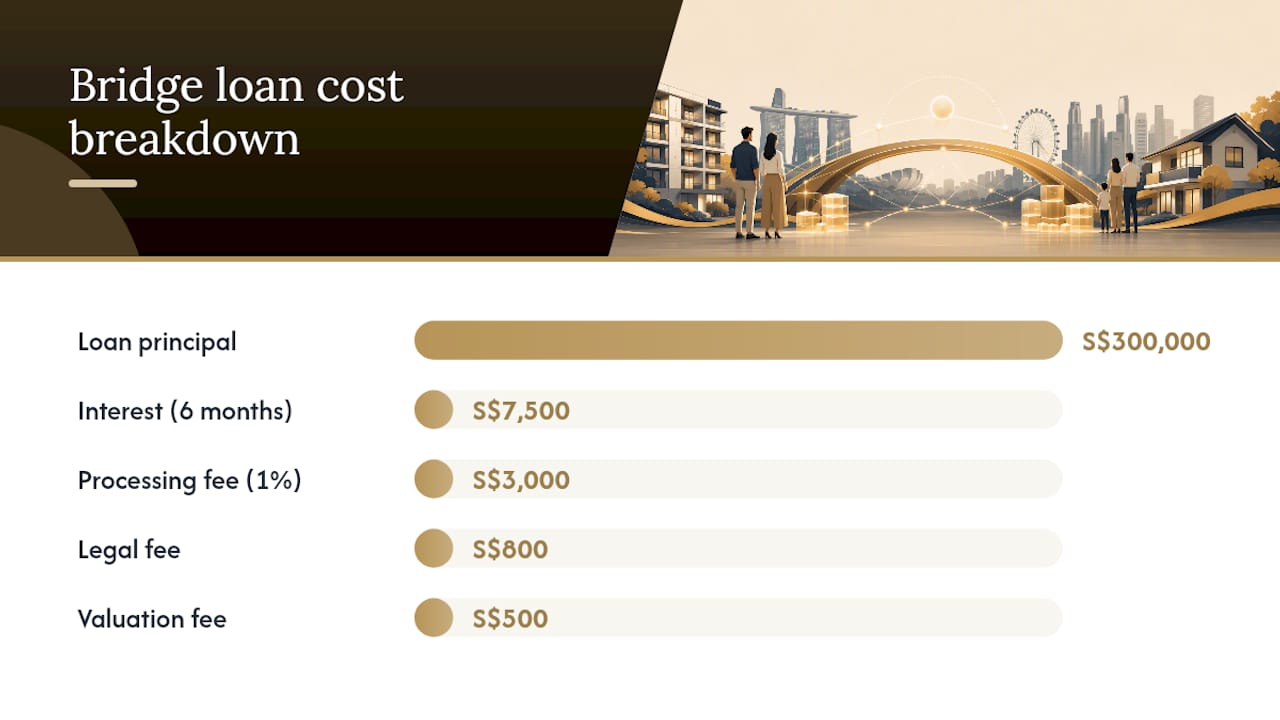
That S$12,550 is the cost of a six-month bridge on a S$300,000 loan at conservative bank rates. If the sale is delayed by two months and a penalty rate kicks in, or if interest is capitalized rather than paid monthly, the figure climbs further. Model the worst-case scenario, not the best.
How to apply: step-by-step from decision to disbursement
The application process for a bank bridging loan typically takes one to three weeks from submission to disbursement. Licensed moneylenders can move in days but at a higher cost.
Step-by-step application process:
- Confirm your timelines. Map the OTP exercise deadline for the new property against the expected completion date of your existing property sale. The gap is the period your bridge must cover.
- Get a property valuation. Most banks require an independent valuation of both properties. Commission this early — it takes three to five working days.
- Secure your documents. Gather the OTP for the new property, the signed S&P or OTP for the existing property, your last three months' payslips (or NOA), CPF statements, and your outstanding loan statement.
- Approach a lender or mortgage specialist. Submit a formal application. A mortgage specialist can run parallel applications to multiple banks, which saves time and gives you rate leverage.
- In-principle approval. The bank reviews your documents, runs the credit check, and issues an in-principle approval, typically within three to seven working days.
- Legal processing. Your solicitor prepares the equitable mortgage or caveat documentation. Budget three to five working days for this.
- Caveat lodgment. The caveat is lodged with the Singapore Land Authority, protecting the lender's interest.
- Disbursement. Funds are released directly to the relevant party (developer, seller's solicitor, or CPF Board as applicable).
Required documents checklist:
- Valid OTP for the new property
- Signed S&P Agreement or OTP for the existing property
- Last three months' payslips or latest Notice of Assessment
- CPF statement (OA balance and withdrawal history)
- Outstanding home loan statement
- NRIC (both borrowers if joint application)
- Property valuation reports
According to LendingBee, banks typically require all of the above before processing begins, so having them ready before you approach a lender cuts the timeline meaningfully.
Pro Tip: For new-launch buyers, align your bridging loan application with the developer's payment schedule from day one. Start the application as soon as you exercise the OTP.
Risks, red flags, and practical alternatives
A bridging loan is a useful tool in the right situation. In the wrong one, it can compound a cash-flow problem rather than solve it.
Red flags that suggest you should not proceed:
- Your existing property has been on the market for more than three months without serious offers
- The property is in a submarket with low transaction volume or complex title issues
- You are relying on an auction outcome that is not yet confirmed
- You have not modeled the cost if the sale takes two months longer than planned
- The lender's contract includes a conversion clause that shifts you to a higher rate if the bridge is not repaid on time
Practical alternatives:
- Use CPF OA funds first. If your CPF OA balance is sufficient to cover the downpayment gap, deploy it before taking on a bridge. The cost of a bridging loan almost always exceeds the CPF interest rate foregone.
- Negotiate a vendor extension. If you are buying a resale property, ask the seller for a longer completion period. Many sellers will agree to a 12-week or longer timeline, which may eliminate the need for a bridge entirely.
- Sell before you buy. In a buyer's market or when your existing property has uncertain demand, selling first and renting temporarily is cheaper than a six-month bridge plus the risk of a delayed sale.
- Short-term personal loan. Only viable for small gaps (under S$30,000) where the bridging loan fees would exceed the personal loan interest cost. For larger amounts, the math rarely works.
- Rent-back agreement. Some sellers will allow you to rent back the property after completion, giving you time to find and settle on a new purchase without a bridge.
Pro Tip: Before signing any bridging loan agreement, ask the lender two specific questions: What is the penalty rate if the bridge is not repaid by the agreed date? Is there an extension option, and what does it cost? The answers tell you your worst-case exposure.
What new-launch buyers at Aurea should know about timing
New-launch purchases like Aurea at 802 Beach Road follow a developer-set payment schedule that does not flex for individual buyers. The booking fee, followed by progressive payments tied to construction milestones, creates a series of hard deadlines. If CPF funds are tied up in an existing property sale, a bridging loan can cover interim payments — but only if the coordination is done early.
Key coordination points for new-launch buyers:
- Speak with a mortgage specialist before exercising the OTP, not after. The specialist can map your CPF refund timeline, your existing sale timeline, and the developer's payment schedule against each other.
- Confirm the expected CPF refund date with your HDB or conveyancing solicitor. CPF refunds after an HDB sale take time, and that gap is exactly what a bridge is designed to cover.
- Use Aurea's sales documentation (OTP, payment schedule, developer letter) as part of your bridging loan application. Lenders want to see the full picture of the transaction, and developer documents add credibility to the application.
- Minimize the bridging period. Every additional month costs money. If you can time your HDB sale completion to align closely with the developer's first major payment milestone, the bridge tenure shrinks and so does the total cost.
For buyers considering city-fringe new launches, the best city fringe condos guide provides useful market context on timing and pricing dynamics that affect how quickly existing properties sell.
According to Homejourney, early coordination with a dedicated mortgage specialist is one of the most effective ways to reduce the risk of missed developer payment deadlines and to keep the bridging period as short as possible.
Pro Tip: Ask the Aurea sales team for the full progressive payment schedule at your first appointment. Mapping those dates against your existing property sale timeline is the first step in deciding whether you need a bridge at all.
The exit strategy is the only thing that matters
Most buyers fixate on the interest rate when they research bridging loans. That's the wrong place to focus.
The rate difference between the cheapest and most expensive bank option on a S$300,000 bridge over six months is a few hundred dollars. The difference between a clean exit and a delayed sale that pushes your bridge into penalty territory can be tens of thousands. Lenders know this, which is why the saleability assessment of your existing property carries more weight than your income in many approval decisions.
My honest advice: if your existing property is priced correctly, actively listed, and in a submarket with reasonable transaction volume, a bridging loan is a practical, low-drama tool. Use it, minimize the tenure, and pay interest monthly rather than capitalizing it. If any of those conditions are uncertain, sell first. The cost of renting for two or three months while you wait for the right purchase is almost always lower than the cost of a bridge on a property that takes longer than expected to sell.
For new-launch buyers specifically, the coordination piece is underestimated. Developer deadlines are fixed. CPF refund timelines are not always predictable. Getting a mortgage specialist involved before you exercise the OTP — not after — is the single most effective way to avoid a cash-flow crunch that a bridging loan then has to solve under time pressure.
This article is general information, not a substitute for advice from a qualified financial advisor. Consult a qualified financial professional about your own circumstances before acting on anything here.
Sources
Product terms, rates, and regulatory guidance change. Before submitting any application, verify the following directly:
- NOTICE TO MERCHANT BANKS BANKING ACT, CAP 19
- Purchase your dream home with DBS Loans | DBS Singapore
- Bridging Loan Singapore 2026: How It Works & Rates - SingSaver
- How Bridging Loan Works And How To Apply For One | LendingBee
- Bridging Loan Singapore: Complete Guide for Property Buyers | Homejourney | Homejourney Blog