
Buyer's Stamp Duty in 2026 still runs on a six-band scale topping out at 6% for residential purchases above S$3 million, while Additional Buyer's Stamp Duty adds up to 65% on top for certain entities and 60% for foreigners, per IRAS). Sellers face a Seller's Stamp Duty holding period now stretched to four years for homes bought on or after July 4, 2025. Every buyer and seller must settle their duty within 14 days of signing, verified and paid through IRAS's e-Stamping portal.
TL;DR:
- Buyers must pay stamp duty within 14 days of signing, based on the higher of purchase price or valuation, with rates up to 6% for properties above S$3 million.
- ABSD rates vary widely, with foreigners paying 60% and entities up to 65%, while Singapore citizens buying their first property pay no ABSD.
- The seller's holding period increased to four years in July 2025, with SSD rates from 4% to 16% for properties sold within this period.
- Additional duties like lease, mortgage, and share transfer duties may also apply, requiring careful planning and legal review before signing.
- Potential buyers should verify their duty obligations early, considering remissions, buyer profiles, and valuation differences to avoid costly surprises.
Table of Contents
- Understanding Stamp Duty Rates in Singapore for 2026
- How to Calculate Buyer's Stamp Duty: Step-by-Step Examples
- ABSD Rules: Buyer Profiles, Remissions, and Real Numbers
- Seller's Stamp Duty: What Changed in July 2025 and What It Means Now
- Lease Duty, Mortgage Duty, and Share Transfer Duty You Might Be Missing
- Filing and Paying Stamp Duty: Deadlines, Steps, and Penalties
- Pre-Signing Checklist for Buyers, Sellers, and Corporate Purchasers
- What Rising Stamp Duty Means for New Launch Buyers in 2026
- Get Buyer-Ready for Aurea Before You Budget for Stamp Duty
- Where to Verify These Rates Yourself
- Sources
Understanding Stamp Duty Rates in Singapore for 2026
Every property transaction in Singapore carries at least one layer of stamp duty, and often three. Buyer's Stamp Duty (BSD) applies to every purchase regardless of nationality. Additional Buyer's Stamp Duty (ABSD) stacks on top depending on who is buying and how many properties they already own. Seller's Stamp Duty (SSD) only bites if you sell within the holding period window after buying.
Residential BSD is calculated on a progressive six band structure, and it's charged on whichever is higher between the purchase price and the market valuation, then rounded down to the nearest dollar, according to IRAS.
| Portion of price/value | BSD rate |
|---|---|
| First S$180,000 | 1% |
| Next S$180,000 | 2% |
| Next S$640,000 | 3% |
| Next S$500,000 | 4% |
| Next S$1,500,000 | 5% |
| Remainder above S$3,000,000 | 6% |
Non-residential property, meaning commercial and industrial units, tops out lower. There's no 5% or 6% band for non-residential deals, which is one reason some investors have shifted attention toward commercial assets when residential costs climb.
ABSD by buyer profile is where the real money moves. Rates below reflect the structure that has applied since April 2023 and continues into 2026:
Certain foreign nationals get relief from these rates entirely. Citizens of the United States, Iceland, Liechtenstein, Norway, and Switzerland qualify for ABSD remission under free trade agreement provisions, putting them on the same footing as Singapore Citizens for a first purchase, according to IRAS's FTA guidance.
SSD rates apply only if you sell within the holding period after purchase. The rules changed materially in mid 2025:
- For properties bought on or after July 4, 2025, the holding period is now 4 years, up from 3-year previously, per the MAS media release on the change.
- Sell within year 1: 16% SSD.
- Sell within year 2: 12% SSD.
- Sell within year 3: 8% SSD.
- Sell within year 4: 4% SSD.
- Sell after year 4, or if you bought before July 4, 2025 (older 3 year schedule still applies to those purchases): no SSD.
How to Calculate Buyer's Stamp Duty: Step-by-Step Examples
BSD calculation follows one rule: apply the six band table to whichever is higher, purchase price or valuation, then round down to the nearest dollar. There's no minimum duty floor for standard purchases, but rounding always favors the payer by a few cents.
Pro Tip: Always ask your agent for the OTP price and the most recent valuation side by side. If the valuation comes in higher, IRAS charges BSD on that higher number, not on what you actually paid.
Here's the math for five common price points based on the official BSD tiered rates:
- S$500,000 purchase. 1% on S$180,000 = S$1,800; 2% on next S$180,000 = S$3,600; 3% on remaining S$140,000 = S$4,200. Total BSD: S$9,600.
- S$1,000,000 purchase. 1% on first S$180,000 = S$1,800; 2% on next S$180,000 = S$3,600; 3% on next S$640,000 = S$19,200. Total BSD: S$24,600.
- S$1,500,000 purchase. BSD on first S$1,000,000 is S$24,600; 4% on next S$500,000 = S$20,000. Total BSD: S$44,600.
- S$3,000,000 purchase. BSD on first S$1,500,000 is S$44,600; 5% on next S$1,500,000 = S$75,000. Total BSD: S$119,600.
- S$5,000,000 purchase. BSD on first S$3,000,000 is S$119,600; 6% on next S$2,000,000 = S$120,000. Total BSD: S$239,600.
Now layer on ABSD. Total stamp duty: S$1,919,600. A Singapore Citizen buying the same unit as a first property pays only the S$119,600 BSD, with zero ABSD. The buyer's profile changes the math more than the price band does.
ABSD Rules: Buyer Profiles, Remissions, and Real Numbers
ABSD hinges entirely on two questions: who is buying, and how many residential properties they already hold. A Singapore Citizen buying their first home pays nothing extra. The same citizen buying a second property pays 20%, and a third pushes that to 30%. Permanent Residents pay 5% from their very first purchase, then jump to 30% and 35% for subsequent ones.
Foreigners pay a flat 60% regardless of whether it's their first property or fifth, and companies or trustees buying residential property pay 65%, per IRAS's ABSD schedule.
Two remissions matter most for readers planning a purchase:
- Married couple remission: if a Singapore Citizen married to a foreigner or PR buys jointly and later sells their prior property within 6 months, they can claim back the ABSD paid, provided at least one spouse is a citizen.
- FTA remission: nationals of the US, Iceland, Liechtenstein, Norway, and Switzerland are treated as Singapore Citizens for ABSD purposes on their first purchase.
Take a Permanent Resident buying a S$1,500,000 unit as their second property. BSD comes to S$44,600. Total stamp duty: S$494,600, more than a third of the purchase price before legal fees or agent commissions even enter the picture. For deeper coverage of these profile based rates, the Aurea blog's ABSD guide walks through more scenarios.
Seller's Stamp Duty: What Changed in July 2025 and What It Means Now
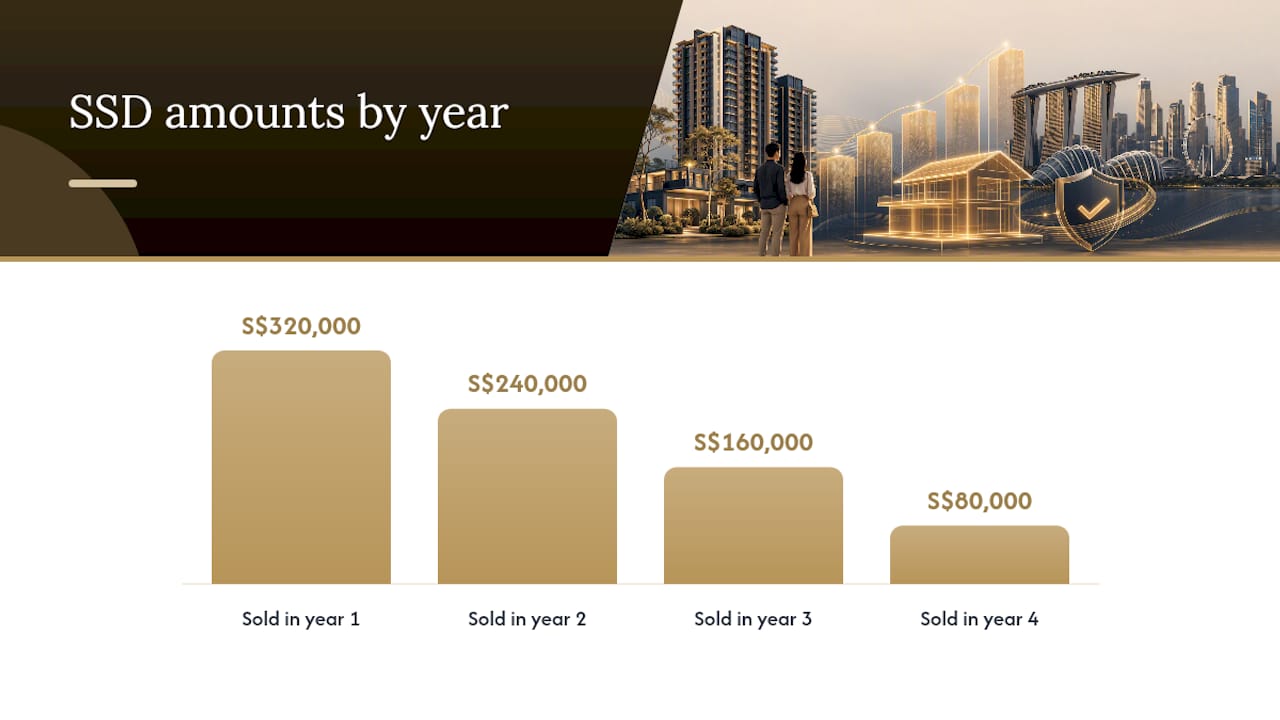
SSD only applies to private residential property, and only if you sell within the holding period. HDB flats are exempt from SSD but carry their own Minimum Occupation Period rules that function separately. The holding period itself is the part that changed. Anyone who bought on or after July 4, 2025 now faces a 4 year window instead of the previous 3, with SSD rates also raised across the board, according to the MAS announcement.
Here's what that means in dollars for someone who bought a S$2,000,000 condo after the July 2025 cutoff:
- Sold in year 1: SSD of 16%, or S$320,000.
- Sold in year 2: SSD of 12%, or S$240,000.
- Sold in year 3: SSD of 8%, or S$160,000.
- Sold in year 4: SSD of 4%, or S$80,000.
- Sold in year 5 or later: no SSD.
Transfers between spouses, transfers into a trust for immediate family, and certain inheritance related disposals are generally exempt, though each case needs individual confirmation with IRAS before assuming exemption applies. If you bought before July 4, 2025, your older purchase still runs on the 3 year schedule that was in place at the time, not the new 4 year rule.
Lease Duty, Mortgage Duty, and Share Transfer Duty You Might Be Missing
Property transactions rarely stop at BSD, ABSD, and SSD. A few other duties catch corporate buyers and investors off guard.
- Lease duty applies when you sign a lease with an average annual rent above a certain threshold or pay a lease premium; longer commercial leases and any lease with an upfront premium usually trigger it.
- Mortgage duty applies to loan or charge documents, and banks typically handle the stamping directly as part of loan disbursement, so most buyers never see this step happen.
- Share transfer duty hits corporate buyers who acquire property indirectly by purchasing shares in a company that owns real estate, a structure some investors use and one that still requires stamping on the share transfer instrument itself.
Each of these has its own IRAS reference page, and a conveyancing lawyer should flag which ones apply before you sign anything.
Filing and Paying Stamp Duty: Deadlines, Steps, and Penalties
The clock starts the moment you sign. You have 14 days from the date of the Option to Purchase or the Sale and Purchase Agreement to stamp the document, whether you're buying private property or an HDB resale flat.
- Confirm your deadline. Count 14 calendar days from signing, not 14 working days. HDB purchases follow the same rule but often align it with the resale application timeline.
- Log into myTax / e-Stamping. Go to the IRAS e-Stamping portal, select the document type, and enter the property details, purchase price, and buyer profile information.
- Pay upfront in cash. BSD and ABSD must be paid in cash within the 14 day window. You can reimburse yourself from CPF Ordinary Account funds only after the transaction completes, not before.
- Keep proof of stamping. The stamp certificate is required for the eventual transfer of title, so file it with your other transaction documents.
Miss the deadline and IRAS charges a penalty, generally the higher of S$10 or an amount equal to the duty itself for the first three months late, rising further after that. Refunds and appeals for overpaid duty or wrongly assessed ABSD go through IRAS's formal refund application process.
Pre-Signing Checklist for Buyers, Sellers, and Corporate Purchasers
Before anyone signs an Option to Purchase, run through this list:
- Confirm your exact buyer profile (citizen, PR, foreigner, or entity) since this alone can swing your total duty by hundreds of thousands of dollars.
- Check whether an FTA remission or married couple remission applies to your situation before assuming the standard ABSD rate is final.
- Compare the purchase price against the most recent valuation, since IRAS charges BSD on whichever figure is higher.
- Budget separately for BSD, ABSD, and any potential SSD exposure if you might sell within the new 4 year window.
- Ask your conveyancing lawyer to confirm the e-Stamping deadline and whether CPF reimbursement timing fits your cash flow.
- If buying through a corporate entity, ask specifically whether share transfer duty or the 65% entity ABSD rate applies to your structure.
Budgeting tools like the downpayment planning guide on the Aurea blog can help map these duties against your total cash outlay before you commit.
What Rising Stamp Duty Means for New Launch Buyers in 2026
Stamp duty now eats a real chunk of the cash a buyer needs upfront, and that hits new launch buyers differently than resale buyers because progress payments stretch over years. Anyone financing an Aurea unit as an investment should map their expected holding period against the new 4 year SSD window before signing, not after. Citizens and PRs buying their first home face a much lighter load than foreigners or entities, which is worth confirming early with a lawyer. For a sense of where demand and pricing are heading, the 2026 market outlook on the Aurea blog is a useful next read.
— Velisa
Get Buyer-Ready for Aurea Before You Budget for Stamp Duty
Working out your BSD and ABSD exposure before you shop for a unit puts you ahead of most buyers who only do the math after falling for a floor plan. Aurea-sgcondo's own buyer resources lay out unit layouts, pricing tiers, and the exact figures you'll need to run through the calculations covered above, so you can budget your total cash outlay, not just the headline price.
If you're weighing a 2 bedroom against a family sized 4 bedroom layout at 802 Beach Road, or trying to figure out whether your buyer profile changes which unit makes financial sense, the property tax overview on the Aurea blog covers the recurring costs that follow after stamp duty is settled. For property specific guidance on fees and paperwork beyond stamp duty, Haio is a useful additional resource. Reach out to a sales team through the main site to request current pricing and a buyer's checklist tailored to your profile before your next viewing.
Where to Verify These Rates Yourself
Every rate in this article traces back to a public source. For BSD, ABSD, and remission details, check the IRAS stamp duty quick-links page. Pay and file through IRAS e-Stamping. For the SSD holding period change, see the MAS media release, and for historical rate comparisons, Data archives past figures from IRAS.
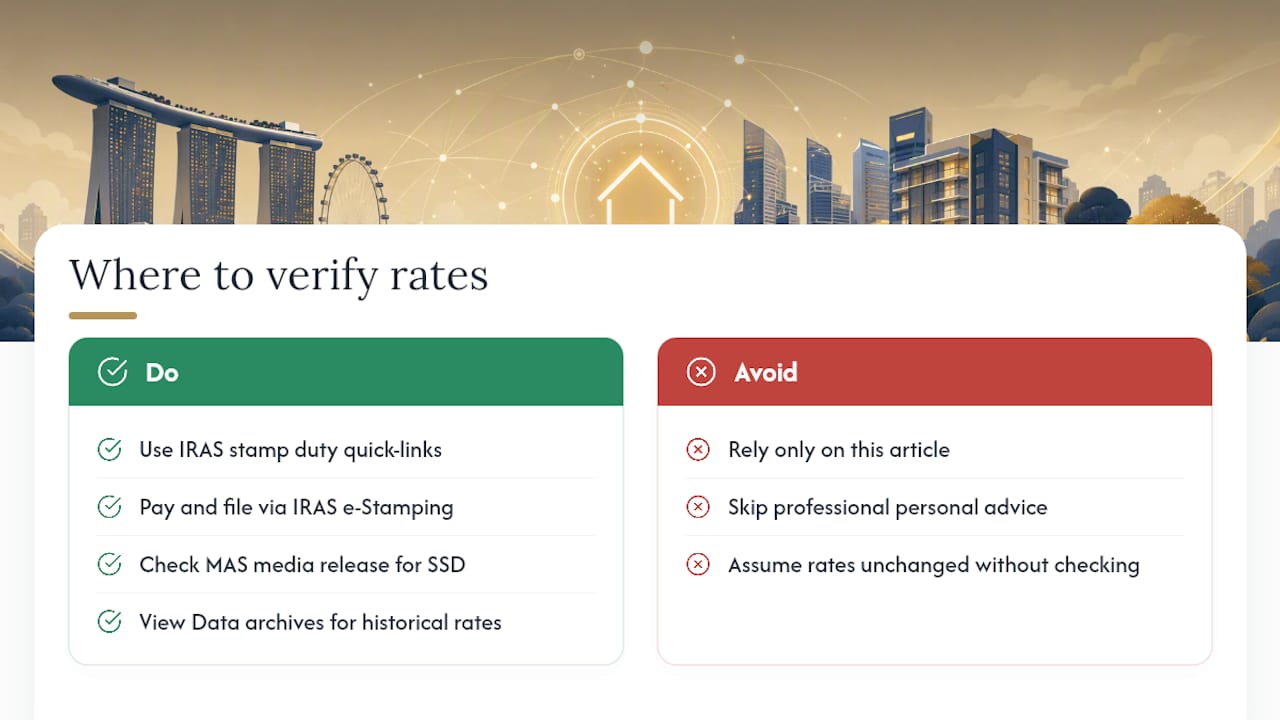
This article is general information, not a substitute for advice from a qualified financial advisor. Consult a qualified financial professional about your own circumstances before acting on anything here.
Sources
- MAS media release — extension of the holding period of seller's stamp duty and higher SSD rates
- IRAS e-Stamping / myTax