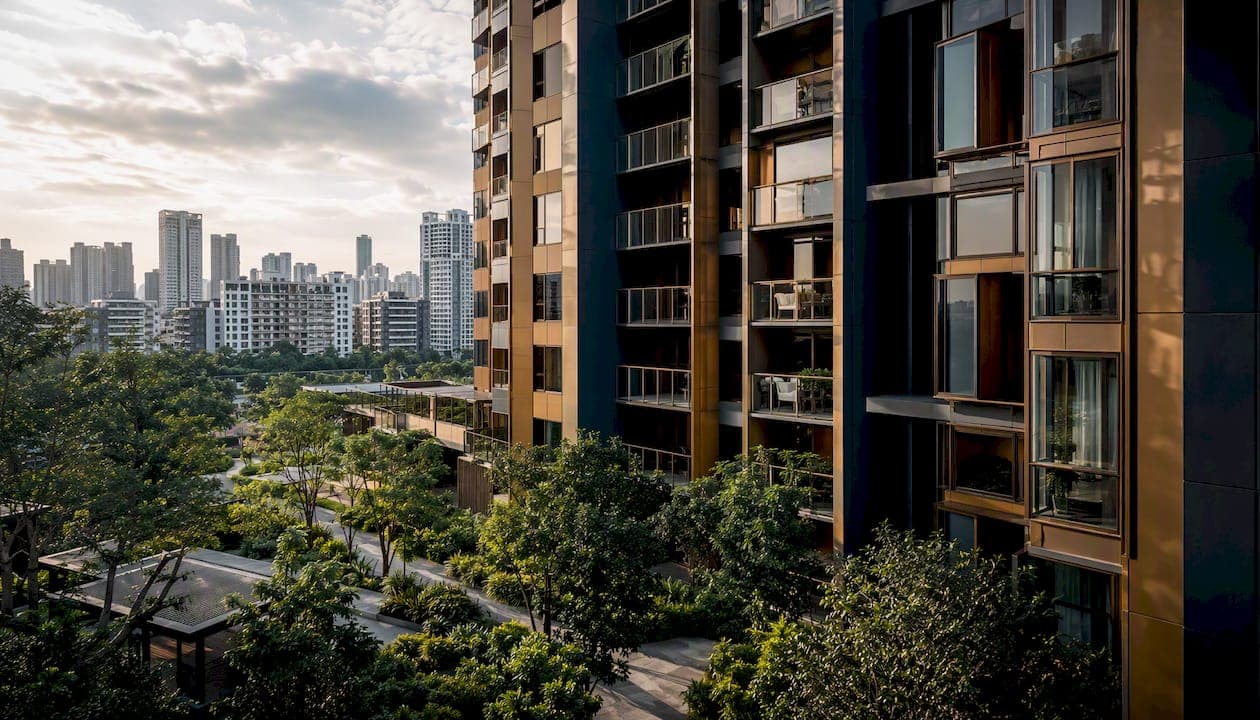
The Singapore property market in 2026 is holding up better than most analysts expected at the start of the year, but the gains are narrowing and the divergence between segments is sharper than the headline numbers suggest. Private residential prices are still climbing, just more slowly. HDB resale has hit its first quarterly dip since 2019. And the supply pipeline is the fullest it has been in years.
Quick snapshot for decision-makers:
- URA Private Residential Price Index (PPI): 218.3 in Q1 2026, up 0.9% quarter-on-quarter — the sixth consecutive quarterly gain, followed by a flash estimate of +0.5% in Q2 2026
- HDB Resale Price Index (RPI): 203.4 in Q1 2026, down 0.1% quarter-on-quarter — the first negative reading since 2019
- 3-month compounded SORA: hovering near 2.5–3.0% in mid-2026, keeping floating-rate mortgage costs elevated but off their 2023 peak
What this means in practice:
- Buyers have more negotiating room in HDB resale and non-prime private segments than at any point since 2022
- Sellers in premium pockets (CCR, select RCR) still hold pricing power; mass-market sellers need to sharpen their expectations
- Investors should model a four-year minimum hold to clear Seller's Stamp Duty (SSD) and absorb any near-term price softness
- The supply wave arriving through 2027–2028 will gradually shift leverage toward buyers in most segments
Key Takeaways
The Singapore property market in 2026 is stable but diverging: private prices are rising modestly, HDB resale has plateaued, and the supply pipeline will shift leverage toward buyers through 2027–2028.
| Point | Details |
|---|---|
| Private prices still rising, but slower | URA PPI hit 218.3 in Q1 2026 (+0.9% q-o-q); Q2 flash estimate slowed to +0.5% |
| HDB resale has paused | RPI at 203.4, down 0.1% q-o-q in Q1 2026 — first negative reading since 2019 |
| Supply wave is real and large | Full-year 2026 GLS confirmed list ~9,320 units; completions pipeline — ahead |
| Stress-test at prevailing elevated SORA | TDSR caps total debt at 55% of gross income; model payments at 4.5% before committing |
| Aurea-sgcondo fits the RCR thesis | City-fringe location at 802 Beach Road, MRT access, 2–5 bedroom layouts, completion 2029 |
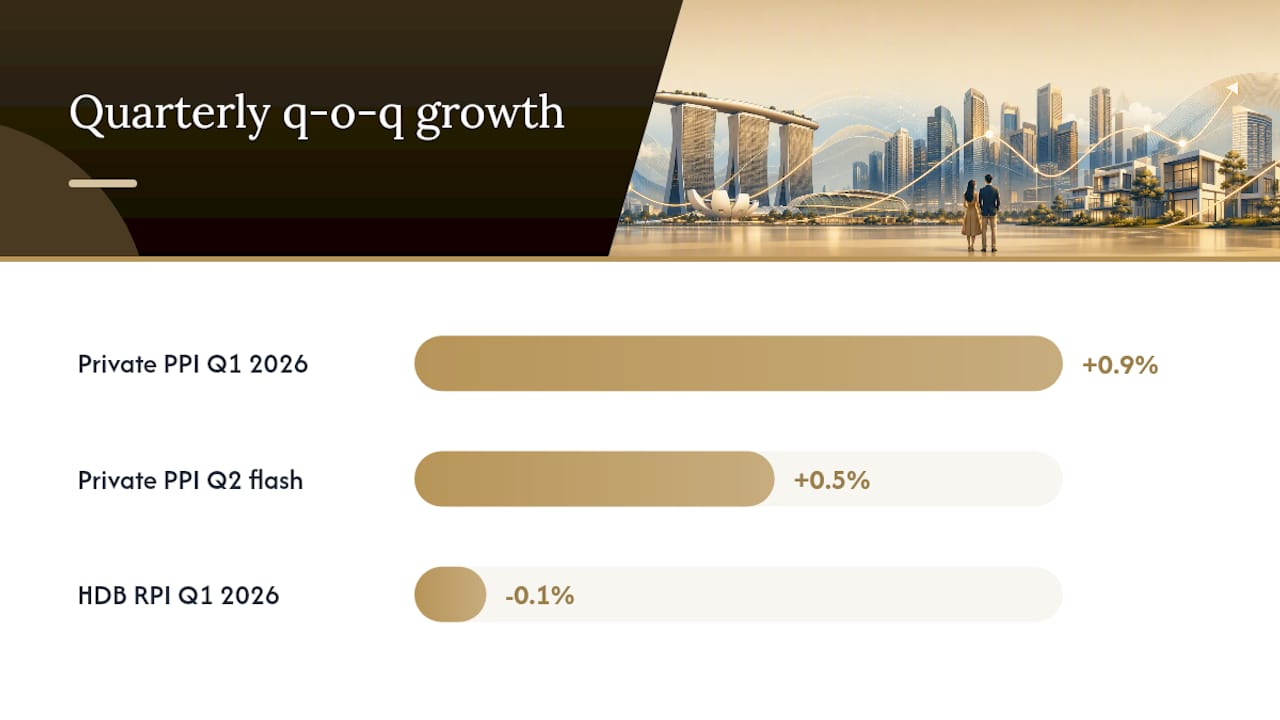
Table of Contents
- ## 1. Where private residential prices actually stand in mid-2026
- ## 2. HDB resale: the first pause since 2019 and what sellers should know
- ## 3. Supply pipeline: what the GLS confirmed list means for H2 2026 and beyond
- ## 4. How mortgage rates and SORA shape what you can actually afford in 2026
- ## 5. ABSD, SSD, TDSR, and the policy framework buyers must understand in 2026
- ## 6. Office, retail, and industrial: what the sector indices show
- ## 7. Opportunities and risks by buyer, seller, and investor segment
- ## 8. What to watch in H2 2026: the release calendar and key signals
- ## 9. Why city-fringe RCR condos look compelling right now
- ## 10. How to read the official indices: URA, HDB, JTC, MAS, and SingStat
- ## 11. An editorial perspective on what the 2026 data actually tells you
- Aurea-sgcondo: a city-fringe option built for the 2026 buyer profile
- Sources
## 1. Where private residential prices actually stand in mid-2026
The private residential market posted +0.9% quarter-on-quarter in Q1 2026, extending a run that began in Q4 2024. Cumulatively, private prices showed modest gains in H1 2026 — modest by Singapore standards, but still positive.
Regional splits: CCR, RCR, and OCR
The three market regions are not moving in lockstep. The Core Central Region (CCR) — covering Districts 9, 10, 11, and the Downtown Core — has been the most volatile, with luxury demand driven partly by foreign buyers and partly by ultra-high-net-worth locals. The Rest of Central Region (RCR), often called the city-fringe, has been the most consistent performer: strong upgrader demand, good MRT connectivity, and price points that remain accessible relative to CCR. The Outside Central Region (OCR) has seen the largest volume of new launches but faces the most direct competition from the incoming supply wave.
Transaction mix: resales are gaining share
Developer sales have slowed as fewer major launches hit the market in H1 2026, and buyers are increasingly finding value in the secondary market. That shift matters because resale prices are more negotiable and reflect real market clearing prices rather than developer-set launch prices.
The deceleration from +0.9% to +0.5% in a single quarter is not a crash signal — it is a normalization. Cushman & Wakefield's mid-2026 Singapore outlook frames 2026 as a year of resilience amid macro uncertainty, with occupier demand and safe-haven capital flows sustaining price stability, but downside risks from global rate uncertainty and trade headwinds remaining real.
## 2. HDB resale: the first pause since 2019 and what sellers should know
It is small in absolute terms, but directionally meaningful for a market that ran up sharply from 2020 through 2024.
Key HDB resale data points for Q1 2026:
- RPI: 203.4 (down 0.1% quarter-on-quarter)
- Resale transactions: fell approximately 4.6% quarter-on-quarter in Q1 2026
- Million-dollar resale transactions continued to cluster in mature estates: Bishan, Toa Payoh, Queenstown, and Buona Vista, where large floor areas and central locations command premiums that the broader market does not
The MOP wave and what it does to supply
A significant cohort of HDB flats built under the Build-To-Order (BTO) program between 2019 and 2021 is reaching its five-year Minimum Occupation Period (MOP) through 2026 and 2027. When a flat hits MOP, its owners can sell on the open market. That adds resale supply at exactly the moment when BTO completions are also rising. The combined effect is a larger pool of resale units competing for the same pool of buyers — which is the structural reason the RPI dipped, not a sudden collapse in demand.
Practical signals for sellers and upgraders:
- Sellers in non-premium estates should price competitively from day one; the days of listing high and waiting are largely over in the mass-market HDB segment
- Upgraders moving from HDB to private have a genuine window: HDB resale proceeds are still near historical highs, and private resale prices are negotiable in OCR
- CPF Housing Grants remain available for eligible resale buyers; the Enhanced CPF Housing Grant (EHG) can reach up to S$80,000 for first-timers — check current eligibility on the HDB eligibility pages before transacting
## 3. Supply pipeline: what the GLS confirmed list means for H2 2026 and beyond
The Government Land Sales (GLS) program is the government's primary tool for managing private housing supply, and the 2026 confirmed list is the largest in recent memory.
The full-year 2026 GLS confirmed list of approximately 9,320 units is materially above the 10-year average, a deliberate policy signal. Analysts note that the government is using supply management as its primary lever to prevent overheating rather than reintroducing demand-side cooling measures immediately.
What the pipeline means for different buyers:
- Near-term buyers (2026): Limited new completions this year; rental market stays tight, supporting landlord yields
- Medium-term buyers (2027–2028): The bulk of the completions pipeline arrives; buyer leverage increases, particularly in OCR
- Investors: The gap between launch price and resale value at completion will narrow as supply increases — underwriting assumptions need to reflect that
The MOP wave from HDB and the private completions pipeline are arriving simultaneously, which is unusual. That double supply event is the single biggest structural factor shaping the Singapore real estate forecast through 2028.
## 4. How mortgage rates and SORA shape what you can actually afford in 2026
The 3-month compounded SORA rate, which underpins most floating-rate home loans in Singapore, has eased from its 2023 peak but remains elevated relative to the 2010–2021 era.

The spread between fixed and floating has narrowed compared to 2023, which reduces the urgency to lock in fixed rates — but also means there is less cushion if SORA rises again.
Affordability stress test: a worked example
Assume a private condo purchase with a typical down payment and loan tenure.
| Rate Scenario | Monthly Payment |
|---|---|
| Moderate fixed rate | illustrative monthly payment |
| Moderate floating rate | slightly higher monthly payment |
| Higher stress scenario | noticeably higher monthly payment |
Under the Total Debt Servicing Ratio (TDSR) framework, your total monthly debt obligations — including the mortgage — cannot exceed 55% of gross monthly income.
SORA has moved 200 basis points in a single year before.*
The TDSR and MSR rules from MAS also cap loan tenure at 30 years for private property and 25 years for HDB loans, and LTV limits are 75% for a first property loan. CPF Ordinary Account funds can be used for down payment and monthly installments, but depleting CPF entirely creates retirement risk — a factor many first-time buyers underweight.
## 5. ABSD, SSD, TDSR, and the policy framework buyers must understand in 2026
Singapore's demand-management framework has not been dismantled. The cooling measures introduced between 2021 and 2023 remain in place, and they have a direct bearing on the math for every purchase.
Additional Buyer's Stamp Duty (ABSD) rates currently in effect:
- Singapore Citizens buying a first property: 0%
- Singapore Citizens buying a second property: 20%
- Singapore Citizens buying a third or subsequent property: 30%
- Singapore Permanent Residents buying a first property: 5%
- Singapore Permanent Residents buying a second or subsequent property: 30%
- Foreigners buying any residential property: 60%
Citizens of nationals covered by Free Trade Agreements (the US, Switzerland, Iceland, Liechtenstein, and Norway) are treated on par with Singapore Citizens for ABSD purposes — a distinction that matters for American buyers in particular.
Seller's Stamp Duty (SSD) applies to properties sold within three years of purchase. This is the structural reason a four-year holding horizon is the practical minimum for investors: selling before year four costs real money.
For Buyer's Stamp Duty (BSD)), the rates are tiered: 1% on the first S$180,000, 2% on the next S$180,000, 3% on the next S$640,000, 4% on the next S$500,000, and 5% on amounts above S$1.5 million (with a higher 6% tier above S$3 million). On a purchase of typical value, Buyer's Stamp Duty is a significant upfront cost.
Pro Tip: For buyers considering a second property, model the full ABSD cost as a permanent sunk cost — not a recoverable expense. A Singapore Citizen buying a S$1.5 million second property pays S$300,000 in ABSD upfront. That purchase needs to appreciate significantly before it breaks even against a comparable investment in a REIT or diversified portfolio.
For detailed tax/legal advice on your specific situation, consult a licensed property tax advisor or conveyancing lawyer. The IRAS BSD guidance and decoupling cost analysis are useful starting points, but they are not substitutes for professional advice.
## 6. Office, retail, and industrial: what the sector indices show
The Singapore property market in 2026 is not just a residential story. Commercial and industrial segments are moving on their own dynamics, and for investors allocating across asset classes, the signals are worth tracking.
JTC industrial market (Q1 2026):
- Industrial price index: +1.2% quarter-on-quarter
- Industrial rental index: +0.4% quarter-on-quarter
- Industrial occupancy: approximately 88.9%
The JTC Q1 2026 data shows industrial space continuing to benefit from supply-chain reshoring trends and Singapore's role as a regional logistics and manufacturing hub.
Office and retail (URA/SingStat indices):
The private office market has seen selective strength in Grade A CBD space, where occupancy remains tight and rents have edged up. Suburban retail has been more mixed: anchor-tenant demand is stable, but specialty retail faces structural headwinds from e-commerce. The URA Q1 2026 statistics include rental index movements for office and retail segments that investors should review directly for the most current figures.
For residential investors comparing yields, industrial REITs listed on SGX have delivered more consistent income returns than residential buy-to-let in recent years, largely because ABSD does not apply to REIT units. That is not an argument against residential investment — it is a reminder to compare net yields after all transaction costs, not gross rental yields.
## 7. Opportunities and risks by buyer, seller, and investor segment
The 2026 Singapore market analysis does not produce a single verdict for all participants. The right move depends entirely on which side of the transaction you are on and what your holding horizon looks like.
First-time buyers (HDB and private): This is arguably the best entry window since 2021. HDB resale prices have plateaued, grants are available, and private OCR prices are negotiable.
HDB upgraders: The upgrade math works when HDB proceeds are high and private resale prices are negotiable. Both conditions exist in mid-2026. The timing risk is the MOP wave adding resale supply through 2027, which could soften HDB exit prices if you delay selling.
Private resale sellers: Pricing discipline is required. Buyers have more options than in 2022–2023, and overpriced listings are sitting longer. Properties with strong MRT connectivity and good remaining lease tenure are still moving; those without are not.
New-launch investors: The pipeline is large. Developer pricing on new launches reflects optimism that the secondary market may not share at completion in 2027–2028.
That is thin relative to the capital committed, particularly with ABSD factored in for second-property buyers.
Pro Tip: The most durable edge in 2026 property investment Singapore is granular location selection, not market timing. A city-fringe project near a major MRT interchange with limited competing supply in its micro-catchment will outperform a well-timed purchase in an oversupplied OCR pocket. Check the best RCR condos guide for a ranked shortlist of city-fringe options.
## 8. What to watch in H2 2026: the release calendar and key signals
The second half of 2026 will be shaped by a handful of data releases and policy signals that are worth tracking on a fixed schedule.
Official release calendar:
- URA Q2 2026 full statistics (released July 2026): Confirms the flash +0.5% estimate and provides regional breakdowns, rental index updates, and vacancy data
- HDB Q2 2026 resale statistics (released July/August 2026): Will show whether the Q1 RPI dip was a one-quarter blip or the start of a trend
- URA Q3 2026 flash estimate (October 2026): The first read on whether H2 supply is biting into prices
- GLS H1 2027 confirmed list announcement (typically November/December 2026): Will signal whether the government intends to maintain elevated supply or pull back
- MAS SORA rate trajectory: Watch the Singapore Overnight Rate Average monthly publications; any sustained move below 2.0% would meaningfully improve affordability and likely accelerate transaction volumes
Macro signals that matter for Singapore property:
- Singapore GDP growth: the Ministry of Trade and Industry's advance estimate for 2026 full-year growth will be published in October; a reading below 1.5% would likely prompt policy reassessment
- US Federal Reserve rate decisions: SORA is not directly linked to the Fed funds rate, but global rate sentiment flows through Singapore's interbank market
- China economic data: mainland Chinese buyers, while constrained by the 60% ABSD, still influence luxury CCR demand through corporate structures and family office activity
## 9. Why city-fringe RCR condos look compelling right now
The RCR has been the most consistent performer in the 2026 Singapore real estate forecast, and the reasons are structural rather than cyclical.
HDB upgraders are the dominant demand driver in RCR. They are selling MOP-cleared flats at near-peak prices and moving into private property for the first time. Their budget typically falls in the S$1.2–1.8 million range for a two- or three-bedroom unit, which is exactly the price band where RCR new launches and resales compete most directly.
What makes a city-fringe project worth buying in 2026:
- Walking distance (under 500 meters) to an MRT station on a major line
- Remaining lease of at least 80 years (for freehold or 99-year leasehold projects launched recently, this is not an issue; for older resale, check carefully)
- Low competing supply in the immediate micro-catchment — check URA's pipeline data for units under construction within a 500-meter radius
- Developer track record and construction quality, which affects rental demand and eventual resale liquidity
Pro Tip: *Before committing to a city-fringe project, pull the URA REALIS caveat data for the development and its nearest comparable.
Aurea-sgcondo at 802 Beach Road sits in exactly this city-fringe positioning: multiple MRT stations within reach, a direct link bridge to The Golden Mile, and 188 units across 2-to-5-bedroom layouts plus two penthouses. For buyers and investors looking at city-fringe condos in 2026, the project's location and unit mix align with the demand profile this section describes.
## 10. How to read the official indices: URA, HDB, JTC, MAS, and SingStat
Each official index measures something slightly different, and conflating them is a common source of confusion.
- URA Private Residential Property Price Index (PPI): Tracks price movements of private residential properties (condos, apartments, landed) across all regions. Published quarterly, with a flash estimate released about two weeks after quarter-end and full statistics about four weeks later. Base year is Q1 2009 = 100. The index is transaction-weighted, so a quarter with few high-end transactions can look softer than the underlying market.
- HDB Resale Price Index (RPI): Tracks resale flat prices across all towns and flat types. Published quarterly alongside HDB's resale statistics release. Also base-indexed; movements reflect the median resale market, not premium million-dollar transactions.
- JTC Industrial Indices: Cover price and rental movements for factory, warehouse, and business park space. Published quarterly by JTC Corporation. Occupancy data is included and is the most useful leading indicator for rental direction.
- SingStat Property Price Indices: SingStat compiles and publishes the URA and HDB indices in a single dashboard, making cross-segment comparison easier. Updated in line with URA and HDB quarterly releases.
- MAS SORA: Published daily by MAS; the compounded 1-month and 3-month SORA rates are the benchmark for floating-rate home loans. Available on the MAS website and updated monthly for compounded averages.
- IRAS stamp duty pages: Not an index, but the authoritative source for current BSD, ABSD, and SSD rates. Check IRAS directly before any transaction — rates have changed multiple times since 2021 and could change again.
One important caveat: the URA PPI can be distorted by launch-led volatility. A quarter with a large number of luxury launches in CCR will push the index up even if mass-market prices are flat. Always look at the regional sub-indices alongside the headline number.
## 11. An editorial perspective on what the 2026 data actually tells you
The conventional read of the Singapore property market is that it is "resilient" — a word that appears in almost every analyst report and means almost nothing on its own. What the 2026 data actually shows is more specific and more useful: the market is bifurcating, and the bifurcation is being driven by policy design, not accident.
The government has deliberately kept GLS supply elevated to prevent another 2021–2022-style price surge. The TDSR and MSR rules cap how much debt buyers can take on, which limits the speculative froth that drove previous cycles. These are not temporary measures — they are the architecture of a managed market.
What that means for buyers is counterintuitive: the safest purchases in a managed market are not the ones that look cheapest on paper, but the ones with the strongest structural demand drivers — MRT access, school proximity, upgrader catchment — that policy cannot easily replicate or suppress. A city-fringe condo near a major interchange is not just a lifestyle choice; it is a bet on the durability of Singapore's urban planning logic, which has been remarkably consistent for 30 years.
The risk most buyers underestimate is not price decline — it is illiquidity. A property that cannot be sold within six months at a reasonable price is a problem regardless of what the index says. Check transaction velocity in your target development before you buy, not after.
Aurea-sgcondo: a city-fringe option built for the 2026 buyer profile
If the analysis above points you toward the city-fringe RCR segment, Aurea-sgcondo at 802 Beach Road is worth a close look. The project sits at the intersection of the demand drivers this article identifies: MRT accessibility, a city-fringe location that avoids CCR luxury pricing, and unit layouts from 2 to 5 bedrooms that serve both upgrading families and investors targeting the professional rental market. The link bridge to The Golden Mile adds a connectivity feature that comparable projects in the area do not offer.
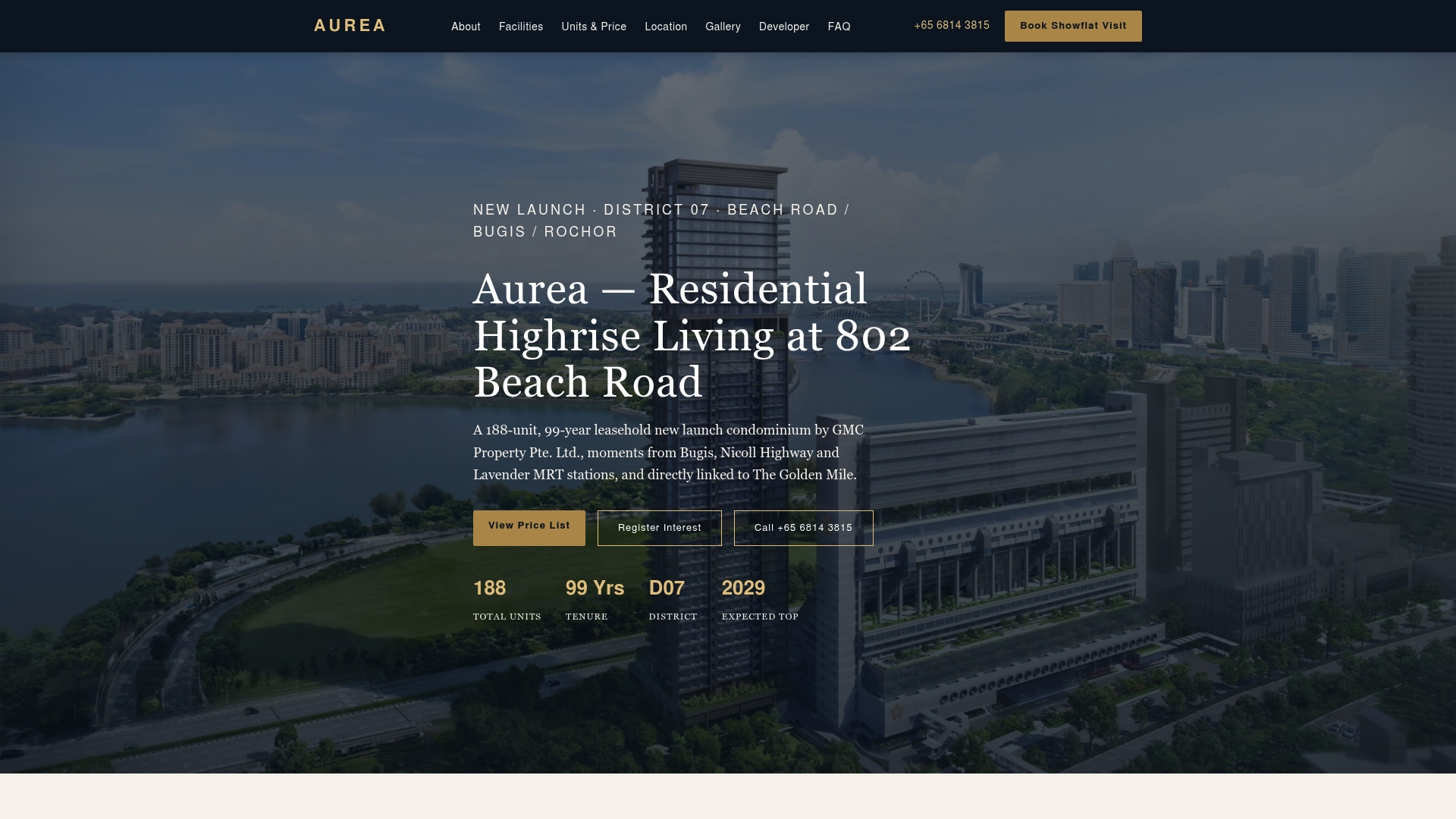
Aurea-sgcondo is developed by GMC Property Pte. Ltd. and marketed through ERA Realty Network Pte Ltd, with completion targeted for 2029. That timeline aligns with the supply wave arriving in 2027–2028 — meaning buyers who transact now are purchasing ahead of the period when buyer leverage peaks, rather than into it. Visit Aurea-sgcondo for current floorplans, pricing updates, and appointment scheduling. Verify all figures with the appointed marketing agents and consult a licensed property advisor before transacting.
Sources
The figures and analysis in this article draw on the following official and authoritative sources. Each publishes on a quarterly or more frequent basis.
- URA — Release of 1st Quarter 2026 real estate statistics
- SingStat — Property price indices (latest news/data)
- Cushman & Wakefield — Singapore market outlook
- MAS — MSR and TDSR rules explainer
This article is market commentary for general information purposes only. It is not financial, legal, or tax advice. Verify all figures with official sources and consult a licensed property advisor, conveyancing lawyer, or tax professional before making any property transaction decision.
This article is general information, not a substitute for advice from a qualified financial advisor. Consult a qualified financial professional about your own circumstances before acting on anything here.