
Decoupling property in Singapore is legal and can eliminate ABSD on a second purchase — but only when three conditions hold: the transfer reflects a genuine change in beneficial ownership, the remaining co-owner qualifies for the full mortgage in sole name under the Total Debt Servicing Ratio (TDSR) framework, and the all-in costs (BSD + CPF refund + legal fees + refinancing) are below the ABSD you would otherwise pay. When all three conditions hold, the arithmetic is often compelling. When any one fails, the transaction either collapses at the bank or gets reassessed by IRAS).
Before you instruct a solicitor, run through these four immediate actions:
- Run the XIRR-style all-in math. BSD on the transferred share, CPF principal plus accrued interest refund, conveyancing fees for both parties, and refinancing costs must all go into the model before you compare to ABSD avoided.
- Check CPF refund exposure. The exiting owner must return every dollar drawn from CPF OA plus accrued interest (typically modeled at 2.5% p.a.) to their CPF account on completion. That cash must exist.
- Confirm TDSR pass. Banks stress-test the remaining owner at a floor rate of around 4%. If they cannot service the full loan alone, the transfer cannot proceed.
- Appoint independent solicitors. Each party needs separate legal representation. One firm acting for both creates a conflict-of-interest risk that can also weaken the commercial substance of the transaction in IRAS's eyes.
Pro Tip: A worked example from mortgage practitioners shows 20% ABSD on a S$1.5M second purchase equals S$300,000 in tax. All-in decoupling costs in comparable scenarios often run S$90,000–S$93,000. That S$200,000+ gap is why owners consider this — but the gap narrows fast once CPF accrued interest and refinancing costs are added.
Table of Contents
- What does decoupling property in Singapore actually mean?
- Why do owners consider decoupling, and when does it make sense?
- How is decoupling executed, and which method carries the least risk?
- What are all the costs you must include in the decoupling math?
- What does the step-by-step process look like, and how long does it take?
- When does decoupling become stamp duty avoidance in IRAS's view?
- How do you decide whether decoupling makes financial sense for your situation?
- What questions should you bring to your solicitor, bank, and tax adviser?
- Key Takeaways
- When decoupling makes sense — and when it doesn't
- Authoritative sources and further reading
What does decoupling property in Singapore actually mean?
Decoupling is a part-sale: one co-owner sells their legal share of a property to the other, so that one name is removed from the title entirely. The result is a sole owner who, from IRAS's perspective, holds no other residential property and can buy a second one as a first-time private residential buyer — paying no ABSD.

The term "decoupling" is informal. The formal transaction is a transfer of an ownership share, governed by the Stamp Duties Act and administered through the Singapore Land Authority (SLA). The key distinction from a full sale is that only the departing co-owner's share changes hands; the property itself stays.
Private property vs. HDB and EC
HDB flats cannot be decoupled between married co-owners except in narrow circumstances: divorce, death of a co-owner, financial hardship, or loss of citizenship. This restriction has been in place since 2016. Executive Condominiums (ECs) during their Minimum Occupation Period (MOP) are treated the same way. Once an EC has cleared its MOP and privatized, it follows private property rules.
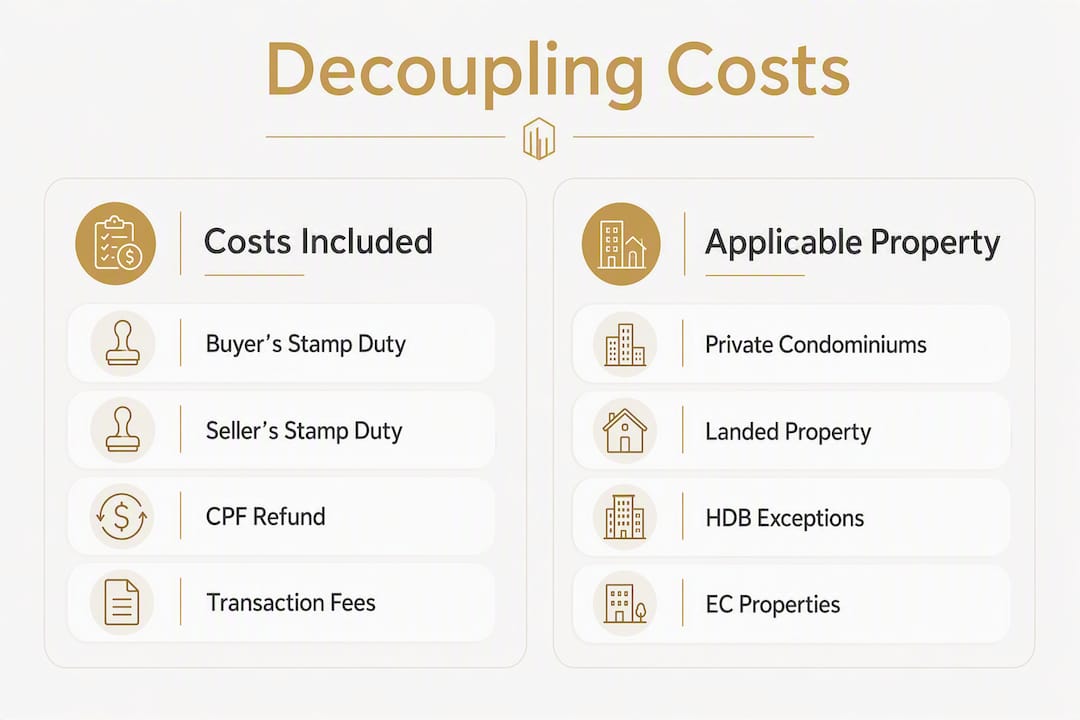
Private condominiums and landed private property are eligible. There is no MOP restriction, no HDB Board approval required, and no cap on the number of times a transfer can occur — though IRAS will scrutinize repeated or structured arrangements.
Joint tenancy vs. tenancy-in-common
Most married couples hold property as joint tenants, meaning neither party owns a defined share. Before a part-sale can happen, the joint tenancy must be severed into a tenancy-in-common, which assigns each party a specific percentage (50/50, 99/1, or any other split). The severance itself is a legal step that precedes the actual transfer and carries its own documentation requirements at SLA.
A transfer counts as a genuine part-sale when the exiting owner receives real consideration, gives up all beneficial interest, and stops sharing in the property's costs and upside. When parties continue to act as joint owners after the paperwork — sharing mortgage payments, occupying the property together, or splitting rental income — IRAS treats the arrangement as lacking substance.
Why do owners consider decoupling, and when does it make sense?
The primary driver is ABSD. Under current ABSD rates), a Singapore Citizen buying a second residential property pays 20% ABSD on the purchase price. For a S$1.5M purchase, that is S$300,000 in tax — payable upfront. By removing one co-owner's name from the existing property before the new purchase, that person re-enters the market as a first-time private residential buyer and pays 0% ABSD.
The financing benefit compounds the tax saving. A first-time buyer with no outstanding mortgage qualifies for a 75% Loan-to-Value (LTV) ratio rather than the 45% that applies to a second property. That difference in upfront cash requirement can be substantial on a S$1.5M purchase.
Non-financial motives also come into play. Some co-owners use decoupling to separate assets ahead of estate planning, to allow one party to qualify for financing independently, or to restructure ownership following a relationship change. These are legitimate reasons, but they do not change the legal and tax mechanics.
The counter-argument is worth taking seriously. The exiting owner permanently loses their legal title and any future upside on that property. The remaining owner carries the full mortgage alone, which concentrates financial risk. And the title change is not easily reversed — unwinding it requires another transfer, with another round of BSD and legal costs. Treat decoupling as a structural decision, not a reversible tactic.
ABSD savings grow with the price of the intended second purchase. Practitioner examples suggest decoupling tends to become cost-positive for second purchases above roughly S$600,000–S$1.2M, depending on CPF exposure and refinancing costs. Below that range, the math often does not work.
How is decoupling executed, and which method carries the least risk?
There are three practical methods, each with different legal, tax, and enforcement implications.
Part-sale at market value
The most defensible approach. The exiting co-owner sells their share at a price supported by a licensed valuation. BSD is assessed by IRAS on the higher of the consideration paid or the market value, so underpricing the share does not reduce stamp duty — it just adds an avoidance risk. The buyer pays BSD; the seller may face Seller's Stamp Duty (SSD) if the property is within the relevant holding window (currently three years for private property). This method produces the clearest evidence of commercial substance.
Outright gift
One co-owner gifts their share to the other for no consideration. BSD is still assessed on market value, so there is no stamp duty saving compared to a part-sale. The gift route is sometimes used in family restructuring, but it can raise questions about whether the donor truly gave up all beneficial interest — particularly if they continue living in the property.
Severance followed by transfer (including 99/1 variants)
Some owners have used a staged approach: first hold the property in a 99/1 split, then transfer the 1% share to achieve decoupling at lower BSD cost. IRAS and the courts have repeatedly flagged 99/1 structures where the arrangement was set up specifically to minimize stamp duty on the transfer leg. The Ministry of Finance has published enforcement data on clawbacks from such arrangements. A 99/1 split established for genuine reasons (unequal capital contributions, for example) is different from one engineered purely to reduce BSD on a future transfer.
Comparison of methods
| Dimension | Part-sale at market value | Outright gift | Contrived 99/1 transfer |
|---|---|---|---|
| BSD cost | On full share at market value | On full share at market value | On 1% share only — but high IRAS risk |
| SSD exposure | Yes, if within holding period | Yes, if within holding period | Yes, on the transferred share |
| Commercial substance | Strong, with valuation | Moderate — no cash changes hands | Low; courts apply substance-over-form |
| Mortgage impact | Full refinance in sole name required | Full refinance in sole name required | Full refinance in sole name required |
| IRAS enforcement risk | Low when properly documented | Moderate | High — active enforcement ongoing |
| Timeline | 6–10 weeks typical | 6–10 weeks typical | Higher risk of reassessment post-completion |
| Estate/control effect | Permanent title change | Permanent title change | Permanent title change |
The key red flags IRAS looks for across all methods:
- Consideration set below market value without a licensed valuation to support it
- Continued shared mortgage payments after transfer
- Exiting owner remaining in occupation without a formal tenancy
- Immediate reversion of economic benefit to the exiting party
- Template-based 99/1 arrangements with no documented commercial rationale
What are all the costs you must include in the decoupling math?
Getting the arithmetic right means accounting for every cost bucket, not just BSD. Owners who focus only on stamp duty routinely underestimate the total outlay.
Buyer's Stamp Duty on the transferred share

BSD applies on the higher of consideration or market value) of the share being transferred. BSD is tiered: 1% on the first S$180,000, 2% on the next S$180,000, 3% on the next S$640,000, 4% on the next S$500,000, and 5% on amounts above S$1.5M (with higher bands applying above S$3M). On a half-share of a S$2.5M property (i.e., a S$1.25M share), BSD works out to a figure near S$84,600, as shown in worked examples for a half-share of a S$2.5M property.
Seller's Stamp Duty
SSD applies if the property has been held for three years or less. For private residential property, SSD rates are 12% in year one, 8% in year two, and 4% in year three. If you are within this window, SSD on the exiting owner's share can add significantly to the total cost.
CPF refund mechanics
This is the cost most owners underestimate. The exiting owner must refund to their CPF Ordinary Account every dollar of CPF principal withdrawn for the property, plus accrued interest. CPF accrued interest is commonly modeled at 2.5% per annum on the outstanding balance. In a worked example where S$300,000 was drawn from CPF, the accrued interest adds roughly S$45,000, meaning S$345,000 must return to CPF OA on completion. That money does not disappear — it goes back into the CPF account — but it creates a real cash requirement at completion that must be funded from the sale proceeds or other liquid assets.
Transaction costs
Conveyancing fees for both parties typically run S$4,000–S$6,500 combined, with each side's solicitor billing separately. A licensed valuation costs roughly S$500–S$1,000 depending on property type and value. Mortgage discharge fees, refinancing admin charges, and bank legal fees add further outlays that vary by lender.
Putting it together: in scenarios involving a half-share of a S$2.5M property, all-in decoupling costs (BSD + legal + valuation + refinancing) commonly run S$90,000–S$93,000 before CPF refund, consistent with worked BSD and fee calculations for a half-share of a S$2.5M property. Compare that to the 20% ABSD on a typical second purchase and the saving is clear — but the comparison only holds if the remaining owner can actually service the full mortgage and the CPF refund cash is available.
What does the step-by-step process look like, and how long does it take?
A typical decoupling transaction runs 6–10 weeks from instruction to registration. The steps below assume a private property part-sale at market value.
- Instruct independent solicitors. Each party appoints their own conveyancing firm. Both firms should be instructed before any other step — they will coordinate the entire process and flag issues early.
- Commission a licensed valuation. A licensed appraiser values the property to establish the market value of the share being transferred. This report supports BSD assessment and demonstrates commercial substance to IRAS.
- Agree on consideration and prepare transfer documents. The parties agree on the transfer price (at or above market value of the share). Solicitors prepare the transfer instrument, option to purchase (if structured as a sale), and supporting agreements.
- Calculate CPF refund amounts. The exiting owner's solicitor requests a CPF statement showing principal withdrawn and accrued interest. Both parties confirm the cash available to fund the refund on completion.
- Obtain bank consent and arrange sole-name refinancing. The remaining owner applies to the existing lender (or a new one) for a sole-name loan. The bank runs TDSR and stress-test checks. If the existing loan cannot be transferred to sole name, a full refinance is required. Banks require the remaining owner to pass TDSR at 55% and a stress-test floor rate of around 4%; failure at this stage stops the transaction.
- Lodge BSD and pay stamp duty. Solicitors lodge the transfer instrument with IRAS for BSD assessment. BSD must be paid within 14 days of the instrument being executed.
- Complete and register with SLA. On completion, the exiting owner receives the agreed consideration, the CPF refund is processed, the mortgage is discharged or novated, and the transfer is registered at SLA. The title now shows the sole owner.
- Confirm registration before any new purchase. Do not exercise an OTP on a new property before the transfer is registered at SLA. If the new purchase is stamped while both names still appear on the existing title, ABSD applies as if the buyer holds two properties.
Required documents checklist:
- Title deed or land register extract
- Licensed valuation report
- CPF statements (principal withdrawn and accrued interest for each CPF account used)
- Mortgage statements showing outstanding balance
- Identity documents for both parties
- Proof of marital status (where applicable for HDB-related checks or CPF rules)
- Transfer instrument drafted by solicitors
- Bank's letter of offer for sole-name refinancing
When does decoupling become stamp duty avoidance in IRAS's view?
Decoupling is not illegal. The legality hinges entirely on intent and execution — a genuine transfer with real commercial substance is protected; a contrived arrangement designed solely to avoid ABSD is not.
The substance-over-form test
Courts and IRAS apply a substance-over-form analysis. The question is whether the parties actually changed their beneficial ownership or merely rearranged paperwork while continuing to behave as joint owners. If the exiting owner keeps paying half the mortgage, continues living in the property without a formal tenancy, or receives a share of rental income after the transfer, IRAS can treat the transaction as a sham and reassess stamp duty as if the transfer never occurred.
The High Court has applied this test in decoupling disputes, and IRAS has published enforcement data on clawbacks from 99/1 arrangements where the structure lacked commercial rationale. The penalties go beyond back-assessed duty: IRAS can impose surcharges and interest, and in serious cases, criminal prosecution under the Stamp Duties Act is possible.
Red flags that attract scrutiny
- A 99/1 ownership split established shortly before a planned second purchase, with no documented reason for the unequal split
- Consideration set below the licensed valuation without explanation
- Both parties using the same solicitor (conflict-of-interest risk and weaker evidence of arm's-length dealing)
- The exiting owner continuing to service the mortgage after completion
- No contemporaneous documentation of the commercial rationale for the transfer
How to build a defensible transaction
Get a licensed valuation before agreeing on price. Use separate solicitors — each party having independent legal representation is both a legal best practice and a substance signal. Document the commercial rationale in writing before the transaction begins. Make sure cash flows are clean: the exiting owner receives the agreed consideration and stops all financial involvement with the property from completion.
Pro Tip: Keep a contemporaneous file — emails, bank transfers, solicitor correspondence — that shows the exiting owner genuinely gave up all economic interest. If IRAS ever reviews the transaction, this file is your first line of defense.
How do you decide whether decoupling makes financial sense for your situation?
The decision framework has two parts: a financial model and a non-financial checklist. Both matter.
The XIRR-style financial model
An XIRR calculation treats decoupling as an investment: you spend money now (BSD, CPF refund, legal fees, refinancing costs) to avoid a larger tax outlay later (ABSD on the second purchase). The cash flows to include, with their timing:
- Day 0 outflows: BSD on transferred share, conveyancing fees for both parties, valuation fee, mortgage discharge/refinancing fees
- Day 0 CPF refund: Principal + accrued interest returned to CPF OA (this is a real cash requirement even though the money goes to your own CPF account)
- Ongoing: Any mortgage interest differential between the old joint-name loan and the new sole-name refinanced loan
- Future inflow (avoided cost): ABSD that would have been paid on the second purchase, at the date of that purchase
Run the model at two or three interest rate assumptions (the current rate, the MAS stress floor of around 4%, and a midpoint). Test sensitivity to holding period: if the second purchase is two years away rather than six months, the CPF accrual grows and the breakeven shifts.
A practical heuristic from mortgage advisers: decoupling tends to pay clearly when the ABSD avoided on the second purchase exceeds the all-in decoupling cost by at least 50%, and the remaining owner's TDSR margin is comfortably above the 55% threshold at the stress-test rate. When the model is close — ABSD saved is only marginally above total costs — the non-financial risks often tip the decision against proceeding.
Non-financial checklist
- Control and legacy. Once the exiting owner's name is off the title, they have no legal claim to the property. If the relationship between co-owners deteriorates, there is no easy remedy.
- Estate planning. Joint tenancy carries a right of survivorship — the surviving owner inherits automatically. Tenancy-in-common (which precedes decoupling) means each party's share passes through their estate, requiring a will and potentially probate. Removing a name entirely changes the estate picture further.
- Divorce and separation risk. A decoupled title does not prevent a court from treating the property as a matrimonial asset in divorce proceedings, but it does complicate the division. Get legal advice specific to your situation before proceeding.
- Income stability of the remaining owner. The sole-name mortgage must be serviceable on one income, including through career disruption or interest rate increases. A remaining owner near retirement or with variable income faces real risk.
- Liquidity. The CPF refund and BSD must be funded at completion. If liquid assets are tight, the transaction may be impossible even if the math works on paper.
When the model is genuinely close-call, the right next step is a formal XIRR run with a mortgage adviser and a written risk note from your solicitor — not a decision made on a spreadsheet alone.
What questions should you bring to your solicitor, bank, and tax adviser?
Going into these conversations with specific questions gets you actionable answers rather than generic explanations.
Questions for your conveyancing solicitor
- Will you act for both parties, or do we each need separate representation? (The answer should be separate firms.)
- What valuation will IRAS require, and which licensed valuers do you recommend?
- How will the transfer instrument be drafted to demonstrate commercial substance?
- Is there any SSD exposure given our current holding period?
- What is your estimated fee, and what does it cover?
- What is the realistic timeline from instruction to SLA registration?
Questions for your bank
- Can the existing loan be transferred to sole name, or does it require a full refinance?
- What is your TDSR calculation method, and what stress-test rate will you apply?
- Will the remaining owner qualify for the full loan amount in sole name at current income?
- What are the mortgage discharge fee, refinancing admin fee, and any early repayment penalty?
- How long does your credit assessment take, and what documents do you need?
Questions about CPF
- How much must the exiting owner refund, including accrued interest to the projected completion date?
- Can the refund be funded from the sale proceeds, or must it come from other cash?
- What is the process for CPF Board confirmation, and how does it interact with the completion timeline?
Questions for a tax adviser or IRAS
- Does the proposed transfer structure carry any risk of an avoidance review?
- What documentation will best support the commercial rationale if IRAS reviews the transaction?
- Are there any recent IRAS positions or court rulings that affect our specific structure?
Key Takeaways
Decoupling property in Singapore saves ABSD only when the transfer is genuine, the remaining owner passes TDSR, and the all-in costs (BSD, CPF refund, legal fees, refinancing) are materially lower than the ABSD avoided on the planned second purchase:
| Point | Details |
|---|---|
| Genuineness is non-negotiable | IRAS applies substance-over-form; continued shared use or payments after transfer can trigger reassessment and penalties. |
| Run the full XIRR model | Include BSD, CPF principal plus accrued interest, legal fees, and refinancing costs before comparing to ABSD avoided. |
| CPF refund is a real cash requirement | The exiting owner must return CPF principal plus accrued interest (commonly modeled at 2.5% p.a.) to CPF OA at completion, e.g. S$300,000 principal + S$45,000 accrued interest in recent scenarios. |
| TDSR must pass in sole name | Banks stress-test the remaining owner at around 4%; failure stops the transaction even when legal paperwork is complete. |
| Register before buying | Complete and register the transfer at SLA before exercising any OTP on a new purchase, or ABSD applies to the new buy. |
When decoupling makes sense — and when it doesn't
The financial case for decoupling is strongest when the numbers are unambiguous: a large second purchase, a wide gap between ABSD avoided and all-in costs, and a remaining owner whose income comfortably clears the TDSR stress test. In those cases, the S$200,000+ saving on a S$1.5M second purchase — comparing S$300,000 ABSD avoided to S$90,000–S$93,000 decoupling costs — is hard to argue with, and the structural change to ownership is a price worth paying.
The cases that concern me are the close-call ones. When the second purchase is modest, the CPF accrual is heavy, or the remaining owner's income is near the TDSR boundary, the model often shows a breakeven that is too thin to justify the permanence of the title change. Owners in that position sometimes convince themselves the math works because they want it to — and that is where mistakes happen.
The estate planning dimension is consistently underweighted. Once a name comes off the title, reversing that decision costs another round of BSD and legal fees. If the co-owners are a married couple and the relationship later changes, the sole owner holds an asset the other party may have contributed to financially but no longer has any legal claim over. That asymmetry can create serious problems. A will and a conversation with an estate planning lawyer should happen before the transfer, not after.
The 99/1 arrangements that IRAS has been pursuing are a cautionary tale about what happens when a tax strategy becomes a template. The structure is not inherently illegal, but when it is used by thousands of buyers in identical patterns with no documented commercial rationale, enforcement follows. The lesson is not to avoid decoupling — it is to avoid doing it the way everyone else did it without thinking about why.
If you are genuinely considering a second property purchase and want to understand how your ownership structure affects your ABSD exposure, Aurea-sgcondo at 802 Beach Road is a new launch development worth examining. With 2-to-5-bedroom units and a 2029 completion, it sits in a price range where ownership structure decisions matter. Speaking to the sales team about how your current title affects your purchase options is a practical first step.
Authoritative sources and further reading
The figures and rules in this article draw on official Singapore government sources and practitioner guidance. Rates and eligibility conditions change; always verify against the primary source before acting.
Official authorities:
- IRAS — Additional Buyer's Stamp Duty): Current ABSD rates, remission conditions, and enforcement guidance
- IRAS — Buyer's Stamp Duty): BSD rate tiers and assessment rules for property transfers
- HDB — Change in Flat Ownership: HDB rules on permitted ownership changes, including the narrow exceptions that allow transfers between married owners
- Ministry of Finance — 99-to-1 enforcement data: Published clawback figures from ABSD avoidance cases involving 99/1 arrangements
- Singapore Land Authority: Registration procedures, title search, and instrument lodgment for property transfers
Selected practitioner reading:
- Nexus Mortgage — Decoupling Private Property Singapore: Worked cost examples, CPF refund mechanics, and TDSR guidance
- Guardian Law — Legal or Illegal? ABSD, 99-1 Ownership, and Decoupling: A lawyer's perspective on commercial substance and enforcement risk
- Cashew — What Still Works and What Is Now Illegal: Current IRAS enforcement patterns and the substance-over-form test in practice
- YY Lee & Associates — Decoupling Property Singapore: Sequencing guidance and OTP timing warnings
Treat IRAS, HDB, and CPF Board as the final authority on rates, eligibility, and timing. Practitioner pieces are useful for worked examples and process guidance, but they reflect the author's interpretation at the time of writing. For a transaction of this size, a written opinion from your own solicitor and a formal XIRR run with a mortgage adviser are not optional extras.
This article provides general information about Singapore property ownership structures and stamp duty considerations. It is not legal, tax, or financial advice. Confirm current rules and your specific eligibility with IRAS, HDB, CPF Board, or a qualified professional before proceeding.