
These figures have held since the Ministry of Finance's April 27, 2023 announcement, and nothing in the 2026 policy calendar has changed them.
ABSD gets calculated on whichever is higher: the purchase price or the IRAS-assessed market value). It sits on top of Buyer's Stamp Duty, not instead of it, so your total stamp duty bill is always BSD plus ABSD combined.
The rates in plain terms:
- Singapore Citizens: 0% (first), 20% (second), 30% (third and beyond)
- Permanent Residents: 5% (first), 30% (second), 35% (third and beyond)
- Foreigners: 60% on any residential purchase
- Entities and trustees: 65%
- Housing developers: a special non-remittable rate applies on top of the standard developer rate
Here's the number that catches most buyers off guard: a foreigner buying a $2 million condo owes $1.2 million in ABSD alone, based on the flat 60% rate applied to the full price, according to worked calculations from ZeroABSD. That amount is due up front. CPF can cover only a portion of stamp duties in specific circumstances, and most of this needs to come from cash within the payment window IRAS sets after the contract is signed.
Key Takeaways
| Point | Details |
|---|---|
| Rates confirmed since April 2023 | SC pays 0/20/30%, SPR pays 5/30/35%, foreigners pay 60%, entities pay 65%. |
| ABSD uses the higher value | Duty is charged on purchase price or IRAS market value, whichever is greater. |
| Joint purchases use the higher rate | A citizen buying with a foreigner pays the full 60% rate on the entire property. |
| Spousal remission needs a 6-month sale | Married couples must sell their first home within six months to qualify for a refund. |
| Cash funding is largely unavoidable | CPF rarely covers ABSD in full, so buyers need substantial upfront cash reserves. |
Table of Contents
- What Are the Official ABSD Rates and Notes for 2026?
- Who Actually Pays ABSD: Buyer Profiles and Property Count
- Calculating ABSD: Worked Examples at Real Condo Price Points
- Getting ABSD Back: Spousal, FTA, and Developer Remissions
- ABSD for Trusts and Entities: The 65% Rate and Its Refund Mechanics
- Payment Deadlines, Stamping, and Penalty Risk: A Buyer's Checklist
- Budgeting for ABSD: Cash, CPF, and Loan Interactions in 2026
- How Aurea-sgcondo Helps Buyers Plan for Stamp Duty Costs
- The Real Lesson Buyers Miss About ABSD Planning
- Sources
What Are the Official ABSD Rates and Notes for 2026?
The rate table below reflects the structure IRAS has published and that MOF confirmed as the basis for property tax policy heading into 2026. Nothing here is a projection. It's the rate schedule currently in force.
A few things the table doesn't show but matter just as much as the numbers themselves.
Transitional Option to Purchase provisions. Buyers who received their Option to Purchase before April 26, 2023, and exercised it within the stipulated window were grandfathered under the prior rate schedule. If you're reviewing an older OTP or resale contract dated before that cutoff, check which schedule actually applies before assuming the current rates bind you.
This is a structural cost developers bake into launch pricing, and it's one reason new-launch pricing tends to track land cost closely.
Free Trade Agreement nationality exceptions. Nationals and permanent residents of the United States, Iceland, Liechtenstein, Norway, and Switzerland are treated as Singapore Citizens for ABSD purposes under Singapore's FTA obligations.
Key clarifications worth flagging before you sign anything:
- ABSD rates are set by buyer profile at the time of purchase, not by nationality changes that happen afterward.
- Market value assessments override declared price when IRAS believes a transaction was structured to understate value.
- The official IRAS ABSD page and the MOF measures announcement remain the two primary documents to check before relying on any third-party summary, including this one.
Who Actually Pays ABSD: Buyer Profiles and Property Count
Your ABSD rate depends on two things: what category of buyer you are, and how many residential properties you already hold (or will hold, counting the one you're about to buy). Get either variable wrong and your stamp duty estimate is wrong too.
- Singapore Citizens pay nothing on a first home. The 20% and 30% tiers only bite when you're adding a second or third property to what you already own, including inherited shares and properties held overseas in some interpretations.
- Permanent Residents never get a 0% tier. Even a first purchase costs 5% ABSD, which surprises a lot of newly minted PRs who assume they're treated identically to citizens.
- Foreigners pay 60% flat, with no property-count tiering and no discount for a first purchase. FTA-nationality exceptions aside, this rate doesn't move.
- Entities, including companies and most trust structures, pay 65% regardless of how many properties the entity owns.
- Housing developers fall under a separate 40% structure tied to remission conditions rather than property count.
Joint purchases get complicated fast because IRAS applies the higher-liability buyer's profile to the entire transaction, not a blended average. A Singapore Citizen buying jointly with a Permanent Resident pays at the PR's rate tier for that purchase.
Property count itself trips up more buyers than the rate table does. IRAS counts beneficial ownership, not just properties held in your own name. If you're a beneficiary under a trust, or you hold a property through a nominee arrangement, that property usually counts toward your total for ABSD purposes. This is precisely the loophole the May 2022 living-trust rule was designed to close, and it's why "just put it in a trust" stopped being useful tax planning advice years ago.
If you're weighing whether to buy solo or jointly with a spouse or family member who has a different residency status, this is the point where a conveyancer or tax adviser earns their fee. The rate difference between a solo citizen purchase and a joint purchase with a foreign spouse can run into hundreds of thousands of dollars on a single transaction.
Calculating ABSD: Worked Examples at Real Condo Price Points
ABSD math is simple arithmetic once you know your rate. The complexity is entirely in figuring out which rate applies to you, not in the calculation itself.
The formula: ABSD owed = applicable rate × the higher of purchase price or IRAS market value. BSD gets calculated separately on the same base, using IRAS's tiered schedule: 1% on the first $180,000, 2% on the next $180,000, 3% on the next $640,000, 4% on the next $500,000, 5% on the next $1.5 million, and 6% on anything above $3 million.
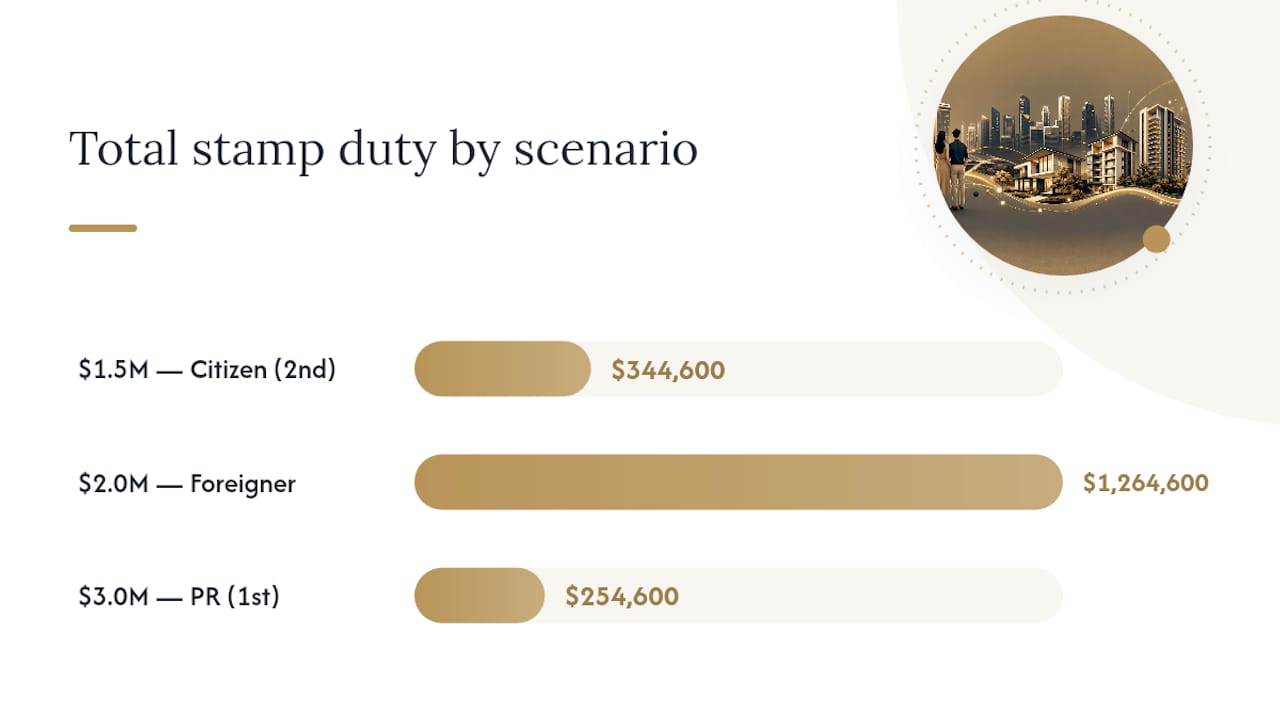
Here's how that plays out at three price points:
- $1.5 million condo, Singapore Citizen buying a second property. BSD comes to roughly $44,600 using the tiered schedule. ABSD at 20% adds $300,000. Total stamp duty: about $344,600, more than double the property's annual rental value in most cases.
- $2 million condo, foreign buyer. BSD lands around $64,600. ABSD at 60% adds $1.2 million, matching the figure ZeroABSD's calculator produces for this exact scenario. Total stamp duty: roughly $1,264,600, well over half the purchase price once you combine both duties.
- $3 million condo, Permanent Resident buying a first property. BSD works out to about $104,600. ABSD at 5% adds $150,000. Total stamp duty: around $254,600, a fraction of what the foreign buyer in scenario two pays on a smaller property.
Notice how the ABSD component dominates the total the further up the buyer-risk ladder you sit. For a citizen buying a first home, BSD is the entire bill. For a foreigner, ABSD outweighs BSD by nearly 20 to 1.
Two technical notes matter here. Stamp duty calculations round to the nearest dollar, and IRAS applies a minimum duty floor so no transaction escapes taxation entirely through rounding. And if you're buying from a related party (family member, related company) at a price that looks suspiciously low, IRAS reserves the right to assess ABSD against the property's independently determined market value instead of your contract price.
Pro Tip: Run your own numbers before you fall in love with a unit. A $50,000 difference in asking price can shift your ABSD liability by tens of thousands of dollars depending on your rate tier, and that's before financing costs even enter the picture.
Getting ABSD Back: Spousal, FTA, and Developer Remissions
Remission doesn't mean you skip paying ABSD upfront. It means you pay first and apply for a refund afterward, and the cashflow gap between those two events is where a lot of buyers get caught out.
The spousal remission is the one most owner-occupiers will actually use. If a married couple, where at least one spouse is a Singapore Citizen, buys a second property and commits to selling their first residential property, they can apply for ABSD remission. The catch: the first property must be sold within six months of the second purchase's completion date, or six months from the Temporary Occupation Permit if buying a property still under construction. Miss that window and the remission is denied, full stop.
Since the e-stamping updates in July 2023, some qualifying refunds process automatically once the sale of the first property is registered, which has cut down on the paperwork burden compared to the manual application process buyers dealt with previously. Still, don't assume it's automatic in your specific case. Confirm through myTax Portal.
FTA remission applies where a buyer holds nationality from the United States, Iceland, Liechtenstein, Norway, or Switzerland; these buyers are treated as citizens for ABSD purposes without needing to apply for anything separately, since it's built into the rate schedule rather than processed as a refund.
Miss that deadline and the remitted amount becomes payable, plus interest, which is exactly the clawback risk that shapes how aggressively developers price and market units as a completion deadline approaches.
To apply for any refund, log into myTax Portal, and keep every supporting document (sale contracts, marriage certificate, TOP notices) ready before you start, since incomplete applications get bounced back and burn weeks you don't have if you're near a deadline.
ABSD for Trusts and Entities: The 65% Rate and Its Refund Mechanics
This is the highest rate on the entire schedule, higher even than the flat foreign-buyer rate.
There's a narrow refund mechanism for trustees.
This refund exists specifically for identifiable-beneficiary trusts, like an inheritance arrangement, not as a general workaround for tax planning.
That distinction matters because of what changed on May 9, 2022. Before that date, transferring property into a living trust was a recognized (if narrow) way to manage ownership structure without triggering the full entity rate, provided beneficiaries were named.
A decoupling arrangement between spouses is usually a cheaper and simpler route to achieving similar ownership flexibility for residential property, and it's worth comparing both paths with a tax adviser before committing to either.
Payment Deadlines, Stamping, and Penalty Risk: A Buyer's Checklist
Missing an ABSD deadline doesn't just cost you interest. It can trigger a formal audit and penalties running up to four times the unpaid duty.
- Pay within 14 days of signing the contract if it was executed in Singapore, or within 30 days if signed overseas. The clock starts from the date of the document, not the date you notice you need to act.
- Stamp the document through IRAS's e-stamping system before or at the point of payment; most conveyancing lawyers handle this as part of standard completion procedure, but confirm it's actually been done rather than assuming.
- Retain your ABSD declaration form and supporting documents for five years. IRAS can audit a transaction well after completion, and missing paperwork puts the burden of proof back on you.
- Budget for the worst case. If IRAS determines duty was underpaid, whether through an honest valuation dispute or a more deliberate understatement, the penalty can reach four times the shortfall on top of the original amount owed.
Pro Tip: Loop in your conveyancing lawyer and mortgage banker at the same time, not sequentially. ABSD timing and loan disbursement timing need to line up, and lawyers who aren't told about a tight mortgage timeline sometimes stamp later than they should.
Budgeting for ABSD: Cash, CPF, and Loan Interactions in 2026
ABSD has to be funded largely in cash. CPF's Ordinary Account can cover stamp duties in some cases, but the amount available depends heavily on your existing CPF balance and how much you're already committing to the down payment and monthly mortgage servicing. For a foreign buyer facing $1.2 million in ABSD on a $2 million purchase, there's effectively no CPF pathway that covers a liability of that size, since CPF usage doesn't extend to foreign buyers in the first place.
This is where ABSD quietly reshapes financing math beyond the stamp duty line item itself. Loan-to-Value limits and Total Debt Servicing Ratio calculations don't account for ABSD as a financeable cost, meaning it comes entirely out of pocket on top of your down payment. Reviewing your TDSR position before you commit to an OTP saves you from discovering a financing gap after you've already paid a deposit.
One factual comparison worth knowing: commercial property is exempt from ABSD entirely, though it still carries standard BSD. That's not a workaround for residential buyers; it's a different asset class with different financing, tenancy, and usage rules, and it only makes sense if commercial property actually fits your investment goals.
Given how much money is at stake and how unforgiving the deadlines are, bring a conveyancing lawyer, tax adviser, and mortgage adviser into the conversation before you sign an OTP, not after.
- Confirm your exact ABSD tier before making an offer, not after
- Check whether CPF can contribute anything to your specific stamp duty bill
- Model your LTV and TDSR position at the price point you're actually considering
- Compare the bank loan versus HDB loan paths if your CPF and cash allocation is tight
Pro Tip: If your cash position is genuinely stretched, a renovation or bridging loan comparison can clarify whether short-term borrowing makes sense to cover ABSD timing, versus liquidating other assets at a bad moment.
How Aurea-sgcondo Helps Buyers Plan for Stamp Duty Costs
Velisa covers Singapore property regulation and financing for the Aurea-sgcondo blog, with a focus on translating IRAS and MOF rules into numbers buyers can actually plan around.
Working out your total acquisition cost for a unit at Aurea, on Beach Road, means adding BSD and ABSD to your purchase price before you even get to renovation or furnishing budgets. That total often surprises buyers who anchored their budget on the listed price alone.
A few resources worth reviewing alongside this guide:
- The TDSR rules breakdown for understanding loan eligibility limits
- The decoupling guide for couples weighing entity versus individual ownership
- The Beach Road area guide for buyers comparing Aurea against nearby options
The Real Lesson Buyers Miss About ABSD Planning
Most ABSD guides stop at the rate table, as if knowing your percentage is the hard part. It isn't.
Conventional advice tells buyers to "budget for ABSD." That's true but useless without a number attached. The gap between a $1.5 million purchase and a $2 million one isn't $500,000 in ABSD exposure for a foreign buyer; it's closer to $300,000 in additional duty alone, before financing costs compound it further.
What I'd prioritize differently: model your exact rate tier and dollar liability before you fall for a unit, not after your offer is accepted. Talk to a mortgage adviser about LTV and TDSR limits at the same time you talk to a conveyancer about stamping deadlines, because these two conversations are usually happening on different timelines when they should be happening together. The rate table is the easy part. The financing sequence is where deals actually fall apart.
This article is general information, not a substitute for advice from a qualified financial advisor. Consult a qualified financial professional about your own circumstances before acting on anything here.