
The government is giving every owner-occupied home a one-off property tax rebate this year: 15% for owner-occupied HDB flats and 10% for owner-occupied private residential properties, with the private rebate capped at $500. You don't need to apply for it. The rebate is automatically deducted from what you owe, and it will already be reflected on your 2026 Property Tax Bill, issued from December 2025.
- Payment deadline: January 31, 2026
- Where to check your bill: myTax Portal or your e-PT notice
- Rebate cap for private homes: $500
Pro Tip: If you haven't logged into myTax Portal in a while, do it before January. That's where your actual bill, reference number, and rebate breakdown live, not in the reminder SMS.
Key Takeaways
Property tax in 2026 hinges on three things: your Annual Value, your owner-occupier status, and hitting the January 31 payment deadline.
| Point | Details |
|---|---|
| Rebate is automatic | HDB owner-occupiers get 15% off; private owner-occupiers get 10%, capped at $500, applied without any application. |
| Deadline is fixed | Pay by January 31, 2026, regardless of whether you dispute your AV or apply for owner-occupier status. |
| AV drives your bill more than rates | Annual Value tracks market rents and can rise even if you never lease your property out. |
| Owner-occupier status covers one property only | Multiple homes mean only one gets the lower progressive bands; the rest pay non-owner-occupier rates. |
| Retirees can extend payments | Eligible owners aged 65+ with income under $39,000 can spread payment over up to 24 months via GIRO. |
This article is general information, not a substitute for advice from a qualified financial advisor. Consult a qualified financial professional about your own circumstances before acting on anything here.
Table of Contents
- How Is Property Tax Calculated in Singapore for 2026?
- What Are the 2026 Property Tax Rates and Sample Calculations?
- What Is Annual Value and How Does IRAS Determine It?
- How Do You Receive and Pay Your Property Tax Bill?
- Who Qualifies for Extended Instalment Plans?
- How Do You Check Your AV and Apply for Owner-Occupier Rates?
- What the 2026 Tax Position Means for Condo Buyers and Owners
- Owner-Occupier vs Non-Owner-Occupier: What's the Real Difference?
- How Do You Appeal an Annual Value You Think Is Wrong?
- How Does Property Tax Affect Your Mortgage and Financial Planning?
- What Exemptions and Concessions Exist Beyond the 2026 Rebate?
- How Do 2026 Rates Compare to Previous Years?
- What Happens If You Pay Property Tax Late?
- Editorial Take: What Actually Matters in the 2026 Property Tax Cycle
- Explore Aurea's Latest 2026 Availability
- Sources
How Is Property Tax Calculated in Singapore for 2026?
Every dollar of property tax you pay traces back to one number: your property's Annual Value (AV). The formula IRAS uses is simple in structure, even if the bands underneath it aren't: Annual Property Tax = Annual Value × Applicable Tax Rate. The rebate then gets subtracted from whatever that calculation produces.
Here's how the 2026 rebate plays out for two very different owners:
- A 3-room HDB flat owner-occupier with an AV of $10,000 pays a modest base tax under the progressive owner-occupier bands. The 15% rebate shaves a proportional slice off that bill, no cap involved, since the HDB rebate has no dollar ceiling.
- A private condo owner-occupier with an AV of $50,000 faces a much higher base tax. Here, the 10% rebate would normally be a bigger dollar figure, but it gets capped at $500. Anyone above a certain AV threshold hits that ceiling and the rebate stops growing.
One scenario worth knowing about: if you apply for owner-occupier tax rates after your bill has already gone out, IRAS doesn't just quietly fix it. You'll get a follow-up notice showing the adjusted tax position, with the rebate and any correction applied retroactively to reflect your new status.
What Are the 2026 Property Tax Rates and Sample Calculations?
Singapore runs a progressive property tax system: the more your property is worth in rental terms, the higher the marginal rate on each additional slice of that value. Owner-occupied residential properties get preferential bands. Non-owner-occupied residential properties pay considerably more at every band. Non-residential properties, including most commercial and industrial units, skip the bands entirely and pay a flat 10% of AV.
The mechanics are straightforward once you see them laid out:
- Take your AV and slice it into bands.
- Apply the marginal rate for each band, not the top rate to the whole AV.
- Add up the tax owed across every band to get your annual total.
- Subtract the 2026 one-off rebate, if you qualify, to get what you actually pay.
Here's what that looks like across three realistic scenarios:
| Property Type & AV | Applicable Rate Structure | Estimated Tax Before Rebate |
|---|---|---|
| HDB flat, AV $10,000 (owner-occupier) | Lower progressive owner-occupier bands | Low, typically under a few hundred dollars |
| Mid-tier private condo, AV $50,000 (owner-occupier) | Mid-range progressive owner-occupier bands | Moderate, several thousand dollars |
| High-end private property, AV $50,000 (owner-occupier) | Top progressive owner-occupier bands | Substantial, well into five figures |
Non-owner-occupied residential units at the same AV levels pay noticeably more, since those bands start higher and climb faster. That gap is deliberate. It's the mechanism the Ministry of Finance points to when it talks about keeping the system progressive: owner-occupiers get a break, investors and landlords carry a heavier share.
What Is Annual Value and How Does IRAS Determine It?
Annual Value is IRAS's estimate of the yearly rent your property could fetch on the open market, furnished but before furnishings and fittings are added back. It's not your actual rental income, and it's not what you paid for the property. It's a benchmark figure, and it moves based on comparable rental transactions in your area.
That distinction trips people up constantly. You can own your unit outright, never rent it out, and still see your AV climb because rents nearby went up.
- AV is reviewed periodically against market rental data.
- It can rise even in years when you make no changes to your property.
- Renovations, subdivisions, or added rooms can also push AV upward at the next review.
- You can check your current AV through IRAS's online services at any time.
Pro Tip: Don't wait for your bill to find out your AV jumped. Check it early in the year through myTax Portal so a higher number doesn't blindside your cash flow planning.
How Do You Receive and Pay Your Property Tax Bill?
Your 2026 Property Tax Bill goes out starting December 2025, and payment is due January 31, 2026. Ad-hoc notices, issued outside the usual annual cycle when something changes mid-year, typically carry a one-month payment window from the date they're sent.
- Go paperless: switch to e-PT through myTax Portal to view your notice digitally instead of waiting on mail.
- Reminders: IRAS sends SMS and email nudges as the deadline approaches, but only if your contact details on file are current.
- Payment methods: AXS stations, PayNow QR codes generated inside myTax Portal, or GIRO for automatic monthly or annual deductions.
- GIRO timing: deductions post on scheduled dates, so check your instalment plan dates rather than assuming a single lump withdrawal.
Update your contact information in myTax Portal now. A missed SMS reminder because of an old phone number is an avoidable way to end up paying late.
Who Qualifies for Extended Instalment Plans?
Retirees on fixed incomes get a longer runway to pay. IRAS offers an extended GIRO instalment plan stretching up to a specified number of months instead of the standard shorter schedule, but eligibility is specific.
- You must occupy the property yourself and it must already qualify for owner-occupier tax rates.
- Your assessable income must be below a certain threshold, and every owner on the title must meet a specified age requirement.
- You need outstanding property tax payable, and you apply directly through IRAS's instalment services, providing proof of age and income where requested.
If IRAS later finds you didn't actually meet the criteria, don't expect the extended plan to quietly continue. It reverts to the standard instalment schedule, and any shortfall gets caught up faster than the 24-month window would have allowed.
How Do You Check Your AV and Apply for Owner-Occupier Rates?
Confirming your status takes minutes, and it's worth doing before your bill lands rather than after.
- Use View Property Summary on myTax Portal, free of charge, to see your own property's AV and tax details.
- If you're checking a property you don't own (useful when evaluating a purchase), use the paid Check Annual Value of Property service instead.
- Locate your property tax reference number on your e-PT notice inside myTax Portal. You'll need it for payments and inquiries.
- Apply for owner-occupier tax rates through IRAS's digital service if you've just moved in or changed occupancy status. Approvals after your bill has already gone out trigger a corrected notice with the rebate applied retroactively.
Pro Tip: Apply for owner-occupier status the moment you collect your keys. Waiting even a few months can mean paying non-owner-occupier rates for part of the year before the correction catches up.
What the 2026 Tax Position Means for Condo Buyers and Owners
For anyone eyeing a new-launch unit, the 2026 rebate is a nice one-off cushion, not a reason to skip conservative budgeting. Build your holding-cost forecast around the progressive rates at your expected AV band, not around the rebate, since the rebate is temporary and the rates aren't.
- Assume AV creeps upward year over year as rents in your area rise, even if you never lease the unit.
- Model your first full year of ownership using the standard progressive bands, then treat any rebate as a bonus, not a baseline.
- Compare holding costs against alternatives; our new launch versus resale breakdown covers how AV and tax exposure differ between the two.
- Read our Singapore property market outlook for where rental benchmarks, and therefore AV, are likely headed.
Owner-Occupier vs Non-Owner-Occupier: What's the Real Difference?
The gap between these two categories is the single biggest lever in your property tax bill, bigger than the AV itself in many cases. Owner-occupier rates apply only when you actually live in the property, and IRAS is explicit that this concession covers exactly one property per owner, no matter how many homes you own or occupy.
That single-property limit surprises a lot of multi-property owners. Buy a second unit and move into it part-time as a weekend home? It still gets taxed at non-owner-occupier rates, because owner-occupier status doesn't stack across properties. You pick the one property, typically your primary residence, that gets the concession, and every other residential property you hold, even one you occupy occasionally, sits in the higher non-owner-occupier bands.
This matters most for households navigating inheritance, matrimonial transfers, or multi-generational living arrangements where more than one unit is technically "occupied" by family members. Only the property registered and confirmed as your primary owner-occupied residence gets the lower bands. If you're weighing how ownership structure affects this, our guide on buying property under a trust walks through how different ownership arrangements interact with occupier status.
For couples or families holding multiple properties, the practical move is deciding early which unit claims owner-occupier status and applying for it promptly, since the non-owner-occupier rates on a second or third home add up fast across a full tax year.
How Do You Appeal an Annual Value You Think Is Wrong?
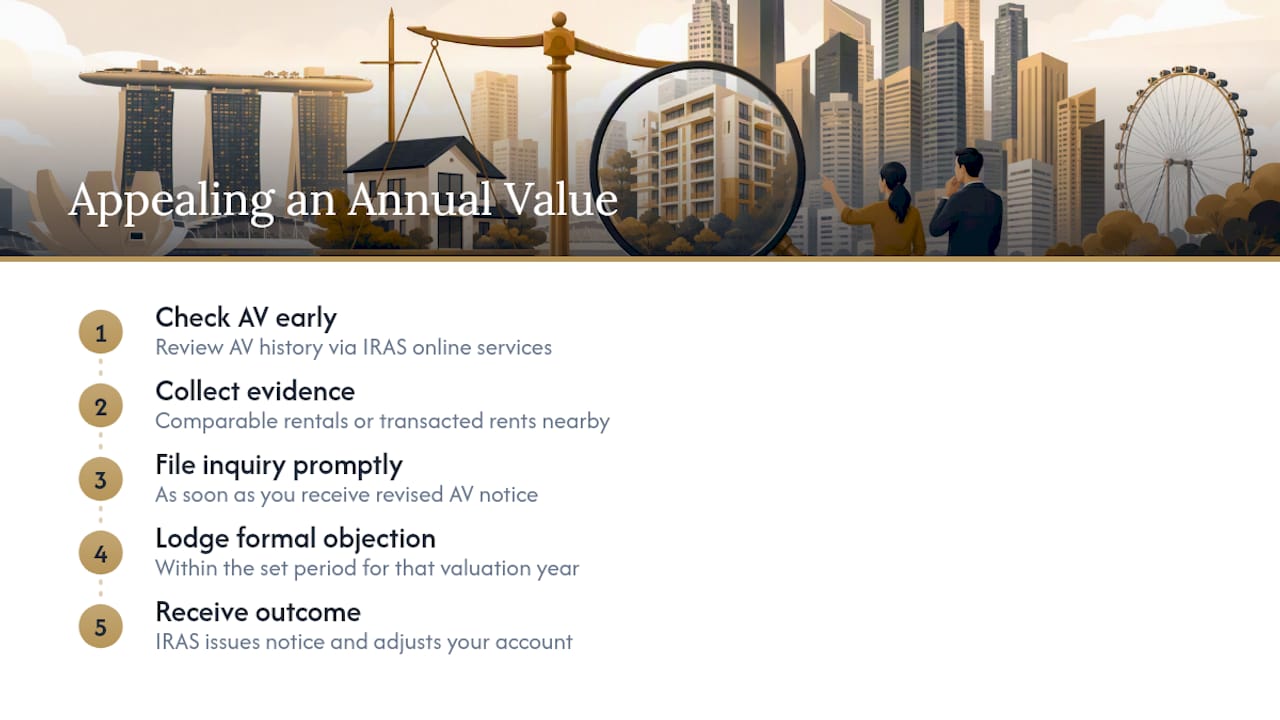
You can dispute your AV, and plenty of owners do, but timing and evidence matter more than the argument itself. If you believe your AV overstates what your property could realistically command in rent, you can raise an objection with IRAS.
The practical approach: gather comparable rental listings or transacted rents for similar units nearby, in the same block or a comparable development, before you file anything. IRAS reviews AV against market rental transactions, so your appeal needs to speak that same language, not a general complaint that the number "feels high."
Owners who anticipate a dispute should check their AV history early through IRAS's online services rather than waiting until a bill arrives. Filing an inquiry as soon as you receive notice of a revised AV, rather than after the payment deadline has passed, gives IRAS more room to review before enforcement kicks in. Once a correction is approved, whether through a formal objection or a status update like an owner-occupier application, IRAS issues a notice showing the adjusted tax position, with the difference reflected in your account.
There's no indefinite window here. Objections tied to a specific valuation year typically need to be lodged within a set period of the bill or notice being issued, so treat a surprising AV jump as something to flag immediately, not something to revisit at your convenience months later.
How Does Property Tax Affect Your Mortgage and Financial Planning?
Property tax doesn't get bundled into your mortgage repayment the way it might elsewhere, but it absolutely belongs in the same budget line. Banks calculating your Total Debt Servicing Ratio focus on loan repayments, not annual property tax, which means it's easy to underbudget for a cost that arrives as a separate, unavoidable annual bill.
Treat your expected property tax as a fixed annual expense sitting alongside maintenance fees, fire insurance, and conservancy charges. For a mid-tier private condo, that annual figure can run into several thousand dollars even after a rebate, money that needs to come from cash flow outside your mortgage servicing.
The trickier part is that this number isn't fixed for the life of your loan. AV moves with market rents, and tax bands can be revised by policy over time, which means your holding cost in year five of ownership may look meaningfully different from year one. If you're stress-testing your finances before committing to a purchase, our TDSR rules guide covers how financing limits interact with the full range of ownership costs, property tax included, not just the loan itself.
Build in a buffer. Assuming your property tax bill stays flat for the next decade is the single most common budgeting mistake new owners make.

What Exemptions and Concessions Exist Beyond the 2026 Rebate?
The one-off rebate isn't the only relief mechanism in the system, though it's the one getting the most attention this year. Owner-occupier tax rates themselves function as a standing concession, available every year, not just in 2026, to anyone who lives in their property and applies for the status.
Beyond that baseline, IRAS has historically extended targeted relief in specific circumstances, properties undergoing redevelopment, vacant land awaiting construction, or units affected by particular hardship situations. Eligibility for these narrower concessions tends to hinge on documented circumstances rather than automatic qualification, so they require an application and supporting evidence rather than the passive treatment the 2026 rebate gets.
The extended GIRO instalment plan for eligible retirees, covered earlier, is really a payment concession rather than a tax reduction: it doesn't lower what you owe, but it stretches the timeline so the burden lands more gently on fixed-income households.
Worth remembering: none of these concessions apply automatically outside the standard owner-occupier rate and the 2026 rebate itself. If your situation involves a redevelopment project, a inherited property in transition, or unusual occupancy circumstances, checking directly with IRAS before assuming you qualify saves you from budgeting around relief that never materializes.
How Do 2026 Rates Compare to Previous Years?
Owner-occupier progressive bands have been in their current structure since being revised effective January 1, 2025, so 2026 largely carries forward last year's rate framework rather than introducing a fresh structural change. What's genuinely new for 2026 is the one-off rebate itself: a temporary cushion layered on top of an otherwise stable rate system.
That's a different shape from some previous years, where rate band adjustments themselves were the headline, gradually raising rates on higher-AV and non-owner-occupied properties to sharpen progressivity. The Ministry of Finance has been explicit that this progressive tilt, taxing higher-value and investment properties more heavily, is a deliberate, ongoing policy direction rather than a one-time adjustment.
For owners tracking their bills year over year, the practical takeaway is this: don't expect 2026's dollar figure to match 2025's exactly, even with an unchanged rate structure, because AV itself can shift with market rents between assessment periods. A flat rate table doesn't mean a flat bill. The rebate is the variable that makes 2026 look different on paper; the underlying mechanics are largely continuous with the prior year.
What Happens If You Pay Property Tax Late?
Missing the January 31 deadline triggers consequences fast, and they escalate if the bill stays unpaid. IRAS applies a penalty on the outstanding amount shortly after the due date passes, and continued non-payment can lead to further enforcement action, including additional penalties and, in persistent cases, recovery actions such as appointing an agent to collect from your salary or bank account, or restricting property transactions.
The same urgency applies whether you're managing one HDB flat or a portfolio of investment units. Non-owner-occupied properties don't get any grace period advantage over owner-occupied ones. Landlords already managing tenant turnover, maintenance, and financing shouldn't treat the property tax deadline as flexible just because it's a smaller line item next to mortgage payments.
If you know in advance that January 31 will be tight, don't wait for a penalty notice to act. GIRO arrangements, including the extended instalment option for eligible retirees, exist specifically to prevent that scenario, and setting one up ahead of the deadline costs nothing. The same applies if you're disputing your AV. An active appeal doesn't automatically pause your payment obligation, so pay by the deadline while your objection is under review, then let any refund or adjustment come through afterward.
Editorial Take: What Actually Matters in the 2026 Property Tax Cycle
The rebate is getting most of the headlines this year, and it's the least important thing in this entire cycle for most owners. A $500 cap on private residential rebates is real money, but it's a rounding error against what actually moves your bill year to year: your Annual Value and whether you've locked in owner-occupier status on the right property.
Conventional advice treats property tax as a once-a-year chore: open the bill, pay it, move on. That's backwards. The smarter move is checking your AV before the bill arrives, especially if you've renovated, if rents in your area have climbed, or if you own more than one residential property and haven't confirmed which one carries owner-occupier status. Waiting until December to think about any of this means you're reacting to a number instead of managing it.
If I had to prioritize one action for readers here, it's this: confirm your owner-occupier application is current on the property you actually live in. That single status, more than any rebate, determines whether you're paying the lower progressive bands or the steeper non-owner-occupier rates for the entire year.
— Velisa
Explore Aurea's Latest 2026 Availability
Understanding your future property tax exposure is part of buying smart, not just an afterthought after signing the option to purchase. Aurea's 188 units across 2 to 5 bedroom layouts and two penthouses at 802 Beach Road give buyers a range of AV bands to plan around, from compact family layouts to larger units suited to households wanting resort-style amenities and direct access to The Golden Mile without leaving the building. Check current availability and pricing at Aurea's official site to see how a unit here fits into your long-term holding-cost picture ahead of the 2029 completion date. If you're also budgeting for post-purchase renovation costs, this Singapore home painting cost guide is a useful companion for early planning.
Sources
- 2026 Property Tax Bill - Singapore
- Gov
- Government Will Grant One-Off Property Tax Rebate for All Owner-Occupied Residential Properties in 2026 - MOF