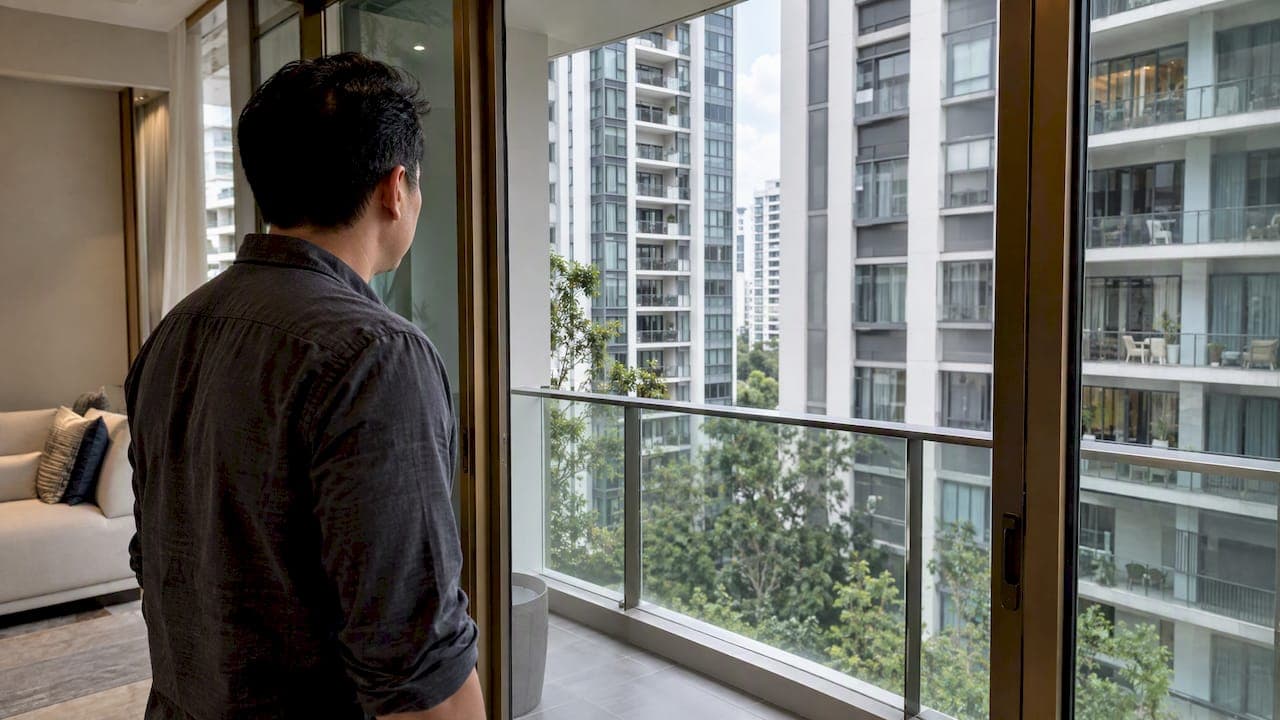
A privacy stack is a unit with few or no direct same-floor neighbours, and genuine ones exist in Singapore, though floor plate and orientation matter as much as floor level. Read the site plan first, then verify at the showflat using URA's balcony and PES rules. Outdoor noise averages 69.4 decibels, so we test sound too.
TL;DR:
- Start with the site plan and floor plate; count same floor neighbors, check opposing windows and block gaps, and locate nearby facilities before choosing a stack.
- URA permits a proposed 1.8m screening wall between adjoining PES, but approval is site specific; request approved drawings and confirm pre installation options.
- Visit the unit on a weekday evening and weekend afternoon, because high floors can still amplify reflected sound; request facade acoustic test results.
- Request the written camera policy, locations, footage access rules, and retention timelines; confirm whether cameras cover balconies or other unit exclusive outdoor spaces.
Table of Contents
- What is a privacy stack and why does it matter in Singapore condos?
- How do you identify privacy stacks on site plans and floor plates?
- What do URA balcony, PES and PRT rules mean for your privacy?
- How do you test noise and acoustics in a private stack?
- What should you verify about security, surveillance and data privacy?
- What belongs on your showflat and site-visit privacy checklist?
- Our perspective on privacy stacks
- Aurea for buyers who put privacy first
- FAQ
- Sources
What is a privacy stack and why does it matter in Singapore condos?
Developers use "private" and "secluded" loosely in brochures. In practice, privacy comes from geometry: how many units share your corridor or floor plate, which stacks face yours across a gap, and how the block sits against its neighbours. A unit on a high floor can still look straight into another bedroom if the block wraps around a narrow courtyard.
Three outcomes are worth separating, because a stack can win on one and lose on another:
- Visual seclusion: few windows or balconies facing yours, and no direct sightline from a neighbour's bedroom.
- Acoustic calm: distance from lifts, play areas, courts and traffic, plus the way facades reflect sound.
- Exclusive outdoor space: balconies, private enclosed spaces (PES) and private roof terraces (PRT) that you can actually screen.
Orientation affects both comfort and privacy. North–south facing units avoid the harshest afternoon sun, and we explain the trade-offs in our piece on north south facing condos in Singapore. If you are weighing a west-facing unit, our west-facing viewing checks cover what to test during a viewing.
The rules matter here too. URA's guidance on balconies, PES and PRT sets what developers may build, including how adjoining PES can be separated. Noise is the other early anchor. Singapore's outdoor noise averages 69.4 decibels, and that is worth considering when assessing a quiet-looking stack.
How do you identify privacy stacks on site plans and floor plates?
Start with documents, not the show unit. A sample flat is furnished to flatter, while the site plan shows what will actually surround you. Work through these steps in order:
- Read the stack numbering. On a typical floor plate, stack numbers repeat vertically. Find stacks at the end of a wing or at a corner, where the number of adjoining units is lowest.
- Count same-floor neighbours. Check how many front doors share your lift lobby or corridor. Fewer doors usually means less foot traffic and fewer shared walls.
- Check the block shape. U-shaped or enclosed blocks can create visual exposure, because opposite wings look into each other, and acoustic exposure, because sound bounces between facades. A straight slab block with generous gaps is easier to read.
- Measure separation distances. Ask for the distance between your block and the next one, then compare the bedroom and balcony windows on each side.
- Locate shared facilities. Children's play areas, courts, barbecue pits and function rooms generate noise. Brochures often leave this out, so mark where each sits relative to your candidate stack.
- Study the elevations. Elevation drawings show window positions, balcony depths and any screening, which tells you what the neighbour will see.
Request these items from the developer or agent: the site plan, floor plate, block separation distances, elevation drawings, PES/PRT annotations and approved balcony-screen designs. Our condo stack selection guide and the showflat checklist using URA, ONEMap and REALIS walk through the same document trail.
Pro Tip: Photograph the site plan at the sales gallery and mark your candidate stack in a different color from the shared facilities, so the noise sources are obvious at a glance.
For broader context on current launches and how their layouts compare, AI New Launch's Singapore new launch condo guide is a useful companion while you shortlist.
One caution from independent reviews: even large, low-density developments with generous setbacks can still have occasional noise or practical issues, as the Leedon Residence review notes. A good site plan lowers the risk but never replaces a visit.
What do URA balcony, PES and PRT rules mean for your privacy?
URA's rules decide how much privacy you can build into outdoor space, so they deserve a close read before you fall for a terrace in a brochure.
Here is what the guidance means in practice:
- PES and PRT rules are specific. URA's handbook covers gross floor area treatment, allowable covers and fencing limits. It also allows a 1.8m screening wall between adjoining PES to be proposed for privacy, but that is site-specific, so never assume it exists.
- The Balcony Incentive Scheme was revised. URA's circular on the scheme reduced bonus GFA caps and set minimum balcony width guidance, both of which shape how roomy and screenable a balcony can be.
- Developers must disclose screens. Under the same revision, developers have to inform homebuyers of allowable balcony screens at the point of purchase, and either install the approved screen in the sales gallery or offer pre-installation options.
What this means for you: where a standard floor plan shows a plain balcony, the approved screen design may change what your neighbours can see, and also what you can see of them. Do not accept a verbal assurance. Ask to see the approved balcony-screen installation drawings in the sales gallery or showflat, and confirm whether pre-installation is offered.
Architects also use softer tools where proximity cannot be avoided. HYLA Architects describe external roller blinds and translucent screening that keep daylight while cutting sightlines. These are useful fallbacks, but they work best when planned from the start rather than retrofitted.

How do you test noise and acoustics in a private stack?
A stack can be visually secluded and still loud. Singapore's outdoor noise levels average 69.4 decibels, making on-site verification worthwhile.
69.4 decibels: Singapore's average outdoor noise level. Even high floors are not immune, because facades and neighbouring buildings can reflect and amplify sound.
That last point corrects a popular belief. High-floor units are not automatically quieter. In U-shaped or enclosed block configurations, sound can bounce off opposite facades and turn a balcony into an echo chamber, so a unit that looks calm on paper can disappoint in person.
Use these on-site checks:
- Visit at different times. Go during a weekday evening and a weekend afternoon, when traffic, play areas and amenities are busiest.
- Listen for echo. Clap once on the balcony and listen for a sharp return from the opposite block.
- Check the neighbours' geometry. Note where lifts, pump rooms, courts and the nearest road sit relative to bedroom windows.
- Ask for acoustic reports. If the developer has acoustic test results for the facade, request them rather than relying on the brochure.
Retrofits are realistic when the numbers disappoint. Acoustic vendors in Singapore, such as Grilles N Glass, commonly recommend laminated or double glazing, improved seals and thicker frames, and cite field installs where noise dropped by more than half in some high-rise cases. Treat that as a vendor claim and ask for product specifications or test results before you budget. We cover the practical side in our guide to double glazing for condo owners.
What should you verify about security, surveillance and data privacy?
A highly private unit can still feel exposed if the building's cameras and access systems are poorly governed. Privacy and security pull in opposite directions, and the management corporation (MCST) sets the balance.
Condo security is now hybrid, combining digital surveillance with live guarding. ACMO's article on balancing privacy and protection advises boards to weigh resident privacy against security and to adopt privacy protocols covering how surveillance data is collected, stored and used. A companion piece on legal considerations for condo surveillance points to camera location, residents' reasonable expectations of privacy, signage, written policies and staff training. Both are Canadian condo-management resources, so treat them as good-practice guidance rather than Singapore law.
Ask the developer or MCST for these items:
- A written surveillance policy that discloses camera locations.
- Data-retention timelines and the procedure for releasing footage.
- Access rules: who can view live feeds and recordings.
- Staff training protocols for security personnel.
- Confirmation of whether cameras cover unit-exclusive outdoor space or only common elements.
Resident apps deserve the same scrutiny. Some housing platforms, such as NoBrokerHood, publish features like secure data hosting, OTP authentication, data masking and deletion policies. Ask whether any app used in your development offers comparable protections.
Pro Tip: Ask whether any camera can see into a balcony, PES or window. Where one can, ask for the placement drawing in writing.

What belongs on your showflat and site-visit privacy checklist?
Bring this list to the sales office and the site. It condenses the checks above into one pass:
- Collect the documents. Request the site plan, floor plate, elevations, approved balcony-screen drawings and any draft MCST house rules.
- Confirm your stack's neighbours. Count units sharing your floor and note which stacks face yours across the gap.
- Check sightlines. Stand where the bedroom and balcony will be, using the floor plan and elevations, and note every window or balcony you can see into.
- Visit twice. Go once during the day and once in the evening to catch play areas, lift traffic and road noise at their busiest.
- Map noise sources. Mark lifts, courts, function rooms and the nearest road against your candidate stack.
- Ask about screening. Confirm the approved balcony screen, and whether pre-installation is offered, as URA requires developers to disclose.
- Ask about surveillance. Request the camera policy and retention rules, and whether cameras cover your outdoor space.
- Know when to call a professional. Consult an acoustician for complex noise concerns, and MCST or legal advice where screening or surveillance rules are unclear.
None of this slows a purchase meaningfully. It takes a few hours, and it replaces a brochure's adjectives with documents you can compare.
Our perspective on privacy stacks
Most buyers hunt for a high floor, when the better question is who shares your wall, your corridor and your sightline. A stack's quality comes from what surrounds it, so privacy is mostly a matter of reading a plan carefully. At Aurea, we weigh its Beach Road location, the available bedroom layouts and the placement of amenities, and we encourage you to ask for every privacy document before you commit, wherever you buy.
— Velisa
Aurea for buyers who put privacy first
If you are shortlisting stacks, we invite you to test our development against this checklist at the showflat. Aurea is a new-launch condominium on Beach Road with a covered link bridge to The Golden Mile, and you can verify the details that matter to you:
- A range of bedroom layouts and penthouses, so you can compare stack positions across unit types.
- Resort-style amenities, so you can check where shared facilities sit relative to each stack.
- Location near multiple MRT lines, which makes repeat visits at different times easy.
Ask for the site plan, stack numbering and screening details, then book a showflat visit through our project page.
This article is general information, not a substitute for advice from a qualified financial advisor. Consult a qualified financial professional about your own circumstances before acting on anything here.
FAQ
What is a privacy stack in a Singapore condo?
A privacy stack is a vertical line of units with few or no direct same-floor neighbours, usually at a wing end or corner. Its real privacy still depends on block orientation, separation distances and what faces it across the gap.
Are high-floor units always quieter and more private?
No. Facades and neighbouring buildings can reflect and amplify sound, so high floors are not immune. Singapore's outdoor noise averages 69.4 decibels, so test the unit in person.
Can I add privacy screens to my balcony?
It depends on the approved design. Under URA's balcony scheme revision, developers must tell buyers which screens are allowed at the point of purchase. Ask to see the approved drawings before you sign.
What should I ask about surveillance in a condo?
Ask for the written surveillance policy, camera locations, data-retention timelines and footage-release rules. Also confirm whether cameras cover private outdoor space, since good practice calls for disclosure and staff training.
Sources
- Balconies, Private Enclosed Spaces, Private Roof Terraces and Indoor Recreation Spaces | Urban Redevelopment Authority (URA)
- Revision to the Balcony Incentive Scheme for Private Non-Landed Residential Developments
- Balancing the Right to Privacy & Protection in Condo Communities - acmo