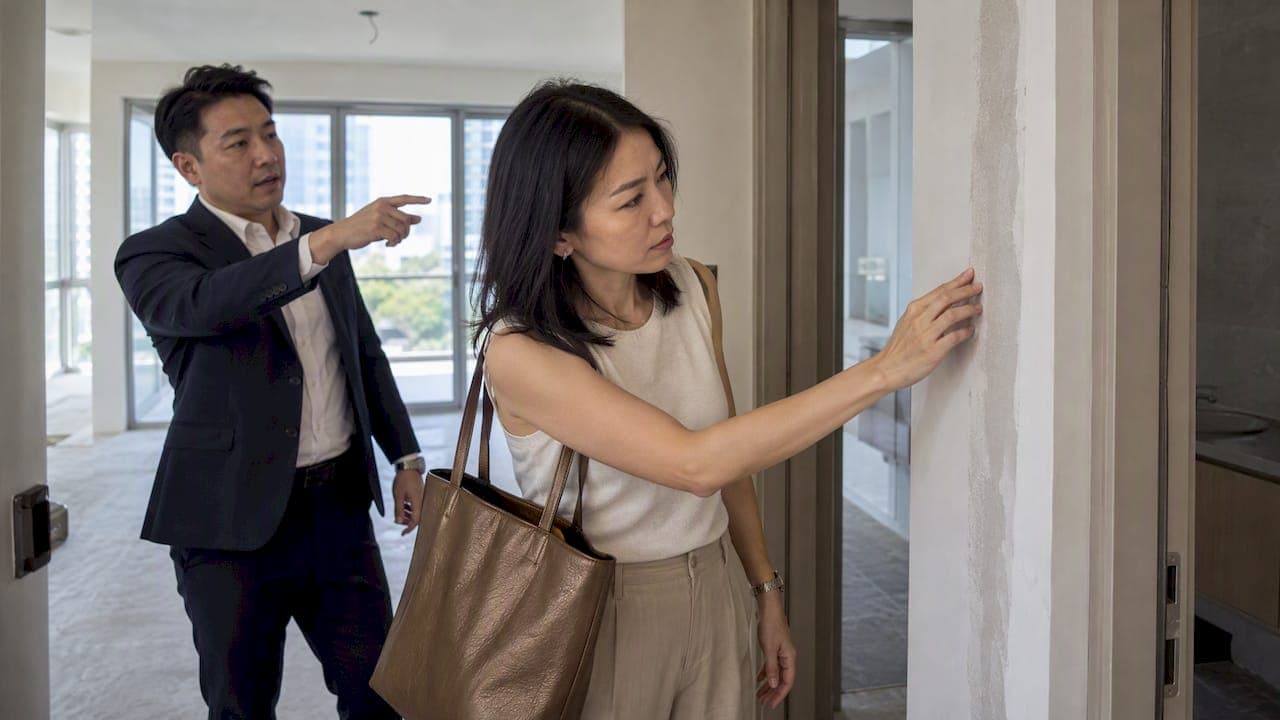
A showflat illustrates the intended design and styling of a unit. It does not replace the written specification sheet and the Sale and Purchase agreement, which define what a developer must actually deliver. Expect decorative items and labelled mock-ups that are not included unless they appear in writing. Before signing, check the visuals against Form 3, the specification sheet, and any side letters attached to the Option to Purchase.
TL;DR:
- Showflats are staged with decorative items that are not included in your actual unit unless explicitly stated in writing, so verify all items listed in specifications.
- Walls, doors, flooring, and built-in fixtures often differ from the specifications due to staging and layout adjustments, so check notices and take measurements on site.
- Balcony screens and enclosed spaces may not be included in the purchase price and should be confirmed through written notices or side letters before signing.
- Measure key dimensions like ceiling height and door clearances yourself and photograph all labels, labellings, and unbuilt enclosures for future reference.
- Report defects within 12 months of handover in writing, keep detailed records, and seek clarification on what is covered under the defects-liability period.
Table of Contents
- What a developer's showflat is allowed to show under URA and BCA rules
- Common differences between the showflat and your actual unit
- How to verify a showflat against the real unit at viewing
- What happens after handover if something doesn't match
- The one-page checklist to bring to every viewing
- Lessons from common showflat misreads
- Request Aurea's specification sheet and book a viewing
- FAQ
- Sources
What a developer's showflat is allowed to show under URA and BCA rules
Showflats in Singapore are not free creative expression. Under the URA Home Buyers' Guide, developers must build show units according to approved plans, and any removed or altered enclosure, such as a wall taken out to help visitor flow, must be clearly labelled on site. Written notices in the sales gallery are supposed to state the materials, finishes and fixtures that will actually be provided in the delivered unit.
That labelling requirement exists precisely because showflats routinely include decorative items that never make it into the real unit: curtains, wallpaper, display appliances, and styled furniture are often just staging. What must match the contract are the built elements tied to the specification sheet, built-in wardrobes, kitchen cabinetry, and fixed fittings named by make or model.
Scale is where most buyers get misled. A showflat dressed with low-profile furniture, strategic lighting, and mirrors can make a room feel noticeably larger than the unit you will receive. Walk the space and ignore the staging. Look instead for the small printed or laminated notices near altered walls or missing doors. Those notices, required under URA guidance, are the honest version of what you are looking at. If a notice is missing where a wall or door clearly differs from the floor plan, that is a question to raise with the sales team in writing before you commit.

Common differences between the showflat and your actual unit
Certain differences show up again and again across Singapore new launches, and they are worth focusing your attention on rather than spreading your scrutiny evenly across every surface.
- Walls and doors may be removed or relocated in the showflat to improve visitor circulation, which changes how usable the actual room will feel.
- Flooring and skirting often show a feature tile in showflats where the specification sheet lists a plainer base finish for most rooms.
- Built-in joinery like wardrobes and kitchen cabinets should be present as specified; loose furniture and soft furnishings are decorative only.
- Appliances and major fixtures should be listed by make and model in the specification sheet, not just shown as a display unit.
- Balcony or private enclosed space (PES) treatments, including balcony screens, may be optional extras rather than standard inclusions.
On that last point, the URA guidance on balconies and PES confirms that approved balcony screens must be shown at actual scale, either in the show unit itself or as an on-site mock-up, and that buyers must be told whether pre-installation is included or sold separately, often through a side letter attached to the Option to Purchase.
Pro Tip: Ask the sales team to point out, in writing, every item in the showflat that is decorative only and every item that is part of the contractual specification.
How to verify a showflat against the real unit at viewing
Treat the showflat visit as a document-gathering exercise, not just a walkthrough. The goal is to leave with enough paper and photos to hold the developer to what was promised.
- Collect the specification sheet, the Form 3 floor plan, any written notices posted in the sales gallery, and draft S&P clauses covering finishes before you leave.
- Measure ceiling height, door swing clearances, and the internal dimensions of wardrobes and cupboards rather than trusting the showflat's apparent proportions.
- Check the PES or balcony area and the location of the air-con ledge, since these affect both usable space and future installation options.
- For any unbuilt or altered enclosure, insist on written clarification from the developer, and photograph the labelling exactly as displayed.
- Take dated, time-stamped photos of every label, every unbuilt enclosure, every finish sample, and any visible defect you notice in the showflat itself.
Our guide on Singapore showflat checklists walks through this process room by room, and our piece on verifying ceiling heights on site covers one of the most commonly misjudged dimensions in a staged unit.
Pro Tip: Bring a tape measure and a printed copy of the floor plan to every viewing. Staged furniture is scaled to flatter the room, not to help you measure it.
What happens after handover if something doesn't match
Once you take possession, the defects-liability period becomes your main protection. Under typical S&P provisions outlined in archived URA guidance on defects clauses, the developer must make good defects that become apparent within the defects-liability period, commonly 12 months from the Notice of Vacant Possession, provided you report them within that window in writing.
- Keep a written, dated record of every defect you report, including photos and the date the developer acknowledges each one.
- Engage your MCST for issues affecting common property rather than raising them as individual unit defects.
- Seek BCA guidance if a developer is unresponsive or if you are unsure whether an issue falls within the DLP.
A developer's CONQUAS banding and history are useful due-diligence indicators before you buy, though they work alongside unit-level checks, not instead of them. Once the DLP ends, maintenance becomes your responsibility, and engaging CaseTrust-accredited contractors for any renovation work is a sensible safeguard.
The one-page checklist to bring to every viewing
Print this before your next appointment and work through it in the sales office.
- Request the full specification sheet in writing.
- Photograph every labelled mock-up or unbuilt enclosure.
- Confirm built-in cupboards and wardrobes are present as specified.
- Check door swing clearances against the floor plan.
- Ask whether balcony screens are included or sold separately.
- Measure ceiling height against the stated figure.
- Compare feature tiles in the showflat to the base finish listed for your unit.
- Confirm appliance make and model numbers in writing.
- Keep a dated photo log of everything you check.
- Note the DLP start date and reporting deadline once you take possession.
| Checklist item | Where to find the answer |
|---|---|
| Specification sheet | Sales office, in writing |
| Floor plan accuracy | Form 3 |
| Balcony screen inclusion | Side letter at Option to Purchase |
| Defect reporting window | S&P defects-liability clause |
Our first 30 days checklist for new condo owners picks up where this one leaves off, once you have the keys.
Lessons from common showflat misreads
The most frequent mistake buyers make is assuming an omitted wall or door in the showflat is cosmetic rather than structural. It usually just reflects staging for visitor flow, but confirming that in writing costs nothing and prevents disappointment. Balcony screens are the second biggest source of confusion, since buyers often assume they are included when they are frequently a paid add-on. Measure first, ask for written confirmation on anything ambiguous, and keep the quick checklist in hand rather than relying on memory. Our deeper dive on dumbbell layouts shows how wall placement changes usable space in ways a showflat rarely makes obvious.
— Velisa
Request Aurea's specification sheet and book a viewing
At Aurea, we build our show units around the same principle this guide follows: what you see should be backed by what we put in writing. Our development at 802 Beach Road offers 2 to 5 bedroom layouts plus two penthouses, resort-style amenities spread across four levels, and a link bridge connecting directly to The Golden Mile.

We invite you to bring the printable checklist above to your viewing and request our full specification sheet before you compare it against anything staged in the sales gallery.
- Ask us for written confirmation on any labelled enclosure or balcony screen inclusion.
- Request the specification sheet by make and model for appliances and fixtures.
- Use our showflat appointment to measure, photograph, and verify rather than just browse.
Reach out through our project page to book a viewing or download the specification sheet for the unit type that fits your household.
This article is general information, not a substitute for advice from a qualified financial advisor. Consult a qualified financial professional about your own circumstances before acting on anything here.

FAQ
Is a showflat legally required to match the actual unit?
Not entirely. Under URA guidance, developers must build show units according to approved plans and label any removed or altered enclosure, but decorative items like curtains or display appliances are not required to appear in your actual unit.
Are balcony screens included in the purchase price?
Not always. URA's balcony guidance confirms balcony screens are often shown at actual scale in the showflat, but pre-installation may be offered as a separate, optional item through a side letter attached to the Option to Purchase.
How long do I have to report defects after handover?
Under typical S&P clauses described in archived URA circulars, the defects-liability period commonly runs 12 months from the Notice of Vacant Possession, and defects must be reported in writing within that window to preserve your remedial rights.
Should I check a developer's track record before buying?
Yes. BCA guidance for prospective condo owners recommends checking the Quality Housing Portal and CONQUAS banding as part of due diligence, alongside your own room-level checks at viewing.
What should I bring to a showflat viewing?
Bring a tape measure, a printed floor plan, and a checklist covering cupboards, door swings, ceiling height, and balcony inclusions, and request the specification sheet in writing before you leave, as outlined in our showflat checklist guide.