
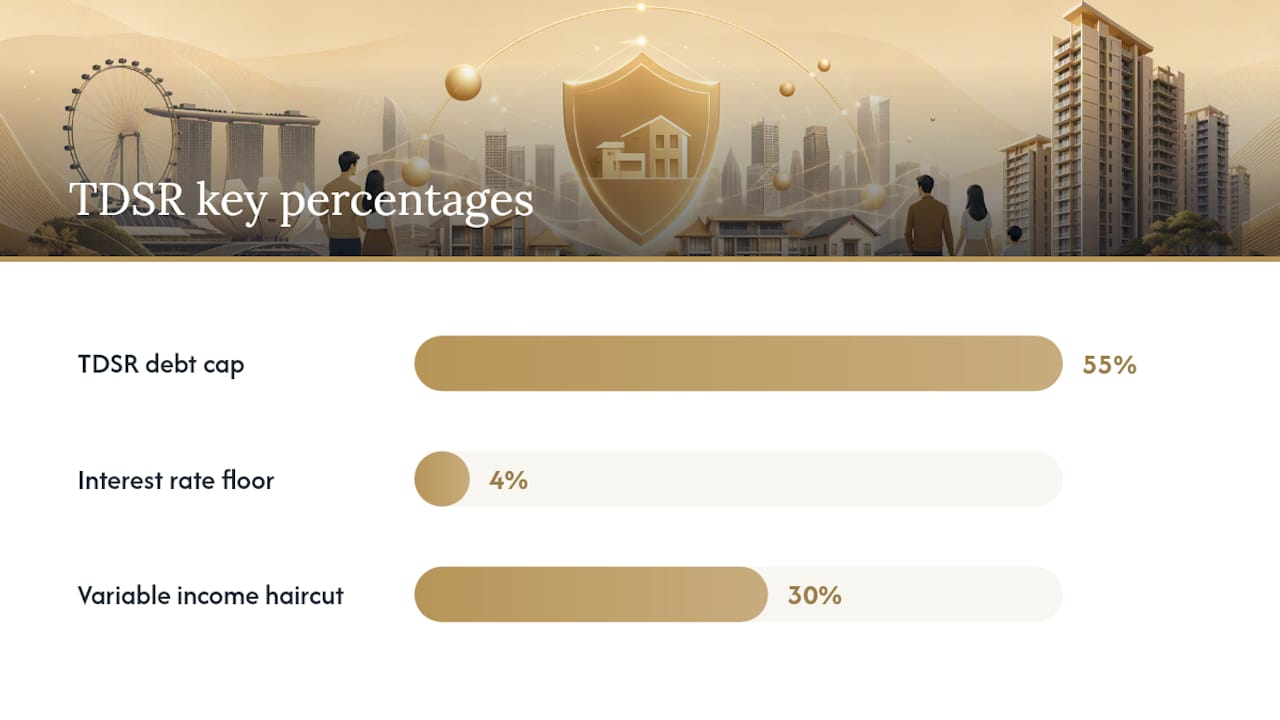
Singapore's Total Debt Servicing Ratio cap sits at 55% of gross monthly income, set by the Monetary Authority of Singapore to prevent borrowers from taking on more debt than they can realistically service. Every lender in Singapore must apply this framework before approving a property loan.
The formula is straightforward: TDSR = total monthly debt obligations ÷ gross monthly income. If that result exceeds 0.55, the loan is declined or must be restructured.
Monthly debt obligations under the MAS TDSR framework include:
- The new mortgage instalment being applied for
- Existing mortgage payments on other properties
- Car loans and hire-purchase commitments
- Credit card minimum payments and unsecured credit lines
- 20% of any outstanding guaranteed loan obligations (as guarantor)
The governing notices are MAS Notice 645 (banks), MAS Notice 1115 and MAS Notice 1115A (merchant banks), and the Guidelines on the Application of Total Debt Servicing Ratio for Property Loans.
Table of Contents
- Key takeaways on TDSR rules in Singapore
- How TDSR actually changes what you can borrow
- Thinking about a new-launch purchase at Aurea?
- Official MAS sources to verify TDSR rules
Key takeaways on TDSR rules in Singapore
Singapore's TDSR framework caps total monthly debt at a regulated percentage of gross income, and lenders stress-test instalments at a medium-term interest rate floor rather than the actual loan rate.
| Point | Details |
|---|---|
| Current TDSR threshold | MAS sets the cap at 55% of gross monthly income; the cap was tightened from a higher previous limit in late 2021. |
| Core formula | Total monthly debt obligations ÷ gross monthly income must not exceed 0.55. |
| Medium-term rate floors | Lenders compute mortgage instalments using the higher of 4% or the prevailing rate. |
| Variable income haircut | Commissions, bonuses, and self-employed income receive at least a 30% haircut; lenders average the prior 12 months. |
| Cap can change | MAS reviews thresholds periodically; always verify the current rule before signing an Option to Purchase. |
| Aurea-sgcondo next step | Buyers considering Aurea at 802 Beach Road can request a financing consultation through the project page before committing. |
How TDSR actually changes what you can borrow
Most buyers focus on Loan-to-Value limits and are surprised to find TDSR is the binding constraint. LTV tells you the maximum loan relative to the property price; TDSR tells you the maximum loan your income can support. For many buyers, especially those with car loans or existing mortgages, TDSR bites first.

The medium-term interest rate floor is the detail that catches people off guard. Lenders do not calculate your instalment at the rate you are offered. They use the higher of 4% or the actual rate, per MAS computation rules. That inflated instalment figure is what goes into the TDSR numerator, reducing the loan quantum you qualify for even when actual rates are lower.
A worked example: Gross monthly income of SGD 10,000. Existing car loan instalment: SGD 800. New mortgage instalment computed at the 4% floor: SGD 3,500. TDSR = (800 + 3,500) ÷ 10,000 = 43%, which clears the 55% cap. Add a credit card minimum payment of SGD 200 and a personal loan of SGD 1,500, and TDSR jumps to 60%, breaching the limit.
MSR vs. TDSR is another distinction worth knowing. The Mortgage Servicing Ratio applies specifically to HDB flats and executive condominiums, capping the mortgage instalment alone at 30% of gross monthly income. TDSR is broader and covers all property types, including private residential and commercial. For a private condo purchase, only TDSR applies. For an HDB flat, both MSR and TDSR apply simultaneously, and the more restrictive rule governs.
Variable income earners face an additional layer. MAS requires lenders to apply at least a 30% haircut to commissions, bonuses, and self-employed income, averaging the prior 12 months. A freelancer earning SGD 12,000 per month on paper may have only SGD 8,400 recognized for TDSR purposes.

Joint applications aggregate both applicants' incomes and all their debt obligations. That aggregation can help or hurt depending on the co-borrower's existing liabilities. Vehicles used to hold property, such as certain holding structures, are subject to their own aggregation rules under Notice 1115A and Notice 645.
Lenders may approve loans above 55% on an exceptional basis, but that path requires enhanced credit assessment and is not guaranteed. It adds time and uncertainty to the mortgage process.
Pro Tip: Document rental income with a signed tenancy agreement before your mortgage application. MAS-compliant lenders require this verification, and missing paperwork can reduce your recognized income at the worst possible moment.
The MAS Guidelines on TDSR also cover exemptions, including certain owner-occupier refinancing situations where the borrower is not taking on additional debt. If you are refinancing an existing home loan without increasing the loan amount, specific conditions may allow the transaction to proceed outside the standard TDSR assessment. Verify the exact conditions with your lender and the current MAS notices before assuming an exemption applies.
Thinking about a new-launch purchase at Aurea?
Understanding TDSR is the first step. Applying it to a specific purchase is where a mortgage adviser earns their value. If you are evaluating a unit at Aurea at 802 Beach Road, the appointed agents at ERA Realty Network can connect you with a mortgage specialist for an affordability review before you commit to an Option to Purchase.
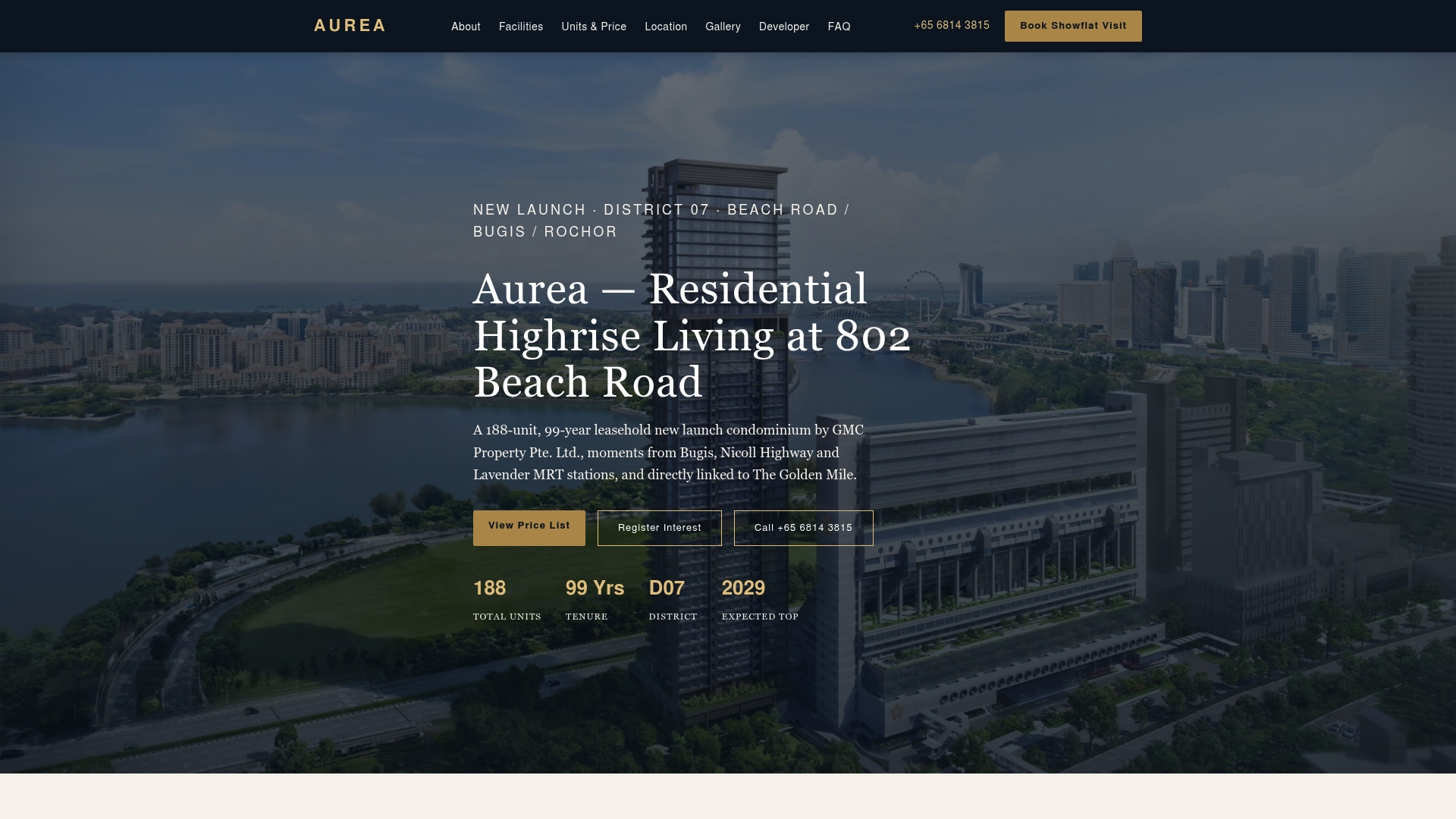
Aurea offers 188 units from 2 to 5 bedrooms plus two penthouses, with resort-style amenities across four levels and direct access to The Golden Mile via a link bridge. Completion is targeted for 2029, giving buyers time to plan financing carefully. Visit the Aurea project page to review floorplans, pricing, and request a consultation.
This article is general information, not personalized financial advice. Verify current TDSR rules directly with MAS or a licensed mortgage broker before making any borrowing decision.
Official MAS sources to verify TDSR rules
| Source | What it covers |
|---|---|
| MSR and TDSR Rules (MAS Explainer) | Current 55% threshold, TDSR definition, MSR vs. TDSR distinction |
| Calculating TDSR for Property Loans (MAS Explainer) | Formula, income haircuts, medium-term rate floors, eligible assets |
| MAS Notice 645 | Bank-specific computation rules; HDB and EC instalment limits |
| MAS Notice 1115 (Amendment) | Merchant-bank computation, joint-applicant aggregation, rate floor scenarios |
| MAS Notice 1115A | Merchant-bank formula and monthly debt obligation parameters |
| Guidelines on Application of TDSR (MAS) | Scope, exemptions, eligible asset treatment, sound credit practices |
| MoneySense: Buying a Property | Consumer-facing examples, debt types included, rental income verification |
| DBS: Understanding TDSR | Policy context, history of the 60% to 55% change, monitoring guidance |
MAS reviews TDSR thresholds in response to market conditions. The cap moved from 60% to 55% in December 2021, and another revision is always possible. Check the MAS notices directly before any major purchase decision, and revisit them if market conditions shift significantly.