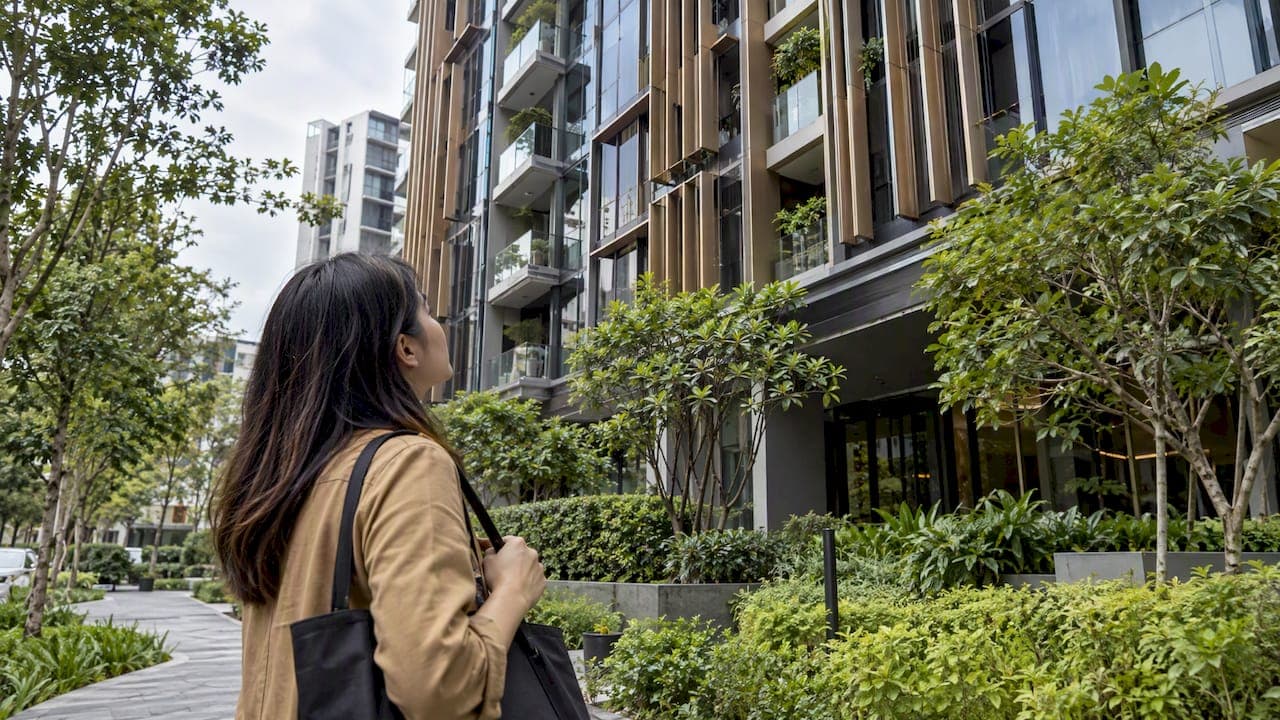
A Green Mark condo is a home whose design and equipment have been assessed by Singapore's Building and Construction Authority (BCA) against its green building standard. For you as a buyer, the benefits fall into four groups: lower running costs, a healthier indoor environment, a possible price premium when you sell, and lower risk of expensive upgrades later. Each one is real, and each comes with limits that the brochure rarely spells out. This guide covers both sides.
TL;DR
- Green Mark is Singapore's national green building rating system, launched in January 2005 and run by BCA. It scores a building's environmental impact and performance.
- Research on Singapore homes has found a price premium of roughly 4% to 6% for certified properties, and the premium tends to be larger at resale than at launch.
- Certified buildings tend to have better indoor air quality, but your own habits, especially air conditioning, decide how much you actually save.
- Certification is not permanent. Check the rating, the scheme version and the remaining validity before you sign an option.
Table of Contents
- What Green Mark actually measures
- Benefit 1: Lower running costs, with a catch
- Benefit 2: Better indoor environment
- Benefit 3: A possible resale premium
- Benefit 4: Protection against obsolescence
- What the label does not guarantee
- How to check a condo's Green Mark status before you buy
- Our perspective
- Looking at a new launch: Aurea at 802 Beach Road
- Green Mark compared with other things that move value
- Getting more from a green-certified home
- FAQ
- Sources
What Green Mark actually measures
BCA launched the scheme in January 2005. It is meant to evaluate a building's environmental impact and performance, and today it covers far more than the electricity bill.
The current standard for most new residential projects, Green Mark 2021, was designed for the tropical climate. It looks at:
- Carbon, including the embodied carbon of materials and construction.
- Intelligence, meaning smart sensors and building controls.
- Resilience to climate change, such as heat and flooding.
- Health and wellbeing, mostly indoor environmental quality.
- Maintainability, or how easily the building can be kept in good condition for decades.
BCA has since introduced Green Mark version 7.0, described as a refresh with more pathways and flexibility. Among its changes are a new tier for frontrunners with at least 70% energy savings and streamlined maintainability criteria. If a developer tells you a project is certified, ask which version applies. A rating under one version does not map neatly onto another.
Benefit 1: Lower running costs, with a catch
The easiest benefit to understand is energy and water efficiency. A green-certified condo is designed to reduce heat gain through the envelope, to use efficient equipment in common areas, and to cut waste. Your share of this shows up in two places.
Maintenance fees. Common-area lighting, lifts, pumps, and ventilation are a big part of a condo's electricity bill. Efficient systems reduce that bill, and a lower bill can mean lower pressure on the management corporation's budget over time. We would not promise a specific figure, because fees depend on facilities, size, and how well the estate is managed.
Your own utilities. Here the picture is more nuanced. Analysts point out that greenness is a shared responsibility between developer and resident. The developer provides the efficient structure and equipment. Your savings then depend on how you use air conditioning and water.
There is also a documented trap, often called the rebound effect. A seminar by Prof. Sumit Agarwal of the University of Macau, drawing on account-level water data in Singapore, looks at how households in green-certified homes use energy and water. The point for you is simple: a home that is cheaper to cool can tempt you to cool it longer. Treat certification as a head start, not as automatic savings.
One more caution comes from the academic literature. A study by Agarwal, Sing and Yang asks whether Green Mark buildings really use less energy, and notes that the existing literature has no conclusive evidence that green buildings save more energy than conventional ones. Read that as a reason to look at specifics (glazing, orientation, ventilation, appliance ratings) rather than at the badge alone.
Benefit 2: Better indoor environment
BCA reports that its research with the National University of Singapore points to better air quality and lower pollutant concentrations in certified buildings, linked with fewer reported health-related symptoms among occupants. For a family with young children or elderly parents, this is arguably more valuable than a few dollars off the power bill.
Badge or no badge, you can judge much of this yourself during a viewing:
- Does air move through the unit? We cover this in 3 cross ventilation checks Singapore condo buyers must run.
- Which way do the main windows face? Afternoon heat is a major comfort factor, as we explain in 6 checks at a 2 to 5PM viewing for west-facing condos and in our guide to north-south facing condos.
- Is the unit's morning sun a plus or a problem? See 7 checks to verify sun and BCA for east-facing units.
Green Mark standards and good orientation work together. A well-certified building with a poorly oriented unit can still run hot.
Benefit 3: A possible resale premium
This is the benefit investors ask about first. Studies of the Singapore market have identified a green premium for certified homes. The research we reviewed cites a 4% to 6% premium over comparable non-certified dwellings, most clearly for projects with higher ratings. Industry commentary goes further: one 2026 buyer guide reports that Platinum residential buildings command 5% to 8% more per square foot, though it calls this an industry estimate, so treat it as indicative and not as a guarantee.
A paper on developers' returns adds a useful timing detail. It finds a premium of about 4% at the presale stage and a higher one, around 10%, at resale, which means the gap between what developers capture and what long-term owners capture can be large. In plain terms: the premium may grow after you buy, which favors owners who hold, not flippers.

The same research suggests a reason why. Green certification acts as a signal of quality. Certified buildings are subject to stringent standards for materials and operations, so the label often works as a proxy for a well-built property that is less likely to need costly retrofits or to age badly as buyers become more sustainability-conscious.
Two honest limits apply. First, these studies cover specific periods and samples, and the market today may differ. Second, a premium is an average across many projects. Location, tenure, unit stack, and timing will move your own result far more than the rating.
Benefit 4: Protection against obsolescence
Singapore has set a target for the built environment. According to the lovelyhomes.com.sg guide cited above, the Green Building Masterplan aims for 80% of buildings by floor area to be certified by 2030. If that direction holds, a home built to a recent green standard is less likely to look dated, and less likely to need expensive upgrades to stay competitive with newer stock.
This is the quiet benefit. It does not show up on day one, but it matters when you sell in ten or fifteen years and the next buyer asks the same questions you are asking now.
What the label does not guarantee
It pays to be exact here, because a green badge can be oversold.
It is not permanent. BCA states that certification for new building projects is generally valid for three years from the Letter of Award or TOP, whichever is later, with extensions possible for sustained high performers. Under version 7, BCA describes an extended 5-year validity for sustained performers. A building that misses its energy targets at the end of a certification or extension period can lose the status.
It is verified after construction. Projects face post-construction checks, which can include site visits to confirm the green features are installed and working. A rating at the design stage and a rating after TOP are not the same thing.
It is not a tier you can assume. Gold, Gold Plus, Platinum, and Super Low Energy mean different things. Ask for the actual level, not just the word "certified".
It does not replace your own checks. Layout efficiency, orientation, ventilation, and the utility room all shape how a home lives. Our guides on efficient condo layouts and the condo utility room cover points a certificate never will.

How to check a condo's Green Mark status before you buy
Use this short list at the viewing or when you receive the option to purchase.
- Ask for the certificate or award letter. It should name the project, the rating level, and the scheme version.
- Check the date. Confirm whether the rating is a design-stage award or a post-construction one, and when it expires. A new launch will not have TOP yet, so ask what stage the certification is at.
- Ask what features earned the rating. Examples include envelope design, efficient lifts and pumps, smart controls, and water-saving fittings. BCA's Green Mark e-Planning portal shows the sort of criteria assessed, such as the building envelope's thermal performance, which is aimed at reducing cooling load.
- Ask about recertification. Someone must pay for assessment again. BCA publishes that its assessment fees depend on building type, size, and whether it is a recertification, so ask how the management corporation plans to handle it.
- Put it next to the basics. Compare the unit's orientation, ventilation, and layout with the rating, not instead of it.
Our perspective
We talk to buyers every week, and the Green Mark question usually arrives late in the conversation, after price and location. We think it deserves an earlier slot, with a realistic expectation.
For a family, the strongest argument is comfort. A building designed to manage heat and air well makes a daily difference, whatever the badge says. For an investor, the strongest argument is risk: a home built to a current standard is less likely to need a costly upgrade before the next buyer arrives.
What we would not do is promise you a bill reduction or a fixed premium. The research does not support promises, and your own habits decide the utility side. Our advice is to treat Green Mark as one of several quality signals, alongside tenure, location, transport links, layout, and the developer's track record.
At Aurea, we encourage you to ask us for the sustainability documentation that applies to the project and to check it yourself against the questions above. We would rather you buy with clear eyes than on a label.
— Velisa
Looking at a new launch: Aurea at 802 Beach Road
If you are comparing new launches, Aurea is a 99-year leasehold highrise condominium at 802 Beach Road, developed by GMC Property Pte. Ltd. It has 188 units from 2 to 5 bedrooms, plus two penthouses, resort-style facilities across four levels, and a link bridge to The Golden Mile. It sits close to multiple MRT stations, and completion is set for 2029.
Published prices, as listed on our site:
| Layout | Published price |
|---|---|
| 2 Bedroom | S$1,770,000 to S$2,075,800 |
| 3 Bedroom | S$2,639,900 to S$3,058,600 |
| 4 Bedroom | S$4,080,510 to S$4,512,990 |
| 4 Bedroom Premium | S$5,186,105 to S$5,723,390 |
| 5 Bedroom | Not published |
| Penthouse | Not published |
If sustainability credentials matter to your decision, ask our team for the project's current documentation and compare it with the checklist in this article. You can view the layouts and register your interest on our site.
If you are weighing a central location against other options, our 2026 investor guide to CBD condos and our comparison of executive condos and private condos may help.
Green Mark compared with other things that move value
It helps to rank the factors. In our experience, buyers who focus on one feature miss the others.
| Factor | What it affects | How much you can verify yourself |
|---|---|---|
| Location and MRT access | Rental demand, resale liquidity | High: walk the route at rush hour |
| Tenure | Long-term value | High: it is in the documents |
| Layout efficiency | Daily usability | High: measure circulation space at the show unit |
| Orientation and ventilation | Comfort, cooling use | High: visit at different hours |
| Green Mark rating | Running costs, health, resale signal | Medium: ask for the certificate and its details |
| Your own energy habits | Actual utility bills | Fully in your hands |
Green Mark sits in the middle: worth checking, rarely decisive on its own.
Getting more from a green-certified home
Once you own the unit, a few habits keep the benefits real:
- Set the air conditioner to a moderate temperature and use fans to move air, instead of running a lower setting for longer because the home feels efficient.
- Open windows for cross ventilation when the weather allows, if your unit has a layout that supports it.
- Use the building's water-saving fittings as intended and watch your monthly consumption for changes.
- Take part in management corporation decisions on common-area upgrades, since efficient equipment is what keeps the building's performance up and its rating alive.
The last point matters. A building keeps its certification by continuing to meet energy targets, so owners are part of the outcome.
FAQ
What is the Green Mark scheme in Singapore?
It is Singapore's green building rating system, launched by BCA in January 2005. It evaluates a building's environmental impact and performance. The current framework looks at carbon, intelligence, resilience, health and wellbeing, and maintainability.
Does a Green Mark condo cost more?
Studies have found a premium of roughly 4% to 6% for certified homes compared with similar uncertified ones. Research on developers suggests the premium is smaller at presale and larger at resale. Your actual price depends mainly on location, tenure, and unit.
How long is Green Mark certification valid?
For new building projects, certification is generally valid for three years from the Letter of Award or TOP, whichever is later. Sustained performers may get extensions. Always ask for the expiry date of the project you are considering.
Will a Green Mark condo lower my electricity bill?
It can help, but it is not automatic. Your savings depend on how you use air conditioning and water, and research notes that some households in efficient homes use more because running costs feel lower. Orientation and ventilation also matter.
Sources
- Green Mark Certification Scheme, BCA
- Green Mark 2021, BCA
- Green Mark Version 7, BCA
- Green Mark Fee, BCA
- Green Mark e-Planning Portal, BCA
- Economic returns to residential green building investment: the developers' perspective
- Economic returns to energy-efficient investments in the housing market: evidence from Singapore (Program on Housing)
- From Efficiency to Excess: energy usage in green-certified homes, University of Macau
- Are Green Buildings Really Greener? Agarwal, Sing and Yang, SSRN
- Singapore BCA Green Mark Guide 2026, Lovely Homes