
Banks order an independent valuation on every new-launch unit, and your home loan gets sized against whichever number is lower: the price you agreed to pay or that bank's valuation. If the valuation comes in under your purchase price, the gap doesn't disappear. You cover it in cash, since MAS lending rules and MoneySense affordability guidance don't let you borrow against a shortfall.
TL;DR:
- Valuations rely on recent comparable transactions; early in a launch, developers' prices may serve as a limited reference point.
- The bank orders the valuation after you exercise your Option to Purchase, usually taking five to ten working days, with fees included in your mortgage costs.
- A valuation below your purchase price means your loan will be based on the lower figure, requiring you to cover the shortfall with cash or CPF.
- Coordinating valuation timing with your financing milestones and setting aside contingency funds can prevent cash flow surprises.
- Always review the full valuation report and comparables used before finalizing your loan or negotiating with the developer.
Table of Contents
- How Bank Valuation Works for New Launch Condos
- When Does the Bank Order the Valuation, and What Does It Cost?
- The Loan Math: Why the Lower Figure Wins
- What Actually Moves a New-Launch Valuation
- If the Valuation Comes in Low, Here's What to Actually Do
- Your Pre-Purchase Financing Checklist
- Mapping Valuation Timing to a Real New-Launch Schedule
- Why Valuation Risk Is a Cash Problem, Not a Price Problem
- See Aurea's Payment Timeline and Buyer Resources
- Where to Verify These Rules Yourself
- Sources
- FAQ
How Bank Valuation Works for New Launch Condos
A bank valuation isn't a rubber stamp on the developer's price sheet. It's a separate check, run by a valuer the bank trusts, built to protect the lender's exposure rather than confirm what the sales gallery already told you.
Under MAS notice 632 and related regulatory guidance, banks in Singapore rely on MAS-approved valuers to assess residential property before releasing a loan. These valuers overwhelmingly use the Direct Comparison Method for condos. In practice, that means pulling three to five recent comparable transactions, usually within the same development or a nearby precinct, then adjusting for differences in floor level, facing, size, and finishes.
Here's where new launches get tricky. Early in a project's sales run, there are barely any comparables to pull from. Valuers often end up leaning on the developer's own transacted prices from the first few weeks of launch, since there's nothing else to compare against yet. That's not the same as accepting the price at face value. Adjustments still apply, and later purchasers in the same tower can get a different result than the first batch of buyers, purely because the comparable pool has shifted.
A few things worth understanding before you sign an Option to Purchase:
- The valuation exists specifically because banks won't take the developer's word on value.
- Desktop or preliminary valuations (a faster, less detailed pass) sometimes get used for early loan estimates, but the full valuation report is what actually determines the disbursed amount.
- A desktop figure and a full report figure can differ, sometimes enough to matter.
- Valuers work off recorded transactions, not asking prices or agent projections.
If you're weighing a launch against something already built, the comparable pool problem is one of the clearest practical differences between new launch and resale condo purchases, and it's worth understanding before you commit deposit money.
When Does the Bank Order the Valuation, and What Does It Cost?
Timing catches a lot of buyers off guard. The valuation typically gets ordered after you exercise your Option to Purchase, once your loan application moves into processing. Some banks run a preliminary check earlier to support the Approval in Principle, but the number that actually counts comes later, tied to the formal loan offer.
Turnaround is usually five to ten working days for a standard condo unit, assuming the valuer can access enough comparable data. New launches with thin transaction histories can take longer, since the valuer may need to wait on fresher data points or make more manual adjustments.
Fees are modest relative to the transaction size, and the bank typically arranges and bills the valuation as part of your loan processing costs rather than something you source independently. A few things to nail down with your loan officer or mortgage broker before you sign anything:
- Ask exactly when the full valuation will be ordered relative to your OTP exercise date.
- Confirm whether your Approval in Principle is conditional on that later valuation, since an IPA is not a locked loan amount.
- Get a written estimate of the fee and who's paying it.
- Ask what happens procedurally if the valuation comes in below your agreed price.
Coordinating this with your Option to Purchase timeline matters, because the standard exercise period gives you a narrow window to sort out financing before penalties or forfeiture risk kick in.
The Loan Math: Why the Lower Figure Wins
Every bank in Singapore applies the same principle: your loan-to-value ratio gets calculated against whichever figure is lower, the purchase price or the bank's valuation. MAS loan-to-value rules cap how much you can borrow based on factors like the number of outstanding home loans and your loan tenure, but the LTV percentage itself always applies to the smaller of those two numbers.
Here's how that plays out with real numbers:
- You agree to buy a unit for a high seven-figure price, and your bank approves a loan-to-value ratio of around three-quarters.
- If the valuation matches your price, your maximum loan is approximately three quarters of your purchase price, leaving you to fund the remaining portion through cash and CPF.
- If the valuer instead comes back at a slightly lower amount, your loan drops to about three quarters of that lower valuation.
- That difference doesn't vanish. It shifts straight onto your cash or CPF contribution, on top of what you'd already budgeted.
A valuation shortfall of even 2 to 3% on a seven-figure purchase can mean tens of thousands of dollars in extra cash due almost immediately, often with days rather than weeks to arrange it.
This is exactly why your Approval in Principle should never be treated as a guarantee. An IPA reflects your income and creditworthiness at a point in time. It doesn't lock in a loan amount against a specific unit until the full valuation comes back and the bank issues its final Letter of Offer. Understanding how loan tenure interacts with LTV helps you see why two buyers with identical incomes can end up with very different maximum loan amounts.
What Actually Moves a New-Launch Valuation
Valuers don't look at your unit in isolation. They're comparing it against a moving target of recent transactions, and several specific attributes push the number up or down.
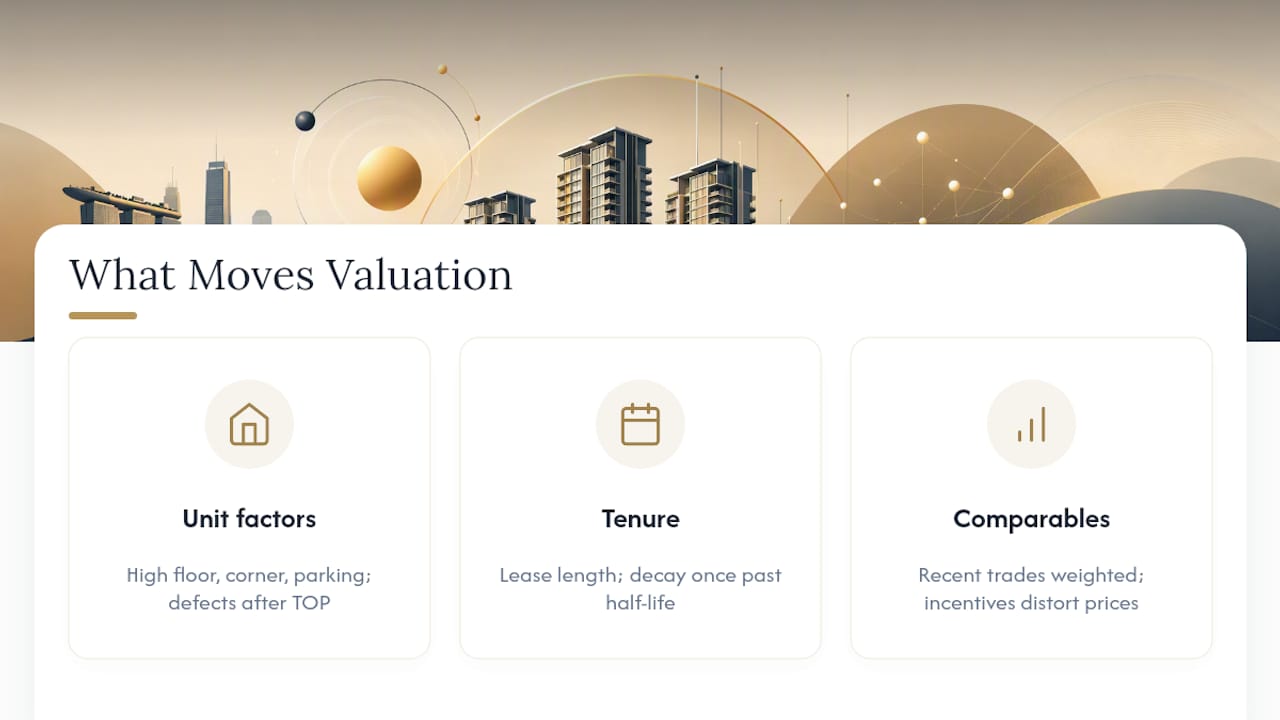
Unit-level factors carry real weight. A high floor with an unblocked view typically values higher than an identical layout facing a service road or a neighboring block. Corner units with better light, efficient layouts with less wasted space, and units with dedicated parking tend to command a premium in the valuer's adjustment calculations. Condition matters too, though for new launches this usually shows up only after Temporary Occupation Permit, when early resale comparables start reflecting finishing quality and any defects.
Tenure is a quieter but persistent factor. For 99-year leasehold developments, remaining lease length feeds directly into long-term value, and lease decay accelerates once a project passes the halfway mark of its lease. A brand-new 99-year launch has this working in its favor now, but it's worth understanding for anyone planning to hold and eventually sell.
Market comparables are the trickiest piece. Recency matters. A transaction from six months ago carries more weight than one from two years ago, and valuers discount older data during periods of price movement. Developer incentives, like absorbed stamp duty or furniture vouchers, can distort headline transaction prices without showing up as a separate line item, which sometimes explains why a valuation lands below what the price list suggests.
Pro Tip: Ask your agent for the actual transacted prices of units on your floor or one above and below it, not just the average price per square foot for the whole project. Valuers work off specific comparables, and so should you.
If the Valuation Comes in Low, Here's What to Actually Do
A shortfall isn't a dead deal, but every option has a cost or a deadline attached. Work through these roughly in order of how fast you can act:
- Top up in cash. This is the most common fix. You can use savings, and in many cases CPF Ordinary Account funds, though CPF rules set specific conditions on how much can go toward a down payment versus other costs. Banks will also want to see the source of any large cash top-up documented clearly.
- Negotiate with the developer. This works better than most buyers expect at new launches, especially if the project has multiple unsold units and the developer wants to keep momentum going. A price adjustment or absorbed fee is more realistic than a full price match, though.
- Switch lenders or loan products. Different banks sometimes return different valuations, since they may use different panels of valuers or weigh comparables differently. Refinancing to another bank before your OTP exercise deadline can occasionally close a modest gap, but it rarely helps with a large shortfall and eats into your exercise timeline.
- Consider a contractual exit or delay. Walking away from an OTP after the option fee is paid usually means forfeiting that fee, and exiting after exercise carries steeper contractual consequences. Read the sale and purchase agreement's forfeiture clauses before assuming this is a low-cost option.
Before deciding, request the full valuation report from your bank, not just the headline figure. Ask specifically which comparables the valuer used and what adjustments were applied. That paper trail is what you'd need if you decide to challenge the number or negotiate with the developer.
Your Pre-Purchase Financing Checklist
The best defense against a valuation surprise is sequencing. Line up these steps before you exercise your Option to Purchase, not after.
- Confirm with your bank exactly when the full valuation will be ordered and whether your Approval in Principle is conditional on it.
- Set aside a contingency fund, ideally a few percent of the purchase price, on top of your planned down payment.
- List every acceptable source for a potential top-up ahead of time: CPF Ordinary Account, savings, or proceeds from an existing property sale.
- Collect comparable transaction data yourself from your agent or URA's transaction records before committing.
- Note any developer incentives attached to your unit's price, since these can affect how a valuer reads the headline figure.
- Sync your timeline across your bank, mortgage broker, lawyer, and the developer's sales team so nobody is caught off guard by the OTP exercise deadline.
Pro Tip: Don't budget only for the down payment. Between buyer's stamp duty, legal fees, and a possible valuation gap, most new-launch buyers underestimate total cash needed by a wide margin until they see the final numbers laid out together.
Mapping Valuation Timing to a Real New-Launch Schedule
Buyers of new launch condominiums in Singapore typically move through milestones such as booking, exercising the Option to Purchase, progressive payments tied to construction stages, and eventual completion in the project's planned timeline. The bank valuation typically lands in the window right after OTP exercise, which is precisely when your financing needs to be locked down, not still being figured out.
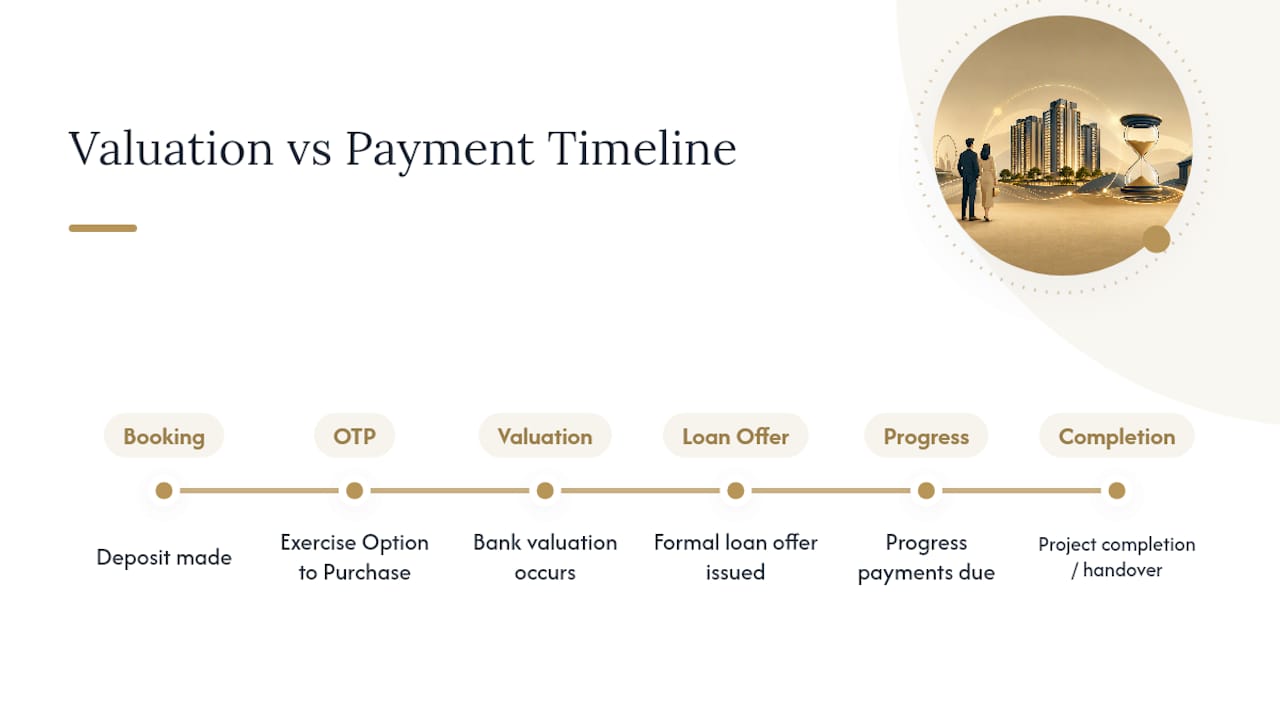
Sales representatives typically help buyers understand payment schedules stage by stage, which aids in seeing exactly when each disbursement is due and where a valuation shortfall would need to be covered. Matching that schedule against your bank's timeline early removes most of the last-minute scrambling that catches new-launch buyers off guard.
Why Valuation Risk Is a Cash Problem, Not a Price Problem
Most new-launch buyers treat valuation shortfall as a pricing debate, something to argue about after the fact. It's really a liquidity question you should be solving before you exercise the option, not after the bank's letter arrives.
In a market where valuations can lag fast-moving launch prices, the buyers who avoid trouble aren't the ones who negotiated hardest. They're the ones who kept enough cash on the side and asked their bank about valuation timing before signing anything. Coordinate early with your lender and agent. It's cheaper than finding out the hard way.
— Velisa
See Aurea's Payment Timeline and Buyer Resources
This new launch project features units across 2 to 5 bedroom layouts and penthouses, set for completion in the planned timeline. Because financing timelines matter as much as unit selection, Aurea's project page lays out payment schedules stage by stage, so you can see exactly when each payment falls due against construction progress.

If you're comparing unit types, 2 Bedroom units at Aurea run from $1,770,000 to $2,075,800, while larger layouts including 3 Bedroom, 4 Bedroom, and 4 Bedroom Premium units are listed with their own price ranges on the same page. Reviewing these figures alongside your bank's expected loan-to-value calculation, before you commit to an Option to Purchase, is exactly the kind of groundwork this guide walks through. Reach out to Aurea's appointed sales representatives to get a payment schedule specific to the unit and layout you're considering, and ask them to walk you through how progressive payments line up against your financing timeline.
Where to Verify These Rules Yourself
- MoneySense: affordability and loan-to-value guidance
- MAS: loan tenure and loan-to-value limits
- CPF: using CPF savings for a property down payment
- IRAS: buyer's stamp duty guidance
- URA: property transaction records
This article is general information, not a substitute for advice from a qualified financial advisor. Consult a qualified financial professional about your own circumstances before acting on anything here.
Sources
- MoneySense — Buying a property: how much can you afford?
- CPF — Can I use my CPF savings for the down payment of my property?
- IRAS — Buyer's stamp duty (BSD)
- MAS — Loan tenure and loan-to-value limits (housing loans)
FAQ
What Are the Upcoming New Launches in Singapore?
New launch activity in Singapore shifts throughout the year as developers roll out projects across different districts, including waterfront and city-fringe sites like Beach Road. Check URA's transaction data and individual developer sites for the most current project list, since availability changes month to month.
How Can I Find Out the Bank Valuation of a Property in Singapore?
You generally cannot request a formal bank valuation yourself before applying for a loan. Once you apply, the bank arranges a MAS-approved valuer to assess the unit, and the figure becomes part of your loan offer, not something published publicly beforehand.
Should I Buy a New Launch or Resale Condo?
It depends on your priorities. New launches offer newer facilities, progressive payment structures, and typically longer remaining lease terms, while resale units come with established, verifiable transaction histories that make valuation more predictable. Comparing new launch versus resale trade-offs against your own timeline and cash flow is the better starting point than picking one category outright.
Which Bank Gives the Highest Valuation?
No single bank consistently values higher than others, since each draws on its own panel of MAS-approved valuers and comparable data at a given point in time. Getting valuation estimates through more than one lender before committing can help you spot unusually low or high outliers, but the underlying comparable data tends to converge across banks over time.
What Happens if My Approval in Principle Doesn't Match the Final Loan Amount?
This is common and expected. Your Approval in Principle is based on your financial profile, not a locked figure against a specific unit, and the final loan amount only firms up after the full valuation report comes back.