
Yes, lease decay matters right now, whether you own an HDB flat, a leasehold condo, or you're shopping for either. It cuts resale value in visible bands, shrinks how much CPF you can use, and shortens the loan tenure a bank will offer once your remaining lease drops below certain thresholds. The three thresholds to know cold: CPF usage gets pro-rated once your flat's lease can't cover the youngest buyer to age 95, CPF and HDB loans are off the table entirely under 20 years remaining, and pricing pressure intensifies once you cross the 60-year mark.
PropKaki's tracking shows the gap is not theoretical: HDB resale flats with under 60 years left transacted at a median of S$557 psf in Q2 2026, versus S$751 psf for flats with 90+ years. A 25.8% difference.
Your urgent checklist before doing anything else:
- Pull your flat's exact remaining lease from your HDB lease documents or resale listing, not a rounded guess.
- Run a CPF and loan tenure scenario using your youngest co-owner's age against that exact lease figure.
Key Takeaways
Lease decay reduces leasehold property value in bands, shrinks CPF and loan eligibility past set thresholds, and directly affects rental yield and resale liquidity in Singapore.
| Point | Details |
|---|---|
| Know your exact remaining lease | Pull the precise figure from HDB records before running any CPF or Bala estimate. |
| Watch the CPF age-95 test | CPF usage gets pro-rated once the lease can't cover the youngest buyer to age 95. |
| The 60-year band is the pivot | Pricing pressure and loan tenure caps intensify sharply once remaining lease drops below 60 years. |
| Private condos may decay less than Bala predicts | Location and demand can buffer theoretical loss for well-positioned leasehold condos. |
| Consider a fresh 99-year tenure | Aurea's new-launch units at 802 Beach Road reset the lease clock entirely, avoiding near-term CPF and loan restrictions. |
This article is general information, not a substitute for advice from a qualified financial advisor. Consult a qualified financial professional about your own circumstances before acting on anything here.
Table of Contents
- What Lease Decay Means and How Bala's Table Measures It
- Real Transaction Data Tells a Sharper Story Than the Formula
- The CPF and Loan Rules That Actually Shrink Your Buyer Pool
- Resale Pricing and Timing: What Shorter Leases Do to Your Exit
- What Owners and Buyers Can Actually Do About It
- Notes for Buyers Weighing Short-Lease Risk Against New Launches
- The Legal Framework Behind Lease Expiry and Renewal Rights
- How HDB Flats and Private Condos Experience Decay Differently
- Where Lease Decay Pressure Is Heading Next
- What Lease Decay Does to Rental Yield and Investment Returns
- Sources
What Lease Decay Means and How Bala's Table Measures It
Lease decay is the loss in market value a leasehold property suffers as its remaining tenure shrinks toward zero. A freehold home never faces this. A 99-year leasehold flat or condo does, because the land eventually reverts to the state, and buyers price that expiry date into what they're willing to pay today.
The Singapore Land Authority's Bala's Table has been the industry's reference tool for decades. It converts remaining lease years into a percentage of freehold value, and the curve is not straight. Value erodes slowly in the early decades, then accelerates as the lease shortens, because financing and CPF restrictions start biting hard at the same time buyers grow wary.
Here's a simplified way to use it:
- Find your flat's remaining lease in years.
- Look up the corresponding Bala relativity percentage for that lease length.
- Multiply that percentage against a comparable freehold benchmark price for your area to estimate a theoretical leasehold value.
Apply that percentage to a S$1,000,000 freehold-equivalent benchmark and you get a rough anchor point, not a valuation.
Pro Tip: Treat Bala's output as a ceiling for older leases and a floor for younger ones. It tends to be conservative for flats under 40 years (real transactions can dip below it) and can overstate decay for well-located private condos where demand cushions the drop.
Real Transaction Data Tells a Sharper Story Than the Formula
Bala's Table is theory. The PropKaki Curve is what actually happened at the HDB resale counter. Its Q2 2026 band medians show a clear staircase: flats with 90 years or more remaining lease fetched S$751 psf, while flats under the 60-year mark fetched just S$557 psf, a 25.8% gap.
That gap isn't purely a lease-decay signal, though. A few things blur the picture:
- Town mix differs across bands. Older leases cluster in mature estates like Toa Payoh and Ang Mo Kio, which carry their own pricing dynamics independent of tenure.
- Flat size composition shifts too. Shorter-lease bands often skew toward smaller 3-room units, which naturally post lower psf figures than larger flats in newer estates.
The tracker's own methodology accounts for some of this by computing medians directly from official HDB resale transactions and suppressing any band-quarter with fewer than 10 sales, so the numbers you see reflect real liquidity, not thin samples.
For private condos, the picture gets more forgiving. A DR-NTU academic study on lease decay and resale pricing found that Bala's Table can overestimate depreciation for some leasehold condos, because location quality and ongoing demand buffer the theoretical loss. A well-positioned 99-year condo near an MRT interchange doesn't decay on schedule the way a formula assumes. Practically, that means private buyers shouldn't panic-price a unit purely off a Bala calculation, but HDB buyers should treat the PropKaki bands as the more reliable real-world signal.
The CPF and Loan Rules That Actually Shrink Your Buyer Pool
The financing rules are where lease decay stops being abstract and starts limiting your options directly. CPF Board applies a hard test: your CPF usage is pro-rated whenever the remaining lease does not cover the youngest buyer to age 95. Fall short of that coverage, and you can only use a portion of your CPF Ordinary Account, not the full balance. Drop under 20 years of remaining lease, and CPF is excluded entirely, along with HDB concessionary loans.
Banks apply a parallel squeeze. Loan tenure gets capped by the lowest of three limits: the bank's own policy ceiling (usually 30 years for HDB, 35 for private), the borrower's age cap, and the remaining lease minus a safety buffer. Guidance from the Monetary Authority of Singapore shapes how conservatively banks apply these caps, and once your tenure gets compressed, loan-to-value ratios often fall too, meaning a bigger cash outlay upfront.
Here's how that plays out for two realistic buyers:
Two adaptable steps for running your own numbers:
- Take your youngest co-owner's age, subtract it from 95, and compare that figure against the flat's remaining lease. Any shortfall triggers pro-rating.
- Check what happens if remaining lease minus a typical buffer produces a tenure shorter than what your monthly budget assumes. That gap often forces a larger downpayment. For readers weighing how much cash they'd need to bridge that gap, budgeting for a condo downpayment and understanding maximum loan tenure mechanics are worth reading before you commit to an offer.
Resale Pricing and Timing: What Shorter Leases Do to Your Exit
Discounts don't move in a straight line as lease years fall, they cluster around bands, and the transition points matter more than the raw year count. Properties with 75 to 99 years remaining trade closest to full market value. Once you drop into the 60 to 74 range, pricing softens moderately. The 40 to 59 band is where CPF pro-rating starts affecting a meaningful share of buyers, compressing demand further. Below 20 years, the pool of buyers who can even finance the purchase collapses, since CPF and HDB loans are excluded outright.
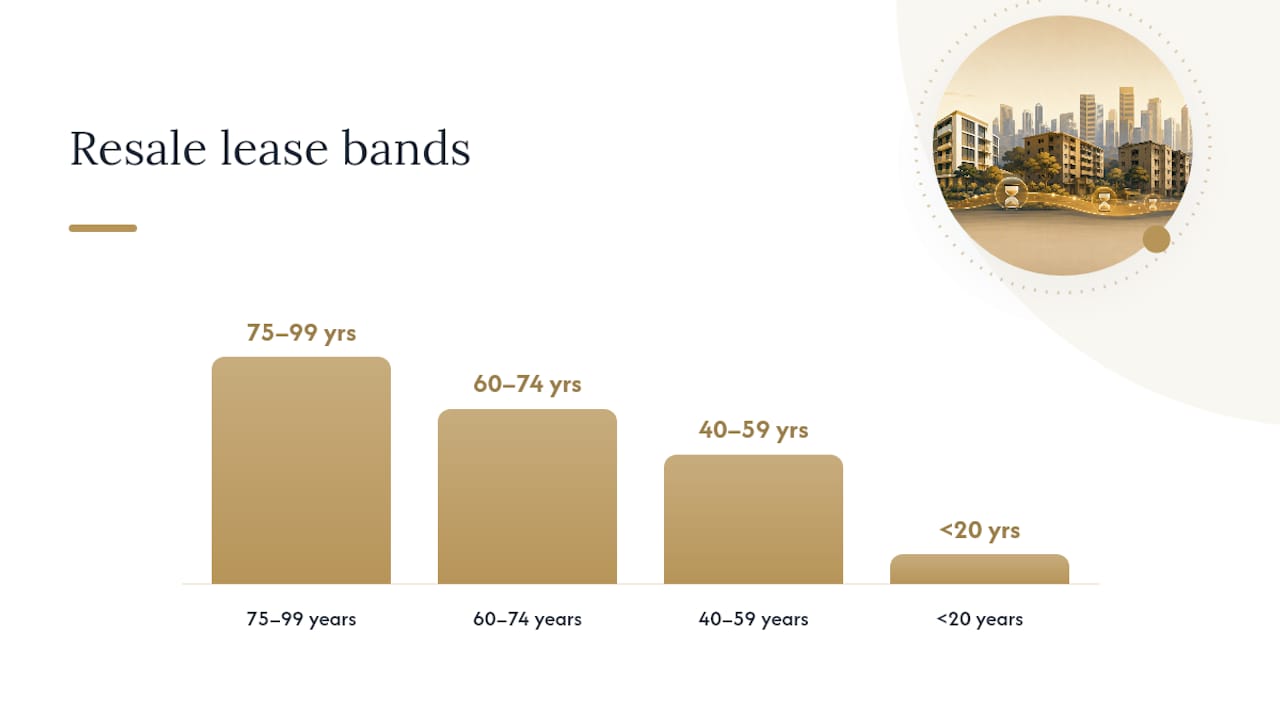
These ranges shift by location and flat type. A short-lease flat in a mature estate near an MRT station can still hold value better than a longer-lease flat in a less connected town, so treat band figures as directional, not a formula to apply blindly; for more on protecting property interests long term, consider how a Property Trust can help manage estate planning.
Shorter leases also mean thinner liquidity. Fewer buyers qualify for financing, which stretches time-on-market and gives buyers more negotiating leverage. If you're selling into that band, a few things help:
- Price slightly below the last comparable transaction in your exact lease band, not the broader estate average, to attract cash-ready buyers faster.
- Market directly to investors and cash buyers rather than first-time owner-occupiers who depend heavily on CPF and bank financing.
Pro Tip: If your estate has an upcoming URA Master Plan rezoning or a nearby MRT line extension, mention it explicitly in your listing. Redevelopment potential and transport upgrades are among the few factors that can partially offset lease-decay pricing pressure.
What Owners and Buyers Can Actually Do About It
Whether you're holding a short-lease flat or shopping for one, the same sequence of checks applies. Work through it before you list, offer, or negotiate.
- Confirm your exact remaining lease and run it through a Bala relativity estimate to get a rough value anchor.
- Run the CPF age-95 test and a bank tenure scenario together, since both restrict your buyer pool simultaneously.
- Price and market toward the buyer segment your lease band actually supports, cash investors for short leases, owner-occupiers for longer ones.
- Prepare marketing materials that lean on location, layout, and amenities rather than tenure, since tenure is the one thing you can't change.
Lease top-ups exist for select private developments under government-backed schemes, but they're the exception, not a fallback most owners can count on. HDB flats have no equivalent top-up mechanism. En bloc sales and the Selective En Bloc Redevelopment Scheme (SERS) do reset tenure entirely, but both are low-probability events that hit a small fraction of estates each year, not a retirement plan.
If you're eyeing a short-lease purchase, due diligence goes beyond the lease number itself. Check the sinking fund balance, ask for maintenance and major-works records, and scan for planned redevelopment nearby. Pro Tip: A healthy sinking fund on a 40-year-lease flat can matter more to your near-term costs than the lease figure itself, since deferred maintenance bills land regardless of how many years remain.

Notes for Buyers Weighing Short-Lease Risk Against New Launches
Aurea, a 99-year leasehold development at 802 Beach Road by GMC Property Pte. Ltd., illustrates the practical contrast: a fresh tenure clock versus an ageing one. Buyers comparing the two paths should weigh sinking fund health, expected major works, and cash buffer needs before deciding.
- Check the sinking fund balance and reserve fund top-up history on any resale unit.
- Ask for the last three years of maintenance records, not just the current statement.
- Budget a cash buffer for major works, since public funding rarely covers non-essential repairs on ageing condos.
Readers modeling their own numbers can dig deeper into loan and CPF mechanics on the Aurea blog.
The Legal Framework Behind Lease Expiry and Renewal Rights
Singapore's leasehold system rests on statutory land grants, not private freehold ownership. When a 99-year lease originally granted by the state expires, the property and its land revert to the state under the terms set out at the lease's origin, and current law does not guarantee any automatic renewal or compensation to the owner. HDB's own guidance confirms this directly: lease expiry returns flats to HDB without compensation, a point many first-time buyers underestimate because it feels distant when a lease still has 70 or 80 years to run.
There is no statutory right to renew a residential lease in Singapore the way some other jurisdictions allow. The exceptions that do exist, SERS for HDB estates and en bloc redevelopment for private condos, are discretionary and selective, not entitlements. SERS depends on government assessment of redevelopment potential and site suitability, and only a small number of estates get selected each year. En bloc sales require majority consent among owners and depend on developer interest, which itself depends on site value and zoning potential under the URA Master Plan.
For private leasehold land, some parcels operate under different original grant terms, and a minority carry 999-year or freehold status, which sidesteps the decay question entirely. Buyers should confirm tenure type directly from the title deed or the developer's sale documents rather than assuming based on the building's age or reputation, since tenure terms vary by original land grant, not by building type.
How HDB Flats and Private Condos Experience Decay Differently
Lease decay hits HDB flats and private condos through different mechanisms, even though the underlying math is similar. HDB flats face a narrower buyer pool restriction because most buyers depend heavily on CPF and HDB concessionary loans, both of which carry the age-95 and 20-year rules directly tied to lease length. That makes HDB resale pricing more sensitive to the exact remaining-lease figure, which is why PropKaki's band-based tracking shows such a clean staircase pattern across HDB transactions.
Private condos behave differently. Buyers there more often use bank loans rather than HDB concessionary financing, and banks apply their own tenure formulas rather than the CPF-specific age-95 test. That gives private leasehold buyers slightly more financing flexibility at the margins, though MAS-influenced tenure caps still apply once remaining lease shortens materially.
Location quality also plays a larger role in private condo pricing resilience. The DR-NTU study found Bala's Table can overstate decay for well-positioned private leasehold units, a pattern less pronounced in HDB estates where flat type and town classification dominate pricing more than micro-location differences. Practically, this means a private condo buyer has more room to bet on location offsetting tenure risk, while an HDB buyer should weight the remaining-lease figure more heavily in their decision.
Where Lease Decay Pressure Is Heading Next
The scale of the issue is set to grow before it plateaus. Singapore's earliest HDB estates, built in the 1960s and 1970s, are steadily crossing the 60-year remaining-lease threshold that historically marks the start of steeper pricing pressure, according to CheckHowMuch's analysis of value loss patterns across lease bands. More flats entering that band each year means more transaction data feeding trackers like PropKaki, which should make band medians increasingly reliable as a pricing guide rather than less.
Expect financing rules to stay the anchor point rather than the lease figure itself. The CPF age-95 test and the 20-year exclusion have remained structurally stable, and any future adjustment would likely come from CPF Board policy review rather than market pressure alone. Buyers should watch CPF Board announcements directly rather than relying on secondhand commentary about pending rule changes.
On the private side, expect academic and industry scrutiny of Bala's Table to keep growing, particularly as more transaction data accumulates for leasehold condos built in the 1990s and 2000s that are now approaching the same 60-year inflection point HDB flats already face. If the buffering effect the NTU study observed holds up across a larger dataset, expect valuers and buyers to increasingly treat Bala as a starting point rather than a final answer for private leasehold pricing, especially in prime and well-connected locations.
What Lease Decay Does to Rental Yield and Investment Returns
Rental yield calculations often ignore lease decay entirely, which is a mistake for anyone holding a leasehold unit as an investment rather than a home. Yield is just annual rent divided by purchase price, but the purchase price itself already reflects the market's pricing-in of remaining lease. A unit bought cheap because it sits in a shorter-lease band can post a higher headline yield, since the denominator is smaller, while carrying more capital-value risk over the holding period.
The real distortion shows up at exit. An investor who buys a flat with 55 years remaining and holds for 15 years sells with 40 years left, right in the band where CPF pro-rating and tighter loan tenure start cutting into the buyer pool. Even if rental income held steady throughout, the capital appreciation (or depreciation) component of total return can turn negative, dragging down the investment's overall performance despite decent yield along the way.
This matters most for buyers treating a leasehold unit as a long-hold retirement asset. A property generating solid rent today can still underperform on total return if its lease crosses a financing threshold during the holding period. Investors should model total return, not yield alone, and factor in where the remaining lease will land at their planned exit date, not just at purchase.
A Short Note on Balancing Tenure Risk With Life Plans
Weigh tenure risk against your actual timeline: a 5 to 15 year planning horizon suits most buyers, but retirement assets deserve a conservative bias toward longer leases. For deeper, personalized modeling, the Aurea blog is worth exploring further.
— Velisa
A New-Launch Path That Resets the Tenure Clock
If a shorter remaining lease and its financing restrictions are the exact problem you're trying to avoid, buying a fresh 99-year leasehold unit sidesteps it outright. Aurea, located at 802 Beach Road, offers 188 units across 2 to 5 bedroom layouts plus two penthouses, with resort-style amenities spread across four levels and a link bridge connecting directly to The Golden Mile. Completion is slated for 2029.
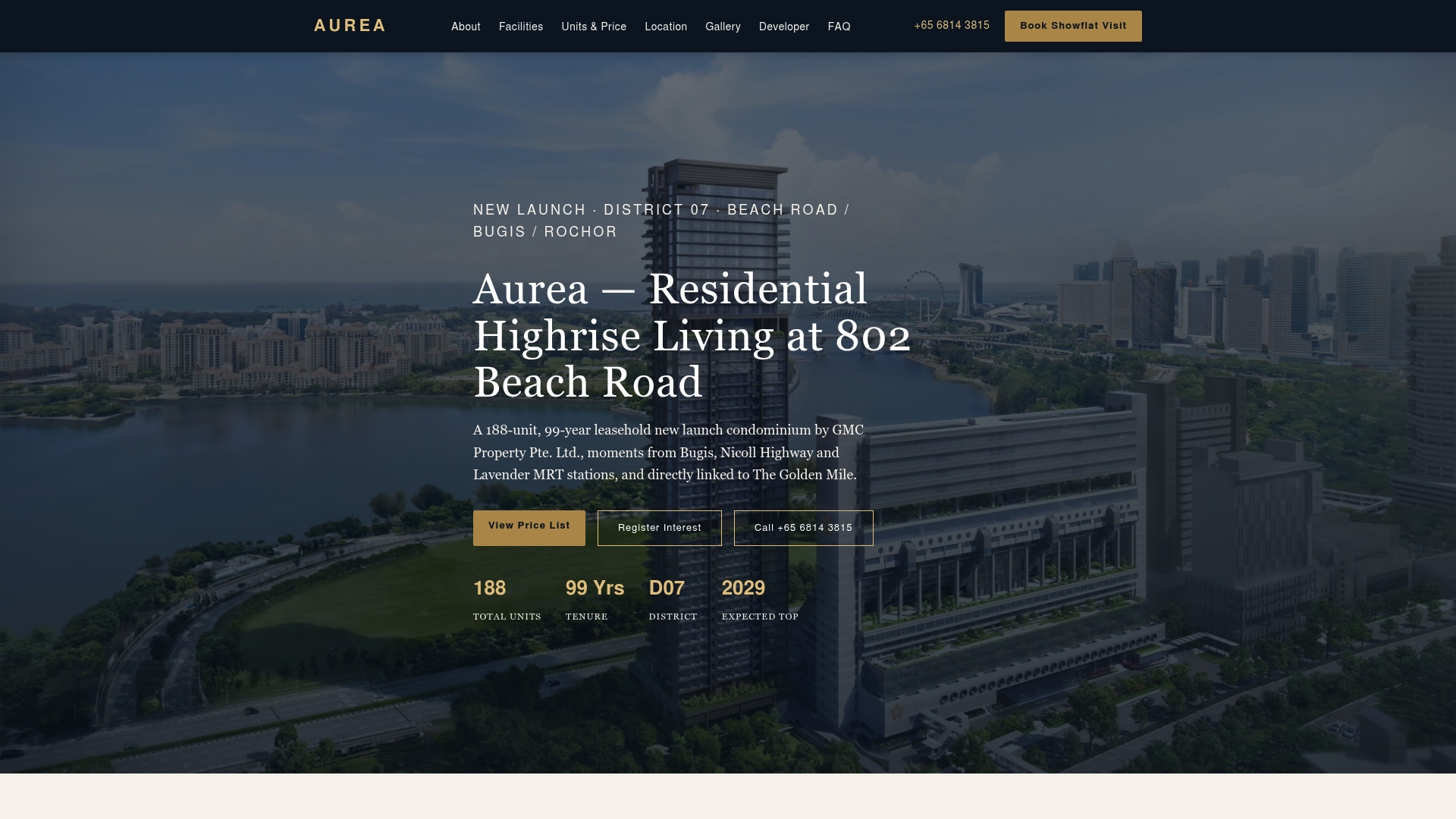
For a family or professional weighing a leasehold purchase, starting fresh at year 99 means CPF pro-rating and tenure-linked loan caps aren't a concern for decades, unlike a resale unit already partway down the decay curve. Aurea sits close to multiple MRT stations, which matters for the same reason location matters in the resale market: it's one of the few things that can offset pricing pressure as any lease ages over time. If you want to see how the unit mix and layouts fit your own timeline, check the latest updates on the Aurea project page and schedule a viewing.
Sources
- CPF Board — How much CPF savings can I use to buy a property if its lease does not cover the youngest buyer to age 95?
- PropKaki — HDB lease decay tracker (PropKaki Curve)
- The Straits Times — Ageing condos: public funding limits (BCA clarification)
- Housing & Development Board (HDB)