
Before you register for any new launch, you need three things locked in: an Approval-in-Principle from a bank, a solicitor already engaged, and cash or CPF ready to cover 20% of the purchase price plus any Additional Buyer's Stamp Duty due within 14 days of exercising your Option to Purchase. Walk into booking day with a ranked list of backup units, since your ballot number determines your time slot and the best stacks disappear fast. If your cash buffer for duties isn't sitting in the bank yet, wait for the next launch.
TL;DR:
- You need an approved bank loan (AIP) before booking and sufficient cash or CPF ready to cover 20% plus duties within 14 days of exercising the OTP.
- Stamp duties (BSD and ABSD) must be paid within 14 days of OTP exercise, with ABSD depending on residency status and number of existing properties.
- The booking process is influenced by ballot numbers, with popular units disappearing quickly, so ranking backup choices is essential.
- Financing relies on a 75% loan-to-value ratio, TDSR limit of 55%, and interest-only payments during construction on disbursed amounts, not the full loan.
- Most mistakes happen when buyers overlook deadlines, underestimate ABSD costs, or fail to verify developer licenses and project plans before committing.
Table of Contents
- What Is the New Launch Condo Buying Process in Singapore?
- How Much Financing Do You Need and When?
- What Stamp Duties and Taxes Apply to New Launch Purchases?
- How Does the Balloting and Booking Day Process Work?
- What Happens During Progressive Payments and at Key Collection?
- What Due Diligence Should You Do Before Exercising the OTP?
- What Costs Come After You Sign the S&P?
- What Are the Biggest Risks and Mistakes to Avoid?
- Velisa's Checklist and Priorities for New Launch Buyers
- See What Aurea Offers a Singapore New Launch Buyer
- Sources
- FAQ
What Is the New Launch Condo Buying Process in Singapore?
Buying a new launch condo in Singapore follows a fixed legal sequence set out under the Housing Developers (Control and Licensing) Act, and skipping a step isn't an option. Here's how it runs from the first email to the day you collect your keys.
- Register interest (EOI) and review the price list. Developers open an expression-of-interest period before launch, often with a preview for early registrants. You'll get indicative pricing, floor plans, and a sense of which stacks are selling fastest.
- Ballot and booking day. If demand outstrips supply, the developer assigns ballot numbers that determine your appointment slot. Show up with your unit shortlist ranked, because slots move in 15 to 30 minute windows and popular layouts vanish within the first hour.
- Pay 5% and receive your Option to Purchase (OTP). This fee is typically payable by cheque, and it reserves your unit while the OTP gives you a fixed exercise window.
- Exercise within three weeks. You have 21 days from the OTP date to sign the Option to Purchase and pay the remaining 15%, bringing your total upfront commitment to 20%. Miss this window and the developer can forfeit your booking fee entirely.
- Sign the Sale & Purchase Agreement (S&P). Your solicitor lodges this with your bank, which then begins scheduling loan disbursements against construction milestones.
- Pay stamp duty. Buyer's Stamp Duty and any Additional Buyer's Stamp Duty are due within 14 days of exercising the OTP, according to URA's developer guidelines. Late payment triggers penalty interest, no exceptions.
- Progressive payments through construction. You'll pay in stages tied to milestones like foundation work, structural completion, and roofing.
- TOP and CSC. Temporary Occupation Permit means you can collect keys; Certificate of Statutory Completion follows later and closes out the defects liability period.
Each stage has a legal deadline attached to it, and the earliest ones (exercise and stamp duty) are the ones that trip up unprepared buyers most often.
How Much Financing Do You Need and When?
Getting your financing sorted before booking day isn't optional. Developers and agents expect to see an AIP letter, and banks won't budge on the numbers once you're committed.
Here's what actually shapes your borrowing capacity:
- Approval-in-Principle (AIP): A conditional loan offer from your bank based on income, existing debt, and the property's indicative value. Get this before you book, not after.
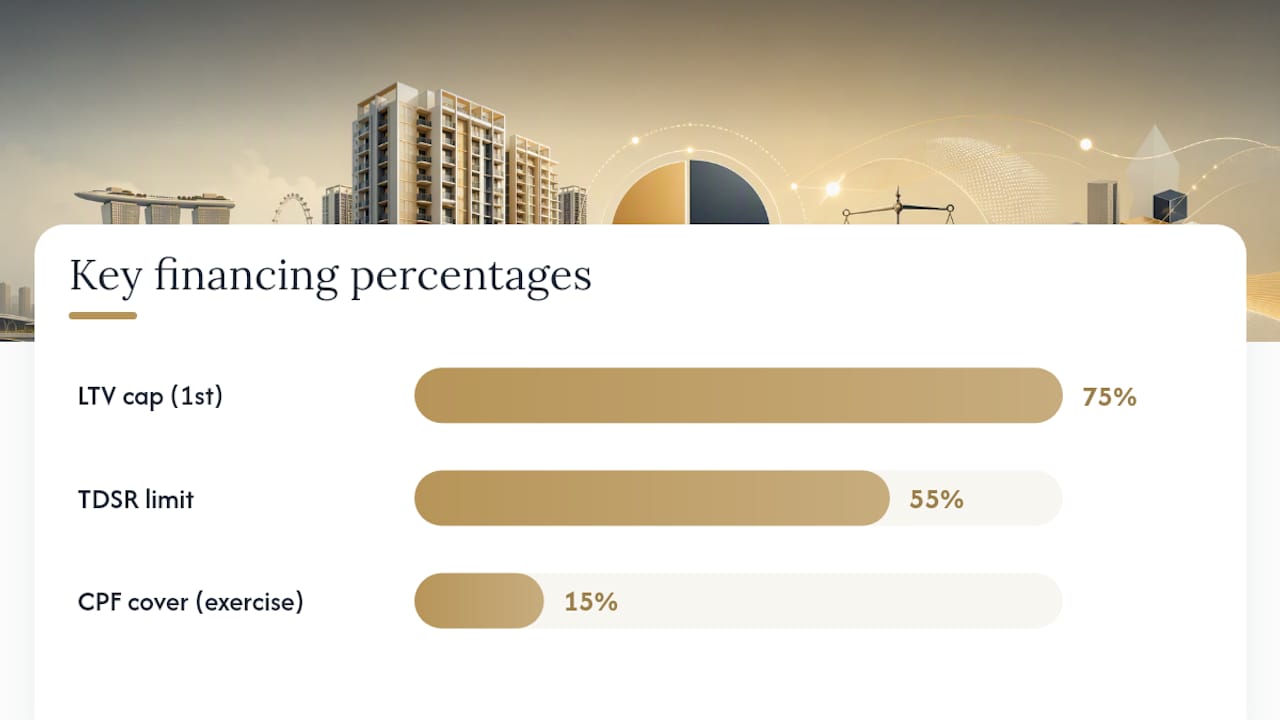
- Loan-to-Value (LTV): Banks lend up to 75% for a first home loan on private property, per MAS lending guidance. A second mortgage caps out lower.
- Total Debt Servicing Ratio (TDSR): Your total monthly debt obligations, including the new mortgage, can't exceed 55% of gross monthly income. Banks stress-test this against a higher notional interest rate, not your current promotional rate.
- Interest During Construction (IDC): You only pay interest on loan tranches actually disbursed at each milestone, not on the full loan amount from day one. This keeps early carrying costs manageable but creeps up as construction progresses.
- CPF usage: You can use CPF Ordinary Account savings for the 15% exercise payment and progressive payments, but ABSD must come from cash.
Pro Tip: Get your AIP from at least two banks before booking day. Rates and TDSR calculations vary slightly, and having two offers in hand gives you negotiating room and a fallback if one bank's underwriting drags.
Budget for a downpayment stress test now rather than after you've fallen in love with a unit. A cash downpayment budget breakdown helps you separate what CPF covers from what needs to sit in your bank account in cash.
What Stamp Duties and Taxes Apply to New Launch Purchases?
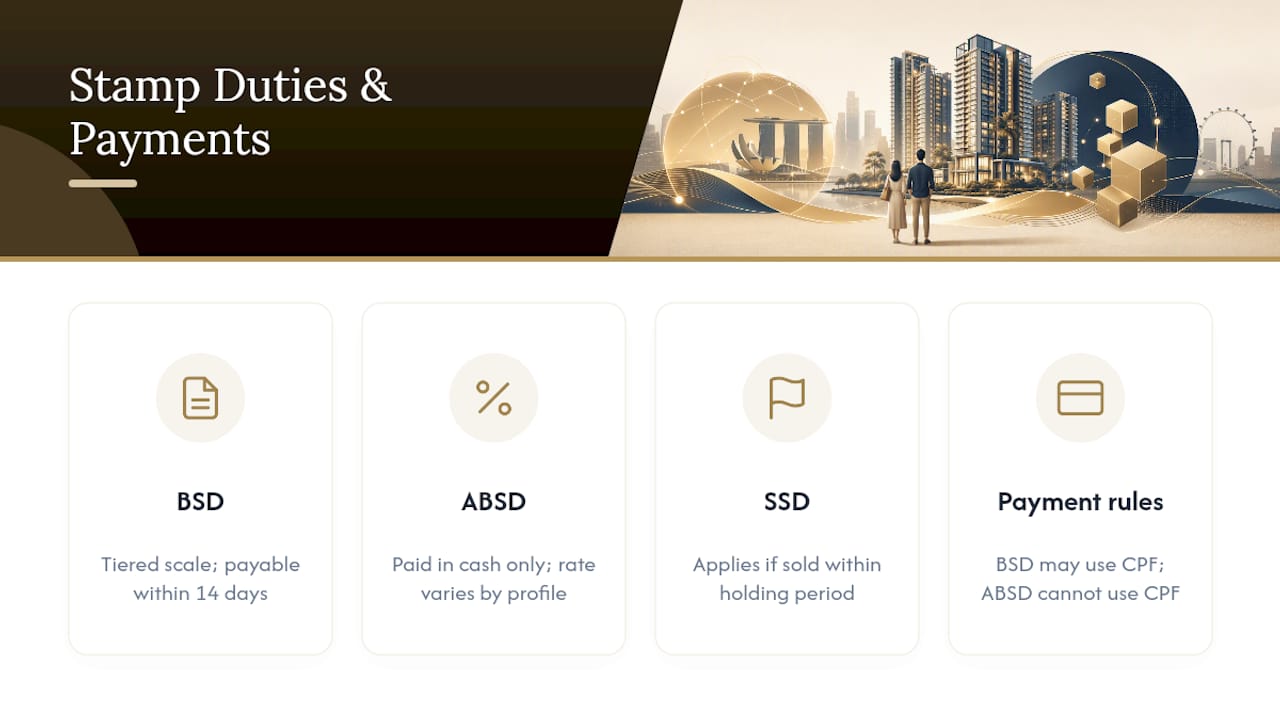
Buyer's Stamp Duty (BSD) applies to every property purchase in Singapore on a tiered scale based on price, and it's due within 14 days of exercising your OTP. Miss that deadline and IRAS charges penalty interest on top of the duty owed.
Additional Buyer's Stamp Duty (ABSD) is where cashflow planning actually matters. ABSD must be paid entirely in cash, never CPF, and the rate depends on your residency status and how many properties you already own, according to IRAS's ABSD schedule). A Singapore citizen buying a first property pays no ABSD. A citizen buying a second property, a permanent resident, or a foreign buyer each face materially different rates, and the gap between those brackets can run into hundreds of thousands of dollars on a single unit.
Stamp duty deadline: Both BSD and any ABSD owed must be settled within 14 days of exercising the OTP, whether you're paying from cash, CPF (for BSD only), or a mix of both.
Seller's Stamp Duty (SSD) applies if you sell within the statutory holding period, and it's a real constraint if your exit strategy involves flipping before TOP. Recent policy has adjusted SSD windows and rates over time, so check the current SSD holding period rules before assuming you can sell quickly for a profit. Run your own numbers against worked stamp duty examples before you commit to a unit, and see current ABSD rates for your specific buyer profile.
How Does the Balloting and Booking Day Process Work?
Popular launches use a ballot system: the developer collects EOIs, assigns ballot numbers, and those numbers translate directly into appointment time slots on booking day, as StackedHomes explains in its booking-day walkthrough. A low ballot number gets you an early slot and first pick of the best-priced units before price adjustments kick in for later tranches.
Before you even reach booking day, your showflat visit should answer specific questions:
- Does the layout waste space on long corridors or an oversized bathroom relative to the bedroom?
- What's the actual noise exposure, given the unit's orientation toward roads, MRT lines, or neighboring blocks?
- How far is the unit stack from the pool deck, gym, or function rooms, and does that proximity mean noise or added privacy?
- Does the facing direction give you afternoon heat load that will hike your air-conditioning bills?
Your ranked shortlist matters here: if your first choice is gone by the time your slot arrives, you want your second and third choices decided in advance, not debated on the spot. Reviewing a showflat checklist cross-referenced against URA and ONEMap before you go saves you from discovering a planned expressway behind your "unblocked view" after you've already booked.
What Happens During Progressive Payments and at Key Collection?
The Progressive Payment Scheme ties your payments to construction milestones rather than a lump sum, and the percentages are fairly standardized across most new launches, per LovelyHomes' payment breakdown.
- Foundation work typically triggers an early progressive payment after your initial 20%.
- Structural completion (main frame, walls) triggers another tranche.
- Roofing, doors, and windows and other finishing milestones each release further payments as they complete.
- TOP (Temporary Occupation Permit) is when the final major payment falls due and you can collect keys.
- CSC (Certificate of Statutory Completion) follows later, closing out the defects liability period during which the developer must fix defects reported.
Your bank disburses loan tranches to match each milestone, and interest during construction accrues only on amounts actually drawn down. At key collection, walk through the unit methodically: check for tiling defects, test every tap and switch, and log everything in writing within the defects liability window. A detailed 30-day key collection checklist covers what to inspect before you sign off.
What Due Diligence Should You Do Before Exercising the OTP?
- Confirm the developer's Sale Licence through URA's Controller of Housing register, which lists every licensed project and its sale conditions.
- Have your solicitor review the S&P for delay remedies, defects liability terms, and any retention sums held back at handover.
- Check the URA Master Plan and REALIS for planned infrastructure, upcoming supply nearby, and zoning that could affect your unit's future value.
- Cross-check ONEMap for exact distances to MRT stations and schools that marketing materials sometimes round generously.
Pro Tip: Ask your solicitor specifically what happens if TOP is delayed beyond the contractual date. Most S&P agreements include compensation clauses, but the rate and trigger conditions vary, and you want this in writing before you exercise, not after.
URA's eservice for developer sales data lets you check transaction prices and confirm the project's licensing status independently of what the sales gallery tells you.
What Costs Come After You Sign the S&P?
Your total budget doesn't stop at the purchase price.
- Renovation typically runs from a light refresh to a full renovation depending on unit size and finish level, and this sits outside your mortgage.
- Interest during construction accrues as your bank disburses each progressive payment tranche.
- Holding costs including maintenance fees and property tax start once TOP is issued, even before you move in.
- Contingency buffer for a delayed TOP, since every extra month of construction extends your IDC exposure and rental holding costs if you're not living there yet.
What Are the Biggest Risks and Mistakes to Avoid?
Most costly new-launch mistakes are avoidable with basic diligence:
- Opaque pricing or missing Sale Licence details are a red flag; walk away if the developer can't produce a licence number on request.
- Over-leveraging past what TDSR comfortably allows leaves no room for a rate hike or income disruption during a multi-year construction period.
- Underestimating ABSD as a cash requirement, rather than treating it as an afterthought, is the single most common budgeting error among first-time new-launch buyers.
- Ignoring the supply pipeline nearby; check the URA Master Plan for competing launches that could pressure rental yields or resale value after TOP.
Velisa's Checklist and Priorities for New Launch Buyers
If I had eight weeks before a launch, I'd spend the first two on financing, not showflat visits. Get your AIP, engage a solicitor, and build your cash buffer before you fall for a floor plan. Rank three units, not one, because the one you want rarely survives to your ballot slot. And if the numbers only work with a rosy rental assumption, walk away. That discipline matters more than the view.
— Velisa
See What Aurea Offers a Singapore New Launch Buyer
If the priorities in this guide line up with what you're after, Aurea is worth a direct look. It sits at 802 Beach Road with a link bridge straight into The Golden Mile and short walks to multiple MRT lines, which matters if daily commute time is part of your buying decision. The 188-unit mix runs from 2 bedroom to 5 bedroom layouts and two penthouses, with resort-style amenities spread across four levels, so the unit-shortlist exercise from earlier in this guide has real range to work with here.
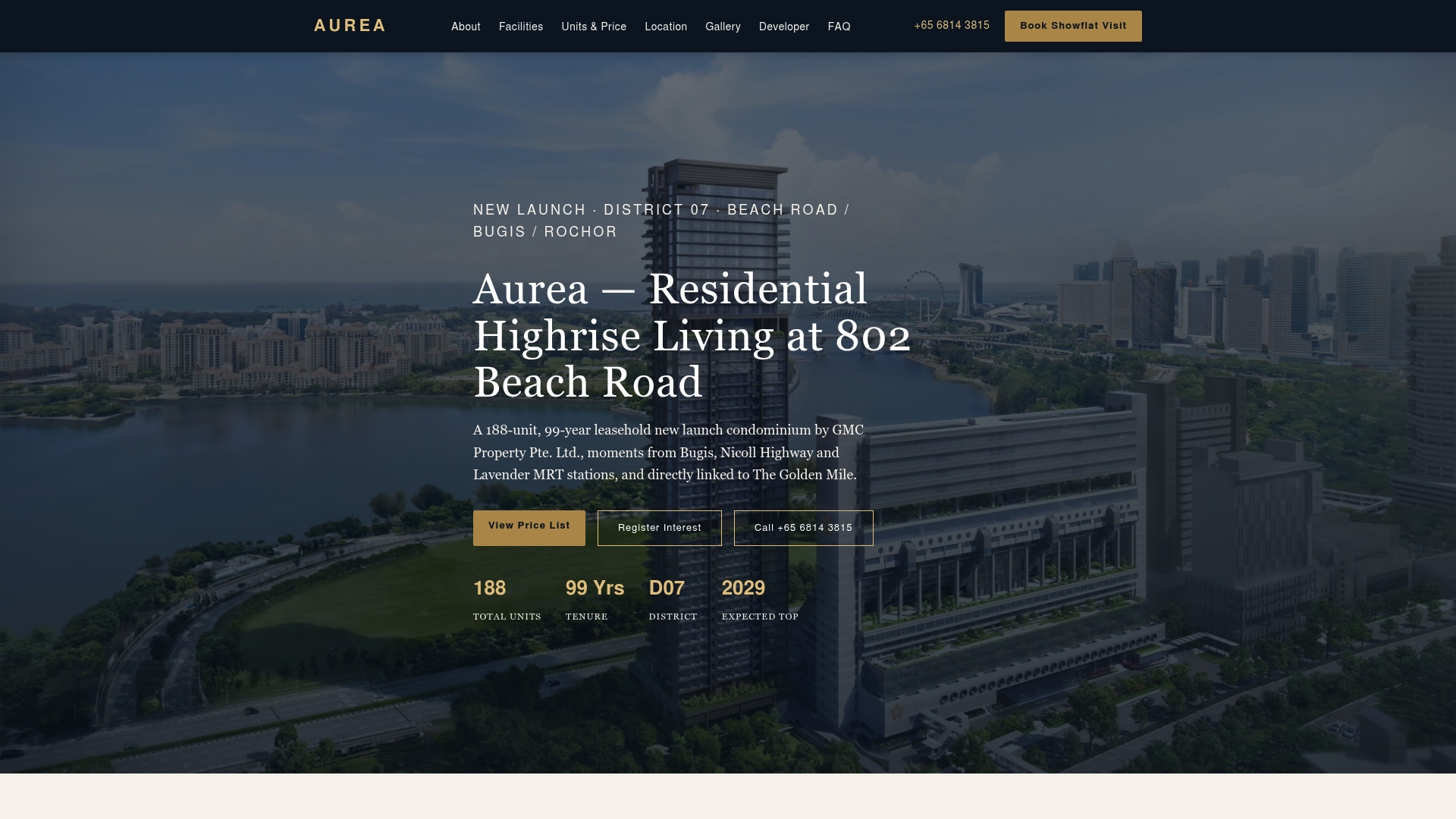
Pricing starts from $1,770,000 for a 2 Bedroom unit and runs to $3,058,600 for a 3 Bedroom, with 4 Bedroom units listed from $4,080,510 and 4 Bedroom Premium from $5,186,105. Pricing for the 5 Bedroom and Penthouse layouts is available on request. Aurea is a project developed and published by this site, and we're upfront about that. If it fits your shortlist, request the full price list and floor plans, or book a showflat viewing directly through the Aurea project page.
This article is general information, not a substitute for advice from a qualified financial advisor. Consult a qualified financial professional about your own circumstances before acting on anything here.
Sources
- Housing Developers (Control and Licensing) Act / URA developer guidelines
- Monetary Authority of Singapore (MAS) — lending and TDSR guidance
- URA developer sales and project data (eservice)
FAQ
Can I use CPF for the ABSD payment?
No. ABSD must be paid entirely in cash; CPF Ordinary Account savings can cover BSD and progressive payments but not ABSD.
How does the ballot system affect which unit I get?
Your ballot number determines your booking day time slot, so a later number means the most popular stacks and floors may already be sold by the time your appointment arrives.
Is Aurea a good fit for a first-time new launch buyer?
Aurea's mix of 2 to 5 bedroom layouts and central location near multiple MRT lines suits families and professionals following the cashflow steps in this guide; full pricing and floor plans are available through the Aurea project page.