
A mortgage lock-in penalty is a fee your bank charges when you refinance, redeem, or sell your property before a fixed lock-in period ends. The exact penalty percentage varies and should be confirmed in your facility letter. Pull out your facility letter right now and check two things: the lock-in expiry date and the exact penalty percentage listed in the fees schedule. That number, multiplied against your loan balance, tells you exactly what's at stake before you make any refinancing move.
TL;DR:
- Lock-in penalty rates typically range from 0.75% to 1.5% of the outstanding loan balance, increasing with longer remaining lock-in periods and larger loan sizes.
- Refinancing during the lock-in period almost always triggers the penalty, unless the loan specifies a sale waiver clause or involves internal rate switching with the same bank.
- To avoid paying the penalty and higher thereafter rates, start reformulating refinancing plans at least four months before the lock-in expires and compare offers in advance.
- Running the numbers carefully is essential, as legal subsidy clawbacks and partial prepayment caps can significantly affect total costs when exiting before lock-in ends.
- Verifying conditions regarding penalty triggers, waiver clauses, and notice periods in your facility letter ensures you understand your obligations before making refinancing decisions.
Table of Contents
- What Lock-In Periods and Lock-In Penalties Actually Mean
- What the Penalty Actually Costs in Dollars
- Triggers and Exceptions: When You Do (and Don't) Pay
- Timing It Right: A Four-Month Plan to Avoid the Thereafter Rate
- How to Reduce or Avoid Paying the Penalty
- Your Facility Letter Checklist Before You Call the Bank
- What This Means for New-Launch Condo Buyers
- Where to Verify the Details Yourself
- Why Most Advice on Lock-In Penalties Misses the Point
- Sources
What Lock-In Periods and Lock-In Penalties Actually Mean
Singapore mortgages carry two different kinds of "lock" that people constantly mix up. A pre-closing rate lock protects your interest rate while the bank processes your loan application, before disbursement. A post-disbursement lock-in period is different: it's the window, usually two to three years, during which you agreed to stay with that bank in exchange for a lower promotional rate. Break it early, and you pay a fee. MoneySense's guidance on how home loans work confirms this distinction and notes that penalties may apply while you remain inside the lock-in window.
Banks spell this out in the facility letter and accompanying fees schedule, usually under a heading like "Prepayment/Cancellation Fee" or "Early Redemption Charge." DBS's published fees and charges page is a useful reference for how one major bank itemizes these costs. The wording usually differs by trigger:
- Refinancing to another bank almost always counts as a full redemption and triggers the penalty.
- Full redemption (paying off the entire loan, whether from savings, sale proceeds, or another lender) triggers it too.
- Partial prepayments beyond your allowed cap (often 10% to 20% of the outstanding balance per year) can trigger a partial penalty on the excess amount.
- Selling the property without a waiver clause in your facility letter usually counts as redemption, not an exemption.
What the Penalty Actually Costs in Dollars
Most Singapore banks charge somewhere between 0.75% and 1.5% of your outstanding loan balance if you exit during lock-in, according to guidance from both Maybank and Loansaver's breakdown of local lock-in practice, which points to 1.5% as a commonly cited figure among Singapore lenders. The exact rate depends on the bank, the loan package, and how many years remain in your lock-in term.
The math looks like this: on an outstanding loan of $800,000, a 1.5% penalty costs $12,000. At 0.75%, the same balance costs $6,000. That's the difference between two banks' fine print, applied to one homeowner's decision to refinance in the same month.
A few things push that number around in practice:
- Loan size. The penalty scales directly with your outstanding balance, not your original loan amount, so paying down principal early shrinks the eventual penalty too.
- Remaining lock-in tenure. Some banks taper the rate down the closer you get to the lock-in's natural expiry.
- Legal subsidy clawbacks. If your bank paid your legal fees or gave you a cash rebate at loan signing, a clawback clause may require repaying that subsidy separately from the lock-in penalty. This is contract-specific and can add several thousand dollars on top of the redemption fee.
Triggers and Exceptions: When You Do (and Don't) Pay
Not every early move costs you money. Here's how the common scenarios actually shake out:
- Refinancing to a new bank during lock-in almost always triggers the full penalty, calculated on your outstanding balance at the time of redemption.
- Full redemption from sale proceeds triggers the penalty too, unless your facility letter contains a sale waiver clause, common in some packages, which exempts you from the fee specifically when the loan is redeemed because of a property sale.
- Partial prepayment within your annual allowance (often 10% to 20% of the loan) is usually penalty-free. Anything above that cap gets charged at the standard rate.
- Internal repricing (switching to a different rate package with the same bank) typically avoids the penalty entirely, since you're not leaving the lender.
- Legal subsidy clawback periods run separately from lock-in penalties and sometimes extend longer. You could clear the lock-in window and still owe a clawback if you exit before that separate period ends.
The sale waiver is worth confirming in writing. Some facility letters grant it automatically; others require you to request it or only apply it under specific conditions, like selling to an unrelated third party rather than transferring within family.
Timing It Right: A Four-Month Plan to Avoid the Thereafter Rate
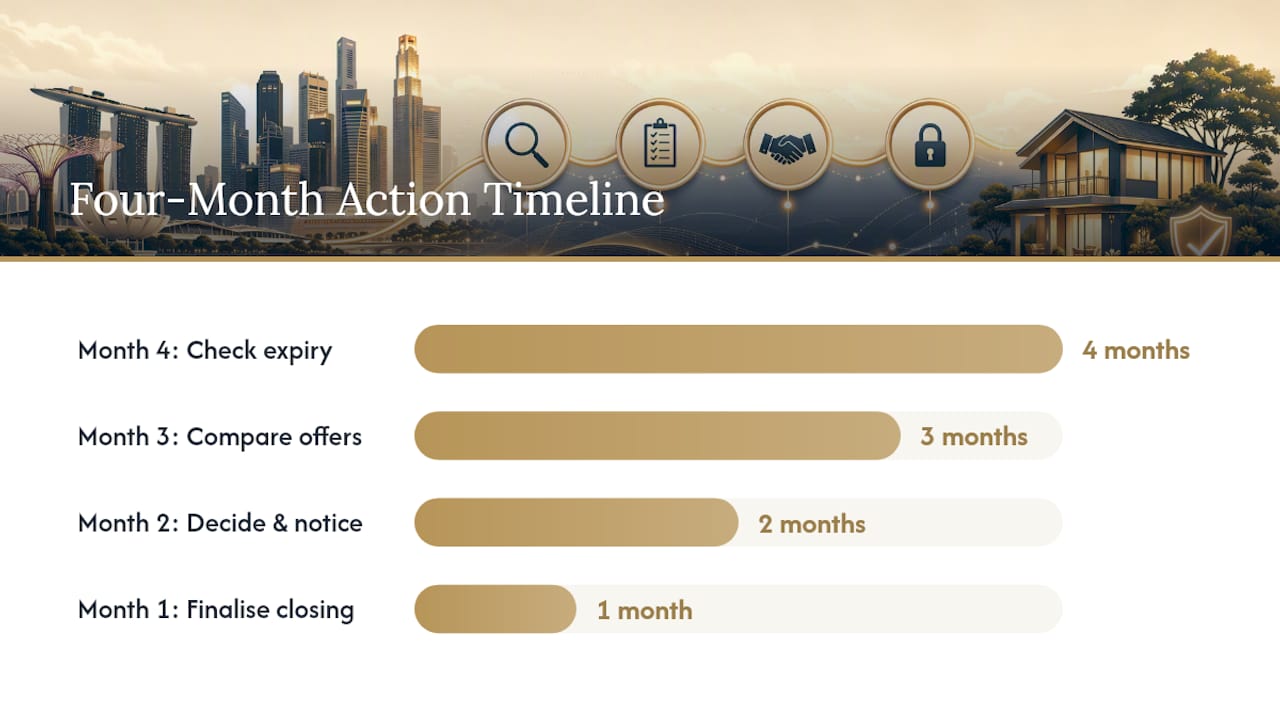
Once your lock-in period ends, your loan usually reverts to a "thereafter rate," which is often meaningfully higher than your promotional rate. Miss the window to reprice or refinance, and you'll pay that higher rate for however long it takes to sort out new paperwork. Loansaver's guidance recommends starting the process around four months before your lock-in expires, and that buffer isn't arbitrary. Most banks require two months' notice for redemption, and legal processing for a refinance, new valuation, disbursement, and discharge of the old mortgage, eats up the rest.
Here's the sequence that keeps you off the thereafter rate:
- Month 4: Check your facility letter for the exact expiry date and request an indicative repricing quote from your current bank.
- Month 3: Compare that quote against refinancing offers from at least two other banks, factoring in legal subsidies and processing fees.
- Month 2: Decide between repricing and refinancing. If refinancing, issue your formal redemption notice through your conveyancing lawyer to meet the bank's notice window.
- Month 1: Finalize the new loan's valuation, disbursement, and old mortgage discharge before lock-in expiry hits.
Pro Tip: Ask your current bank for an indicative repricing rate even if you're leaning toward refinancing elsewhere. It costs nothing to request, and it gives you a real number to negotiate against, sometimes the bank will match or beat an external offer just to keep your business.
How to Reduce or Avoid Paying the Penalty
The cheapest exit is often the one you never have to pay for. Before committing to any move, run the numbers side by side: penalty amount, legal fees for a new loan, administrative charges, and any subsidy clawback, against what you'd actually save in interest over the next few years. A refinance that saves $200 a month looks a lot less attractive once you subtract a $12,000 penalty and $3,000 in legal costs.
A few tactics genuinely move the needle:
- Ask for internal repricing first. It's almost always penalty-free and gives you leverage when discussing terms with a competing bank.
- Negotiate the spread, not just the headline rate. Some banks will shave points off a repricing offer for existing customers with clean repayment histories.
- Use your annual prepayment allowance strategically. If you're planning a partial payoff, spread it across lock-in years to stay under the penalty-free cap each time.
- Coordinate sale proceeds with your waiver clause. If you're selling and your facility letter includes a sale waiver, confirm the paperwork trail your bank needs to actually apply it, don't assume it's automatic.
Your Facility Letter Checklist Before You Call the Bank
Pull your loan documents and check these items before you pick up the phone:
- Lock-in expiry date, usually stated as a specific date or "X years from disbursement."
- Penalty percentage wording, and whether it applies to full redemption only or also partial prepayments above the cap.
- Notice period required for redemption, commonly one to two months.
- Sale waiver clause presence, and any conditions attached to it.
- Permitted annual prepayment amount without penalty.
- Subsidy clawback window, which may run longer than the lock-in itself.
When you call your bank or conveyancing lawyer, ask directly: "What's my exact penalty if I redeem this month?" and "Is there a subsidy clawback separate from the lock-in fee?" Request a written breakdown, not a verbal estimate, before you commit to anything.
What This Means for New-Launch Condo Buyers
If you're buying a new launch, your financing timeline runs on a different clock than someone refinancing an existing flat. Check whether your legal subsidy clawback window extends past your projected completion date, and make sure your lock-in expiry doesn't land awkwardly close to your move-in schedule, that overlap can force a rushed refinance decision right when you're also settling moving costs.
If you're using a bridging loan to cover the gap between your existing property's sale and your new unit's completion, align its exit date with your lock-in review, not against it. And before signing anything, it's worth comparing a bank loan against an HDB concessionary loan if you're eligible, since the lock-in mechanics differ substantially between the two. Your maximum loan tenure also shapes how much flexibility you have when repricing later.
Where to Verify the Details Yourself
Don't take any single source's word on your specific numbers, verify against official channels. MoneySense's home loan overview is the government's plain-language starting point. If you're comparing against an HDB concessionary loan, HDB's own interest rate and servicing page explains rules that don't map onto bank lock-in terms at all. For funding a redemption or top-up, check CPF's guidance on using CPF savings for property purchases. And before locking in your conveyancing timeline, a checklist for choosing a conveyancing lawyer helps you avoid delays that eat into your notice period.
Why Most Advice on Lock-In Penalties Misses the Point
Most guides treat the lock-in penalty as a single scary number and stop there. That's the wrong frame. The penalty itself is usually the smaller cost. The bigger one is the thereafter rate you pay for months while you dither over whether refinancing is "worth it," because you started the process too late to hit the bank's notice window.
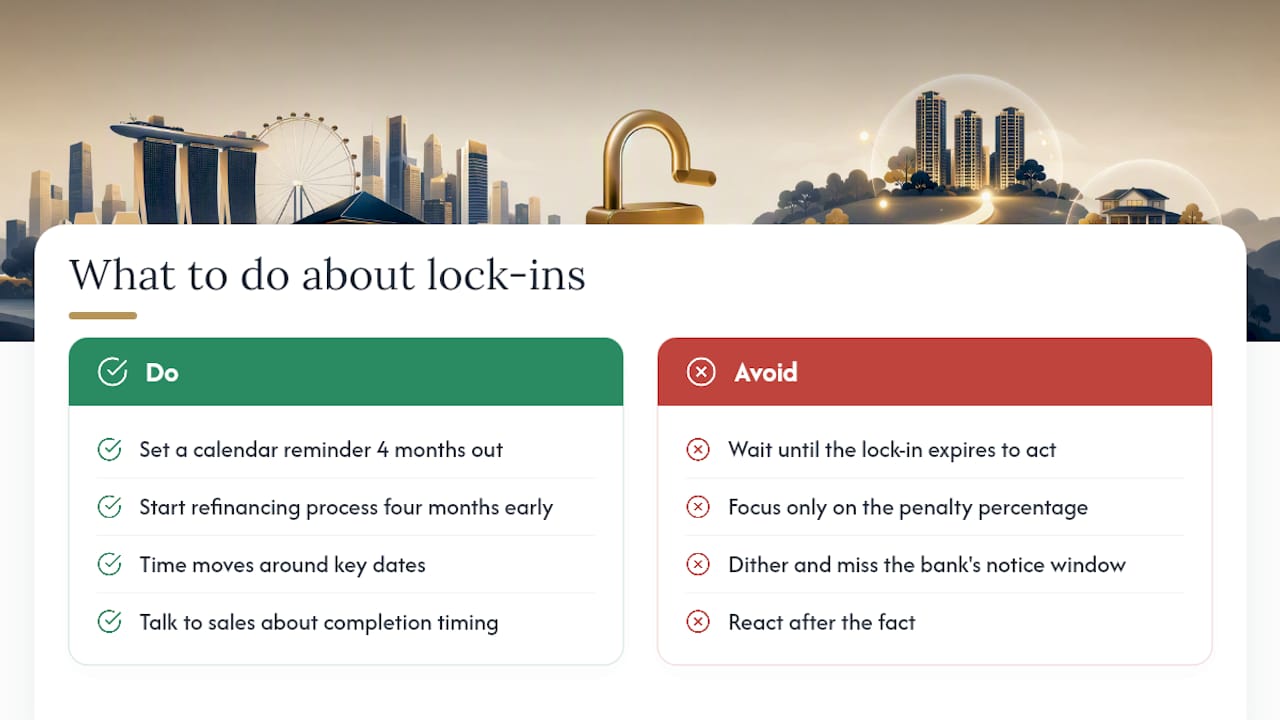
The conventional advice, "shop around before your lock-in ends," is technically correct and practically useless without a timeline attached. Four months out is not a suggestion; it's the minimum runway legal processing actually requires in Singapore. Buyers who wait until the lock-in expires to start comparing offers almost always end up paying the higher rate for at least a month or two by default, which frequently costs more than the penalty they were trying to avoid.
If you take one thing from this guide, make it the calendar reminder, not the percentage. A flexible approach to timing your move around key dates, whether that's a lock-in expiry or a property closing, consistently beats reacting after the fact. New-launch buyers watching early bird pricing windows should apply the same discipline to their financing decisions.
— Velisa
Ready to see how a new launch's payment schedule and completion timeline fit your own financing plan? Check the latest updates on Aurea and talk to the sales team about how lock-in timing lines up with your unit's projected completion.
This article is general information, not a substitute for advice from a qualified financial advisor. Consult a qualified financial professional about your own circumstances before acting on anything here.
Sources
- How home loans work - Singapore - MoneySense
- Home Loan Fees and Charges - Singapore (DBS)
- Mortgage lock-in period Singapore: Reprice vs Refinance - Loansaver
- Set your house (loan) in order even as interest rates soar - Maybank