
An Option to Purchase (OTP) is your exclusive, time-limited right to buy a specific condo unit at a fixed price, secured with an upfront option fee that the seller keeps if you walk away. Once you exercise it, the OTP becomes a binding sale contract, so the immediate move is to lock down financing (an HFE letter for HDB, a bank Letter of Offer for private property) and call a conveyancing lawyer before you sign anything.
- What it is: A short window where the seller cannot sell to anyone else.
- What it costs upfront: A refundable-only-if-things-go-your-way option fee.
- What to do next: Confirm your loan approval and legal representation before exercising.
For context, HDB-regulated resale flats run on a strict 21-day option period, while private and new-launch condos, including projects like Aurea at Beach Road, follow more flexible but still deadline-driven timelines. Either way, Buyer's Stamp Duty (BSD) and, for many buyers, Additional Buyer's Stamp Duty (ABSD) become due shortly after you exercise, and the Council for Estate Agencies (CEA) expects both parties to use proper documentation throughout.
Key Takeaways
An Option to Purchase becomes a binding contract the moment you exercise it, so financing approval and legal review must happen before you sign, not after.
| Point | Details |
|---|---|
| HDB option period is fixed | Resale flats give buyers exactly 21 calendar days to exercise, expiring at 4pm on that date. |
| Private terms are negotiable | Resale option fees run about 1% of price; new-launch booking fees are typically around 5%. |
| Financing comes first | Secure your HFE letter or bank Letter of Offer before paying any option or booking fee. |
| Stamp duty has a deadline | BSD and ABSD are due to IRAS within 14 days of exercising the OTP. |
| New-launch buyers should verify the schedule | Aurea and similar developments publish booking, OTP, and progressive payment timelines buyers should request directly before committing. |
Table of Contents
- What Is an Option to Purchase for a Condo?
- HDB Resale OTP vs Private Resale and New-Launch Developer OTP
- What to Look For Inside an OTP Before You Sign
- Buying a Private Condo: From Offer to Exercised OTP
- The HDB Resale Flat OTP Process, Step by Step
- Exercising the OTP: Documents, Payments, and Stamp Duty
- After You Exercise: SPA, Conveyancing, and Completion
- If a Deal Falls Through: Forfeiture and Your Options
- Your Pre-Exercise Checklist and Questions to Ask
- Mistakes Buyers Make With OTPs, and How to Avoid Them
- How OTPs Work for New-Launch Condos Like Aurea
- Practical Advice Rarely Mentioned Before Signing
- Get Help With Your OTP Timeline and Paperwork
- Official Forms and Links Worth Bookmarking
- Sources
What Is an Option to Purchase for a Condo?
An OTP works in two stages: the seller grants it, and the buyer decides whether to exercise it. During the option period, only you can buy that unit. No other buyer can make an offer, no matter how much they're willing to pay.
Who grants the OTP depends on what you're buying. For a private resale condo, the current owner issues it directly. For a new launch, the developer issues it after you pay a booking fee. For an HDB resale flat, the seller must use the HDB-prescribed OTP form, complete with Important Notes that spell out both parties' obligations.
Here's the part buyers underestimate: exercising the OTP isn't a formality. The moment you sign and return it with the exercise fee, you've entered a legally binding sale agreement. There's no cooling-off period after that.
- OTP grant: seller commits to sell, buyer pays the option fee.
- OTP exercise: buyer commits to buy, contract becomes binding.
- Legal note: once exercised, backing out means losing your deposit, or worse.
Pro Tip: Read the OTP the day you receive it, not the day before it expires. A conveyancing lawyer can flag problem clauses in an hour, but only if you give them time to actually look.
HDB Resale OTP vs Private Resale and New-Launch Developer OTP
The fine print changes dramatically depending on what kind of condo you're buying, and mixing up the rules is the single most common OTP mistake in Singapore. HDB resale flats follow a fixed script. Private resale and new launches leave more room for negotiation, and more room for expensive surprises.
- Private resale: Option period is negotiated (commonly two to three weeks), option fee is typically about 1% of the purchase price, and the exercise payment usually brings the total deposit to 5%.
- New-launch developer OTP: Booking fee of roughly 5%, OTP issued within 3 business days of booking, and exercise typically adds another 15% to reach a 20% total deposit.
If you're buying resale, double-check that the seller's agent is actually using the current HDB-prescribed form. An outdated version can create disputes later, even if both parties signed in good faith.
What to Look For Inside an OTP Before You Sign
Most buyers skim the OTP for the price and the date, then miss the clauses that actually create risk. Read every page, not just the summary block at the top.
Start with the basics: the option date, the expiry date and time (HDB flats lapse at 4pm sharp on day 21), the agreed purchase price, and the exact option fee and exercise fee amounts. Then check the conditions precedent, meaning any clause that makes the sale contingent on you securing a loan or a satisfactory valuation. Without that clause, a failed bank valuation could still leave you on the hook.
- Confirm the option fee amount and whether it counts toward the total deposit.
- Check the SPA signing deadline and completion date.
- Verify what's included: fittings, furniture, renovations, or bare-unit condition.
- Confirm who signs, and that witness requirements are met if required.
- Check for supplementary agreements that modify the standard terms.
Fee ranges to sanity-check against what you're being asked to pay: HDB resale caps out at S$5,000 combined, private resale option fees run around 1% of price (a S$1.5 million condo means roughly S$15,000 at risk), and new-launch booking fees sit near 5% of purchase price. A guide to private residential OTP terms lays out the standard clause structure if you want to compare against what you've been handed.
Buying a Private Condo: From Offer to Exercised OTP
The private-market process, whether resale or new launch, moves through a fairly consistent sequence:
- Agree on the purchase price verbally or through your agent.
- Pay the option fee (resale) or booking fee (new launch) to secure the OTP.
- Engage a conveyancing lawyer immediately, don't wait until the option period is halfway gone.
- Apply for a Letter of Offer (LO) or in-principle approval from your bank.
- Review the OTP terms with your lawyer before the deadline.
- Exercise the OTP by signing and paying the exercise fee to reach the agreed deposit level.
Private resale option periods commonly run two to three weeks, though sellers can negotiate shorter or longer windows. New-launch developers typically hold to a tighter script, with roughly 21 days from booking to exercise. Miss either deadline and the OTP simply lapses, taking your option fee with it.
Financing checks matter here more than buyers realize. Review your TDSR exposure before you even pay the option fee, since a loan rejection after you've exercised won't undo the contract. If you're weighing HDB financing against a bank loan for an executive condo or private unit, settle that decision before the clock starts.

The HDB Resale Flat OTP Process, Step by Step
HDB resale works differently because HDB controls the form, the timeline, and several prerequisites the private market doesn't impose. If you're financing with an HDB loan, you need a valid HFE (HDB Flat Eligibility) letter before the seller can validly grant you the OTP.
- Obtain your HFE letter if you're taking an HDB loan, or a bank LO if going private.
- Agree on the resale price with the seller.
- Seller grants the OTP using the mandatory HDB-prescribed form.
- You pay the Option Fee (S$1 to S$1,000) directly to the seller.
- Review the OTP and Important Notes, ideally with a lawyer, within the 21-day window.
- Exercise by paying the Option Exercise Fee, then submit the resale application to HDB.
Two payment details trip people up constantly:
- The Option Fee and Option Exercise Fee combined cannot legally exceed S$5,000.
- The 21-day clock starts the day the OTP is granted, not the day you receive a copy of it.
Let the option lapse without exercising, and the seller keeps the fee, full stop. There's no partial refund mechanism built into the HDB process.
Exercising the OTP: Documents, Payments, and Stamp Duty
Exercising the OTP is where paperwork and cash flow collide, and practical financing checks are crucial because a missing document can unravel weeks of negotiation. Before you sign the exercise form, have three things in hand: a valid HFE letter (HDB) or bank Letter of Offer (private), proof of funds for BSD and ABSD, and your lawyer's contact details on file with the seller's side.
The exercise deposit schedule usually works like this: your original option fee counts toward the total deposit, and the exercise payment tops it up to the agreed level, typically 5% for private resale or 20% for new launches. Buyer's Stamp Duty is due within 14 days of exercising the OTP, and Additional Buyer's Stamp Duty, where applicable, follows the same window. Both can be paid using CPF Ordinary Account funds up to prevailing limits, though cash is often required for any shortfall.
- Confirm your LO or HFE issue date falls on or before your planned exercise date.
- Budget separately for solicitor's fees, which typically run S$2,500 to S$3,500 for a straightforward private purchase.
- BSD and ABSD payments are due to IRAS within 14 days of exercise, not completion.
- Keep every receipt: option fee, exercise fee, and stamp duty payment slips.
Pro Tip: Request your Letter of Offer at least a week before your OTP's exercise deadline. Banks can take several business days to process, and a delayed LO is one of the most preventable reasons buyers miss their exercise window entirely.
After You Exercise: SPA, Conveyancing, and Completion
Exercising the OTP triggers the next phase: your lawyer prepares or reviews the Sale and Purchase Agreement (SPA), which typically needs signing within a set window after exercise, often up to eight weeks for new launches.
For resale transactions, private or HDB, completion usually follows eight to twelve weeks after exercise, during which your lawyer runs title checks, confirms no outstanding encumbrances, and coordinates the balance payment. For new launches, you'll instead move into progressive payment milestones tied to construction stages, right through to the Temporary Occupation Permit (TOP).
- Lawyer confirms title is clean and free of unpaid liens.
- Progressive payments (new launch) are billed at each construction milestone.
- Completion (resale) involves final payment and key collection on a fixed date.
- At handover, inspect for defects and document them before signing off.
If you're planning renovations once you get the keys, it's worth comparing a renovation loan against a personal loan early, since approval timing can overlap with your final payment schedule.
If a Deal Falls Through: Forfeiture and Your Options
Backing out after exercising an OTP is expensive, and the consequences aren't symmetrical between buyer and seller. If you fail to complete after exercising, you risk forfeiting your full deposit, not just the option fee, and potentially facing a claim for damages if the seller resells at a lower price.
Sellers have far less room to maneuver once an OTP is granted. They generally cannot revoke it during the option period, and if they refuse to honor an exercised OTP, buyers can pursue specific performance or damages through the courts. HDB transactions add another layer: HDB itself can intervene if either party breaches the prescribed terms.
- Buyer forfeits option fee if the OTP lapses unexercised.
- Buyer risks losing the full deposit if they default after exercising.
- Seller cannot usually revoke a validly granted OTP mid-term.
Pro Tip: Preserve every email and text exchanged during the option period. If a dispute ever reaches a lawyer or HDB, that paper trail is often what decides who's actually at fault.
Your Pre-Exercise Checklist and Questions to Ask
Run through this before you sign anything. Confirm your LO or HFE is valid, that the valuation matches or exceeds the agreed price, and that the seller has disclosed any encumbrances or outstanding mortgages on the unit. Check the fixtures inventory against what you actually walked through during viewing, and get a receipt for every payment you make.
Ten questions worth asking your agent, the seller, or your own lawyer before exercising:
- Is my loan approval final, or still conditional?
- What happens if the bank valuation comes in below the OTP price?
- Are there any known defects or disputes tied to this unit?
- What's the exact completion or handover date?
- Does the option fee count fully toward the deposit?
- Are there any supplementary clauses beyond the standard form?
- Who holds the funds in escrow, and when are they released?
- What's the penalty structure if either side defaults?
- Is the seller's mortgage fully redeemable by completion?
- Has the agent confirmed CEA registration and license validity?
A missing LO, an undisclosed encumbrance, or a vague SPA clause should stop you cold until your lawyer signs off.
Mistakes Buyers Make With OTPs, and How to Avoid Them
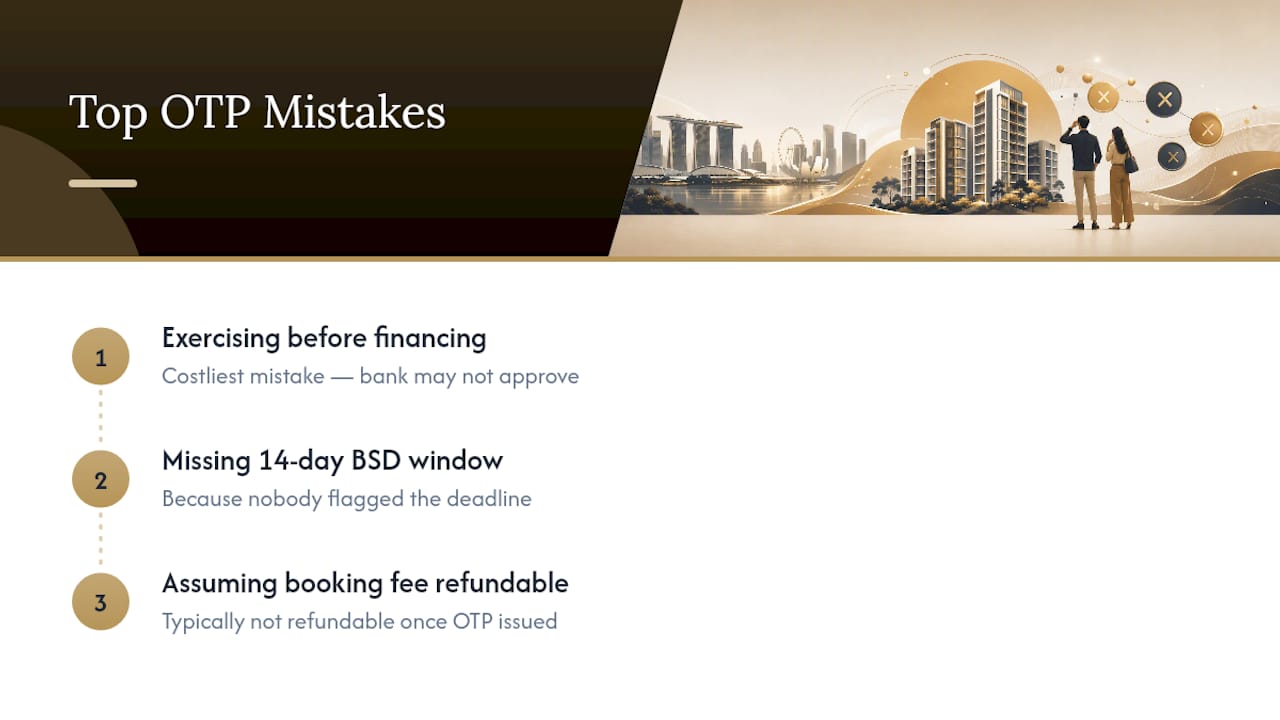
The costliest mistake is exercising before your financing is confirmed, assuming the bank will "probably" approve the loan. Second most common: missing the 14-day BSD payment window because nobody flagged the deadline. Third: assuming a new-launch booking fee is refundable if you change your mind, when it typically isn't once the OTP is issued.
Watch for evolving developer practices in 2026, some projects now issue OTPs with tighter re-issuing conditions if the initial exercise period lapses, which shifts more risk onto slow-moving buyers.
Pro Tip: Get your Letter of Offer before you pay any option or booking fee, not after. It costs you nothing to ask a bank for a conditional approval early, and it protects the money you're about to put at risk.
How OTPs Work for New-Launch Condos Like Aurea
New-launch OTPs follow a standard rhythm across most Singapore developers, and Aurea, the 188-unit development at 802 Beach Road, is a useful example of how the schedule typically plays out. Buyers pay a 5% booking fee, the developer issues the OTP within 3 business days, and exercising the OTP adds another 15% to reach the standard 20% deposit before SPA signing under REDAS-standard terms.
For any new-launch purchase, confirm the developer's licensing status and that payments flow into a regulated Project Account, not a general company account. That single check protects your deposit if a project runs into construction delays.
- Confirm the exact booking-to-OTP-issue timeline stated in the developer's sales materials.
- Check how progressive payment milestones align with construction stages before signing.
- Ask for the published payment schedule in writing, not just a verbal summary from the sales team.
If you're comparing unit types, it's also worth reviewing how executive condos differ from private condos on eligibility and financing before you commit to a booking fee.
Practical Advice Rarely Mentioned Before Signing
Buyers spend so much energy negotiating price that they forget the OTP has other room to move. Ask for a slightly longer option period if your financing is complex, most sellers will grant an extra few days rather than lose a serious buyer entirely. Time your Letter of Offer request the moment you start seriously viewing units, not after you've found "the one," since banks don't process approvals overnight.

Some clauses simply aren't up for discussion. HDB's prescribed terms and a developer's standard SPA conditions under REDAS won't bend for an individual buyer, and pushing on those wastes negotiating capital better spent elsewhere. Know the difference between a clause you can question and one you're wasting breath on. If your lawyer flags something structural, like an unclear encumbrance or a valuation gap, that's the moment to step back, not push forward.
Get Help With Your OTP Timeline and Paperwork
Reading through option periods, exercise fees, and stamp duty deadlines is a lot to track alone, especially when a bank's approval timeline doesn't always match a developer's OTP window. Aurea-sgcondo gives prospective buyers of the Aurea development direct access to the actual payment schedule, project documents, and illustrative timelines you'd otherwise have to piece together from scattered sources, so you know exactly what's due and when before you pay a single dollar.
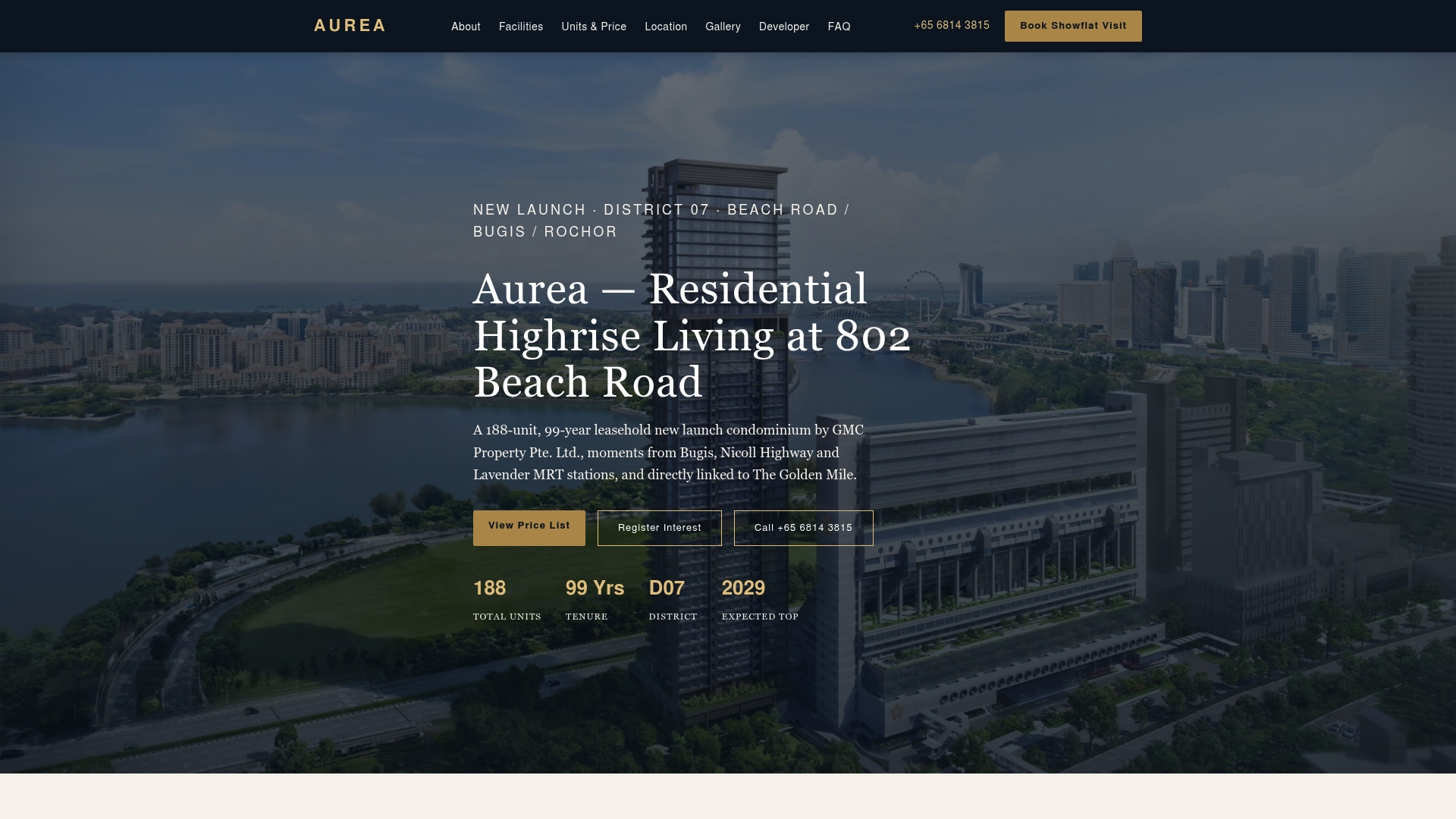
Aurea, GMC Property's 188-unit development at 802 Beach Road with two to five-bedroom layouts and two penthouses, publishes its booking-to-OTP schedule and progressive payment milestones for exactly this reason: so buyers aren't guessing about deadlines during a legally binding process. If you're weighing a unit at Aurea, request the full documentation package and a project appointment through the Aurea project page, where the sales team can walk you through the OTP timeline before you commit a booking fee.
Official Forms and Links Worth Bookmarking
Always check the official page's last-updated date before relying on any downloaded form.
This article is general information, not a substitute for advice from a qualified financial advisor. Consult a qualified financial professional about your own circumstances before acting on anything here.
Sources
- Buying or Selling a private residential property
- Buying property (URA)
- What is Option-to-Purchase (OTP): Full 2026 Guide - PropertyKakis