
For a private condominium, the maximum loan tenure under MAS rules is capped at the longest allowed tenure for bank loans on non-HDB residential properties. That is the regulatory ceiling. In practice, most buyers get less, because lenders layer on their own age caps and lease checks before approving any term.
Two qualifiers matter immediately:
- If your loan tenure exceeds the typical long tenure threshold, or if the loan extends past your 65th birthday, the lender must apply a lower loan-to-value (LTV) limit under MAS rules.
- Banks commonly require the loan to be fully repaid by age 65 or 70, which means a 40-year-old borrower may only qualify for a 25-to-30-year term regardless of the 35-year cap.
Before you call a bank, know your age, your co-borrower's age, and the remaining lease on the property. Those three numbers will define your real ceiling faster than any rule of thumb.
Key Takeaways
The maximum condo loan tenure in Singapore is 35 years under MAS rules, but lender age caps, LTV triggers, and lease checks routinely shorten that in practice.
| Point | Details |
|---|---|
| MAS cap for private condos | Bank loans on non-HDB properties are capped at 35 years; HDB flat loans are capped at 30 years. |
| LTV reduction triggers | Tenure above 30 years or loan extending past age 65 drops the maximum LTV from 75% to 55%. |
| Lender age rule | Most banks require full repayment by age 65 or 70, which is often the binding constraint, not the MAS cap. |
| Total interest trade-off | On a S$1,000,000 loan at 3.5%, a 35-year term costs roughly S$340,000 more in interest than a 20-year term. |
| Aurea-sgcondo | Connects buyers to mortgage advisers and provides financing fact sheets for the new launch at 802 Beach Road. |
Table of Contents
- What MAS officially says about maximum loan tenure for condos
- How banks actually apply the tenure cap
- How tenure length changes what you actually pay
- How tenure interacts with LTV, TDSR, and your borrowing capacity
- How to calculate your personal maximum tenure
- When a longer tenure makes sense and when it does not
- Practical tips for negotiating tenure with your lender
- A note on what buyers often get wrong
- Aurea-sgcondo and financing your new condo purchase
- Sources
What MAS officially says about maximum loan tenure for condos
MAS sets the headline caps clearly: 30 years for HDB flat loans and 35 years for non-HDB private residential properties, including condominiums. These apply to bank loans. HDB concessionary loans follow separate rules published on HDB's official site.
The LTV reduction trigger is equally specific:
- Tenure exceeds 30 years for a private property loan: lower LTV applies.
- Tenure exceeds 25 years for an HDB flat loan: lower LTV applies.
- Loan repayment extends past the borrower's age of 65: lower LTV applies, regardless of tenure length.
That is a significant gap in financing, not a minor adjustment.
MAS Notice 825 is the binding instrument that lenders must follow. It sets out the exact requirements for new and refinanced residential property loans, covering tenure caps, LTV ratios, the Mortgage Servicing Ratio (MSR), and the Total Debt Servicing Ratio (TDSR). Lenders cannot grant terms that breach Notice 825, which is why understanding it matters as much as knowing the headline number.
How banks actually apply the tenure cap
Banks do not simply hand you 35 years. They run several checks that frequently produce a shorter approved term.
Repayment-by-age cap. Most local banks require the loan to be fully repaid by around age 65, though some may extend this for certain borrower profiles. For example, a borrower in their late 30s targeting repayment by that age will have a maximum tenure shorter than the regulatory maximum.
Remaining lease check. For leasehold condos, lenders look at how much lease is left. A common rule applied by several lenders caps the loan tenure to a significant portion of the remaining lease. Buy a 99-year leasehold condo with 60 years remaining, and the effective tenure ceiling under that rule is 45 years, which is above the MAS cap anyway. PropertyGuru's mortgage tenure guide documents this lease-remaining check as a standard lender practice.

Joint borrower age weighting. When two borrowers apply together, banks typically calculate an income-weighted average age to determine the effective borrower age for tenure purposes. A higher-earning older co-borrower pulls the weighted age up, shortening the available term. MoneySense's home loan explainer covers this and recommends checking how the bank treats joint applications before assuming you qualify for the full tenure.
Pro Tip: Ask your bank specifically whether they use age 65 or 70 as their repayment ceiling, and whether they apply income weighting for joint applications. The answer varies by institution and can change your available tenure by several years.
How tenure length changes what you actually pay
Longer tenure, lower monthly payment, higher lifetime interest. That trade-off is straightforward in principle but easy to underestimate in dollar terms.
Longer tenure reduces monthly repayments but increases total interest paid over the loan life. For example, lower monthly payments with longer tenures come at the cost of substantially higher total interest.
The jump from a shorter to a longer term saves a significant amount monthly but increases total interest paid substantially over the loan life. MoneySense is direct about it: longer tenures lower monthly cashflow pressure but increase total interest, and borrowers should not automatically take the maximum tenure without planning.
Singapore floating rates have moved sharply in recent years.
How tenure interacts with LTV, TDSR, and your borrowing capacity
Tenure is not just a repayment schedule. It directly affects how much you can borrow and whether you pass the debt-service tests.
LTV interaction. As noted above, a tenure above 30 years or a loan extending past age 65 triggers a lower LTV. On a S$2 million condo, the difference is S$400,000 in available financing.
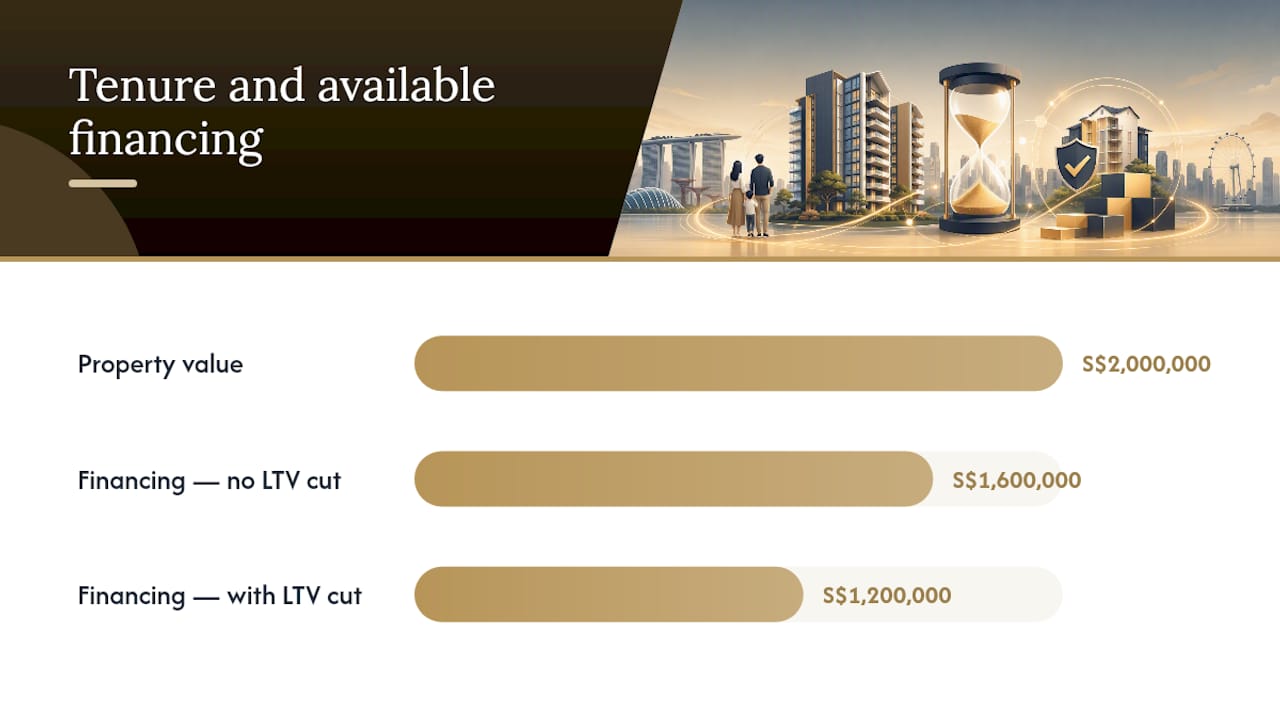
TDSR. The TDSR framework caps total monthly debt obligations at 55% of gross monthly income. A shorter tenure produces a higher monthly repayment, which consumes more of your TDSR headroom. Paradoxically, choosing a longer tenure can help you pass the TDSR test by reducing the monthly repayment figure, even though it costs more over time. Understanding this interaction is covered in detail in our TDSR Singapore rules guide.
This does not apply to private condo loans, but it matters if you are comparing across property types.
Documents and figures lenders will assess:
- Your NRIC and proof of age (and co-borrower's)
- Latest payslips and CPF contribution history (typically 3 months)
- Notice of Assessment from IRAS for the past 2 years
- Existing loan statements (car loans, personal loans, other mortgages)
- Property details including remaining lease
- Estimated property value or Option to Purchase
The CPF home purchase planner lets you model different tenure assumptions against your CPF balance and required cash outlay, which is worth running before any bank meeting.
How to calculate your personal maximum tenure
Work through these steps before you speak to a lender.
-
Establish your repayment-by-age ceiling. Subtract your current age from the bank's maximum repayment age (use 65 as the conservative assumption, 70 if you know the lender allows it). A 36-year-old targeting repayment by 65 has a ceiling of 29 years.
-
For joint applications, calculate the income-weighted average age. Multiply each borrower's age by their share of combined income, then add the results. Two borrowers aged 35 and 50, earning S$8,000 and S$4,000 respectively: weighted age = (35 × 8/12) + (50 × 4/12) = 23.3 + 16.7 = 40. Subtract from 65: maximum tenure is 25 years.
-
Check the remaining lease. For a leasehold condo, note the years of lease remaining. Apply the 75% rule: multiply remaining lease by 0.75. If that figure is lower than the MAS cap of 35 years, it becomes your effective ceiling for that lender.
-
Confirm the LTV effect. If your desired tenure exceeds 30 years, verify whether the lower LTV (55% instead of 75%) changes your financing plan. If it does, you may need a larger down payment or a shorter tenure to preserve the higher LTV.
When a longer tenure makes sense and when it does not
Pros of a longer tenure:
- Lower monthly repayments free up cash for other investments or expenses.
- Easier to pass TDSR when income is moderate relative to the purchase price.
- Useful for younger buyers who expect income to grow and plan to prepay later.
Cons of a longer tenure:
- Substantially higher total interest paid over the loan life.
- Slower equity buildup, which matters if you plan to refinance or sell within 10 years.
- Greater sensitivity to interest rate rises over a longer compounding period.
Scenario callouts:
- Young first-time buyer (late 20s to early 30s): A longer tenure preserves monthly cashflow and keeps TDSR comfortable. The trade-off is acceptable if you plan to make partial prepayments when income rises.
- Near-retirement buyer (mid-50s): The age cap will likely force a shorter tenure anyway. Focus on LTV implications and whether CPF usage is sustainable at the higher monthly repayment.
- Investor buying for yield: Rental income needs to cover repayments comfortably. A longer tenure lowers the monthly outlay, which helps yield calculations, but check that rental income projections hold under a higher-rate scenario. Our CBD condo investor guide covers yield considerations in more detail.
Practical tips for negotiating tenure with your lender
Questions to ask your bank:
- What is your maximum repayment age, and does it differ by borrower profile?
- How do you calculate the effective borrower age for joint applications?
- What lease-remaining rule do you apply for leasehold condos?
- Can you show me the monthly repayment and total interest for 25, 30, and 35 years side by side?
Alternatives to extending tenure:
- A larger down payment reduces the loan quantum, which lowers monthly repayments without extending the term.
- Partial prepayments during the loan lock-in period (check for prepayment penalties first) reduce the outstanding principal and can shorten the effective loan life.
- Splitting a loan across two tranches with different tenures can optimize TDSR headroom while keeping total interest lower.
- Refinancing after the lock-in period (typically 2 to 3 years) lets you renegotiate tenure and rate as your financial position changes.
For a deeper comparison of bank loan structures versus HDB loan options, the bank vs HDB loan guide on Aurea's blog walks through the key differences relevant to private condo buyers.
Checklist for your mortgage appointment:
- Bring 3 months of payslips and your last 2 NOAs
- Know your existing monthly debt obligations (car loan, credit cards, other mortgages)
- Have the property's remaining lease confirmed
- Prepare three tenure scenarios (e.g., 25, 30, 35 years) and ask the bank to quote each
- Ask for the stress-tested repayment at current rate plus 2% and plus 4%
A note on what buyers often get wrong
Many buyers walk into a bank meeting and accept whatever tenure the officer suggests, usually the maximum available, without running the numbers themselves. The monthly saving from a 35-year versus a 25-year term feels significant in the moment. The additional interest paid over the loan life rarely gets the same attention.
The more useful habit is to decide in advance what monthly repayment you are genuinely comfortable with, then work backward to the tenure that produces it.
Flexibility matters too. A shorter tenure with a comfortable buffer is easier to manage than a stretched 35-year term that leaves no room for income disruption, a rate rise, or an unexpected expense.
Aurea-sgcondo and financing your new condo purchase
Buying a new launch condo involves more financing variables than a resale purchase, particularly around tenure, CPF usage, and progressive payment schedules tied to construction milestones.
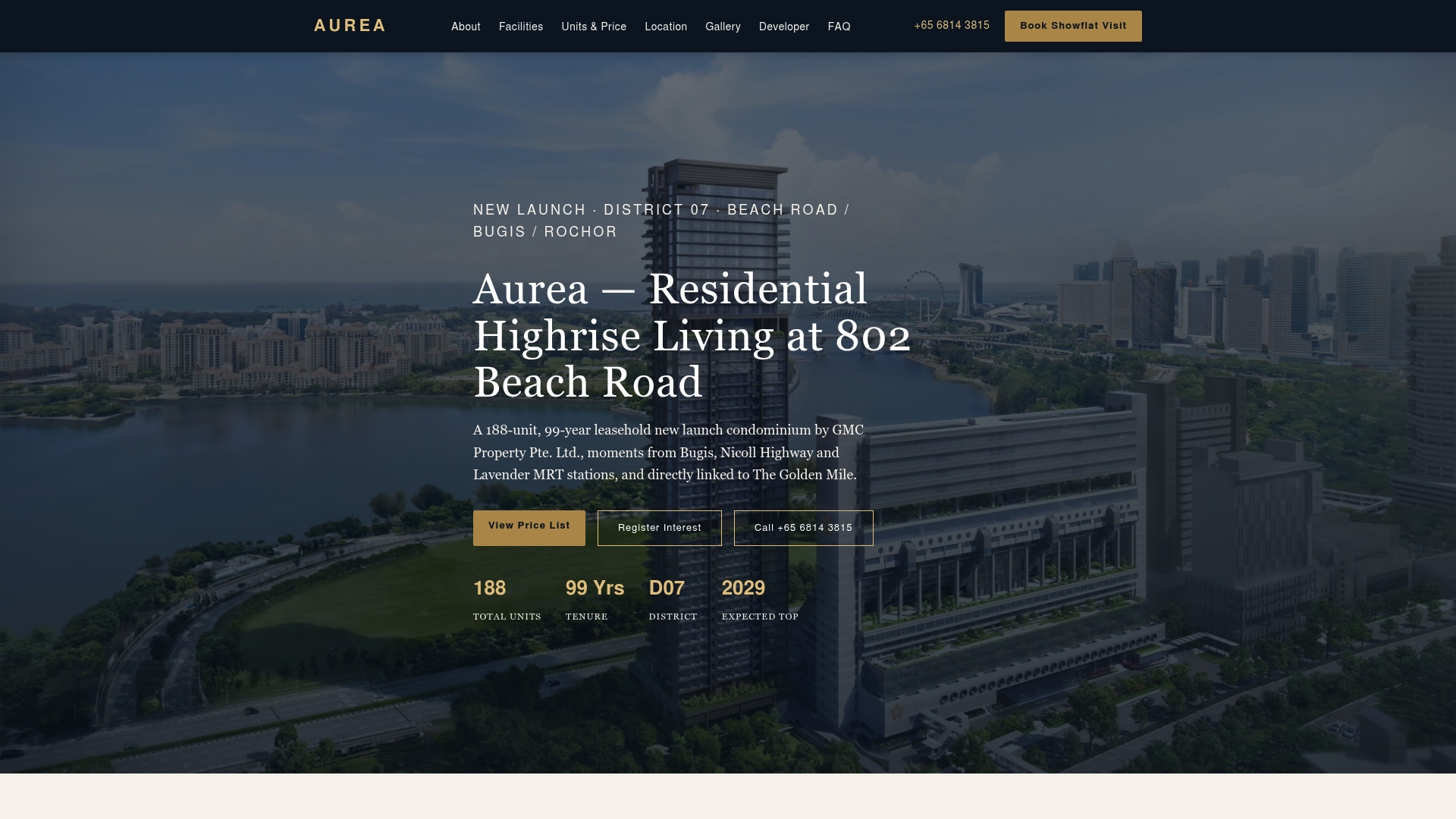
Aurea-sgcondo at 802 Beach Road connects prospective buyers with mortgage advisers familiar with new launch financing structures and can provide development-specific fact sheets covering payment timelines and financing assumptions. Aurea does not provide loans directly, but the sales team can help you understand the numbers before you approach a bank, so your first lender conversation is more productive. Contact the Aurea sales team or visit the project page to request a financing fact sheet and arrange a consultation.
Sources
The following official pages are the primary references for Singapore condo loan tenure rules:
This article is general information, not a substitute for advice from a qualified financial advisor. Consult a qualified financial professional about your own circumstances before acting on anything here.