
Net yield, after property tax, MCST fees, and vacancy, usually lands about 1.5 percentage points lower. Before you assume any listing is a good yield play, pull recent URA lease evidence or run a Two Homes rental valuation. That single check separates a real number from an agent's optimistic guess.
TL;DR:
- Realistic net rental yields in Singapore are typically about 1.5 percentage points lower than gross yields after property tax, fees, and vacancy costs.
- The median private condo gross yield in 2026 is around 2.88% to 3.06%, with higher yields mainly in OCR districts due to lower entry prices relative to rent.
- Operating costs such as property tax, MCST fees, agent commissions, and vacancy buffers can reduce net yield by nearly 1 percentage point or more.
- Target condo purchases near MRT stations and employment hubs, especially in districts like Geylang, to maximize occupancy and actual rental returns.
- Conduct thorough due diligence by verifying actual lease evidence, modeling conservative rent scenarios, and reviewing building health before investing based on yield figures.
Table of Contents
- What Is a Good Rental Yield for a Singapore Condo in 2026?
- How Do You Calculate Gross and Net Rental Yield?
- What Ownership Costs Cut Into Your Net Yield?
- Where Do Higher Condo Yields Actually Show Up?
- How Do You Underwrite a Condo for Realistic Rental Yield?
- How This Guide Draws on Aurea's Local Data
- Should You Buy for Yield or for Capital Growth?
- See How Aurea Fits Your Own Underwriting Numbers
- Where to Check the Numbers Yourself
- Sources
- FAQ
What Is a Good Rental Yield for a Singapore Condo in 2026?
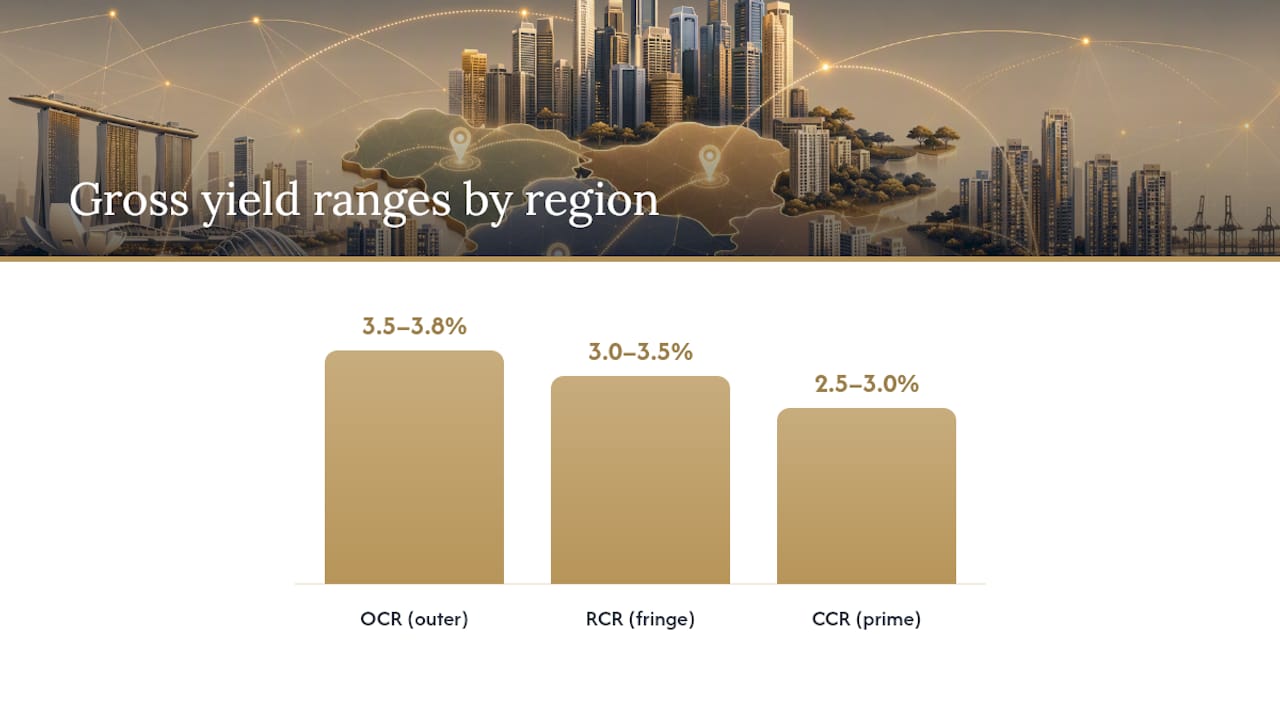
Regional averages tell you whether a quoted yield is realistic or inflated. PropertyNet puts OCR gross yields around 3.5% to 3.8%, RCR (city-fringe) closer to 3.0% to 3.5%, and CCR (prime, city center) at the low end, roughly 2.5% to 3.0%. The trade-off is familiar: CCR buyers pay for capital preservation and prestige, not cash flow.
Median figures back this up. DollarsAndSense' 2026 analysis finds the median private condo gross yield sitting near 2.88%, while GlobalPropertyGuide reports an island-wide average closer to 3.06% for Q2 2026. Both numbers point the same direction: yields have stabilized after a few volatile years, and outsized returns now concentrate in specific pockets rather than across the board.
A few forces are shaping that picture right now:
- New supply completing through the URA pipeline is easing rent pressure in some districts.
- Tenant demand remains steady near MRT stations and employment hubs, keeping vacancy low there.
- Rents have largely plateaued after the sharp post-pandemic run-up, so yield gains now come more from entry price than from rent growth.
How Do You Calculate Gross and Net Rental Yield?
Gross yield is the number everyone quotes, and it's also the number that hides the most. The formula is simple:
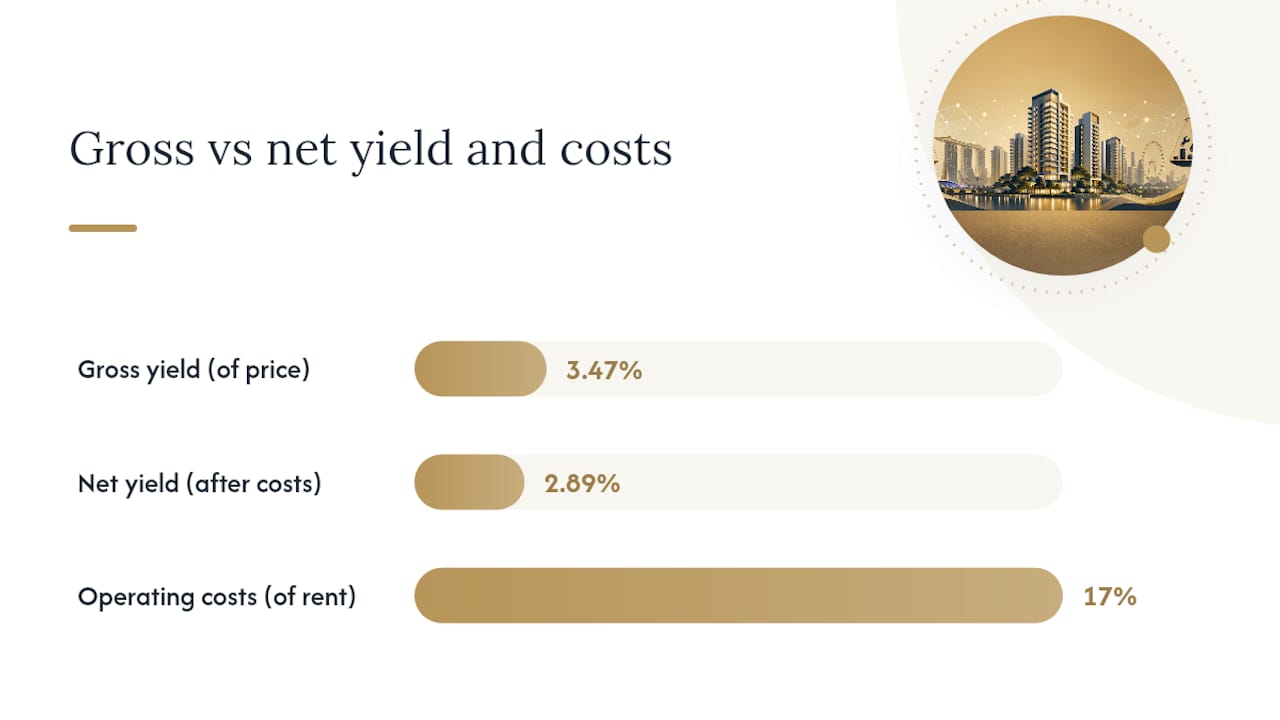
- Gross yield = (Annual rent ÷ Purchase price) × 100. A $1,800,000 two-bedder renting for $5,200 a month generates $62,400 a year, for a gross yield of 3.47%.
- Net yield = ((Annual rent − Annual operating costs) ÷ Total acquisition cost) × 100. Operating costs include property tax, MCST fees, agent commission, insurance, and a vacancy allowance.
- Monthly cash flow = Rent − Mortgage payment − Property tax (monthly share) − MCST − Vacancy reserve − Repairs.
Quick math: on that same $1,800,000 unit, if annual costs run $10,400 (roughly 17% of gross rent), net yield drops to about 2.89%, nearly 0.6 points below gross before you've even touched mortgage interest.
Amortize one-time costs, like the agent's commission or renovation spend, over the length of the lease instead of expensing them in year one.
What Ownership Costs Cut Into Your Net Yield?
Four recurring costs do most of the damage to a headline gross number, and they rarely get modeled honestly before purchase.
- Property tax: IRAS) applies non-owner-occupied rates to a unit's Annual Value, and those bands are progressive, meaning higher-AV units get taxed proportionally harder.
- MCST fees: small projects with basic facilities often charge $250 to $350 a month; developments with multiple pools, gyms, and function rooms can run $500 to $700 or more.
- Agent commission: budget one month's rent per two-year lease as a standard amortized cost, not a surprise line item.
- Vacancy buffer: set aside at least half a month's rent per year, more in markets with heavy new supply.
Mortgage interest and loan structure matter just as much as any of the above. MAS loan-tenure and LTV rules cap how much you can borrow and for how long, which directly shapes your monthly repayment and, therefore, your cash flow math. Check the maximum loan tenure available to you before you lock in a purchase price based on yield alone.
Pro Tip: *Pull your MCST's last two annual budgets before you buy, not just the current monthly fee.
Where Do Higher Condo Yields Actually Show Up?
Chasing a percentage on a spreadsheet without checking the district behind it is how investors end up with a paper yield and a real vacancy problem. A few consistent patterns from 2026 data are worth building your shortlist around.
- District 14 (Geylang) and select OCR towns post some of the highest gross yields on the island, largely because entry prices stay lower relative to achievable rent.
- One and two-bedroom units consistently out-yield three-bedders and larger family layouts, since unit price scales faster with size than rent does, a pattern DollarsAndSense' 2026 data shows clearly across multiple districts.
- Remaining lease tenure affects both financing eligibility and long-term rentability; a shorter lease can restrict your buyer's mortgage options if you ever sell to an investor.
- Proximity to an MRT line and a real employment node beats a marginally higher yield on paper almost every time, because it's what keeps a unit occupied through a soft rental market.
If you're weighing a Bugis MRT condo against a similarly priced unit further from transit, run both through the same rent-evidence check before deciding. Bugis rental yield and Beach Road rental yield figures both benefit from the same connectivity logic, dense MRT access, F&B, and office catchment nearby.
How Do You Underwrite a Condo for Realistic Rental Yield?
Treat every potential purchase like a mini due-diligence exercise, not a gut call based on the listing agent's projection.
- Pull real rent evidence. Check URA's caveated lease data for the project or comparable buildings nearby, then cross-check against a Two Homes rental valuation. Caveated leases beat asking rents because they reflect what tenants actually signed for, not what a landlord hopes to get.
- Run the math three ways. Calculate gross yield, net yield, and monthly cash flow under a base case and a conservative case with rent trimmed 5% to 10%.
- Check the building's health. Review MCST statements, transaction volume over the past two years, and any signs of chronic vacancy in the project.
- Stress-test the downside. Model a 15% rent drop plus an extra month of vacancy. If cash flow still holds without you topping up from savings every month, the deal has real margin.
Pro Tip: If a unit only works on paper at your base-case rent with zero vacancy, walk away. Real tenancies have gaps between leases, and your underwriting should assume that from day one.
How This Guide Draws on Aurea's Local Data
This guide leans on Singapore-specific primary sources, IRAS, URA, and MAS, rather than secondhand estimates. Velisa covers condo regulation and location analysis on the Aurea blog, including property tax mechanics and district comparisons referenced throughout this piece.
Aurea itself, 188 units from 2 to 5 bedrooms at 802 Beach Road, sits close to multiple MRT lines with a direct link bridge to The Golden Mile. That combination of transit access and unit variety is exactly the kind of profile this checklist is built to test, run the same rent-evidence and cash-flow steps on any Beach Road listing before assuming its yield story holds up.
Should You Buy for Yield or for Capital Growth?
Buy compact OCR or city-fringe units near job nodes when monthly cash flow needs to carry the mortgage. Buy CCR or prime addresses when you can absorb a lower yield in exchange for long-term capital appreciation and easier resale liquidity. Match the choice to your holding horizon and your tolerance for topping up cash flow in a soft year, not to whichever number looks best in a listing.
— Velisa
See How Aurea Fits Your Own Underwriting Numbers
Aurea is a direct, in-market example you can actually run the checklist above against, rather than a generic case study. The 802 Beach Road development offers 188 units from 2 to 5 bedrooms plus two penthouses, with resort-style amenities across four levels and a link bridge straight into The Golden Mile, all within walking distance of multiple MRT lines.

Two-bedroom, three-bedroom, and four-bedroom units have published price ranges you can plug into the gross and net yield formulas above once you have a comparable rent estimate. Pricing for five-bedroom units and the penthouses is available on request through the development's official page. Before treating any figure as final, check property tax implications for non-owner-occupied ownership and review subletting rules so your vacancy assumptions hold up legally as well as financially. Visit the Aurea project page to request current PSF pricing and rental comparables, then run your own numbers before deciding whether Aurea, or any other project, actually clears your yield threshold.
Where to Check the Numbers Yourself
- URA e-service: rental caveats and supply pipeline
- MAS: loan tenure and LTV limits
- Two Homes: rental valuation calculator
- Renovation budgeting: see AEC Technical Advisory's guidance on structural work that affects net yield
This article is general information, not a substitute for advice from a qualified financial advisor. Consult a qualified financial professional about your own circumstances before acting on anything here.
Sources
- MAS — Loan tenure and loan-to-value limits
- URA e-service — property market information: residential pipeline
- Two Homes — Rental yield calculator (Singapore)
- DollarsAndSense — Guide to condo rental yields in Singapore (2026 edition)
FAQ
What Is the 2% Rule for Rental Properties?
It rarely applies in Singapore, where yields vary depending on location and unit size, generally lower than US benchmarks.
How Much Rental Yield Is Considered Good in Singapore?
A gross yield of 3.5% or higher is generally considered strong for a private condo in 2026, particularly in OCR locations.
Is a 7% Rental Yield Realistic for a Singapore Condo?
A yield that high is far above the current market range for private condos, where the median sits near 2.88% gross according to DollarsAndSense.
Will Singapore Rental Prices Fall Further?
Rents have largely stabilized after their sharp post-pandemic climb, with new supply from the URA pipeline easing pressure in select districts. A modest further softening is plausible in areas facing heavy completions, but well-located, transit-linked units have shown more resilience than the broader market.
What Does an Aurea Condo Cost?
Two-bedroom units at Aurea start from 1,770,000-2,075,800 SGD, three-bedrooms from 2,639,900-3,058,600 SGD, four-bedrooms from 4,080,510-4,512,990 SGD, and 4-bedroom premium units from 5,186,105-5,723,390 SGD. Pricing for five-bedroom units and penthouses is available on request through the Aurea project page.