Yes, you can sublet a private condo in Singapore, but three rules decide whether you stay legal. Every tenancy must run at least three consecutive months under URA rules, occupancy is capped at six unrelated people (eight if you register and qualify), and you must verify tenant passes while stamping the lease with IRAS. Miss any of these and you risk fines up to S$200,000.
TL;DR:
- Subletting condos legally requires verifying unit size, occupancy caps, and minimum three-month stays, with larger units eligible for up to eight tenants if registered.
- Owners must obtain management consent, properly draft and e-stamp tenancy agreements within 14 days, and declare rental income to IRAS to avoid fines or penalties.
- Failing to meet minimum stay rules or exceeding occupancy limits can trigger fines up to S$200,000 and criminal penalties, with enforcement often initiated by neighbor complaints or management reports.
- Private condo owners should check for restrictions with URA, while HDB owners face additional MOP and quota requirements, making compliance essential for legal subletting.
- Most disputes stem from skipping legal checks or misjudging unit size, stressing the importance of proper documentation, landlord consent, and adherence to regulation before listing or approving a tenant.
Table of Contents
- Quick Legal Checklist Before You List or Approve a Condo Sublet
- URA Rules on Minimum Stay, Occupancy Caps, and Registration
- Landlord and Tenant Obligations: Consent, Contracts, Stamping, and Tax
- How HDB Subletting Differs From Private Condo Rules
- Penalties for Illegal Short-Term Subletting and What Enforcement Looks Like
- Step-by-Step: How to Sublet Your Condo Legally
- When MCST By-Laws Clash With Your Right to Sublet
- Velisa's Take: Practical Landlord Tips for New-Launch Corridors
- Considering a New-Launch Condo Purchase?
- Official Resources for Verifying Condo Subletting Rules
- Sources
- FAQ
Quick Legal Checklist Before You List or Approve a Condo Sublet
Before you post a listing or sign anything, run through the basics. Most disputes and fines trace back to landlords who skipped one of these steps thinking it was optional.
- Check your head lease or house rules first. Some developments require written management consent before you sublet, and skipping this step can trigger MCST action even if URA has no issue with your tenancy.
- Lock in a minimum three-month stay per occupant. URA does not permit private residential rentals shorter than three consecutive months, full stop.
- Confirm your unit's floor area against the occupancy cap. Units under 90 sqm cap out at six unrelated occupants; units 90 sqm or larger can apply for the temporary eight-person cap by registering with URA and paying a registration fee.
- Verify any foreign tenant's pass before signing. The pass needs at least six months of validity remaining at the start of the tenancy, and MOM puts the verification duty on the landlord, not the tenant's word.
- Set aside time to declare the rental income. Rental income is taxable, and landlords who ignore this find out the hard way during an IRAS audit.
Pro Tip: Photograph the unit and log its floor area from your original sale and purchase agreement before you list it. Landlords who guess at square footage often misjudge whether they qualify for the eight-person occupancy relaxation, and that mistake gets expensive fast.
URA Rules on Minimum Stay, Occupancy Caps, and Registration
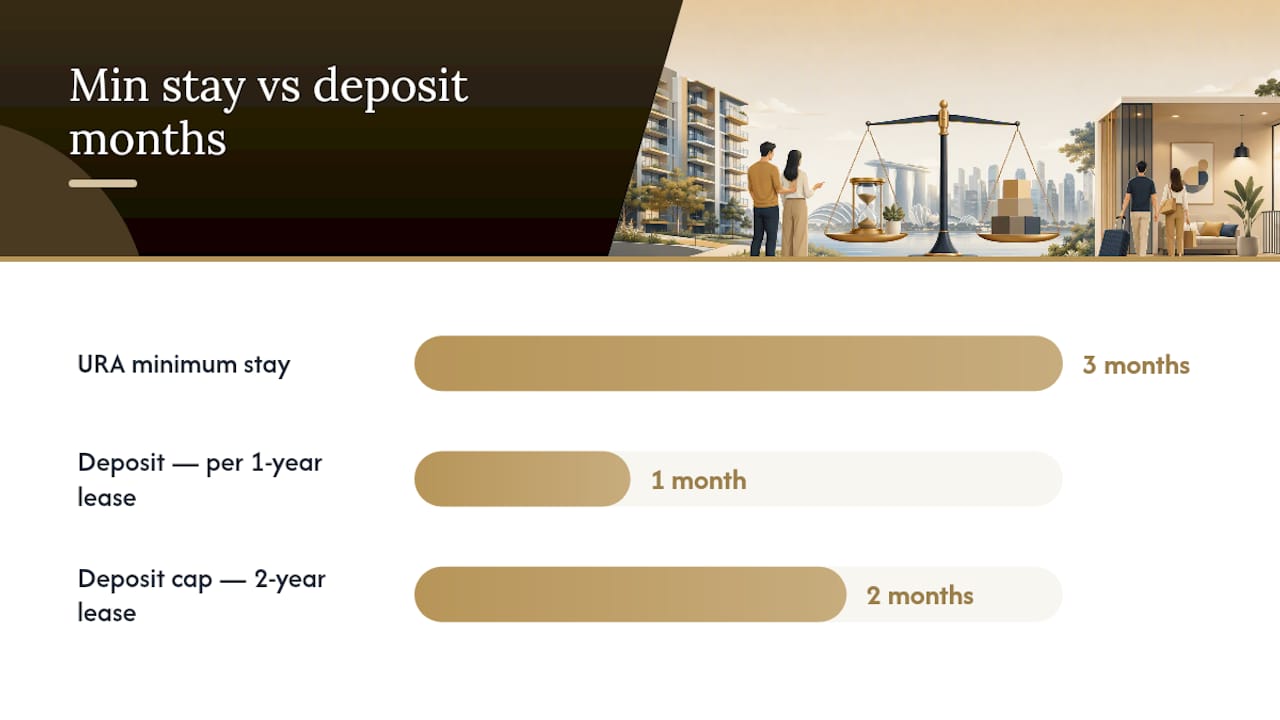
The three-month minimum is the backbone of Singapore's private rental framework. URA defines "consecutive" strictly: you cannot chop a tenancy into shorter blocks or rotate different occupants through the same lease to dodge the rule. A signed agreement covering less than three months, even with a single tenant, breaches the minimum rental period requirement, and that applies whether the unit is a studio or a five-bedroom penthouse.
Occupancy caps work on a sliding scale tied to unit size:
- Private units smaller than 90 sqm: capped at six unrelated occupants.
- Units 90 sqm or larger: eligible for a temporary eight-person cap if the owner registers with URA and pays a registration fee. The relaxed eight-person allowance runs until the end of 2026, so owners planning longer leases should confirm the policy is still active closer to that date.
Enforcement typically starts with a complaint, often from a neighbor or the MCST itself, rather than a random inspection. URA can request tenancy agreements, utility records, and visitor logs as evidence. This is where MCST operational controls matter: many developments already run visitor registration and access card systems that create a paper trail. If your building logs every guest who taps in, a rotating cast of "visitors" staying under three months becomes obvious fast, and management often reports the pattern to URA before you even hear a complaint.
Landlord and Tenant Obligations: Consent, Contracts, Stamping, and Tax
Written landlord consent is not always legally mandatory for a sale-and-purchase-owned condo, but it is mandatory practice if a mortgage, trust arrangement, or MCST by-law requires notification. Skipping this step is the single most common way owners end up in avoidable disputes with lenders or management corporations.
A solid tenancy agreement should cover:
- A subletting clause stating the property may be leased and under what conditions.
- A minimum-stay clause matching or exceeding URA's three-month floor.
- Notice period terms for both renewal and early termination.
- An inventory list attached as a schedule, itemizing furniture, fittings, and their condition.
- Deposit terms, typically one month's rent per year of lease, often capped around two months for a two-year term, according to common tenancy conventions.
Every signed tenancy needs e-Stamping through IRAS within 14 days of execution. Convention in the Singapore market has the tenant bear the stamp duty cost, though nothing stops parties from negotiating otherwise in the agreement itself.
Stamp duty on a residential lease is typically calculated at 0.4% of the total rent payable over the lease term, based on IRAS's own e-Stamping guidance.
Rental income is assessable and must be declared to IRAS. Landlords can claim deductions for costs like property tax, fire insurance, and maintenance fees paid during the rental period, details covered further in our property tax guide. On tenant screening, don't take a tenant's word on pass validity. Ask for the actual pass document and confirm the expiry date yourself using the MOM verification tool; acceptable documents include Employment Passes, S Passes, Student Passes, and Long-Term Visit Passes.
How HDB Subletting Differs From Private Condo Rules
HDB flats and private condos operate under entirely separate regimes, and conflating them is one of the fastest ways to break a rule you didn't know existed. HDB owners must clear the Minimum Occupation Period before they can sublet at all, something private condo owners never have to worry about.
- HDB owners need formal HDB approval before subletting, whether the whole flat or individual bedrooms.
- Quotas restrict how many non-citizen tenants can occupy a flat, and these vary by flat type and ethnic group under the Ethnic Integration Policy.
- Subletting a bedroom while the owner remains in residence follows different, generally lighter, requirements than subletting the entire flat.
- HDB applications run through HDB's own portal with dedicated forms, while private condo compliance runs through URA's registration system instead.
Private condo owners skip MOP and quota requirements entirely, but they inherit the three-month minimum stay rule and occupancy caps that HDB flats structure differently around family nucleus and citizenship status. If you own both a HDB flat and a private unit, treat them as two separate compliance tracks. Buyers weighing an Executive Condo against a private condo should note that ECs generally follow private condo subletting rules once the MOP for ECs has passed, not the HDB framework.
Penalties for Illegal Short-Term Subletting and What Enforcement Looks Like
Breaching the three-month minimum is not a slap-on-the-wrist violation. Fines for illegal short-term rentals can run up to S$200,000, and repeat or serious offenders can face criminal penalties, including possible imprisonment.
URA guidance sets penalties for unauthorized short-term letting at up to S$200,000, with repeat offenders risking criminal prosecution.
MCSTs have their own enforcement toolkit that operates independently of URA action:
- Administrative fines for breaching house rules on visitor registration or guest duration.
- Restricted access to shared facilities like pools, gyms, or function rooms for units under investigation.
- Direct reporting to URA when management suspects illegal short-term letting, often triggered by neighbor complaints about frequent turnover.
The collateral damage often exceeds the direct fine. Running short-term stays outside the rules can void your home insurance policy, leaving you exposed if a "guest" causes property damage or an accident occurs on-site. Neighbors who've had enough of rotating strangers in the corridor can also bring civil claims for nuisance, separate from anything URA or the MCST does. A landlord who thought they were earning a quick S$300 a night on a short-term letting platform can end up facing a five-figure fine, a voided policy, and a lawsuit, all from one bad tenancy decision.
Step-by-Step: How to Sublet Your Condo Legally
Follow this sequence and you'll avoid the mistakes that trip up most first-time landlords.
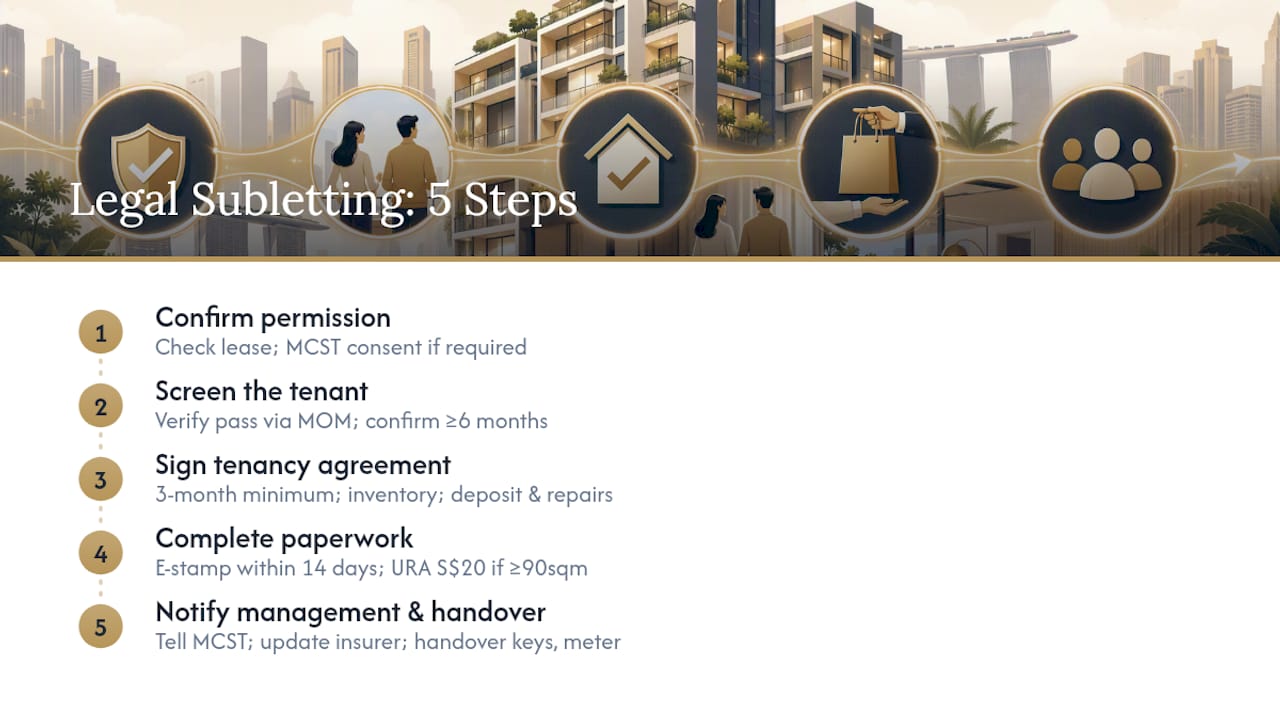
Step 1: Confirm you're allowed to sublet. Review your head lease if the unit isn't fully paid off, and check whether your MCST's house rules require notification or written consent before you list the unit.
Step 2: Screen the tenant properly. Ask for proof of employment, request references from a previous landlord if available, and if the tenant is a foreign national, verify their pass validity directly through the MOM system rather than trusting a photocopy. Confirm at least six months remain on the pass at tenancy start.
Step 3: Draft and sign the tenancy agreement. Build in the three-month minimum stay clause, attach a full inventory list, specify the deposit amount and refund conditions, and clarify who handles minor repairs versus major ones.
Step 4: Handle the paperwork. E-Stamp the tenancy with IRAS within 14 days of signing. If your unit is 90 sqm or larger and you want the expanded occupancy allowance, register with URA and pay the S$20 fee before the tenant moves in, not after.
Step 5: Notify management and close the loop. Inform your MCST of the new tenancy so it's recorded in the building's visitor and access-card system, update your home insurer if the policy terms require disclosure of tenanted status, and walk through a handover checklist with the tenant covering keys, access cards, and meter readings.
Pro Tip: Keep a digital folder with the signed lease, stamped IRAS certificate, tenant's pass copy, and MCST notification email all in one place. If a dispute or an URA inquiry ever comes up, having everything ready in five minutes instead of scrambling for a week makes an enormous difference in how the conversation goes.
When MCST By-Laws Clash With Your Right to Sublet
The Building and Construction Authority clarified that MCST by-laws cannot strip an owner of the fundamental right to lease their unit. A management corporation can impose reasonable operational conditions, like visitor registration or notice requirements, but it cannot flatly ban subletting or impose restrictions so onerous they amount to a de facto ban.
If you believe a by-law crosses that line, you have real options:
- Raise the issue formally at an Annual General Meeting and propose an amendment with clearer, less restrictive wording.
- Escalate unresolved disputes to the Strata Titles Boards, which have authority to strike down overreaching by-laws.
- Gather evidence before filing: meeting minutes, the exact by-law text, notices you received, and any correspondence showing the rule was applied unevenly or unfairly.
In practice, most disputes resolve without a formal hearing. Offering to register your tenant with management, sharing a simple house-rules document, or proposing softer wording at committee level usually gets you further, faster, and cheaper than a Strata Titles Board filing.
Velisa's Take: Practical Landlord Tips for New-Launch Corridors
New-launch developments often see a wave of units hit the rental market around the same completion window, which puts pressure on asking rents. Landlords who chase the highest possible figure sometimes sit vacant for months while a neighbor accepts a modest concession and secures a stable, longer-term tenant instead.
Simple house rules, a transparent deposit and inventory process, and prompt MCST notification prevent most of the friction I see landlords run into. None of it is complicated, but skipping it is exactly how disputes start. If you're facing a contested by-law or a tenancy clause that feels unusually restrictive, get a solicitor or a licensed salesperson involved before you sign anything. That advice costs far less than an eviction dispute or a fine.
— Velisa
Considering a New-Launch Condo Purchase?
If you're weighing a private condo purchase with future rental flexibility in mind, unit layout and floor area matter more than most buyers realize. Larger layouts that clear the 90 sqm threshold open the door to the expanded occupancy allowance, a detail worth factoring into your decision before you sign an option to purchase. Aurea offers a range of bedroom layouts and penthouse options, with resort-style amenities and link bridge access to The Golden Mile. Explore the latest Aurea updates to see current unit availability and layout options.
Official Resources for Verifying Condo Subletting Rules
For rules straight from the source, consult URA's short-term accommodation guidance and its renting property page for occupancy and registration details. HDB owners should check HDB's renting out a flat page for MOP and quota rules. For tax and stamping, use IRAS's e-Stamping portal, and verify tenant passes through MOM's official tool. Reviewing your unit's actual floor area against URA's threshold is easier when you already have accurate measurements on hand, something covered in our showflat checklist guide.
This article is general information, not a substitute for advice from a qualified lawyer. Consult a qualified legal professional about your own circumstances before acting on anything here.
Sources
- URA — Short-term accommodation and renting property guidance
- URA — Renting property guidance (occupancy and registration)
- MOM — verifying work pass validity
FAQ
Can My Boyfriend or Girlfriend Live With Me Without Being on the Lease?
Yes, a partner who is not a paying tenant and is not part of a subletting arrangement can generally live with you without appearing on the tenancy agreement, since this isn't considered subletting under URA rules.
Can I Let a Friend Stay in My HDB Flat for Free?
Letting a friend stay for free without payment is typically treated as a visitor arrangement rather than subletting, but HDB still expects any long-term additional occupant to be declared, and extended stays can raise questions about undeclared subletting.
Is Subletting Allowed for HDB Flats?
Yes, but only after the owner meets the Minimum Occupation Period and secures HDB approval, unlike private condos which have no MOP requirement at all.
How Many Subtenants Are Allowed in a 2-Room HDB Flat?
HDB sets occupancy caps by flat type and tenant nationality, with smaller flats like 2-room units generally allowed fewer subtenants than larger flat types; check HDB's official subletting page for the exact quota tied to your flat type.
What Happens If I Rent Out My Condo for Less Than Three Months?
You breach URA's minimum rental period rule, which can result in fines of up to S$200,000 and, for repeat or serious violations, criminal penalties including possible imprisonment.