
For Singapore new-launch buyers, "lease top up condo" in this context means buying a new 99-year leasehold condominium unit, not paying a government premium to extend an aging lease. If you are evaluating a new launch, your real priorities are location, amenities, financing, and developer track record, with the Singapore Land Authority (SLA) and CPF rules forming the policy backdrop you should understand before signing.
TL;DR:
- The lease on a new launch condo already includes a full 99-year term, so buyers do not need to pay for lease extension or renewal.
- Lease renewal policies apply only to older properties and involve government approval and land premiums, not new-launch units.
- CPF and bank loan limits depend on the remaining lease length, but a 99-year lease generally satisfies the age-95 requirement for most younger buyers.
- Resale value is influenced more by location, amenities, and developer reputation than by the exact number of lease years remaining.
- Buyers should verify lease start dates and estimate maintenance, CPF, and loan scenarios with professionals before committing to a new launch purchase.
Table of Contents
- What "lease top up" actually means for a new-launch buyer
- How SLA's lease renewal policy actually works
- Financing, CPF, and loan tenure: what to check before you sign
- What lease length really does to resale value
- A practical checklist before you commit to a new-launch unit
- Aurea as a working example of these trade-offs
- A buyer's honest read on lease length
- Ready to look at a specific new launch? Here's what to bring
- FAQ
- Sources
What "lease top up" actually means for a new-launch buyer
The phrase gets confusing because Singapore has two completely different situations that share similar wording; for a comparative perspective, see this leasehold property sale explained for NZ sellers which details leasehold practice in New Zealand. One is buying a fresh 99-year leasehold unit from a developer, where the full lease term starts the day the land was granted to the developer. The other is the formal lease renewal process some owners of much older leasehold properties pursue with SLA, which involves a government premium and is not something a buyer can simply purchase on demand.
- A new-launch 99-year condo already has a full, fresh lease term baked into the price you pay today.
- Lease renewal for aging properties is a separate, government-led process reserved for existing leaseholders, not new buyers.
- If you are comparing new launches, the lease is already "topped up" to 99 years as part of the purchase, so your focus shifts to financing and resale factors instead.
This article covers the first meaning only. If you came here looking for how to extend a lease on an older flat or condo, that process sits with SLA and follows entirely different rules.
How SLA's lease renewal policy actually works
Even though lease renewal does not apply to your new-launch purchase, understanding the government baseline helps explain why remaining lease years matter at all in Singapore's property market. SLA's lease policy treats renewal as a case-by-case decision rather than an automatic right.
- Applications are generally considered only after half the lease term has expired and no later than three years before expiry.
- Approval depends on planning intent and land-use priorities, not just the owner's request.
- If a renewal is granted, SLA's lease renewal process requires the lessee to pay a land premium set by the Chief Valuer.
SLA states that lease renewal processing typically takes about 20 weeks, which gives a sense of how deliberate and administrative the process is compared to a straightforward property purchase. Government policy generally favors recovering land for reallocation rather than extending leases indefinitely, which is part of why Singapore's land supply keeps cycling through redevelopment. For a new-launch buyer, this matters mainly as context: your 99 years start fresh, and any renewal conversation is decades away and governed by rules that may shift by then.
Financing, CPF, and loan tenure: what to check before you sign
Remaining lease length has a direct, immediate effect on how much CPF you can use and how long a bank will let you borrow, so this is where new-launch buyers should spend real attention.
- CPF guidance allows full use of Ordinary Account savings, up to the lower of purchase price or valuation, if the remaining lease can cover the youngest buyer until age 95.
- If the remaining lease falls short of that age threshold, CPF usage is capped on a prorated basis, which can force buyers to fund a larger cash portion.
- Banks often shorten loan tenure based on either the remaining lease or the borrower's age, whichever produces the shorter term, directly raising your monthly repayment.
For a fresh 99-year lease on a new launch, CPF's age-95 rule is rarely a problem for younger buyers, but it becomes relevant for older buyers or multi-generational purchases. A 60-year-old buyer, for instance, would need the lease to run well past age 95, which a fresh 99-year term comfortably covers, but worth confirming against the specific lease start date. Our earlier piece on maximum loan tenure walks through how banks calculate these limits in more detail.
Pro Tip: Ask the developer for the exact lease commencement date in writing, then run both the CPF usage cap and loan tenure scenario with your banker before you commit to an option to purchase.
What lease length really does to resale value
A 99-year lease does not age evenly in buyers' minds, nor does it behave the way simplified lease tables suggest. Tools like Bala's Table are built for government valuation and stamp duty purposes, not as a forecast of what your unit will fetch on resale in twenty or forty years. Treating them as a precise price predictor misreads their purpose, and the connection between "years left" and actual resale price is far looser than the tables imply, as our guide on lease decay explains in more depth.
What tends to move resale value more than raw lease count:
- Proximity to MRT lines and major transport nodes.
- Overall location desirability and surrounding amenities.
- Quality and reputation of the developer, plus the building's maintenance standards.
- Unit mix, floor level, and view, since these affect who wants to buy later.
Investors chasing rental yield or faster resale often weigh these factors more heavily than lease years alone, while owner-occupiers planning to stay for decades may care less about resale timing and more about whether the unit fits their family now.
A practical checklist before you commit to a new-launch unit
Use this sequence when you are seriously evaluating a new 99-year leasehold launch, rather than fixating on lease length in isolation.
- Confirm the exact lease start date and expected completion timeline from the developer.
- Check current and planned MRT lines or bus connections serving the site.
- Review the unit mix to see whether layouts match your household size or your target tenant profile.
- Research the developer's track record on past projects and delivery timelines.
- Ask for a preliminary estimate of monthly maintenance and sinking fund contributions.
- Run a CPF usage and loan tenure scenario with your bank before signing the option to purchase.
When you meet the marketing agent, ask for the lease start year in writing, a sample maintenance fee estimate, and relevant clauses from the Sale and Purchase Agreement covering lease commencement. Our option to purchase guide lists what else to request at that stage.
Pro Tip: Fold the lease start date into your exit planning early: a unit completing in 2029 with a lease dated from land acquisition may have a few years' head start eaten into the 99-year clock before you even collect keys.
Aurea as a working example of these trade-offs
Aurea illustrates how location and amenities can offset lease-related concerns for new-launch buyers. The project offers varied bedroom layouts and resort-style amenities spread across multiple levels.
Units within walking distance of multiple MRT stations, paired with a varied unit mix that suits both small households and larger families, tend to hold broader buyer appeal over time, which supports liquidity regardless of how many lease years remain. The amenity spread across four levels, rather than a single shared facility floor, also widens the pool of residents who find the building practical day to day. For readers who want more detail on financing mechanics or lease-related regulation, our blog covers loan tenure limits, subletting rules, and lease decay in separate posts linked throughout this guide.

A buyer's honest read on lease length
Treat the 99-year tenure on a new launch as policy context, not a countdown clock you need to worry about this decade. What actually determines whether you are happy with the purchase is cashflow fit, transport access, and whether the unit suits your household or your target tenant, not the number of years printed on a lease table. Before you sign anything, document the lease start date, get a written maintenance estimate, and run your CPF and loan scenarios with your banker so the numbers are real rather than assumed.
— Velisa
Ready to look at a specific new launch? Here's what to bring
If you are weighing a new-launch purchase against the lease and financing questions covered above, Aurea offers a concrete option to test against your own checklist. We offer a range of unit sizes designed to suit different household needs or investment goals.
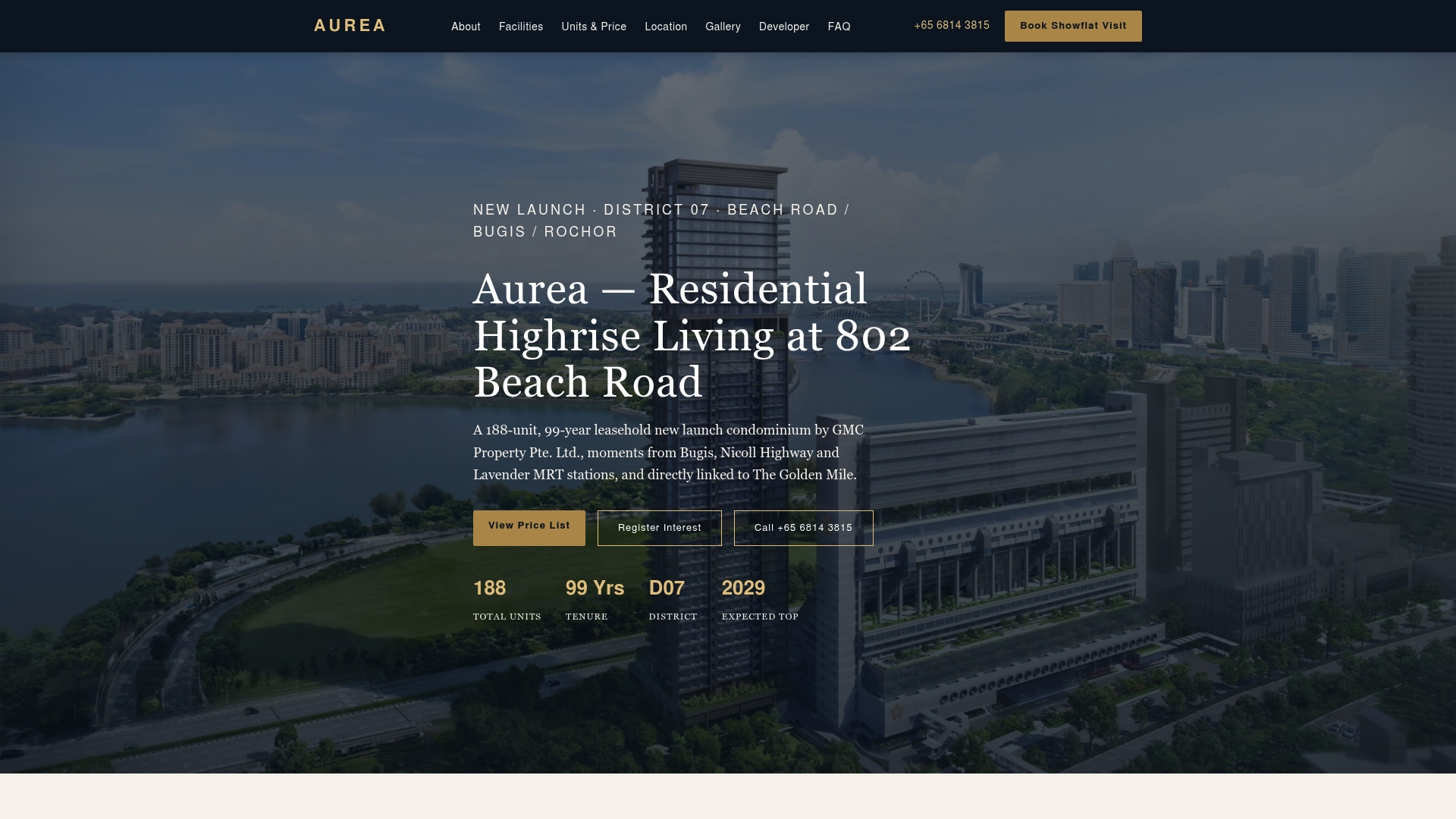
- Direct link bridge access to The Golden Mile adds a practical, everyday convenience most new launches cannot match.
- Resort-style amenities across four levels give residents multiple leisure options without leaving the building.
- Multiple nearby MRT stations support both owner-occupier convenience and longer-term rental or resale demand.
Before booking a viewing, prepare your CPF and loan scenario questions so you can ask about lease commencement and maintenance estimates on the spot. Visit the Aurea project page to check current unit availability and arrange an appointment.
This article is general information, not a substitute for advice from a qualified financial advisor. Consult a qualified financial professional about your own circumstances before acting on anything here.
FAQ
Does "lease top up" apply to buying a new condo launch?
In the context of a new 99-year leasehold launch, the lease is already fresh and fully in place as part of your purchase, so there is no separate top-up step to complete. The formal lease renewal process is a distinct government procedure that applies only to existing leaseholders on much older properties, as outlined by SLA's lease policy.
How does remaining lease affect my CPF usage?
CPF rules allow full use of your Ordinary Account savings if the remaining lease can cover the youngest buyer until age 95, according to CPF's guidance. A fresh 99-year lease on a new launch comfortably meets this for most buyers, though it is worth confirming against your exact age and the lease start date.
Will a 99-year lease hurt my resale value later?
Lease tables like Bala's Table are designed for valuation and stamp duty purposes, not as resale price forecasts, so they should not be read as a precise prediction of future value. Location, transport access, developer reputation, and building maintenance tend to influence resale demand more directly than lease years alone.
What should I ask the developer before signing?
Request the exact lease commencement date, a written estimate of monthly maintenance and sinking fund contributions, and the relevant clauses in the Sale and Purchase Agreement covering lease start and completion timing. These details let you run accurate CPF and loan tenure calculations before committing.
Is a 99-year leasehold condo a good investment compared to freehold?
Leasehold and freehold properties serve different buyer priorities, and leasehold condos in Singapore have been standard since 1967 as part of how the government manages land supply, according to Gov. Many buyers weigh location, price, and amenities more heavily than tenure type alone when deciding between the two.
Sources
- Lease Policy | Singapore Land Authority
- How much CPF savings you can use for your home purchase | CPF
- Gov