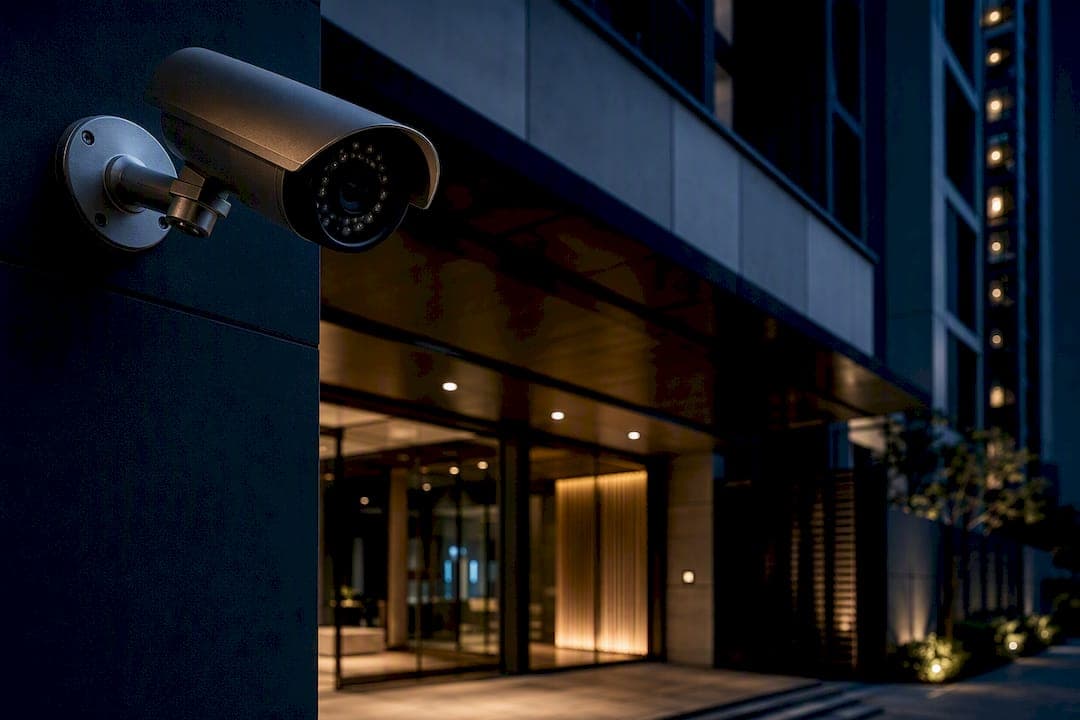
The essentials are layered protections: strong access control, continuous surveillance, trained on-site staff, good lighting and landscaping, and integrated alarms. No single device does the job alone. Together, these categories close the gaps that any one system leaves open, and the sections below break down how to prioritize them, whether you're managing a 40-unit walk-up or a 400-unit tower.
TL;DR:
- Encrypted RFID, NFC, and biometric credentials significantly reduce risks associated with cloning and lost fobs; multi-factor authentication is highly recommended.
- Cameras should be placed at high-traffic chokepoints like lobbies, stairwells, and parking entrances, avoiding private areas or units to comply with privacy laws.
- Functional security relies on proper maintenance and clear policies for audit logs, data privacy, and fob sharing, with regular reviews and legal oversight.
- Lighting and landscaping are cost-effective deterrents, especially when lighting every exterior approach and trimming shrubs that create hiding spots.
- New developments can incorporate integrated security plans from the design stage, offering better coverage and access zoning than retrofit solutions.
Table of Contents
- What Does Layered Condo Security Actually Look Like?
- How Should Access Control Work in a Condo Building?
- Where Should CCTV Cameras Go, and Where Shouldn't They?
- What Should Security Guards and Patrols Actually Do?
- Why Lighting and Landscaping Matter More Than People Think
- What Alarms and Sensors Belong in a Modern Condo?
- How Do You Secure Parcels, Visitors, and Parking?
- What Policies and Maintenance Keep Security Systems Working?
- How Do New Developments Approach Security From Day One?
- Convenience, Privacy, and Safety Rarely Pull in the Same Direction
- What Buyers Should Know About Aurea's Approach to Security
- Sources
- FAQ
What Does Layered Condo Security Actually Look Like?
Security professionals think in zones, not gadgets. A building's defenses run from the outside in: perimeter (fences, gates, lighting), entry points (lobby doors, parking gates, garage ramps), common areas (gyms, pools, mailrooms, elevators), and finally the unit level (individual door locks and in-suite alarms). Each zone needs its own controls, and weakness in one undermines the rest. A building with a biometric lobby door but an unlit, unlocked side entrance from the parking garage hasn't actually solved anything.
How much a building needs depends heavily on its size and resident count. A useful way to think about it:
- Small buildings (under 50 units): Basic keyed or fob access, motion-sensor lighting on every exterior approach, and a monitored alarm panel usually covers the real risk. Twenty-four-hour staffing rarely pencils out financially at this scale.
- Mid-size buildings (50 to 200 units): This is where access control systems, camera coverage of every common area, and part-time or shift-based concierge staff start paying for themselves, especially in buildings with active parcel volume or shared amenities.
- Large towers (200-plus units): These properties generally need an integrated platform tying access, video, and alarms together, plus around-the-clock staffing, because the sheer volume of daily entries and deliveries makes manual oversight unworkable.
Every upgrade involves trade-offs. More cameras mean more footage to manage and more privacy questions from residents. Biometric access is convenient until someone worries about where their fingerprint data lives. Cost scales fast, too. A multifamily security overview from Pelco notes that comprehensive systems need to account for shared spaces like elevators, stairwells, and pools individually, not as an afterthought bolted onto the lobby system. Buildings that skip this step often end up with camera coverage in the places that look impressive on a walkthrough and gaps in the places incidents actually happen, like stairwell landings and loading docks.
How Should Access Control Work in a Condo Building?
The fob you clip to your keychain matters more than most residents realize. Older low-frequency fobs are trivially easy to clone with a $20 device bought online. Modern systems avoid that problem by using encrypted credentials, and Swiftlane's guide to condo key fob systems points out that encrypted RFID, NFC, or Bluetooth credentials sharply cut the risk of duplication compared to legacy fobs, particularly when paired with multi-factor authentication such as a fob plus a PIN or a fingerprint scan.
Mobile credentials add convenience since residents already carry their phones everywhere, and biometrics remove the "lost or copied fob" problem entirely. Both raise real privacy questions worth addressing before rollout, not after a resident complains.
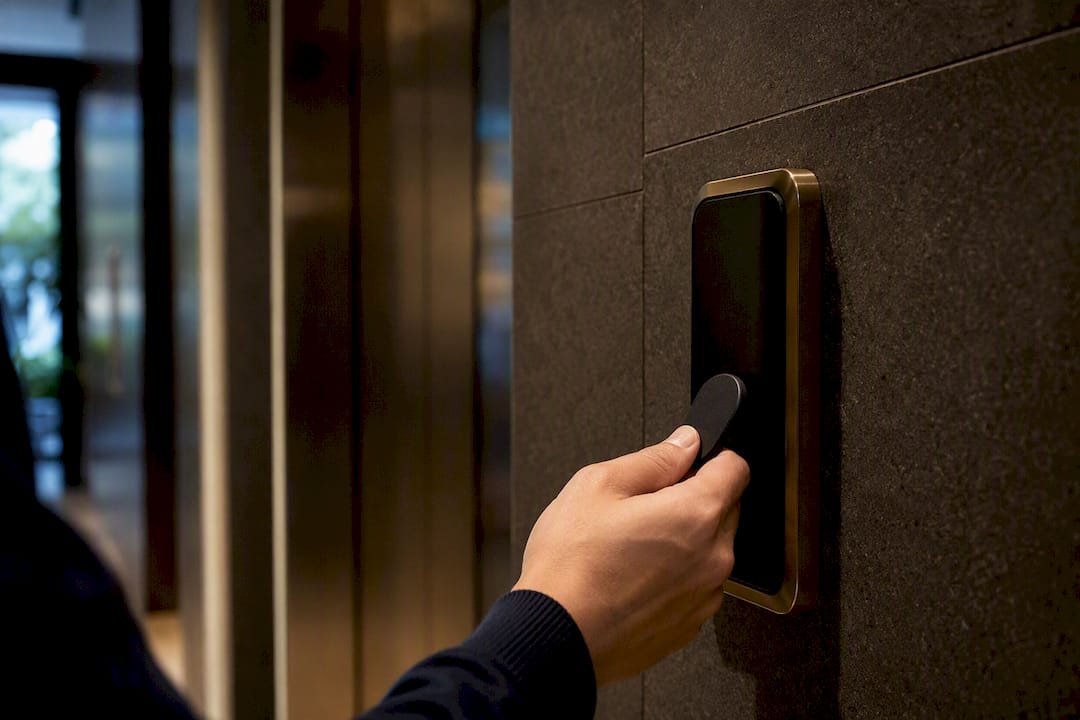
Pro Tip: Ask any vendor whether their system logs every entry attempt, not just successful ones. Failed access attempts are often the earliest signal something is wrong.
A few operational habits separate a well-run access system from a vulnerable one:
- Deactivate lost or stolen credentials within hours, not days, and keep a documented process for it.
- Maintain audit logs showing who entered where and when, since these are the first thing investigators ask for after an incident.
- Extend access control to elevators and amenity floors so a fob only opens the zones a resident is actually authorized to use.
- Consider hybrid credential setups (fob, mobile, and biometric options together), since Swiftlane notes hybrid models let buildings upgrade gradually instead of ripping out an entire system at once.
Roughly speaking, buildings that skip audit logging lose the ability to answer the single most common question a board faces after a theft: who was actually in the building that day?
Where Should CCTV Cameras Go, and Where Shouldn't They?
Camera placement determines whether footage is actually useful when something goes wrong. The highest-value locations are the ones people pass through without thinking twice: the main lobby entrance, mailroom, every stairwell landing, parking garage entries and exits, and loading or delivery zones. Cameras belong at chokepoints, not just wide-open lobbies where footage rarely shows a clear face.
Cameras should never point into individual units, private balconies, or changing areas near pools and gyms. Boards that get this wrong expose themselves to real legal risk, since CCTV and biometric deployments carry privacy obligations that vary depending on where the property is located, and a legal review before installation is far cheaper than one after a complaint.
Good lighting and clear sightlines do more for footage quality than a higher-resolution camera. A dim, backlit entrance produces useless silhouettes no matter how many megapixels the camera has.
Monitoring comes in a few flavors: a manned on-site console, remote cloud-based monitoring handled by a third party, or a hybrid where footage links directly to access-control events. Pelco's multifamily systems guide recommends this kind of tied-together, single-dashboard setup because it lets one alert (a door forced open, say) automatically pull up the matching camera feed instead of making staff hunt for it after the fact.
Before installing anything, a board should settle:
- How long footage is retained, and who can access archived recordings.
- Which areas carry a reasonable expectation of privacy and are therefore off-limits.
- Whether biometric data (if used) requires separate consent documentation.
What Should Security Guards and Patrols Actually Do?
Concierge staff, static guards, and mobile patrol services aren't interchangeable, even though buildings often use the terms loosely. A concierge handles the front desk, greets visitors, and manages deliveries, but usually isn't trained for confrontation. A static guard is posted specifically for deterrence and response. A mobile patrol service checks multiple properties on a rotating, randomized schedule and works best for smaller buildings that can't justify a full-time position.
- Match the role to the risk. Smaller buildings with modest foot traffic often do fine with randomized mobile patrols rather than a fixed guard station, which Forx Security notes can be a cost-effective alternative to round-the-clock staffing.
- Vary patrol timing. Predictable rounds are easy to work around. Randomized schedules that hit stairwells, loading docks, and parking levels at different times each shift close that gap.
- Require documented reporting. Every incident needs a written log, and photo or video evidence attached to it, so boards and police have something concrete to work from.
- Verify licensing and training before signing a contract. A guard company's credentials matter as much as its price quote.
Why Lighting and Landscaping Matter More Than People Think
Cheap fixes often outperform expensive tech. Motion-sensor lighting on every walkway, stairwell, and parking approach removes the dark corners where most incidents happen, and it costs a fraction of a camera upgrade. Landscaping matters just as much: overgrown shrubs next to entry doors or ground-floor windows create hiding spots that no camera angle fully solves.
- Light every exterior approach, not just the main entrance.
- Trim shrubs and hedges below window-sill height near ground-floor units.
- Schedule landscaping maintenance seasonally so growth doesn't quietly erase sightlines over a few months.
Practitioners consistently flag lighting and trimmed landscaping as some of the most cost-effective deterrents available, largely because they reduce camera blind spots at the same time they remove places for someone to loiter unseen. Buildings weighing yard and courtyard redesigns should also check local rules on condo yard modifications before assuming a landscaping change is purely cosmetic.
Pro Tip: Walk the property at night once a quarter. Daylight walkthroughs miss almost every lighting gap that actually matters.
What Alarms and Sensors Belong in a Modern Condo?
A complete sensor package covers more than intrusion. Door and window contacts, glass-break detectors, and motion sensors handle break-in risk. Smoke and carbon monoxide detectors cover fire and air-quality hazards. Water-leak sensors, often overlooked, protect against the kind of slow damage that racks up the biggest repair bills in shared buildings.
- Tie sensors into a central alarm panel that pushes real-time alerts to staff or a monitoring center.
- Route water-leak and temperature alerts directly to the property team, since early notification often prevents damage rather than just documenting it after the fact.
- Test every sensor type on a fixed schedule, not only when something already seems wrong.
- Calibrate sensitivity carefully. Overly sensitive motion detectors generate false alarms that train staff and residents to ignore real ones.
Buildings that integrate leak and temperature sensors with their broader management systems catch problems early enough to avoid expensive repairs, which is exactly the kind of quiet, unglamorous win that never shows up in a security brochure but shows up on the maintenance budget.
How Do You Secure Parcels, Visitors, and Parking?
Package theft is probably the most common security complaint in any building with online-shopping-heavy residents. Locker systems that require a one-time code offer strong protection with minimal staff involvement, while a concierge-managed parcel room adds a human checkpoint but needs staffing hours to run properly. Automated locker platforms like StokdUp's storage management system show how this workflow can run without a staffed desk at all.
- Verify visitors through video intercom before granting entry, rather than buzzing anyone in on request.
- Issue temporary, time-limited credentials for contractors and guests instead of lending out a resident's fob.
- Control parking gates with the same access system used for the building, and add license-plate capture where local rules permit it.
- Secure bike storage with its own access control and fixed anchor points, since bike rooms are frequently the weakest link in an otherwise well-secured building.
What Policies and Maintenance Keep Security Systems Working?
Hardware without governance fails quietly. Boards need a written CCTV and privacy policy, a documented consent process for any biometric enrollment, clear visitor rules, and an explicit ban on fob-sharing between residents.
Maintenance contracts deserve just as much attention as the initial installation. Vendor agreements should specify inspection frequency, response-time guarantees, and a replacement budget for aging hardware, since a Pelco analysis of multifamily systems makes the point plainly: a security system is only as reliable as the maintenance schedule behind it. Buildings planning ahead for these costs often fold them into broader condo maintenance fee budgeting.
- Keep audit logs for a defined retention period and specify who can review them.
- Require legal review before deploying any CCTV or biometric system, given how privacy obligations shift by jurisdiction.
- Give residents a simple, visible channel to report security concerns rather than burying it in an email chain.
| Policy area | Minimum requirement | Owner |
|---|---|---|
| CCTV and privacy | Written policy, signage, retention limit | Board/management |
| Biometric data | Documented consent, legal review | Board/legal counsel |
| Fob-sharing | Explicit prohibition in house rules | Property manager |
| Vendor maintenance | SLA with inspection frequency | Management/vendor |
How Do New Developments Approach Security From Day One?
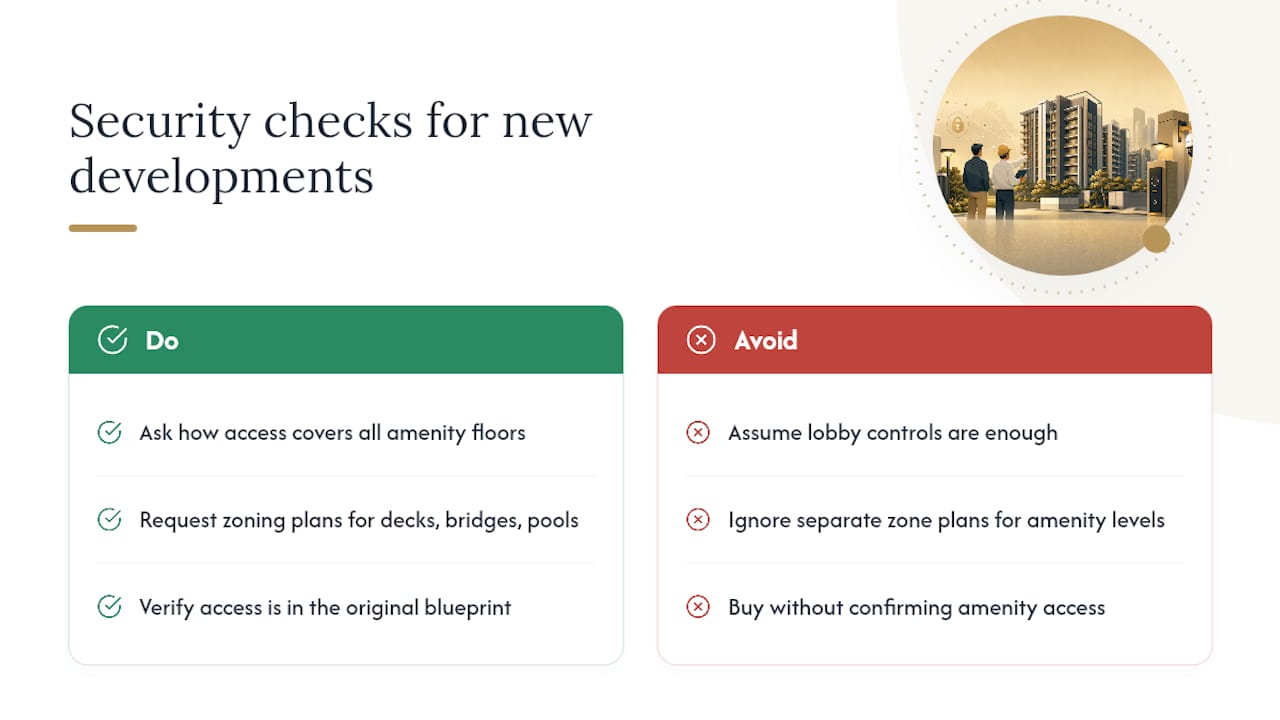
New highrise projects have an advantage older buildings don't: security gets designed in before a single unit sells, rather than retrofitted around existing wiring and layouts. Amenity decks, link-bridge access points, and multiple pool levels each need their own access zoning worked into the original blueprint. Buyers evaluating resort-style amenity buildings should ask specifically how access control extends across every amenity floor, not just the main lobby.
Convenience, Privacy, and Safety Rarely Pull in the Same Direction
Buildings that treat security as one integrated system outperform buildings that buy devices piecemeal. Mobile access is convenient, but convenience without a second authentication factor is a trade most boards make without fully weighing it. Residents comply with policy far more readily when they helped shape it, not when it's handed down after the fact.
— Velisa
What Buyers Should Know About Aurea's Approach to Security
Aurea, the 188-unit highrise at 802 Beach Road developed by GMC Property Pte. Ltd., builds security planning into its four-level amenity design from the start rather than adding it after handover. With units ranging from two to five bedrooms plus two penthouses, and a link bridge connecting directly to The Golden Mile, the layout gives designers a chance to zone access across pools, clubhouses, and fitness decks the way this guide describes, rather than retrofitting it later.
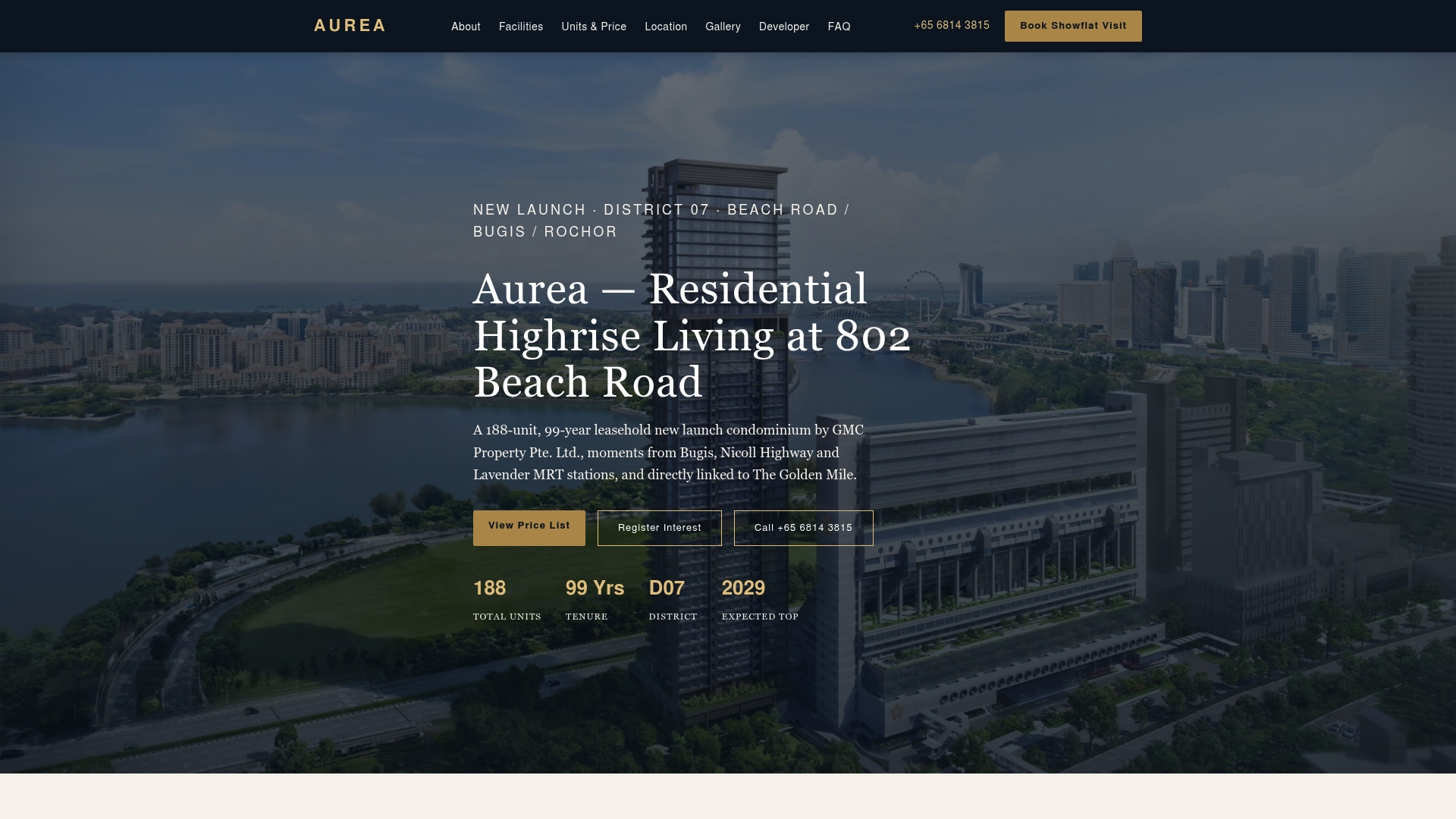
Buyers evaluating security in a new launch face a different question than owners in an older building: they're assessing plans and specifications, not walking an existing property. That's worth knowing going in, because it means the details matter more, not less. If integrated access control, common-area coverage, and amenity zoning across four levels are priorities in your search, Aurea's latest project updates are worth a direct look, and reaching out to the sales team is the fastest way to get specifics on the building's security specifications before booking a viewing.
Sources
- Key fob system for condos: The complete guide | Swiftlane
- Apartment & multifamily security systems | Pelco
- Condo Security - Security Guards & System, Condominium ... | Forx Security
FAQ
What Are Five Qualities of a Good Security Guard?
Reliability, clear incident reporting, physical presence without over-aggression, familiarity with the property's layout, and consistent coordination with property management and emergency services all matter more than any single certification.
What Are Five Key Security Measures for a Condo?
Access control with audit logging, camera coverage of common areas, on-site or patrol-based personnel, motion-sensor lighting with trimmed landscaping, and integrated alarms covering intrusion, fire, and water leaks form the core set most buildings need.
What Are the Core Features of a Condo Security System?
A complete system combines encrypted access credentials, CCTV placed at entry points and common areas, intrusion and environmental sensors tied to a central alarm panel, and a documented maintenance and audit-logging process, all managed through one connected platform where possible.
What Are the Four Main Types of Security Covered in Condo Planning?
Most frameworks break condo security into physical barriers (fencing, locks, lighting), electronic systems (cameras, alarms, sensors), access control (fobs, mobile credentials, biometrics), and human personnel (guards, concierge, patrols) working together as one layered plan.
How Can a Condo Improve Security Without a Full System Overhaul?
Start with the cheapest, highest-impact fixes first: motion-sensor lighting, trimmed landscaping near entrances, and enforcing a no-fob-sharing policy, then layer in access-control upgrades and camera coverage as budget allows.