
Yes, condos in Singapore can install shared EV chargers, and it's gotten considerably easier since the Building Maintenance and Strata Management Act (BMSMA) dropped the approval threshold to a simple majority. You'll still need to clear a few hurdles: an electrical capacity check, an MCST vote, an operator selection, and a grant application if you want the government to help cover costs. The pieces fit together, but the order matters.
TL;DR:
- Installing shared EV chargers in condos now only requires a simple majority vote, but an electrical capacity assessment must be completed first.
- Residents should unplug within 15 to 30 minutes after charging to ensure fair use and avoid disputes over bay blocking and long parking times.
- Condos are advised to start with 7.4 kW chargers, as most EVs in Singapore have onboard AC chargers capped at 7.2 kW, making higher power units often unnecessary.
- The EV Common Charger Grant covers part of the installation costs, with application documents including a capacity report and developer resolutions, emphasizing early planning.
- New developments can incorporate EV readiness from the start, avoiding costly upgrades later, with passive provisions and pre-installed outlets at TOP being ideal.
Table of Contents
- EV Charging Etiquette for Condo Residents
- Where to Charge: Condo Chargers vs Public Options in Singapore
- How to Get Chargers Installed in a Condo
- Choosing the Right Charger: Power Ratings and Compatibility
- Running the System: Operators, Pricing, and Daily Management
- Costs, Grants, and Realistic Timelines
- Aurea's Perspective: Future-Proofing New Launches for EV Charging
- The Perspective That Gets Overlooked
- Sources
EV Charging Etiquette for Condo Residents
Shared chargers only work if everyone treats them like shared property, not a personal parking spot with a bonus outlet. The single biggest complaint MCSTs report is fully charged cars sitting in charging bays for hours while other residents wait.
A few habits fix most of this before it becomes a dispute:
- Unplug and move your car within 15 to 30 minutes of a full charge, not whenever it's convenient.
- Set a phone reminder or use the charging app's notification feature so you're not the reason someone else missed their morning commute.
- Support a booking system if your MCST proposes one. Time-limited slots and idle fees (charges that kick in once your car is done but still parked) keep turnover fair.
- Never block a charging bay with a car that isn't plugged in.
- Report damaged cables, cracked connectors, or error codes immediately rather than assuming someone else will.
- If you're hosting a visitor with an EV, check with management first. Guest access is usually more restricted than resident access.
Pro Tip: Ask your MCST to write idle fees and time limits directly into the house rules rather than leaving them as a verbal understanding. Written rules are what actually get enforced when someone pushes back.
Where to Charge: Condo Chargers vs Public Options in Singapore
Overnight charging in your own condo covers most daily driving. If you commute under 40 to 50km a day, an 8 to 10 hour overnight session on a shared charger tops up more than enough range, and you skip queuing at a public station entirely.
Singapore's public network has grown fast. As of June 2025, LTA counted 14,741 publicly accessible EV charging points across HDB carparks, commercial hubs, and condos combined, part of a national push toward 60,000 points by 2030.
Here's how to think about which option fits your situation:
- Condo overnight charging works for daily commuters with predictable routes and access to a home charger.
- HDB carpark chargers matter if you frequently visit family or friends in public housing estates.
- Commercial fast chargers (at malls, petrol stations, or dedicated hubs) make sense for road trips or when you need a rapid top-up during the day, not as a daily habit.
- Condo residents without a personal charger yet can lean on public fast charging as a bridge while their MCST works through the approval process.
How to Get Chargers Installed in a Condo
The approval process changed meaningfully in 2024. Previously, installing common-property EV infrastructure needed a much higher vote threshold, which stalled plenty of well-intentioned proposals. LTA's amendment to the BMSMA now sets the bar at a simple majority, meaning 50% of owners present and voting at a general meeting.
Three deployment models dominate in practice:
- Capex-free EVCO installs — an Electric Vehicle Charging Operator (EVCO) funds and installs the hardware, then recovers costs through per-charge or subscription fees. The MCST spends nothing upfront but gives up some control over pricing and charger selection.
- MCST-funded installs — the MCST pays for hardware and installation using sinking fund money, then sets its own pricing or offers free charging. More control, more upfront cost.
- Leasing common property to an operator — the MCST rents out a section of the carpark to an EVCO, which then runs the chargers as a standalone business. Rare in Singapore condos but occasionally used where MCSTs want rental income without operational involvement.
The step-by-step sequence looks like this regardless of model:
- Commission a Licensed Electrical Worker (LEW) to assess substation and switch-room spare capacity.
- Decide on a deployment model and, if going capex-free, shortlist EVCOs for quotes.
- Table a motion at an AGM or EGM and secure the simple-majority vote.
- Apply for the EV Common Charger Grant (ECCG) if pursuing co-funding.
- Finalize charger specifications, install, and commission.
Skipping the LEW assessment is the most common mistake. MCSTs that vote first and check power capacity later sometimes discover their substation can't support even a modest rollout without a costly upgrade.
Choosing the Right Charger: Power Ratings and Compatibility
LTA guidance is specific here: condos should use type-approved smart chargers rated under 23 kW, and for most buildings, starting smaller is the smarter move.
The 7.4 kW starting point: LTA's own guide for MCSTs recommends beginning with low-powered chargers around 7.4 kW rather than jumping straight to 22 kW installs. Most EVs sold in Singapore have onboard AC chargers capped at 7.2 kW or 11 kW anyway, so a 22 kW charger often just wastes capacity your car can't use.
That mismatch is the core of the sizing decision:
- A 7.2 kW charger fully replenishes most EV batteries overnight, matching typical onboard charger limits.
- 11 kW chargers suit vehicles with three-phase onboard chargers, but check your model's actual limit before paying extra for capacity you can't draw.
- 22 kW installs generally only make sense if a meaningful share of the resident EV fleet has three-phase 22 kW onboard chargers, which remains uncommon.
- Scaling with 7 to 7.4 kW units as demand grows avoids "unable to charge" events during peak evening hours when transformer capacity gets tight.
On the physical side, don't overlook cable management, wheel stoppers to prevent bay overshoot, and weatherproof housing for chargers in semi-outdoor carparks. These are cheap add-ons at install time and expensive retrofits later.
Running the System: Operators, Pricing, and Daily Management
Once chargers are live, someone has to run them. That's where licensed EVCOs come in. Under the Electric Vehicles Charging Act, any operator providing paid charging services must hold an EVCO license, which comes with conditions around uptime guarantees, third-party liability insurance, and service standards.
Typical arrangements MCSTs encounter:
- Pay-per-charge billing based on kWh consumed, similar to a utility meter.
- Subscription models where residents pay a flat monthly fee for unlimited or capped access.
- Capex-free revenue sharing, where the EVCO recovers its installation cost through usage fees over several years.
Day-to-day, the MCST's role shifts from installer to overseer: fielding fault reports, enforcing booking and idle-fee rules, and holding the EVCO accountable to whatever maintenance service level was agreed in the contract. A capex-free arrangement lowers the barrier to getting chargers installed at all, but MCSTs still need to negotiate uptime and maintenance terms upfront rather than assuming the operator will self-police.
Costs, Grants, and Realistic Timelines
The EV Common Charger Grant co-funds a meaningful chunk of installation costs for condo chargers, with a cap per charger and a program window that isn't open-ended.
The grant has already supported roughly 2,000 EV chargers in condominiums, and funding is expected to run until late 2026 or until the allocated quota is exhausted, whichever comes first.
Budgeting realistically depends on your model:
- Under a capex-free EVCO arrangement, out-of-pocket cost to the MCST is often close to zero, with the operator recovering costs through usage fees over time.
- Under an MCST-funded model, expect to cover hardware, installation labor, and any switchboard upgrades the LEW assessment flags, partially offset by the ECCG.
- Documents typically needed for a grant application include the MCST resolution, LEW capacity report, and EVCO quotation.
Applying early matters more than most MCSTs realize, since caps and deadlines don't wait for a slow AGM cycle.
Aurea's Perspective: Future-Proofing New Launches for EV Charging
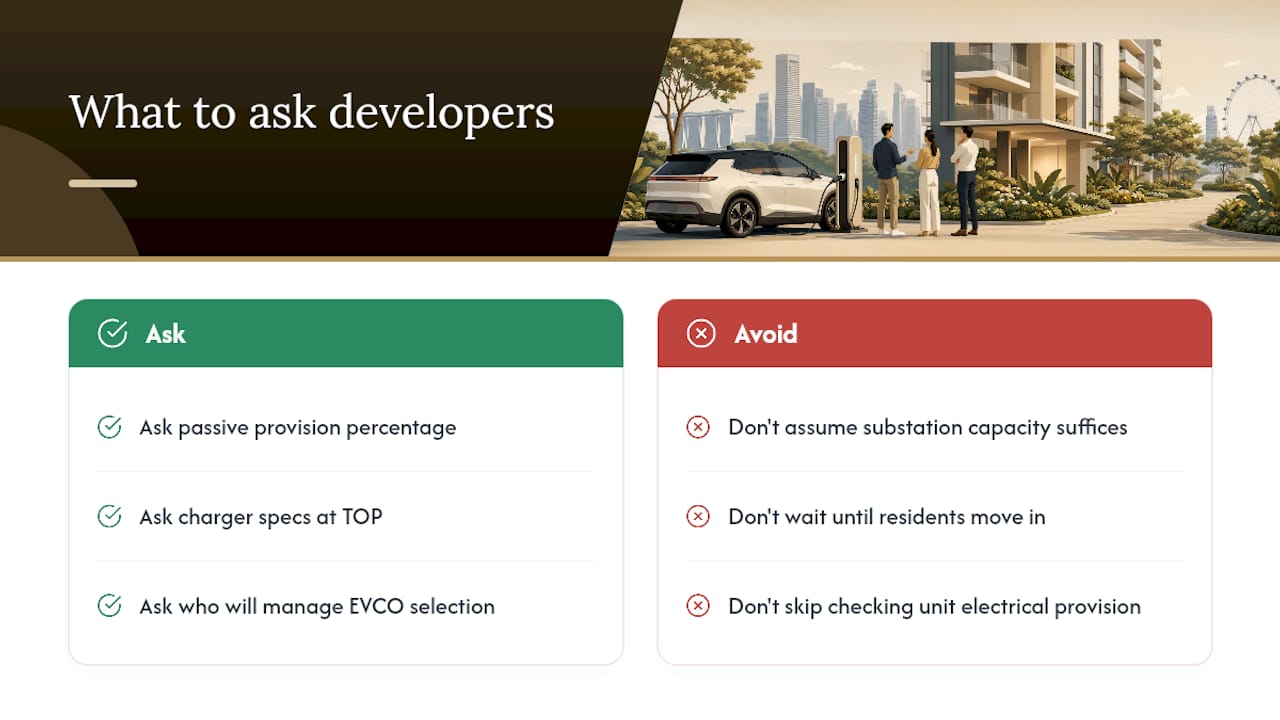
New developments have an advantage older condos don't: they can build EV readiness into the design instead of retrofitting it, benefiting from insights on modern condo amenities and resident expectations. Passive provision, meaning pre-laid conduit and reserved switchboard capacity, plus a base level of active chargers ready at Temporary Occupation Permit (TOP), removes the exact bottleneck most older MCSTs now face: discovering the substation can't handle demand after residents have already moved in.
If you're evaluating a new launch, ask the developer directly what passive provision percentage is built in, which charger specifications are planned at TOP, and who will manage EVCO selection after handover. At Aurea, situated at 802 Beach Road with 188 units spanning 2 to 5 bedroom layouts, resort-style amenities across four levels reflect exactly this kind of forward planning, the same instinct that should extend to electrical infrastructure most buyers never think to ask about until they own an EV. You can review current unit availability and project updates directly.
The Perspective That Gets Overlooked
Most coverage of EV charging in condos treats the BMSMA vote change as the headline story, and it is significant. But the vote was never the hardest part. The hardest part is that most MCSTs vote to approve chargers before anyone has confirmed the building's substation can actually support them, then discover months later that a six-figure electrical upgrade sits between the vote and the ribbon cutting.
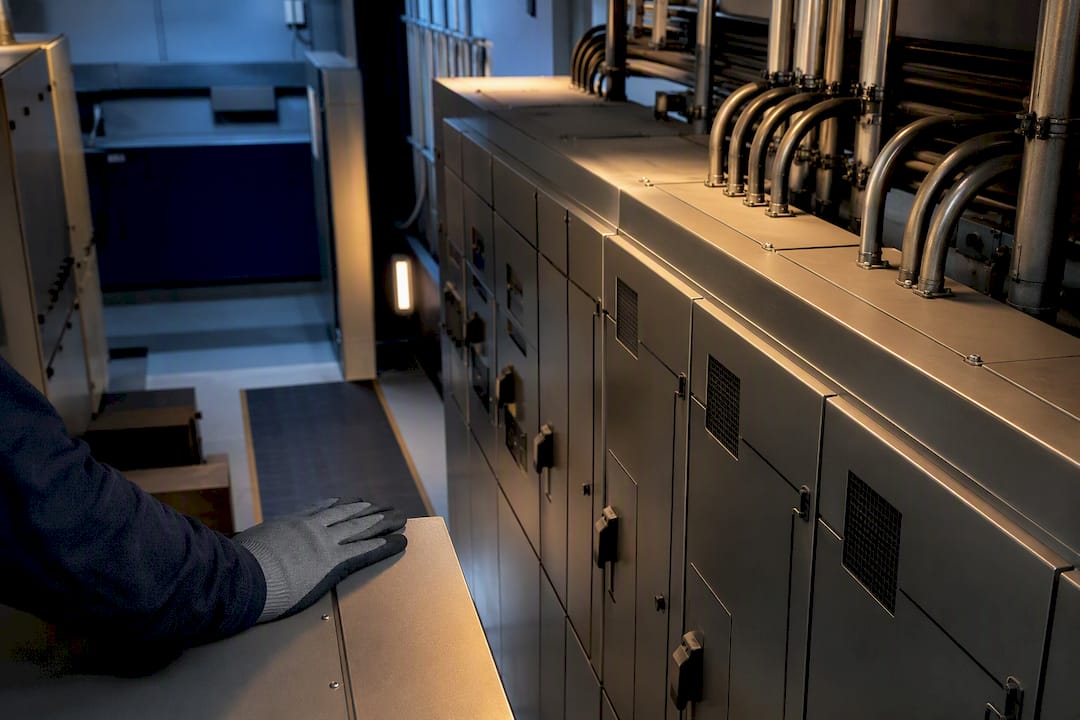
The LEW assessment should come before the AGM motion, not after, yet in practice most committees do it backwards because a vote feels like progress and a technical study feels like a delay. That sequencing mistake costs far more time than doing it properly the first time.
There's also a quieter issue nobody likes discussing: fairness between EV owners and non-EV owners when MCST sinking funds pay for chargers only some residents will ever use. Capex-free EVCO models sidestep this by shifting cost to usage fees, which is probably why they're becoming the default choice even among MCSTs that could technically afford to self-fund. The residents who benefit pay for it directly, and everyone else's sinking fund stays untouched. That's not a technical argument for capex-free deployment. It's a political one, and it's the real reason adoption is accelerating faster than the grant numbers alone would suggest.
— Velisa
Sources
- Expanding Singapore's EV charging infrastructure (LTA news release)
- Electric vehicles | Ministry of Transport
- 2,000 EV chargers in condominiums co-funded under government grant | The Straits Times