
For most private-condo buyers who want fast bank disbursement and fewer paperwork delays, PKWA Law is the strongest overall pick thanks to its bank-panel breadth and institutional track record. Lee Kim Kee suits buyers who want a seasoned sole practitioner, Norman Ho fits high-value or contested transactions, and HDB resale buyers on tighter budgets often do well with Mohammed Shakirin or Lim Fung Peen. Profiles, fees, and vetting questions follow below.
TL;DR:
- Choosing a conveyancing lawyer with confirmed bank-panel status and a strong review history can significantly reduce loan disbursement delays.
- Lawyers specializing in high-value, complex, or contested transactions like Norman Ho or Abdul Wahab may be better suited for specific dispute-prone or sophisticated deals.
- Fees and timelines vary between HDB and private property deals, with HDB conveyancing generally costing less and following more standardized procedures.
- Prioritize direct questions about bank-panel membership, recent relevant experience, response times, and clear fee structures during initial consultations.
- Engaging a lawyer early, aligned with your loan approval timeline, helps prevent delays in mortgage processing and property settlement.
Table of Contents
- Best Conveyancing Lawyers in Singapore: Full Shortlist
- How Do You Choose the Right Conveyancing Lawyer?
- What Do Fees and Timelines Look Like for HDB vs Private Property?
- How We Picked and Verified This Shortlist
- Why Aurea's Local Property Expertise Shapes This Guide
- What Does a Conveyancing Lawyer Do When Disputes Arise?
- How Do You Verify a Lawyer's Accreditation in Singapore?
- Why Bank Panels Matter More Than Star Ratings
- A Different Kind of Decision: Choosing Your Next Home
- Sources
Best Conveyancing Lawyers in Singapore: Full Shortlist
Picking from Singapore's crowded conveyancing market gets easier once you separate lawyers by what they actually specialize in, not just star ratings. Some names below run boutique practices built on decades of personal client relationships. Others sit inside larger firms with formal bank-panel status and directory recognition from The Legal 500 Asia-Pacific. Both types can do excellent work, but they suit different buyers.
The table below ranks the most institutionally recognized options first, since bank-panel status and directory rankings tend to matter more for smooth loan disbursement than review counts alone.
| Lawyer / Firm | Best For | Standout Credential | Bank Panel Status | Fee Shape (HDB / Private) |
|---|---|---|---|---|
| PKWA Law | Institutional reliability, major bank panels | Explicit bank-panel listing, large review base | Confirmed on major bank panels | Fixed fee, tiered by property type |
| Norman Ho | High-value or complex transactions | Multiple directory recognitions (Chambers, Legal 500) | Firm-level panel coverage | Higher fixed fee, scope-dependent |
| Monica Yip | Complex property or financing advisory | Consistent directory recognition, deep sector tenure | Firm-level panel coverage | Custom scope, fixed or blended |
| IRB Law | High transaction volume, transparent pricing | Large stated case volume | Panel status varies by branch | Fixed fee, published rate cards |
| Lee Kim Kee | Long-standing personal service | 39 years in practice, client-reviewed | Ask directly, confirm with your bank | Fixed fee, HDB-friendly |
| Lim Fung Peen | Broad residential experience | Named in SingaporeLegalAdvice's 2026 shortlist | Ask directly, confirm with your bank | Fixed fee, standard HDB/private rates |
| Mohammed Shakirin | Cost-conscious, responsive service | Praised for clear client communication | Ask directly, confirm with your bank | Lower fixed fee, HDB-focused |
| Lim Kim Hong | Detail-heavy, meticulous review | Known for careful title and contract checks | Ask directly, confirm with your bank | Fixed fee, standard rates |
| Abdul Wahab | Probate, divorce, contested title | Hands-on experience with sensitive estate matters | Ask directly, confirm with your bank | Custom scope, higher for litigation elements |
A few notes on reading this table before you start calling firms:
- "Bank panel status" listed as "ask directly" doesn't mean the lawyer lacks panel membership. It means panel status isn't standardized or published across all banks, so confirming directly with your own bank's conveyancing list is the only reliable check.
- Fee shape describes the billing structure, not an exact quote. Actual fees depend on property value, mortgage complexity, and whether title issues surface during searches.
- Directory recognition (Chambers, Legal 500) tends to track larger firms handling higher-value or more complex deals, while sole practitioners like Lee Kim Kee or Lim Kim Hong build reputation through decades of repeat and referred clients instead.
PKWA Law leads this list because it combines the two things that matter most for a typical private-condo purchase: confirmed placement on major bank panels and a large, public review history that lets you verify service quality before you sign an engagement letter. That combination doesn't automatically make it the right fit for every transaction, though. If you're dealing with a contested inheritance or a messy divorce-related transfer, Abdul Wahab's specific experience in sensitive estate matters will likely serve you better than a generalist practice. If your deal involves nine-figure asset structuring or cross-border elements, Norman Ho's profile at Rajah & Tann, or Monica Yip's long tenure in corporate real estate advisory, reflect the kind of complexity those transactions demand.
Lee Kim Kee and Lim Fung Peen occupy a different niche entirely. Both are practitioners with long track records built on direct client relationships rather than firm infrastructure. For a straightforward HDB resale or a mid-market private condo purchase, a sole practitioner with 30-plus years of experience often moves faster and costs less than a mid-sized firm, simply because there's less internal handoff between the person you spoke to and the person doing the work.
How Do You Choose the Right Conveyancing Lawyer?
Choosing a conveyancing lawyer isn't about finding the biggest name. It's about matching specific criteria to your specific transaction. A lawyer who's brilliant at HDB resales might have never handled a staged-payment new-launch contract, and that gap can cost you time and money if it surfaces mid-transaction.
Five criteria matter more than anything else:
- Bank panel membership. Yuen Law notes that panel membership speeds up mortgage paperwork considerably, since panel lawyers already have established workflows with that bank's loan disbursement team.
- Responsiveness. A conveyancing timeline runs on deadlines. A lawyer who takes three days to reply to a straightforward query is a liability once you're racing to meet a loan approval date.
- Fee transparency. Ask for a written fee schedule before engagement, not a verbal estimate.
- Track record with similar transactions. A lawyer who mostly handles HDB resales may not be the right choice for a five-bedroom penthouse purchase with complex financing.
Here are the questions worth asking on your first call or email:
- Are you on the panel of [your bank's name]?
- How many conveyancing matters similar to mine did you complete in the last year?
- What's your fixed fee, and what triggers additional charges?
- Who will actually handle my file, day to day?
- What's your typical turnaround time for document review?
- Have you handled [HDB resale / new launch / private resale] transactions recently?
- What happens if a title search reveals a caveat or encumbrance?
- Can you provide a reference or point to recent client feedback?
Red flags worth taking seriously: a lawyer who won't confirm bank-panel status upfront, vague or shifting fee quotes, slow replies before you've even engaged them, and an unwillingness to explain what happens if title searches turn up problems. If a lawyer dodges a direct question about panel membership, that's usually because the answer is no, not because the question was unclear.
Pro Tip: Line up your lawyer selection with your loan approval timeline, not after it. Banks often need your lawyer's details to finalize mortgage paperwork and CPF withdrawal forms, so engaging a conveyancer late can stall your loan disbursement even after approval comes through.
What Do Fees and Timelines Look Like for HDB vs Private Property?
Conveyancing must legally be handled by a qualified lawyer in Singapore, who prepares the sale and purchase agreement, lodges documents with the Singapore Land Authority, coordinates CPF fund usage, and liaises with your bank on mortgage matters. HDB resale conveyancing generally costs less than private property work, partly because HDB publishes standardized fee guidance for straightforward cases. Private property fees vary more, since they scale with purchase price, mortgage complexity, and whether the transaction involves a new launch with staged payments.
The timeline from signing the Option to Purchase to completion typically spans several weeks, with these milestones along the way:
- Exercise of the Option to Purchase and initial deposit payment
- Lawyer engagement and instruction to begin title searches
- Caveat and encumbrance checks on the property title
- Loan documentation finalized with your bank
- CPF withdrawal forms processed for downpayment and completion
- Final completion and handover of keys
Title searches catch lodged caveats or encumbrances early, which matters because unresolved issues here can delay settlement by weeks. Bank-panel membership speeds up the loan disbursement leg specifically, since a panel lawyer already has an established process with that bank's mortgage team rather than starting from scratch.
How We Picked and Verified This Shortlist
This list draws on a mix of public trust signals rather than a single ranking source. The core signals:
- Firm practice pages describing services, specializations, and bank-panel claims
- Bank-panel listings stated directly on firm websites
- Client-review evidence published on firm pages or in SingaporeLegalAdvice's 2026 roundup
We could not independently verify real-time bank-panel status for every practitioner listed, since panel membership isn't published in one central registry and changes periodically. If you're reading this and a detail has shifted, confirm directly with the firm and your bank before engaging. This shortlist favors demonstrable institutional signals and recent client feedback over marketing claims alone.
Why Aurea's Local Property Expertise Shapes This Guide
This guide comes from Aurea-sgcondo's editorial team, led by Velisa, who covers Singapore property buying on the Aurea property blog. That work includes practical guidance on Option to Purchase timelines for condo buyers and financing choices between bank and HDB loans, both of which intersect directly with conveyancing decisions. As the team behind a new-launch condominium project at 802 Beach Road, Aurea sees firsthand how financing timelines, legal paperwork, and completion dates interact for real buyers, not just in theory. That vantage point shapes the practical emphasis in this guide on bank-panel status and realistic timelines over generic legal explainers.
What Does a Conveyancing Lawyer Do When Disputes Arise?
Most conveyancing transactions close without incident, but disputes do surface, ranging from disagreements over defects found during final inspection to disputes about deposit forfeiture when a buyer backs out. A conveyancing lawyer's role shifts noticeably once a dispute emerges.
Before any dispute, the lawyer's job is procedural: drafting agreements, running title searches, coordinating CPF and mortgage paperwork. Once a dispute surfaces, the lawyer becomes an advocate, reviewing contract terms to determine which party is in breach, negotiating a resolution before litigation becomes necessary, and advising on remedies available under the sale and purchase agreement.

Common dispute scenarios include a seller failing to vacate by the agreed date, disagreements over property condition at handover, financing falling through after the Option to Purchase has been exercised, or a caveat surfacing late that complicates the title transfer. Lawyers like Abdul Wahab, who specialize in sensitive or contested matters, tend to have more direct experience navigating these situations than generalist practitioners who mostly handle routine transactions.
If a dispute escalates toward litigation, your conveyancing lawyer may refer you to litigation counsel, since not every conveyancer handles courtroom representation. Asking upfront whether your lawyer handles disputes in-house or refers them out is worth doing before you sign an engagement letter, not after a problem appears.
How Do You Verify a Lawyer's Accreditation in Singapore?
Every practicing lawyer in Singapore must hold a valid practicing certificate issued through the Singapore courts system, and you can verify this status through the Law Society of Singapore's public directory. This is the single most reliable check before engaging anyone, and it takes minutes.
Beyond basic accreditation, look for secondary signals that indicate real specialization rather than a generalist dabbling in property work. Directory recognition from Chambers or The Legal 500 signals peer and client-reviewed expertise, particularly for higher-value or complex transactions. Firm tenure and named partner credentials, like Norman Ho's decades-long profile at Rajah & Tann or Monica Yip's standing at WongPartnership, offer another layer of verification for buyers handling significant transactions.
For sole practitioners without directory recognition, ask directly about years in practice, request examples of similar transactions handled, and check whether the firm's practice pages describe conveyancing as a core service rather than an occasional add-on. A lawyer who lists conveyancing as one of a dozen unrelated practice areas likely handles fewer such matters than someone whose entire practice centers on property transactions.
Why Bank Panels Matter More Than Star Ratings
Most guides to picking a conveyancing lawyer lean hard on review counts and star ratings, and that's the wrong starting point. A lawyer with 80 glowing reviews who isn't on your bank's panel will cost you time you don't have once your loan approval clock starts ticking. Panel status and directory recognition from Chambers or Legal 500 tell you something reviews can't: whether this lawyer's paperwork moves smoothly through your specific bank's disbursement process.
The conventional advice to "just pick someone with good reviews" also glosses over how different HDB and private conveyancing actually are. A lawyer who's handled two hundred straightforward HDB resales isn't automatically equipped for a new-launch purchase with staged payments and developer contract terms. Buyers should prioritize matching a lawyer's actual transaction history to their own deal type first, then use reviews and directory status as a second filter, not the first.
If there's one thing worth doing differently: call your bank before you call a lawyer. Get the panel list, then work backward from there. It narrows your search fast and removes the risk of falling for a lawyer with great reviews but no relationship with the institution funding your purchase.
— Velisa
A Different Kind of Decision: Choosing Your Next Home
Everything above helps you find the right lawyer once you've picked a property. But if you're still deciding what to buy, Aurea-sgcondo offers something the conveyancing firms above can't: a finished product designed around how families and professionals actually want to live in the city, with the legal groundwork of a 99-year leasehold new launch already structured for you.
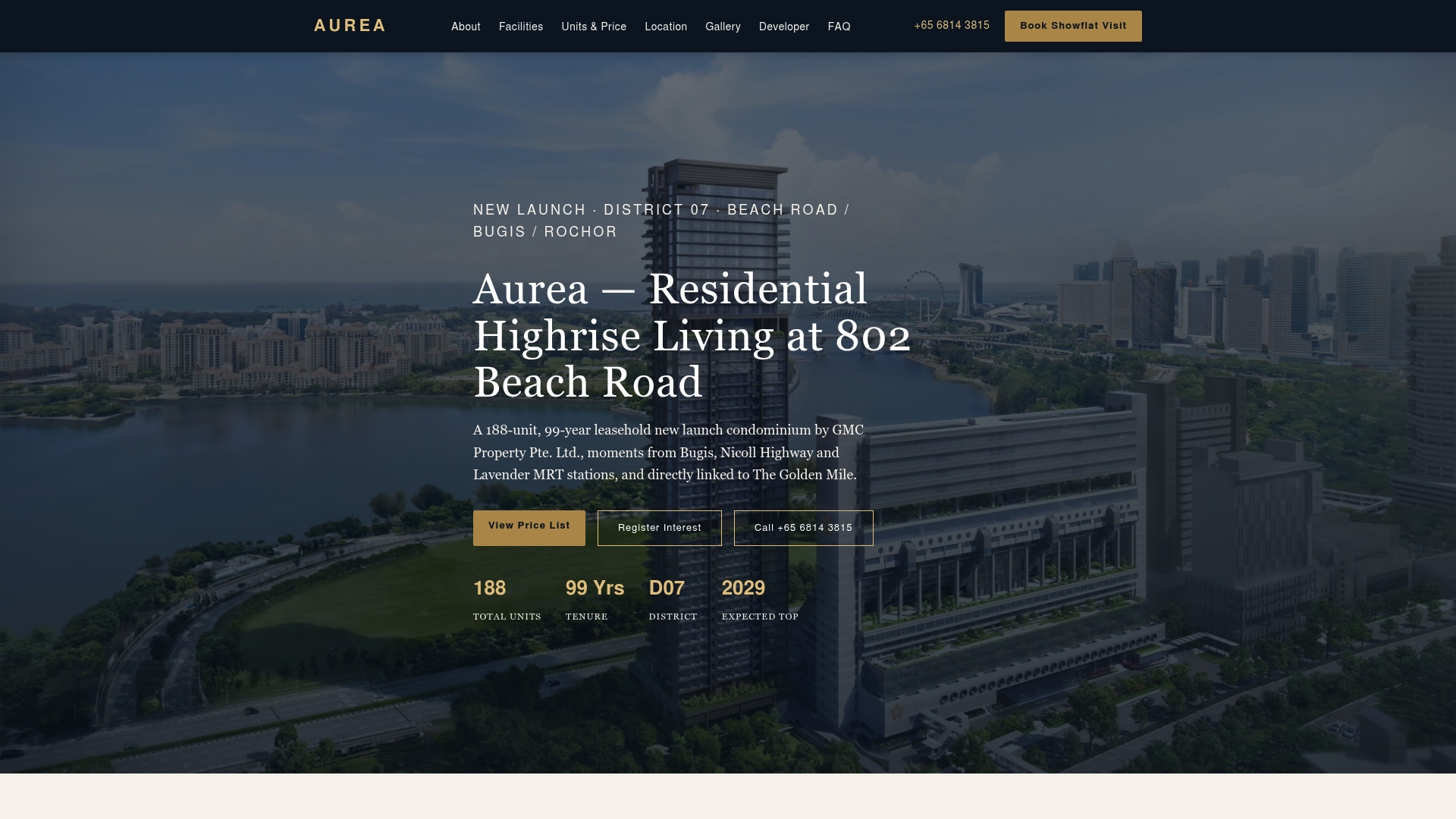
Aurea sits at 802 Beach Road with 188 units spanning two to five bedrooms, plus two penthouses, and resort-style amenities across four levels, including pools, fitness decks, and children's facilities, all connected by a link bridge to The Golden Mile. For buyers weighing a new launch against a resale purchase, working with any of the lawyers profiled above still applies, since your appointed conveyancer will handle contract review, CPF coordination, and bank liaison regardless of which property you choose. What Aurea adds is a location near multiple MRT stations and a layout mix built for families and professionals who want city convenience without sacrificing space. If a new launch near the city center fits your search, check current availability and unit layouts at Aurea before your preferred stack sells out.
This article is general information, not a substitute for advice from a qualified lawyer. Consult a qualified legal professional about your own circumstances before acting on anything here.
Sources
- 5 Highly Rated Conveyancing Lawyers in Singapore (2026) — SingaporeLegalAdvice
- Sale & Purchase of Real Estate | Conveyancing Lawyers — Yuen Law
- Conveyancing Lawyer Singapore | PKWA Law