
If you're buying a private condominium in Singapore, the HDB concessionary loan is not an option. Full stop. Private-condo purchases require a bank home loan from a financial institution (FI) regulated by the Monetary Authority of Singapore (MAS). That single fact shapes everything from your downpayment structure to your rate risk exposure.
Here's what to do right now:
- Start your In-Principle Approval (IPA) with at least two banks (DBS/POSB, OCBC, or UOB are the major local lenders) before you exercise any Option to Purchase (OTP).
- Prepare at least 5% of the purchase price in cash — this is a hard MAS requirement for bank loans; CPF Ordinary Account (OA) funds cannot cover this portion.
- Check CPF and HDB implications if you currently own or plan to own an HDB flat in future, since switching between loan types carries permanent consequences.
Table of Contents
- How does a bank loan compare to an HDB loan for private condo buyers?
- Which buyer profile suits a bank loan, and when does the HDB loan still matter?
- How do bank home loans for private condominiums actually work?
- What is the HDB concessionary loan, and why can't you use it for a private condo?
- Worked example: what rate differences actually cost you
- How do you compare bank loan offers and get an IPA?
- What should you confirm before signing the loan or exercising the OTP?
- What's the right decision for a private condo buyer?
- Key Takeaways
- A note from Aurea-sgcondo on why this guide matters
- Aurea-sgcondo: a private condo designed for buyers who are financing-ready
- Authoritative sources for verification
How does a bank loan compare to an HDB loan for private condo buyers?
The table below covers every dimension that matters to a private-condo buyer. Note that the HDB concessionary loan column is included as a reference benchmark, since many buyers come to this decision from an HDB context or hold HDB property simultaneously.
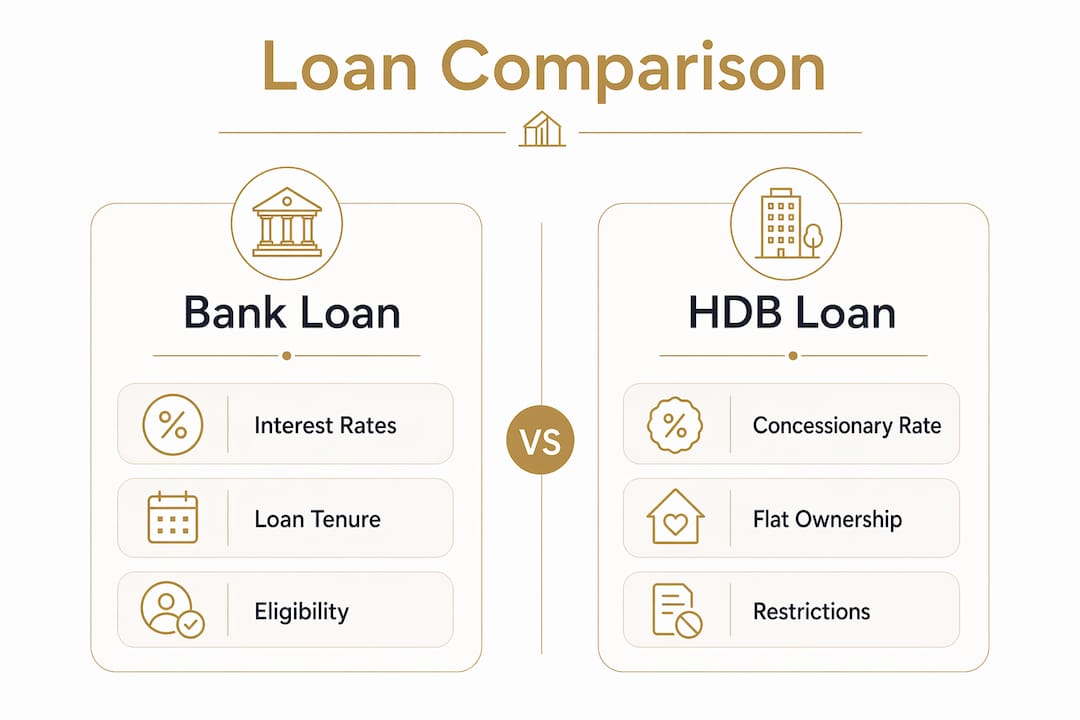
| Dimension | Bank Home Loan (private condo) | HDB Concessionary Loan |
|---|---|---|
| Applicable property type | Private condominiums, landed, HDB flats | HDB flats only — NOT private condos |
| Interest-rate basis | SORA-pegged floating or fixed 2–5 years | CPF OA + 0.1% (currently 2.6% p.a.) |
| Predictability / rate risk | Rate risk after fixed period; SORA can spike | Stable; reviewed quarterly but rarely moves |
| LTV limit | Up to 75% of valuation or price | Up to 75% (HDB flats only) |
| Minimum cash downpayment | 5% cash required; balance from CPF OA | Nil — full CPF OA allowed |
| CPF usage | CPF OA for monthly repayments and 20% downpayment | CPF OA for full downpayment and repayments |
| Max loan tenure | 30 years (private condo) | 25 years (HDB flats only) |
| Refinancing | Can switch between banks; cannot revert to HDB loan | Can refinance to bank loan at any time |
| Early repayment penalty | Yes, during lock-in (typically ~1.5% of outstanding) | None |
| Approval process | IPA → valuation → Letter of Offer (LO) | HDB Flat Portal IPA → HFE letter |
Key implications for private-condo buyers:
- The HDB loan column is irrelevant to your purchase but matters if you hold or plan future HDB property.
- MAS TDSR rules cap total monthly debt repayments at 55% of gross monthly income — this governs how much any bank will lend you.
- The 5% cash minimum is non-negotiable; buyers without it cannot proceed with a bank loan.
Which buyer profile suits a bank loan, and when does the HDB loan still matter?
Since HDB loans don't apply to private condos, every buyer at this stage needs a bank loan. The real question is which bank loan package fits your profile, and whether HDB loan mechanics still affect your financial picture.
-
Cash-ready buyers targeting lower initial rates. If you have the 5% cash downpayment and a buffer beyond it, floating SORA-linked packages from DBS/POSB, OCBC, or UOB currently price below the 2.6% HDB benchmark. You're betting that rates stay manageable — a reasonable bet in a falling-rate environment, but not a guaranteed one.
-
Buyers planning to sell or upgrade within 5–7 years. A 2–3 year fixed package lets you lock in a rate, then refinance or sell before the reversion to floating kicks in. Watch the lock-in period carefully; exiting early costs roughly 1.5% of the outstanding loan.
-
High-income buyers or investors above the HDB income ceiling. The HDB loan caps household income at S$14,000/month for families. Above that, a bank loan is your only route regardless of property type.
-
Permanent Residents and foreigners. HDB loans require at least one Singapore Citizen borrower. PRs and foreigners buying private condos use bank loans exclusively.
The HDB loan still matters to you if you own an HDB flat and are considering upgrading to a private condo. Once you refinance an HDB loan to a bank loan, you cannot switch back — ever. That one-way door is the most consequential rule in Singapore housing finance.
Pro Tip: Treat the HDB-to-bank switch as permanent. If you hold an HDB flat and are considering a bank loan for the first time, model your finances assuming you will never access the 2.6% concessionary rate again. Only then decide.
How do bank home loans for private condominiums actually work?
Bank home loans in Singapore come in two main structures. Floating-rate packages use 3-month compounded SORA plus a spread — as of mid-2026, 3-month SORA sits around 1.34%, with bank spreads of 0.35%–0.55%, producing effective rates of roughly 1.70%–1.90% p.a. Fixed-rate packages lock your rate for 2–5 years, then revert to floating. Fixed 1-year packages currently range at low single-digit percentages; 2-year packages are slightly higher in a similar low range.

The reversion is where most buyers get caught off guard. After the fixed period expires, the loan typically moves to SORA plus spread or the bank's board rate, which may increase depending on market conditions. Refinancing to a new fixed package at that point costs S$2,000–S$3,500 in legal and valuation fees.
Key fees and terms to compare across lenders:
- Spread above SORA (lower is better; 0.35% vs 0.55% matters over 25 years)
- Lock-in length and early repayment penalty (typically 1.5% of outstanding loan)
- Post-lock-in reversion formula — insist on SORA + spread, not a vague "board rate"
- Valuation and legal fees (often S$2,000–S$3,500 per refinancing event)
- TDSR compliance — MAS caps total debt servicing at 55% of gross monthly income
Rate benchmark to keep in mind: The HDB concessionary loan is pegged at CPF OA + 0.1%, currently 2.6% p.a. Any bank package you consider should be evaluated against this figure as the stability baseline.
Approval timeline runs: IPA (a few days to one week) → property valuation → Letter of Offer → acceptance. The HDB Flat Portal's integrated loan service lets eligible buyers compare IPAs from participating FIs in one place — useful even for buyers who will ultimately purchase private property, as it gives a quick read on your borrowing capacity.
What is the HDB concessionary loan, and why can't you use it for a private condo?
The HDB concessionary loan is a government-subsidized mortgage offered directly by the Housing & Development Board to Singapore Citizens buying HDB flats. Its rate is pegged at CPF OA + 0.1%, which is 2.6% per annum in 2026 — reviewed quarterly but historically stable for years at a time.
Eligibility requirements include:
- At least one borrower must be a Singapore Citizen
- Household gross monthly income must not exceed S$14,000 (families) or S$7,000 (singles)
- The property must be an HDB flat — resale or BTO
- Borrowers must not have disposed of private residential property within the 30 months before application
The HDB loan is a policy instrument, not a commercial product. It exists to make public housing affordable for citizens who need stable, predictable financing. Private condominiums fall entirely outside that mandate — which is why no version of the HDB concessionary loan can be applied to a condo purchase, regardless of the buyer's citizenship or income.
If you currently hold an HDB flat with an HDB loan and are buying a private condo, you will need to discharge the HDB loan and refund CPF OA withdrawals (with accrued interest) upon selling the flat. Confirm the exact CPF refund amount with the CPF Board before you commit to a timeline.
Worked example: what rate differences actually cost you
Assumptions: S$1,000,000 loan, 25-year tenure, comparing the HDB concessionary rate (2.6% p.a.) as a benchmark against two bank scenarios.
| Scenario | Rate | Monthly Payment | Total Interest Paid |
|---|---|---|---|
| HDB benchmark (reference only) | 2.6% p.a. | — | — |
| Bank fixed 2 years @ 1.70%, then floating | 1.70% → variable | — | Depends on reversion rate |
| Bank floating SORA-linked @ 1.80% | 1.80% p.a. | — | — |
Rate sensitivity — what a shift does to your monthly payment on a S$1,000,000 loan:
- A 0.5% rate rise (e.g., 1.80% to 2.30%) adds roughly S$270–S$290 per month.
- A 1.5% rate rise (e.g., 1.80% to 3.30%) adds roughly S$830–S$860 per month — a meaningful cash-flow shock for most households.
Worked scenarios show bank loans can save or cost tens of thousands depending on long-term rate evolution. The S$2,000–S$3,500 refinancing cost each time you switch packages further erodes savings if you refinance frequently.
How do you compare bank loan offers and get an IPA?
- Check your TDSR first. Add up all monthly debt obligations and confirm the total stays below 55% of gross monthly income. This sets your maximum loan quantum before you approach any bank.
- Prepare your documents. You'll need recent payslips or NOA (Notice of Assessment), CPF contribution history, NRIC, and the Option to Purchase once you have it.
- Apply for IPAs from at least two banks. Use the HDB Flat Portal IPA service for eligible purchases, or apply directly to DBS/POSB, OCBC, UOB, and other participating FIs. IPAs typically take a few days.
- Request the Letter of Offer. Once you've secured a flat, convert your preferred IPA to an LO through the portal or directly with the bank.
- Compare total cost over your intended holding period — not just the headline rate. A 1.55% fixed rate with a 3-year lock-in and S$3,000 in fees may cost more than a 1.70% floating package if you plan to sell in four years.
- Accept the LO and coordinate conveyancing with your solicitor to align loan acceptance with the OTP exercise deadline.
Questions to ask every lender before signing:
- What is the exact post-lock-in reversion formula? (SORA + spread, or board rate?)
- What is the early repayment penalty during lock-in?
- Can I switch packages within the same bank without incurring full legal fees?
- Are valuation and legal fees subsidized or charged separately?
- Is there a clawback on legal fee subsidies if I refinance within a certain period?
- What is the portability policy if I sell and buy another property?
- Does the bank use a board rate for any part of the pricing, and how is that rate set?
Pro Tip: Ask the lender to give you a written worked example showing your monthly payment at the current rate, at the reversion rate, and at the reversion rate plus 1.5%. If they won't put it in writing, that's your answer.
What should you confirm before signing the loan or exercising the OTP?
Pre-signing checklist:
- Confirm you have at least 5% of the purchase price in cash (not CPF)
- Verify your CPF OA balance covers the remaining 20% downpayment
- Check LTV does not exceed 75% of the lower of purchase price or valuation
- Run your TDSR calculation with all existing debts included
- Have your solicitor review the LO terms before you sign
- Budget S$2,000–S$3,500 for valuation and legal fees on top of the downpayment
- Confirm Buyer's Stamp Duty (BSD) and any Additional BSD (ABSD) obligations separately
Red flags to watch for:
- Post-lock-in rate described only as "board rate" with no published formula
- Early repayment penalty above 1.5% of outstanding loan
- No portability clause if you intend to upgrade or sell within the loan tenure
- Legal fee subsidies with clawback conditions buried in fine print
- Ambiguous conditions on when the LO expires relative to your OTP exercise deadline
Pro Tip: Have your solicitor cross-check the LO acceptance deadline against your OTP exercise date. A mismatch between the two can leave you without financing on the day you need to exercise — a costly mistake that a five-minute legal review prevents.
What's the right decision for a private condo buyer?
Since HDB loans don't apply to private condominiums, the decision is not HDB loan or bank loan — it's which bank loan package fits your risk tolerance and cash position. If you meet the 5% cash requirement and your TDSR clears, a bank loan is your path. If you're not yet cash-ready, pause before committing to an OTP.
Next actions:
- Get IPAs from at least two lenders and compare the post-lock-in reversion formula, not just the headline rate.
- Run the worked-example numbers on your actual loan amount using the sensitivity figures above.
- Consult CPF Board and HDB only if you currently hold or plan to hold HDB property — the one-way door rule applies to you.
Key Takeaways
Private-condo buyers in Singapore must use a bank home loan governed by MAS rules, with a mandatory 5% cash downpayment and TDSR compliance — the HDB concessionary loan does not apply to private property purchases.
| Point | Details |
|---|---|
| HDB loan: not applicable | HDB concessionary loans finance HDB flats only; private condos require a bank loan. |
| 5% cash is mandatory | Bank loans require at least 5% of the purchase price in cash; CPF OA cannot substitute. |
| Rate risk is real | SORA-linked rates can rise sharply after a fixed period; model a 1.5% rate shock before committing. |
| One-way door | Refinancing from HDB to a bank loan is permanent — you cannot revert to the HDB concessionary rate. |
| Compare total cost, not headline rate | Factor in lock-in penalties, reversion formula, and S$2,000–S$3,500 refinancing fees per switch. |
| Aurea-sgcondo buyers | Aurea units at 802 Beach Road are financed via bank loans; secure your IPA before exercising the OTP. |
A note from Aurea-sgcondo on why this guide matters
We put this guide together because the bank vs HDB loan question is the first thing buyers ask when they start looking at private condominiums — and the answer is almost never explained clearly. Most guides compare the two loan types as if both are always available, which leaves private-condo buyers confused about what actually governs their purchase.
For buyers considering Aurea, the financing path is straightforward: a bank home loan, sized against MAS TDSR rules, with at least 5% cash ready for the downpayment. Our marketing agent team at ERA Realty Network can walk you through a finance-ready documentation checklist and connect you with lenders who have experience with new-launch condo financing. Secure your IPA before you exercise the OTP — that sequence protects you.
Aurea-sgcondo: a private condo designed for buyers who are financing-ready
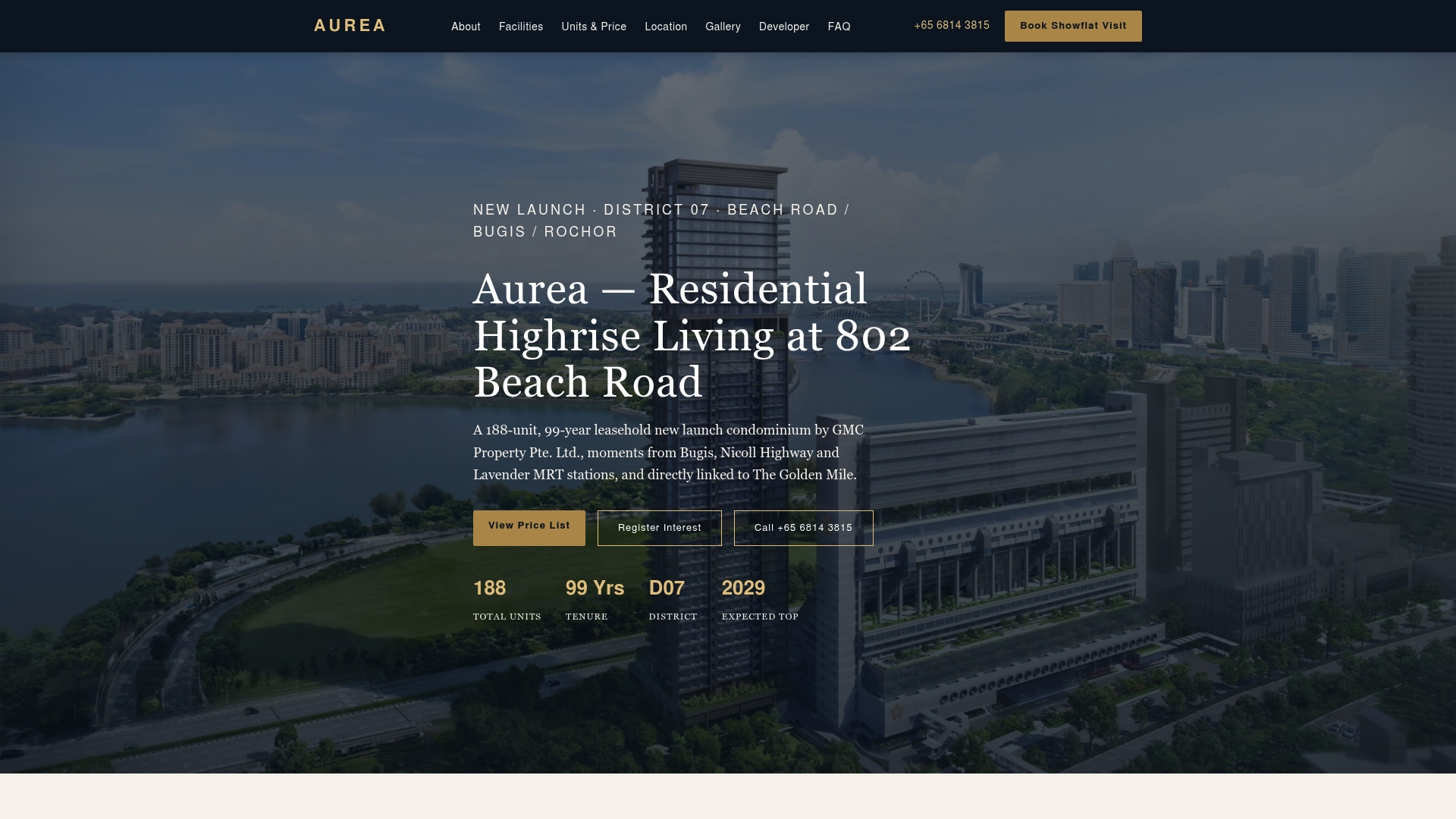
Aurea at 802 Beach Road is a 188-unit residential condominium developed by GMC Property Pte. Ltd., with 2-to-5-bedroom layouts and two penthouses, resort-style amenities across four levels, and a direct link bridge to The Golden Mile. Completion is targeted for 2029, giving buyers using bank loans a clear window to plan their mortgage sizing, CPF contributions, and refinancing strategy before keys are handed over.
For buyers who have their IPA in hand and are ready to move, the next step is straightforward. Visit the Aurea project page to review unit types, floor plans, and pricing, or contact ERA Realty Network to request a finance-ready packet and arrange a viewing appointment.
Authoritative sources for verification
Before signing any loan or exercising an OTP, verify the current rules directly with these official sources:
- HDB Housing Loan pages — eligibility, LTV limits, CPF usage, and HFE letter process: hdb.gov.sg
- HDB Flat Portal IPA service — compare IPAs from participating financial institutions: homes.hdb.gov.sg
- CPF Board — CPF OA withdrawal rules, accrued interest on refunds, and differences between HDB and bank loans: cpf.gov.sg
- MAS — TDSR, MSR, and LTV regulatory rules: mas.gov.sg
- DBS/POSB, OCBC, UOB — current home loan packages, IPA applications, and rate sheets: check each bank's mortgage pages directly for live rates.
This article is general information, not financial or legal advice. Confirm current rates, eligibility rules, and your specific CPF position with HDB, CPF Board, MAS, and a qualified financial adviser or solicitor before committing to any loan or property purchase.