
Yes, non-citizens may buy private condominiums in Singapore without special approval, but the tax and financing requirements usually decide whether the purchase actually makes sense. The Singapore Land Authority allows foreigners to buy condos and apartments freely, while IRAS) applies a steep Additional Buyer's Stamp Duty and the Monetary Authority of Singapore caps how much banks can lend. Sentosa Cove remains an exception for landed homes, and a handful of Free Trade Agreement nationals get different tax treatment on their first purchase.
TL;DR:
- Foreigners can buy private condominiums and approved strata units in Singapore without approval, but landed homes and HDB flats are generally off-limits or require approval.
- Non-citizens face higher stamp duties, with ABSD rates significantly increasing purchase costs, especially after the first property, unless from FTA countries eligible for remission.
- Financing is available but with lower loan-to-value limits and strict debt servicing rules, requiring thorough documentation and early comparison between banks.
- The purchase process involves securing bank approval, signing an option, exercising the contract, and settling stamp duties within specific deadlines, with new launches spreading payments over construction milestones.
- Ongoing taxes on rental income and property value, plus compliance checks and careful planning, are crucial for foreign owners to understand before buying or renting out a condo.
Table of Contents
- Property types foreigners may and may not buy in Singapore
- Who counts as a foreigner, and does your passport change the tax bill?
- Taxes and upfront costs: ABSD, BSD and the cash you need at signing
- Financing for foreign buyers: LTV, TDSR and what banks actually check
- Purchase process and timeline: from IPA to completion
- Approvals, compliance and the documents you will need
- Practical buyer checklist and red flags before you sign
- Resale restrictions and how long you must hold a condo
- Property tax and rental income tax foreign owners should plan for
- Working with lawyers, agents and tax advisors as a foreign buyer
- After you buy: managing, renting and moving money out of Singapore
- When does buying a Singapore condo actually make sense for a foreigner?
- How Aurea fits into a foreigner's Singapore condo search
- Where to check current rules before you transact
- Sources
- FAQ
Property types foreigners may and may not buy in Singapore
Singapore splits residential property into categories, and where you land in that split determines whether you need government approval before you can even make an offer. The Singapore Land Authority sets out these categories under the Residential Property Act, and the line is drawn mainly at landed versus non-landed housing.
Foreigners can buy the following without any approval:
- Private condominium units and apartments, whether freehold or on a 99-year leasehold.
- Strata-titled units in developments approved under the Act.
- Privatised executive condominiums once they pass the statutory minimum occupation period that lifts ownership restrictions.
What is generally off-limits or restricted:
- Most landed residential property, including terrace houses, semi-detached and bungalows, which require Land Dealings Approval Unit (LDAU) approval.
- HDB flats, which are reserved for citizens and permanent residents under separate housing board rules and are not part of the private condo market foreigners can access.
- Landed homes on Sentosa Cove, which sit under a narrower exception: foreigners can apply for approval to buy there, but the property must be used for owner-occupation rather than rented out wholesale.
For most foreign buyers and expats, this means the practical shopping list is private condos, non-landed apartments and eligible ECs. Anyone drawn to a landed house on the mainland should expect to file an LDAU application and demonstrate a case for approval rather than assume it will be granted.
Who counts as a foreigner, and does your passport change the tax bill?
The Residential Property Act defines a "foreign person" as anyone who is not a Singapore citizen, and that single classification drives most of the tax and financing differences you will encounter. Singapore permanent residents sit in a middle category: they can buy private condos freely like foreigners, but they face a lower ABSD rate than non-residents, while citizens face the lowest rates of all.
- Your status is fixed at the date of purchase, so a pending PR application or citizenship grant after signing the Option to Purchase does not change the ABSD you owe.
- Nationals of the United States, Iceland, Liechtenstein, Norway and Switzerland receive national treatment under Singapore's Free Trade Agreements, meaning they can be taxed like Singapore citizens on ABSD, according to IRAS.
- This FTA remission typically applies only to the first residential property purchase, so a second or subsequent purchase reverts to the standard foreigner rate.
Anyone unsure of their classification should confirm it before signing anything, since the ABSD difference between a citizen rate and a foreigner rate on a Singapore condo can run into hundreds of thousands of dollars on a single unit.
Taxes and upfront costs: ABSD, BSD and the cash you need at signing
This is where most foreign purchases in Singapore succeed or fall apart on paper. Two stamp duties apply on top of the purchase price, and both must be paid in cash rather than financed through your mortgage.
Buyer's Stamp Duty (BSD) applies to everyone regardless of nationality and is calculated on whichever is higher: the purchase price or the property's market value, according to IRAS. BSD is tiered and rises with the property value, and it is due within 14 days of signing the Option to Purchase or the Sale and Purchase Agreement.
The bigger number for most foreign buyers is Additional Buyer's Stamp Duty. IRAS sets ABSD rates according to buyer profile, with foreigners paying a materially higher rate than citizens or permanent residents on the same purchase. ABSD is layered on top of BSD and due on the same stamping deadline. For a deeper breakdown of current rates by buyer category, see this ABSD guide for buyers.
A rough cost template you can adapt for any unit:
- Purchase price, as agreed in the Option to Purchase.
- BSD, calculated on the tiered scale against price or valuation, whichever is higher.
- ABSD, calculated against the same base using your buyer-profile rate from the IRAS table.
- Legal conveyancing fees, typically a fixed or percentage-based charge from your appointed lawyer.
- Valuation fees if your bank requires an independent valuation before granting the loan.
Because ABSD and BSD must be settled in cash within the stamping window, and no lender will finance stamp duty, foreign buyers need to plan liquidity for these two line items well before they exercise an Option to Purchase.
Financing for foreign buyers: LTV, TDSR and what banks actually check
Foreigners can get a mortgage in Singapore, but the ceiling on how much you can borrow is lower than what a citizen or PR typically qualifies for, and banks apply conservative underwriting throughout. The Monetary Authority of Singapore sets the framework lenders must follow.
- Loan-to-Value limits depend on how many outstanding home loans you already have and can be lower for a foreigner's first purchase than a Singaporean's, and lower still for a second mortgage.
- The Total Debt Servicing Ratio caps your total monthly debt obligations, including the new mortgage, against your gross monthly income, and MAS requires banks to apply a stress-test interest rate rather than the actual rate you are quoted.
- Where the property is a private residential unit rather than an HDB flat, the Mortgage Servicing Ratio does not apply, but TDSR still does.
Banks generally ask for:
- Passport and Employment Pass or work permit details, since your visa status affects how your income is assessed.
- Recent payslips, income tax statements and bank statements showing salary credits.
- A signed In-Principle Approval application form and, often, a letter confirming employment tenure.
A mortgage broker familiar with foreigner lending can save weeks of back-and-forth, since criteria vary between banks even within MAS's rules. Loan tenure also interacts with your age and the LTV cap, covered in more detail in this guide to maximum loan tenure.
Pro Tip: Apply for In-Principle Approval with two banks in parallel so you can compare loan quantum and rates before you commit to an Option to Purchase.
Purchase process and timeline: from IPA to completion
The sequence is similar whether you are buying resale or new launch, but the cash and paperwork checkpoints fall at different points.
- Secure In-Principle Approval (IPA) from your bank, confirming roughly how much you can borrow, usually valid for 30 days.
- Negotiate and sign the Option to Purchase (OTP), paying the option fee, typically a small percentage of the purchase price held by the seller's lawyer.
- Exercise the OTP within the agreed window, usually 2 to 3 weeks for resale, paying the balance deposit.
- Stamp the documents within 14 days of exercising the OTP, settling BSD and ABSD in cash.
- Instruct a conveyancing lawyer to run title searches, check outstanding mortgages and confirm the lease balance.
- Complete the purchase, typically 8 to 12 weeks after exercise for a resale unit, when the balance purchase price and loan proceeds are disbursed.
New launches follow a different cash rhythm: instead of one lump sum at completion, payments are staggered against construction milestones under the standard progressive payment scheme, which spreads cash outflow over the build period rather than requiring it all upfront.
Approvals, compliance and the documents you will need
Most condo purchases need no government approval, but the paperwork trail still matters because developers and banks run strict checks before they will proceed.
Landed residential property is the trigger for approval: any foreigner buying a house rather than a strata unit must apply through the LDAU portal, and SLA assesses each case on factors including the length of Singapore residence and any exceptional contribution to the economy.
Separately, developers and banks are required to run anti-money-laundering and counter-financing-of-terrorism checks on every buyer, with enhanced due diligence expected under URA circulars governing property transactions. Expect to complete prescribed notification forms and to substantiate where your funds came from.
A practical checklist to have ready before you make an offer:
- Passport and, if applicable, Employment Pass or long-term visa pass.
- Latest two to three years of income tax statements or notices of assessment.
- Recent bank statements showing the source of your downpayment funds.
- Employment letter confirming salary and tenure, if you are salaried.
- A Power of Attorney, properly executed and often notarized, if you are buying remotely and cannot sign locally.
Remote buyers should factor in extra time for document legalization and courier turnaround, since stamping deadlines do not extend for logistics.
Practical buyer checklist and red flags before you sign
Before you exercise any Option to Purchase, confirm four things: your ABSD and BSD cash is set aside separately from your downpayment, your IPA is current, the title and lease balance have been checked by your lawyer, and the developer's track record on past projects has been reviewed.
- Budget for ABSD, BSD, legal fees and a renovation contingency as four separate cash pools, not one lump sum.
- Appoint a conveyancing lawyer before you sign anything, not after.
- Watch for unclear payment schedules, missing title details or vague defect liability clauses as negotiation leverage or reasons to walk away.
Pro Tip: For new launches, schedule your snagging inspection near the end of the Defects Liability Period rather than immediately at handover, so you catch issues that only surface after normal use.
Resale restrictions and how long you must hold a condo
Singapore does not impose a minimum holding period on foreigners buying private condos, unlike the Seller's Stamp Duty regime, which applies to residential property sold within a set number of years of purchase regardless of the seller's nationality. That duty is separate from ABSD and is charged on the seller's side, calculated on the sale price or market value.
Cooling measures in Singapore, including ABSD rates and loan limits, apply at the point of purchase rather than as an ongoing restriction on resale. This means a foreign owner can sell whenever they choose, but selling within the Seller's Stamp Duty window adds a cost that should be factored into any short-term exit plan. There is no separate foreigner-only resale restriction beyond the general rules that apply to every seller in the private market.
Property tax and rental income tax foreign owners should plan for
Owning a condo in Singapore comes with two ongoing tax obligations beyond the one-time stamp duties paid at purchase. Property tax is charged annually on the Annual Value of the unit, which is broadly the estimated yearly rent it could fetch, and the rate is higher for non-owner-occupied properties than for a home you live in yourself.
If you rent the unit out, the rental income is subject to Singapore income tax, and as a non-resident individual you are generally taxed at a flat rate on that income unless you qualify for resident rates based on time spent in Singapore. Deductible expenses typically include mortgage interest, property tax paid, agent commissions and maintenance costs, which can meaningfully reduce the taxable amount. Anyone planning to rent out a unit should model both property tax and income tax alongside the ABSD already sunk into the purchase, since together they shape the real yield.
Working with lawyers, agents and tax advisors as a foreign buyer
A foreign buyer benefits from three types of professional help, and each covers a different risk. A conveyancing lawyer handles the Option to Purchase review, title searches, the stamping process and completion, and is the one professional you should never skip regardless of budget.

A property agent registered with the Council for Estate Agencies can help you access listings, negotiate price and navigate developer sales for new launches, though for a new launch you can also deal directly with the developer's appointed marketing team. A tax advisor becomes valuable once you are renting the unit out or considering a trust structure to hold the property, since ABSD treatment for trusts has its own rules explained in this overview of ABSD trusts. For financing specifically, an independent mortgage advisory such as this property financing guide can help you compare lender criteria before you commit to an IPA.
Engaging these advisors early, before you sign an OTP, is generally cheaper than fixing a problem after the fact.
After you buy: managing, renting and moving money out of Singapore
Once you own the unit, a few practical matters need attention. If you plan to rent it out, subletting rules require you to register tenancy agreements correctly and to be aware of restrictions on the minimum lease period and occupancy limits, with penalties for owners who breach them, as detailed in this guide to condo subletting rules.
Property management for an absentee foreign owner typically means appointing a local managing agent to handle tenant sourcing, maintenance coordination and rent collection, since Singapore does not require owners to be physically present for any of these tasks. Rental income can generally be repatriated overseas without restriction, since Singapore does not impose capital controls on residential property income, though you should keep records for both Singapore tax filing and any reporting obligations in your home country. Maintenance fees, sinking fund contributions and property tax remain due annually regardless of whether you occupy the unit or rent it out.

When does buying a Singapore condo actually make sense for a foreigner?
The ABSD makes a foreigner's purchase a long-horizon bet rather than a quick flip: you are effectively paying a large, non-recoverable entry cost that only makes sense if you plan to hold for years of capital appreciation or steady rental yield. FTA nationals and those planning to convert to PR status soon have a real edge here, since their effective tax load is lower.
For everyone else, renting while investing the ABSD-equivalent capital elsewhere can outperform ownership unless you have a genuine reason to anchor in Singapore, such as relocation, family or a long-term income strategy.
— Velisa
How Aurea fits into a foreigner's Singapore condo search
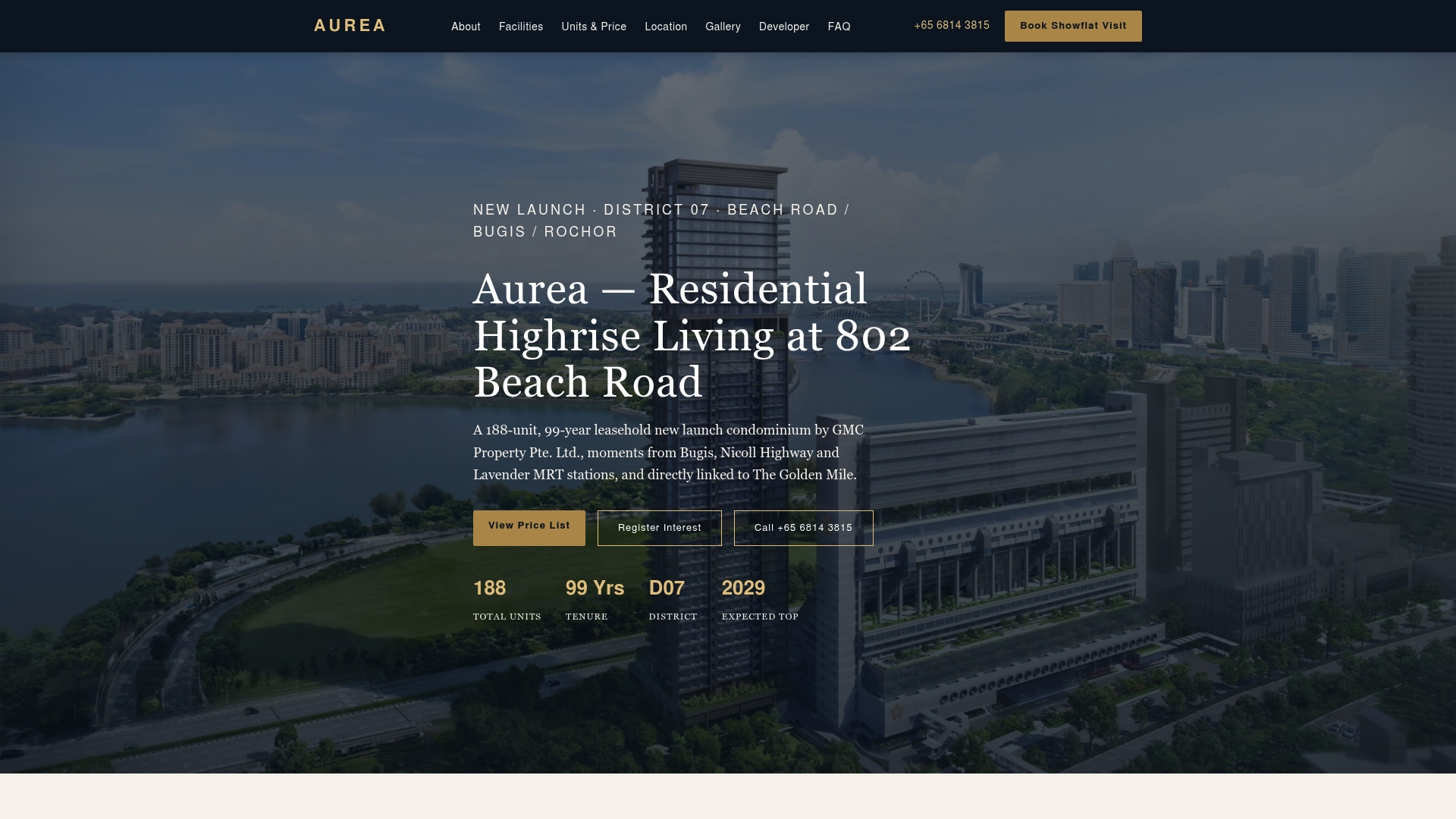
If you have weighed the ABSD and financing math and still want a foothold in Singapore, a new launch changes the cash-flow picture compared to resale. Aurea, located at 802 Beach Road, features multi-bedroom layouts including penthouses on a 99-year leasehold, with resort-style amenities across multiple levels and a link bridge connected to a nearby area.
- New launch units are typically paid for under a progressive payment scheme, so your cash goes out in stages tied to construction rather than all at once at completion.
- The different unit layouts provide options suitable for various household sizes without requiring buyers to change developments.
- Convenient access to public transit stations suits both owner-occupiers relocating for work and investors targeting tenant demand.
If Aurea fits your budget and timeline, you can view current unit pricing and register interest directly on the Aurea project page.
Where to check current rules before you transact
Rules and rates change, so confirm every figure against the primary source before signing anything.
This article is general information, not a substitute for advice from a qualified financial advisor. Consult a qualified financial professional about your own circumstances before acting on anything here.
Sources
FAQ
Can foreigners buy a private condo in Singapore?
Yes, foreigners can buy private condominiums, apartments and eligible strata units in Singapore without needing special government approval, according to SLA guidance. Landed residential property is the main exception and generally requires approval through the LDAU.
Can a non-citizen buy a house in Singapore?
A non-citizen generally cannot buy landed houses such as terraces, semi-detached or bungalow properties without approval from the Land Dealings Approval Unit, assessed case by SLA. Sentosa Cove is a narrower exception where foreigners can apply to buy landed homes for owner-occupation.
Do foreigners need to pay ABSD in Singapore?
Yes, foreigners pay Additional Buyer's Stamp Duty at a higher rate than citizens or permanent residents, on top of the standard Buyer's Stamp Duty, according to IRAS. Nationals of certain Free Trade Agreement countries may qualify for remission on their first purchase.
What is the minimum salary to buy a condo in Singapore?
There is no single published minimum salary figure; your borrowing capacity instead depends on the Total Debt Servicing Ratio, which caps total monthly debt against gross income under MAS rules. A bank will calculate your maximum loan using a stress-tested interest rate rather than a fixed income threshold, so getting an In-Principle Approval is the fastest way to know your actual limit.