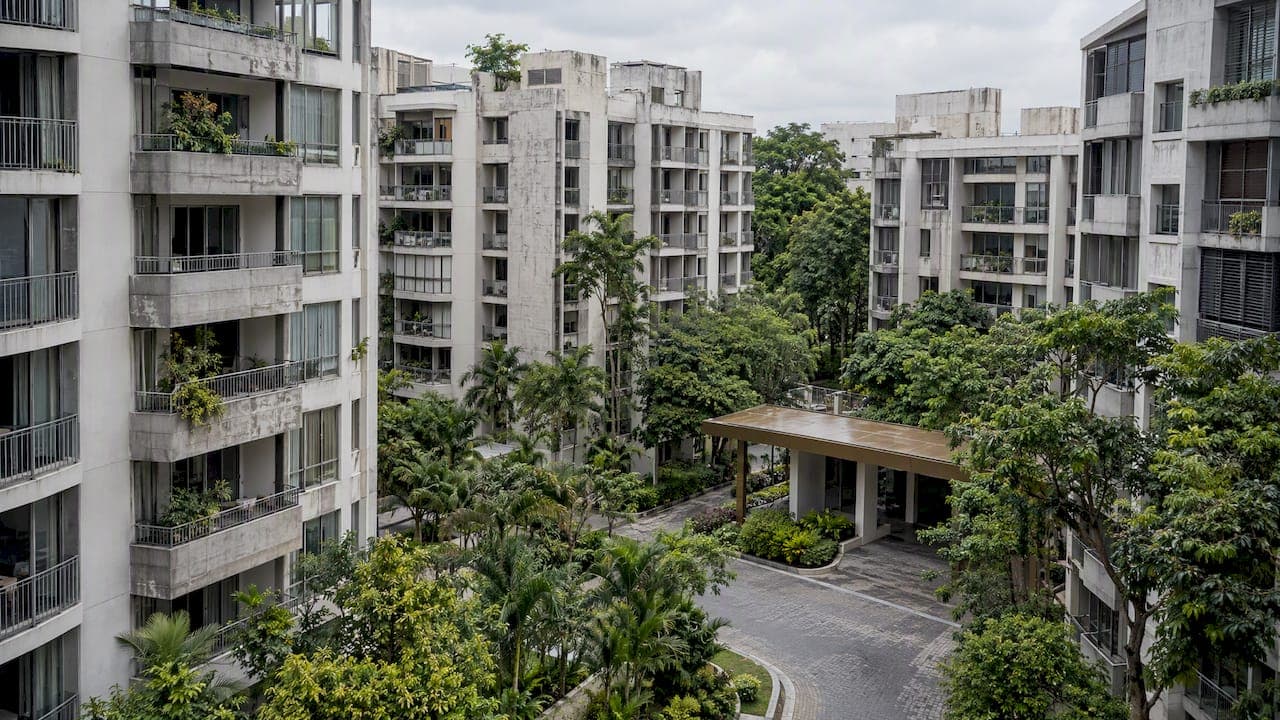
En bloc potential in Singapore comes down to five things: how much more a developer can build on the land than what stands there now, how old the development is, how much lease is left, whether owners can reach the legal consent threshold, and whether the market is hungry for new sites. Any one of them can be strong and the sale still fails. This guide explains each factor, shows where buyers misjudge them, and says plainly why en bloc should be a bonus in your plan and never the reason for buying.
TL;DR
- Developers pay for unused development potential: the gap between the Master Plan gross plot ratio (GPR) and what the existing buildings use.
- A collective sale needs 80% consent by share value and strata area for developments 10 years or older, and 90% for those under 10 years.
- Age, remaining lease, site size, location and owner mix all shift the odds, but none of them sets a timetable.
- A large government land supply competes with older en bloc sites, so developer appetite can cool.
- Buy a home you can afford and want to live in. Treat any en bloc payout as a possible extra, not an income plan.
Table of Contents
- What en bloc potential actually means
- Factor 1: Plot ratio and the unused development gap
- Factor 2: Age of the development
- Factor 3: Tenure and remaining lease
- Factor 4: Site size, shape and location
- Factor 5: Owner mix and the consent threshold
- Factor 6: Market conditions and supply
- The factors at a glance
- What an en bloc sale costs you along the way
- Why en bloc should not be your reason to buy
- Our perspective at Aurea
- Aurea price ranges
- FAQ
- Sources
What en bloc potential actually means
An en bloc, or collective sale, happens when the owners of a whole development sell the land and buildings together to one buyer, usually a developer. Everyone gets a share of the proceeds, even those who voted against. The label "en bloc potential" is a guess about how likely that is to happen, and how attractive the price would be.
That guess is a probability, not a feature of the flat. Listings that advertise it are advertising a hope. Treat the phrase the way you would treat "near future MRT": a reason to look closer, never a reason to pay more without checking the numbers yourself.
Factor 1: Plot ratio and the unused development gap
The single most important factor is the land's development potential. The Urban Redevelopment Authority (URA) says the GPR in the Master Plan guides the development potential of a residential site, and that it is an upper bound, because site shape, height limits, setbacks and similar constraints may stop a project reaching it.

Here is why this matters. A developer pays for land by working backwards from what it can build and sell. If an older condo uses a plot ratio of 1.6 and the Master Plan allows 2.8, there is a lot of extra floor area to monetize. If the existing buildings already use close to the permitted maximum, a developer has little reason to pay a premium over what the flats are worth individually.
A practical check:
- Find the development's land area and total existing gross floor area, then divide to get its current plot ratio.
- Look up the GPR for the site in the URA Master Plan.
- Compare the two. A wide gap is a point in favor. No gap is a strong signal to value the home on its own merits.
- Remember that the Master Plan number is a ceiling. The URA offers an Outline Application to find out whether a proposed plot ratio or building height could be allowed before a formal submission, which shows that the answer is not always obvious from the map.
A reader asking "what does a plot ratio of 2.8 mean?" gets a simple answer: total gross floor area can be up to 2.8 times the land area. On a 10,000 square meter site, that is up to 28,000 square meters of floor area, before site limits cut into it.
Factor 2: Age of the development
Age works in two ways. First, the law: the consent threshold is stricter for newer projects. Second, the practical side: older buildings cost more to maintain, and owners tend to be more open to a sale.
The URA's circular on the consent requirement sets out the rule: 80% of owners by both share value and strata area for developments 10 years or older, and 90% for those under 10 years, under the Land Titles (Strata) Act. A younger development therefore needs far more unity, and a few holdouts can end the attempt.

Age also affects how developers think. A building that is 25 to 30 years old, with ageing lifts, pipes and facades, is easier to see as a rebuild. But age alone is not enough. A 30-year-old condo that already uses its full plot ratio may still never go.
Factor 3: Tenure and remaining lease
Freehold land is easier for a developer to price and to resell. Leasehold land with a long balance is also workable. As a lease runs down, the land loses value to a buyer, and the redevelopment may be worth less. The practical question for a buyer of a leasehold resale flat is whether the remaining lease helps or hurts a future sale.
For new launches, this factor works the other way. A 99-year leasehold condominium starts with its full term. That is relevant if you are comparing a new launch to an older condo sold on en bloc hopes: you are choosing between a long runway and a gamble on a sale.
Factor 4: Site size, shape and location
Developers want sites they can build on efficiently. Large, regularly shaped plots near transport and amenities tend to attract interest. A small or oddly shaped site may not reach its plot ratio in practice, which brings us back to Factor 1.
Location matters because developers sell homes at the end of the process. Good transport access, a strong catchment and a Master Plan that supports higher density give them confidence in the final selling price. Nearby new launches also tell them what buyers will pay in that area.
Factor 5: Owner mix and the consent threshold
This is the human factor, and it is the one most often overlooked. Reaching 80% or 90% is a matter of persuasion, not arithmetic. Owners differ in what they want:
- Investors with short horizons often favor a sale.
- Long-term owner-occupiers may value their neighborhood and refuse.
- Elderly owners may worry about finding a replacement home.
- Owners who bought recently may not want to lose money on stamp duties and transaction costs.
A development with many owners who bought recently, or with a high proportion of owner-occupiers who plan to stay, tends to find consensus harder. The same applies to a very large development, where the owners are numerous and hard to coordinate.
Process matters as much as votes
The consent number is only the start. In Kok Yin Chong v Lim Hun Joo (2019), the Court of Appeal dealt with dissenting owners who challenged the conduct of a collective sale committee. The case is a reminder that committees must follow the statutory steps, including those in the Third Schedule on voting and declaring interests. The courts have some power to approve a sale despite technical breaches, but that discretion is not something a committee should lean on. Private deadlines written into a sale agreement can also be unrealistic, and if they are missed the agreement may be rescinded.
For a buyer, the lesson is simple: a high consent rate in the news does not mean the sale is safe, and a sale can take years.
Factor 6: Market conditions and supply
Even when every physical and legal factor lines up, developers buy only when they believe they can sell the new homes. That depends on prices, interest rates and competing supply.
On prices, the URA's flash estimate says the private residential price index rose 0.5% in the second quarter of 2026, slower than the 0.9% gain in the first quarter, and that the government is sustaining a high and steady supply of private homes. That is a stable market, not a frenzy.
On supply, the Monetary Authority of Singapore's 2026 Financial Stability Review points to a Government Land Sales programme that is delivering well above its ten-year annual average, with roughly 61,000 units in the pipeline. For an older en bloc candidate, that pipeline is competition: developers can choose government sites over collective sale sites, and they price accordingly.
For a deeper view of where prices and supply stand, see our H2 outlook for the Singapore property market.
The factors at a glance
| Factor | Stronger signal | Weaker signal |
|---|---|---|
| Plot ratio gap | Master Plan GPR well above existing use | Existing buildings near the maximum |
| Age | 10 years or older, visible ageing | Under 10 years, 90% needed |
| Tenure | Freehold or long balance lease | Short balance lease |
| Site | Large, regular, near transport | Small, irregular, constrained |
| Owner mix | Many investors, aligned goals | Many long-term occupiers, recent buyers |
| Market | Strong demand, limited new supply | Heavy government land supply |
What an en bloc sale costs you along the way
Owners sometimes assume that once a sale is in motion, the bills stop. They do not. The Inland Revenue Authority of Singapore (IRAS) states that owners remain liable for property tax) until the sale completes, and your lawyer should handle the apportionment with the buyer so that you are reimbursed for your share. Add legal fees, committee costs and the time value of money while you wait, and the headline payout shrinks.
If you sell a home within a few years of buying it, Seller's Stamp Duty can also apply. Our guide on how the OTP date decides your SSD rate walks through the ladder.
Why en bloc should not be your reason to buy
The factors above can raise or lower the odds, but they cannot give you a date. A sale can take years or never happen, and you carry the mortgage the whole time.
The MAS is direct about the financing side. Banks must test affordability using an interest rate floor of 4% and a Total Debt Servicing Ratio of 55%, and the same reply urges borrowers to stay well within that limit because the outlook is uncertain. Buying with the sole hope of an en bloc windfall is the kind of strategy that leaves little room for error. If you are unsure how much you can borrow, read our explainer on TDSR rules for buyers and investors, and speak to your bank or a licensed mortgage adviser about your own numbers.
A better sequence is:
- Decide the home you need and can afford at today's rates, including the stress-test floor.
- Judge it on location, layout, lease and running costs.
- If it also has en bloc potential, treat that as upside.
Our perspective at Aurea
We work on a new launch, so we see this question from the other side. Buyers who ask us about en bloc are usually really asking whether a home will hold its value. Our answer is that the strongest protection is not a rumor about a future sale. It is a home that suits real life, sits close to transport, and has a full lease ahead of it.
Aurea at 802 Beach Road is a 99-year leasehold development of 188 units from 2 to 5 bedrooms plus two penthouses, with resort-style amenities across four levels and a link bridge to The Golden Mile. The development is set for completion in 2029. Families get layouts that fit different household sizes, and professionals get walking access to several MRT lines. None of that depends on a collective sale ever happening.
We would also say this to any buyer, ours or not: if you are comparing an older condo priced on en bloc hopes with a new launch priced on what it delivers, ask which one you could happily live in for ten years without a payout. Work out your cash and CPF downpayment first, using our guide to the CPF condo downpayment, then compare.
— Velisa
Aurea price ranges
If you are weighing a new launch against an older en bloc candidate, here are the published prices at Aurea. These are one-off purchase prices in Singapore dollars:
| Unit type | Published price |
|---|---|
| 2 Bedroom | S$1,770,000 to S$2,075,800 |
| 3 Bedroom | S$2,639,900 to S$3,058,600 |
| 4 Bedroom | S$4,080,510 to S$4,512,990 |
| 4 Bedroom Premium | S$5,186,105 to S$5,723,390 |
| 5 Bedroom | No published price |
| Penthouse | No published price |
You can see layouts and enquire on the Aurea landing page.
FAQ
What is the en bloc process?
Owners form a collective sale committee, agree on a sale method and obtain consent from at least 80% of owners by share value and strata area (90% if the development is under 10 years old). The sale then goes through the statutory steps, including approval of the sale by the relevant board or court. The process can take years, and procedural mistakes can derail it.
Does a high plot ratio gap guarantee an en bloc sale?
No. The gap makes a site more attractive to developers, but the URA notes that the Master Plan figure is an upper bound that site limits may prevent reaching. Owner consent, market demand and competing land supply still decide the outcome.
Do I stop paying property tax once my condo goes en bloc?
No. IRAS says you are liable until the sale is completed. Your lawyer should apportion the tax with the buyer at settlement so you are reimbursed for the period after completion.
Is it safe to buy a condo mainly for en bloc potential?
It is a high-risk approach. The MAS has urged borrowers to stay well within the 55% TDSR limit given an uncertain outlook, and no one can promise when, or whether, a sale will happen. Speak to your bank or a licensed adviser before committing to a loan that depends on that outcome.
Sources
- URA: Gross Plot Ratio
- URA: Outline Application
- URA circular on owners' consent for collective sale
- Kok Yin Chong v Lim Hun Joo [2019] SGCA 28
- URA flash estimate, 2nd Quarter 2026
- MAS Financial Stability Review 2026
- MAS oral reply on US Treasury yields
- IRAS: Selling my property (en bloc sales))