
If you're a married couple with at least one Singapore Citizen (SC) spouse, you may qualify for ABSD remission on a jointly purchased residential property. Two paths exist: full remission when neither spouse owns any residential property, and conditional remission when one or both spouses already own exactly one property, subject to selling it within 6 months of the new purchase (or 6 months after TOP/CSC for uncompleted properties).
Your first move is a quick ownership audit: check each spouse's citizenship status, count every residential property each of you holds beneficially, confirm the new purchase will be in both names only, and mark the 6-month disposal window on your calendar now.
Who typically qualifies:
- Married couple with at least one SC spouse
- Property purchased jointly by the two spouses only (no third party on title)
- Neither spouse owns any residential property at the time of purchase (full remission), OR one or both spouses each own exactly one residential property and will sell it within the statutory deadline (conditional remission)
- The couple remains married through to the disposal date
Who does not qualify:
- Couples where neither spouse is a Singapore Citizen
- Purchases that include a third party on the title
- Properties held on trust or as partnership property
- Couples where one or both spouses own two or more residential properties
- Situations where the first property is not sold within the required 6-month window
Pro Tip: Even when you qualify for remission, ABSD must often be paid upfront at stamping and then refunded later. Budget for that cash float before you commit to a purchase, and confirm with your mortgage lender that your financing plan accounts for it. See TDSR rules for how this affects your loan servicing calculations.
Key Takeaways
Married couples in Singapore with at least one SC spouse qualify for ABSD remission on a joint residential purchase, provided they meet the statutory ownership, disposal, and procedural conditions set out in the Stamp Duties (Spouses) (Remission of ABSD) Rules 2013.
| Point | Details |
|---|---|
| Check citizenship and property count first | At least one SC spouse required; neither may own more than one residential property to qualify. |
| Know your disposal deadline | Sell the first property within 6 months of purchase (resale) or 6 months after TOP/CSC (new launch). |
| Declare intention to sell at stamping | E-Stamping declarations from July 2, 2023 onward trigger automatic refund within ~6 weeks after the sale is stamped. |
| Budget for the ABSD cash float | ABSD is paid upfront for conditional remission and refunded later; plan financing around this gap before committing. |
| Aurea-sgcondo at 802 Beach Road | A 2029-completion new launch where the TOP-triggered deadline gives HDB upgraders a practical disposal window. |
Table of Contents
- Does your joint purchase qualify for full ABSD remission?
- What happens when one or both spouses already own one property?
- How do you actually apply for the remission or refund?
- What disqualifies couples from ABSD remission?
- Worked examples: mapping your situation to an outcome
- Where do you find the authoritative rules and latest changes?
- The timing risk most couples underestimate
- Aurea-sgcondo: new-launch options for couples planning an upgrade
- Sources
Does your joint purchase qualify for full ABSD remission?
Full remission applies when the purchase is the couple's first residential property together and neither spouse owns any residential property at the time the instrument of transfer is executed. The Stamp Duties (Spouses) (Remission of ABSD) Rules 2013 set out the statutory tests precisely: exactly two joint purchasers, both married to each other, with at least one being a Singapore Citizen, and neither holding any residential property beneficially.
What "owning" actually means under the rules
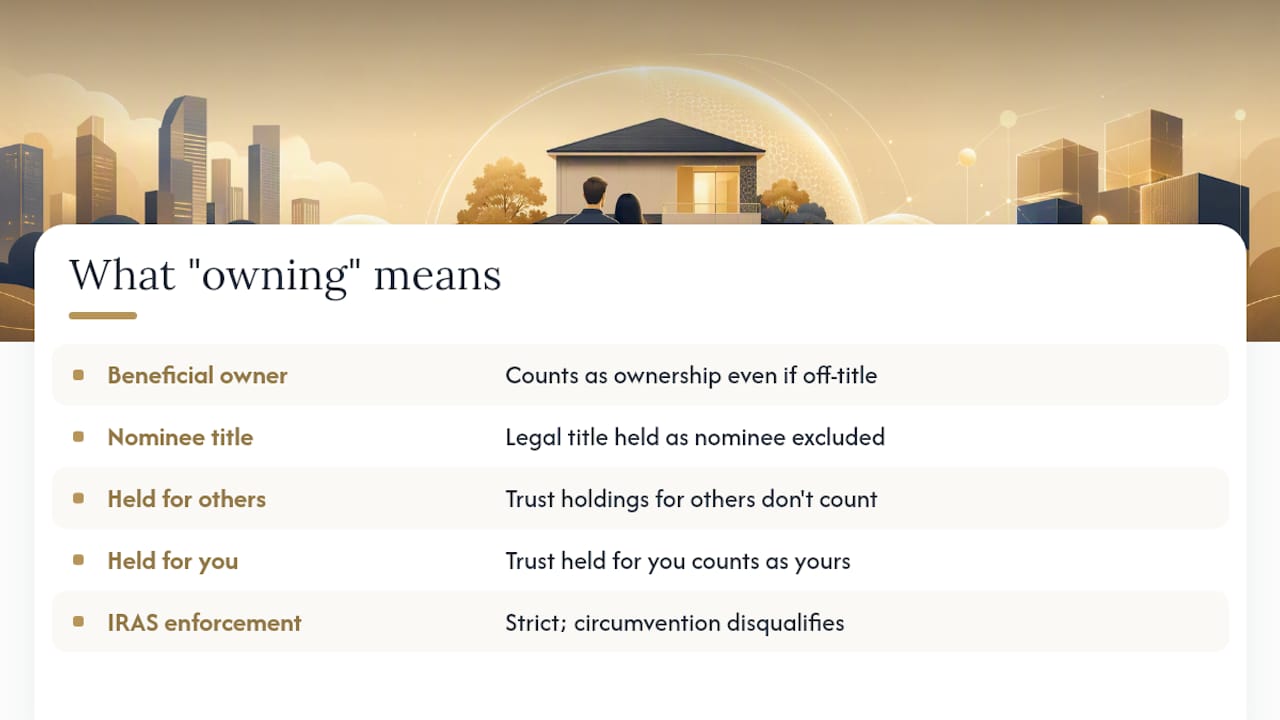
Ownership here means beneficial ownership, not legal title held as a nominee or trustee. If you hold a property on trust for someone else, that holding does not count against you for remission purposes. The reverse is also true: if someone holds a property on trust for you, that counts as your ownership even if your name is not on the title. The statutory rules exclude instruments where the estate in the new property is itself to be held on trust — an important trap for couples considering nominee arrangements.
The remission is designed for genuine matrimonial home upgraders, not investors. IRAS enforces the beneficial-ownership test strictly, and any ownership structure that appears designed to circumvent the rules — including trust arrangements and partnership holdings — will be disqualified. The IRAS guidance on spousal remission makes this intent explicit.
The definition of "married" follows the Rules: a legally valid marriage recognized under Singapore law at the time of purchase. Couples in the process of divorce, or whose marriage is not legally recognized in Singapore, do not meet this test.
One practical nuance: for full remission, ABSD may not need to be paid upfront at all if the eligibility conditions are clearly met and the e-Stamping form is completed correctly. For conditional remission (Scenario B below), ABSD is paid first and refunded later. Confirm which path applies with your conveyancing solicitor before stamping, because paying when you did not need to creates a refund process, and failing to pay when you should have creates penalties.
Note that ABSD is a separate duty from BSD. A remission or refund of ABSD does not affect the Buyer's Stamp Duty you owe, which is calculated on the purchase price or market value and remains payable regardless.
What happens when one or both spouses already own one property?
This is the scenario most upgrading couples face. The Ministry of Finance policy frames it as a government concession: couples who are genuine home upgraders can get ABSD refunded, provided they sell their first property within the required window.
Who this covers
- An SC spouse and a non-SC spouse, where one of them owns one residential property
- Two SC spouses where one owns one property
- Both spouses each owning exactly one residential property (including properties owned separately before the marriage)
If either spouse owns two or more residential properties, the remission is not available. There is no partial remission for owning more than one.
The disposal timeline
| Situation | Disposal deadline |
|---|---|
| Second property is a completed resale | Sell first property within 6 months of the purchase date (date of transfer instrument) |
| Second property is uncompleted (new launch) | Sell first property within 6 months of TOP or CSC, whichever is earlier |
The 6-month clock starts from the date the instrument of transfer for the new property is executed (for resale) or from the date TOP/CSC is issued (for new launches). Missing this deadline, even by one day, forfeits the remission.
Conditions that must hold through to disposal
- The couple must remain married at the date of disposal
- Ownership of the new (second) property must not have changed
- Neither spouse may acquire any other residential property between the purchase date and the disposal date
- ABSD must have been paid on the second property
- The refund claim must be submitted within 6 months after the sale of the first property is stamped
Scenario: HDB upgrader buying a private condo
Say an SC husband owns an HDB flat and his SC wife owns nothing. They jointly purchase a private condo (resale) on March 1. They must sell the HDB flat by August 31 of the same year. If the condo were a new launch with a projected TOP in June 2028, the deadline shifts to December 2028. The cash-flow implication is significant: ABSD at the applicable rate is paid at stamping in March, and the refund only arrives after the HDB sale is stamped and IRAS processes the claim. For context on how upgrading from HDB to private housing affects your loan options, the bank vs HDB loan guide covers the key differences.
How do you actually apply for the remission or refund?
The process splits into two tracks depending on when you stamped the purchase and whether you declared your intention to sell at that point.
Track 1: Automatic refund (e-Stamping declarations from July 2, 2023 onward)
For qualifying purchases where the e-Stamping form was submitted on or after July 2, 2023, and the purchaser declared an intention to sell the first property and claimed the refund in that same form, IRAS will automatically process the refund within approximately 6 weeks after the stamping of the first property's sale. No separate manual application is needed in these cases, but all statutory conditions must still be met and correct supporting documents must be uploaded when stamping the sale.
Track 2: Manual refund application via myTax Portal
If you did not declare intention to sell in the original e-Stamping form, or your purchase predates July 2, 2023, you must apply manually through myTax Portal (Stamp Duty login > Request > Apply for Refund or Apply for Assessment/Appeal for Waiver).
Step-by-step for manual applications:
- Log in to myTax Portal using your Singpass
- Navigate to Stamp Duty > Request > Apply for Refund (or Apply for Assessment/Appeal for Waiver)
- Select the relevant instrument reference for your property purchase
- Upload supporting documents (see checklist below)
- Submit and note the reference number for follow-up
Supporting documents required:
- Option to Purchase or Sale and Purchase Agreement for the new property
- Instrument of Transfer for the new property (with stamping reference)
- Proof of ABSD payment
- Sale and Purchase Agreement and Instrument of Transfer for the first property (sold)
- TOP or CSC certificate (for new launches)
- Marriage certificate
- NRIC or passport copies for both spouses
- Evidence of citizenship status (SC NRIC or citizenship certificate)
Pro Tip: Package your refund request as a single, clearly labeled PDF bundle with a cover page listing each document and the date it relates to. IRAS assessors handle high volumes; a well-organized submission reduces back-and-forth queries and speeds up processing. Your conveyancing solicitor can usually prepare this bundle as part of their post-completion work.
What disqualifies couples from ABSD remission?
The rules are strict because the remission is meant for genuine upgraders. These are the situations that most commonly cause refusals or delays.
Ownership structure problems
- Trust or nominee arrangements: If the new property is to be held on trust, remission is excluded. For instruments executed on or after May 9, 2022, the statutory rules contain an explicit exclusion for trust arrangements. Practitioners should verify this before relying on remission.
- Partnership property: Property held as partnership property does not qualify.
- Third party on title: Any person other than the two spouses appearing on the instrument of transfer disqualifies the purchase entirely.
- Decoupling before purchase: If one spouse recently transferred their share of an existing property to the other to appear "property-free," IRAS may scrutinize the arrangement. Read the decoupling guide for the tax and timing implications before going down that path.
Timing and procedural failures
- Missing the 6-month disposal deadline (even by one day)
- Failing to submit the refund claim within 6 months after the first property's sale is stamped
- Misreporting the TOP or CSC date, which shifts the disposal deadline
- Not declaring intention to sell in the e-Stamping form (loses automatic refund eligibility)
- Acquiring another residential property between the purchase date and the disposal date
Red flags in conveyancing
- Transfers between spouses of partial shares during the interim period
- Using a nominee to hold the first property while the second is being purchased
- Signing an option on a third property before the first is sold
Consequences of disqualification: The ABSD paid is retained by IRAS. There is no partial refund. In cases where ABSD was not paid upfront and remission is later denied, the outstanding duty becomes recoverable with interest and potential penalties. If your situation involves any of the above red flags, get specialist stamp duty advice before executing any instrument.
Worked examples: mapping your situation to an outcome
Scenario 1: SC + SPR couple, no prior property
An SC wife and her Singapore Permanent Resident husband jointly purchase a resale condo as their first home together. Neither owns any residential property. They qualify for full remission under Scenario A. ABSD does not need to be paid upfront if the e-Stamping form is completed correctly to reflect the remission eligibility. BSD is still payable on the purchase price. Outcome: straightforward, no disposal required.
Scenario 2: SC + SC, one spouse owns an HDB flat (the classic upgrader)
Both spouses are SC. The husband owns an HDB flat; the wife owns nothing. They jointly purchase a new-launch private condo with an expected TOP in Q3 2028.
- ABSD is paid at stamping (the purchase is treated as a second property for the husband)
- The disposal deadline is 6 months after TOP/CSC, so roughly Q1 2029
- The husband must sell the HDB flat before that deadline
- After the HDB sale is stamped, IRAS processes the refund (automatically if the e-Stamping declaration was made at purchase; manually otherwise)
- Cash-flow note: ABSD on a property can be a significant amount tied up from stamping until the refund clears. This is illustrative of why planning your financing around this float matters.
For a comparison of EC vs private condo ABSD treatment (relevant if the first property is an EC), the executive condo vs condo guide covers the key differences.
Scenario 3: Both spouses each own one property
Both spouses are SC. The husband owns a condo; the wife owns a separate apartment. They jointly purchase a third property together.
- Both spouses are each disposing of one property
- The disposal deadline is 6 months from the purchase date (resale) or 6 months from TOP/CSC (new launch)
- Both first properties must be sold within the window, or the remission is lost
- Neither spouse may acquire any other residential property in the interim
- Refund claim must be filed within 6 months after the last of the two sales is stamped
Key steps to protect eligibility:
- Declare intention to sell both properties in the e-Stamping form at purchase
- Coordinate sale timelines with both sets of conveyancing solicitors simultaneously
- Confirm with your mortgage lender that bridging finance covers the period between purchase stamping and the refund receipt
- Do not sign any option on another property until both disposals are complete and the refund is received
Singapore has no capital gains tax on property sales, which means the disposal itself carries no additional tax cost beyond the stamp duties already paid. That context matters when you're weighing whether to sell quickly or hold.
Where do you find the authoritative rules and latest changes?
The rules governing ABSD remission for married couples sit across a small number of official sources. Bookmark all of them.
- IRAS: Remission of ABSD for a Married Couple — the primary guidance page. Covers eligibility tests, the 6-month disposal rule, automatic refund conditions, and links to the application flows on myTax Portal. Start here.
- Stamp Duties (Spouses) (Remission of ABSD) Rules 2013 (SSO/AGC) — the statute itself. The definitions of "married," the two-party requirement, trust exclusions, and disposal conditions are all here. Check the version date to confirm you are reading the current text.
- IRAS: Additional Buyer's Stamp Duty (ABSD) — ABSD rates by buyer profile and property count, plus the full list of remissions available. Use this to confirm the rate applicable to your profile and to verify that BSD remains payable separately.
- MOF: Additional Buyer Stamp Duty Remission — the policy announcement explaining the government's intent behind the spousal remission scheme. Useful if you need to understand the policy rationale or track historical changes.
- myTax Portal (Stamp Duty) — the submission channel for all stamping, refund applications, and assessment requests. Save this as a bookmark and use your Singpass login. The "Request" menu is where refund and waiver applications live.
The sections of the statute that matter most for most couples are the definitions (Rule 2), the conditions for remission (Rule 3), and the disposal requirements (Rule 4). If your situation involves a trust, partnership, or any ownership structure other than straightforward joint names, read the exclusions in Rule 3(3) carefully and get legal advice before proceeding.
The timing risk most couples underestimate
Most couples focus on whether they qualify for ABSD remission. The harder problem is whether they can execute the disposal in time.
The 6-month window sounds generous until you factor in a slow HDB resale market, a buyer who needs time to secure financing, or a conveyancing timeline that runs longer than expected. Couples who buy first and sell later are betting that the first property will sell, complete, and be stamped within the window. That is a reasonable bet in a liquid market. In a slower one, it is a real risk.
The practical recommendation: if you are not confident the first property will sell within 5 months of the purchase date (leaving a one-month buffer for completion and stamping), consider selling first or negotiating a longer completion period on the new purchase. A conditional purchase arrangement, where your obligation to complete is tied to the successful sale of the first property, is worth discussing with your solicitor. It adds complexity but removes the timing risk entirely.
One more thing couples often miss: the refund claim window is separate from the disposal window. You have 6 months after the first property's sale is stamped to file the refund claim. If you sell on time but forget to file, the refund is lost. Set a calendar reminder the day the sale completes.
Aurea-sgcondo: new-launch options for couples planning an upgrade
Married couples who have confirmed their ABSD remission eligibility and are ready to move on a new-launch condo have a concrete next step available. Aurea-sgcondo at 802 Beach Road offers 188 units from 2 to 5 bedrooms, plus two penthouses, with resort-style amenities across four levels and direct access via a link bridge to The Golden Mile. The development is set for completion in 2029, which means the TOP-triggered disposal deadline gives most HDB upgraders a realistic window to sell their first property without rushing.
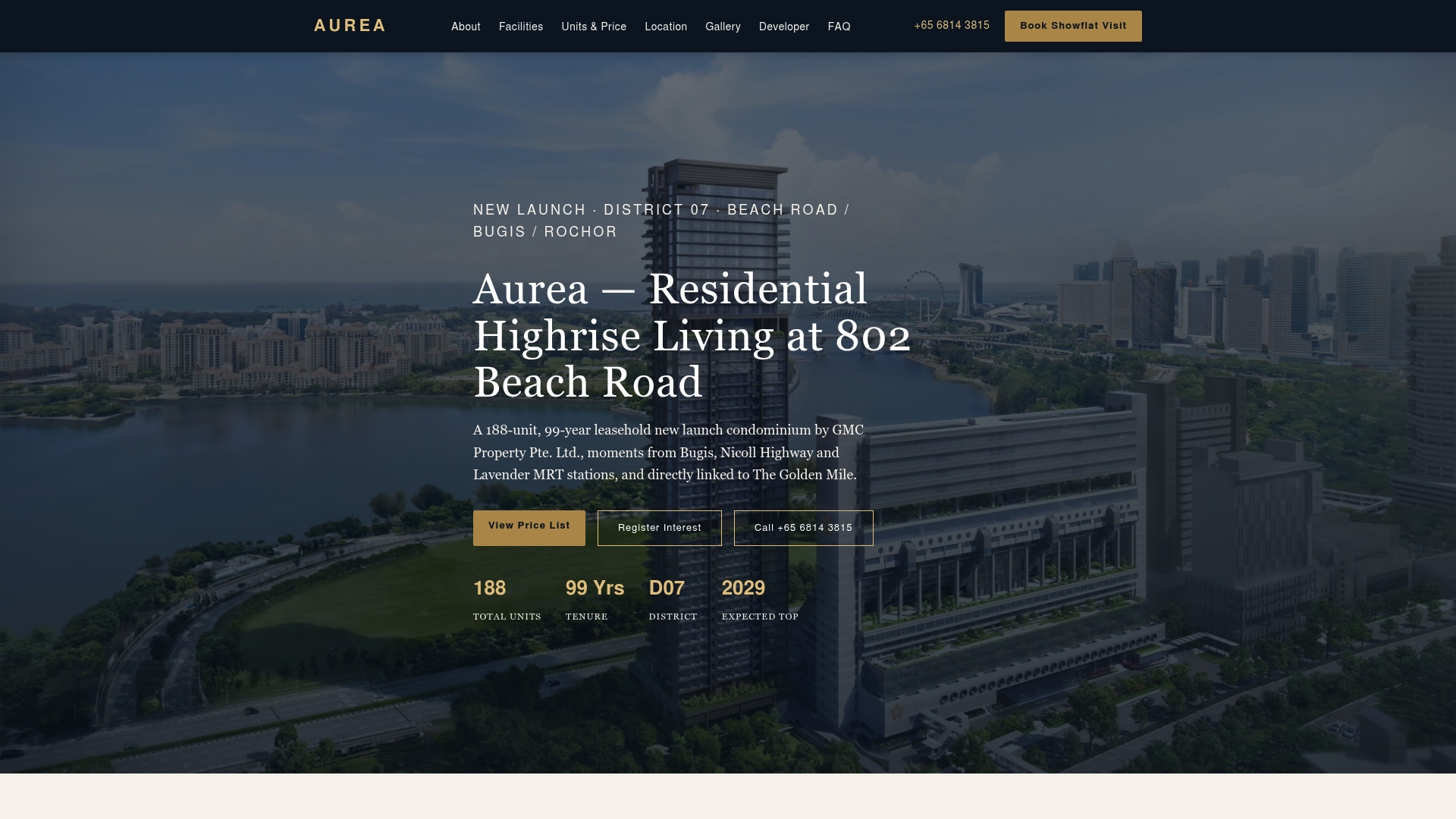
Aurea's sales team, working with appointed marketing agents ERA Realty Network Pte Ltd, can walk you through purchase timing relative to your existing property's expected sale timeline, and connect you with conveyancing partners who handle ABSD remission documentation regularly. For couples weighing unit size against cash-flow constraints, the range of layouts from 2-bedroom to penthouse means there is a configuration for most upgrading budgets.
Visit Aurea-sgcondo to check current availability, request a floor plan, or schedule a viewing. Bring your ownership audit (citizenship status, property count, expected sale timeline) and the sales team can help you map the ABSD remission timeline to your specific purchase plan.
Sources
Use these pages to verify current rules, check rates, and submit applications.
- IRAS | Remission of ABSD for a Married Couple
- Stamp Duties (Spouses) (Remission of ABSD) Rules 2013
- Additional Buyer's Stamp Duty (ABSD)
- Additional Buyer Stamp Duty Remission
- myTax Portal
This article provides general information about ABSD remission rules in Singapore and is not a substitute for professional stamp duty or legal advice. Confirm current rates, deadlines, and eligibility conditions directly with IRAS or a qualified conveyancing solicitor before executing any instrument.