
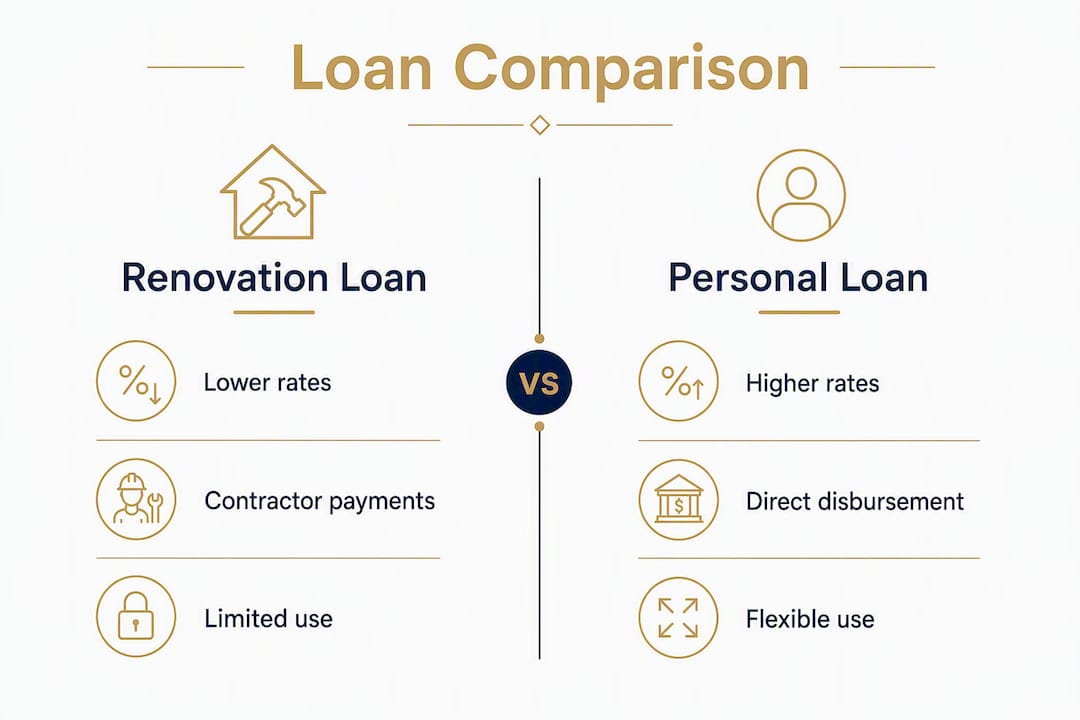
For most Singapore homeowners doing contractor-backed structural work, a renovation loan is the cheaper option. For furniture, appliances, or anything without a formal quote, a personal loan gives you the flexibility a renovation loan simply cannot.
Quick verdict by situation:
- Scoped structural reno with contractor quotes (flooring, carpentry, bathroom fittings): renovation loan. Rates are generally lower than personal loans, and funds go straight to your contractor.
- Large mixed spend (core works plus appliances, soft furnishings, or décor): split it. Use a renovation loan for the contractor portion, a personal loan for the rest.
- Urgent or unquoted needs (emergency repair, last-minute furniture): personal loan. Approval is faster, and no contractor quote is required.
Pro Tip: You can hold both loans simultaneously, but both count toward your Total Debt Servicing Ratio (TDSR). Under MAS rules, your total monthly debt obligations cannot exceed 55% of gross monthly income. Run the numbers before you commit to either.
Table of Contents
- How do renovation loans and personal loans compare side by side?
- What do renovation loans actually cover in Singapore?
- What personal loans cover for home improvements
- What are the eligibility requirements and how long does approval take?
- How much more does a personal loan actually cost?
- How do you decide which loan to use?
- Financing a new-unit fit-out at Aurea-sgcondo
- Are there any tax reliefs on renovation or personal loans in Singapore?
- What happens if you default on either loan?
- Key Takeaways
- The loan you pick matters less than the plan behind it
- Useful sources to verify rates and rules
How do renovation loans and personal loans compare side by side?
| Dimension | Renovation Loan | Personal Loan |
|---|---|---|
| Allowed uses | Structural works, flooring, built-in carpentry, basic bathroom/electrical fittings | Any purpose: furniture, appliances, mixed costs |
| Interest rate (typical) | ~3–5% p.a. | ~3.5–9%+ p.a. depending on credit |
| Eligibility | Owner or qualifying family member; formal contractor quote required | Singapore citizen/PR or eligible foreigner; income proof only |
| Loan amount | Up to 6× monthly income or ~S$30,000–S$50,000 (lender-dependent) | Often higher, depending on income and creditworthiness |
| Tenure | Typically 1–5 years | Commonly up to five to seven years depending on lender |
| Approval speed | Slightly longer (quote verification needed) | Generally faster |
| Flexibility | Funds paid directly to contractor; cannot reallocate | Funds disbursed to your account; spend freely |
| Fees | Insurance premium ~1%, admin/handling fees ~1–2% | Processing fees vary; no mandatory insurance |
| Early repayment | Penalties may apply; check with lender | Penalties may apply; check with lender |
| Best for | Contractor-backed structural and built-in works | Furniture, appliances, mixed or unquoted expenses |
Note: Interest rates, fees, and caps change. Always verify current terms directly with your bank and confirm your TDSR position before applying. MAS sets the TDSR ceiling at 55% of gross monthly income.
What do renovation loans actually cover in Singapore?
Renovation loans in Singapore are purpose-specific. Permitted expenses include structural alterations, flooring, built-in carpentry, and basic bathroom or electrical fittings. Furniture, freestanding appliances, and décor are excluded. That boundary matters more than most buyers realize.
The disbursement process reflects that restriction. Funds go directly from the lender to your contractor, based on the official quotation you submit at application. This staged, quote-driven payment structure reduces misuse risk and is why lenders can offer lower rates.
Loan caps are commonly set at six times your monthly income or a fixed maximum, with many lenders capping at S$30,000–S$50,000. Tenure typically runs one to five years.
Pros:
- Lower interest rates than personal loans
- Structured disbursement keeps the project on budget
- Suitable for large contractor-led works
Cons:
- Cannot cover furniture, appliances, or lifestyle purchases
- Requires formal contractor quotation and signed contract
- Upfront fees reduce net proceeds (see Section 6)
Documentation checklist:
- Proof of property ownership (title deed or HDB ownership documents)
- Formal contractor quotation (itemized, signed)
- Signed renovation contract
- NRIC or passport
- Income documents (payslips, CPF statements, or IRAS Notice of Assessment)
Pro Tip: Get your contractor to itemize the quotation clearly. Lenders scrutinize line items, and a vague quote ("general renovation works: S$25,000") can delay or reduce approval.
What personal loans cover for home improvements
Personal loans are unsecured and disbursed directly to your bank account. You can spend the funds on furniture, appliances, mixed renovation costs, or anything else. No contractor quote is needed.

The trade-off is cost. Personal loan rates typically run 3.5–9%+ p.a., with your credit score doing most of the pricing work. A borrower with a strong credit profile may land close to the renovation loan range; someone with a thinner credit history pays considerably more.
Personal loans also offer longer tenures at some lenders, commonly up to five to seven years, and can accommodate higher loan amounts than renovation loans allow. That makes them useful when your total project budget exceeds the renovation loan cap.
Freelancers and self-employed homeowners often find personal loans more accessible. The documentation is lighter: income proof (IRAS Notice of Assessment or bank statements) rather than contractor quotes and property documents. Industry observations confirm personal loans are faster and require less project-specific paperwork for borrowers with variable incomes.
Pros: Flexible use, faster approval, higher potential loan amounts, no contractor quote required.
Cons: Higher interest rates, no structural incentive to stay on budget, total cost over the loan term can be significantly higher.
What are the eligibility requirements and how long does approval take?
Renovation loan eligibility (typical):
- Must be the property owner or a qualifying family member
- Minimum age usually 21; maximum age at loan maturity varies by lender
- Minimum income threshold applies (varies by lender)
- Property must be in Singapore
Personal loan eligibility (typical):
- Singapore citizen, PR, or eligible foreigner
- Minimum annual income threshold (varies; commonly S$20,000–S$30,000)
- Age 21 and above
For freelancers applying for a personal loan, lenders generally accept IRAS Notices of Assessment or six months of bank statements in place of payslips. Renovation loans are harder to obtain without a stable income record because the lender also needs to verify the contractor.
Typical timelines:
- Personal loan: application to approval often within one to three business days; disbursement shortly after.
- Renovation loan: approval can take three to seven business days once the contractor quote is verified; disbursements are staged as work progresses.
Pro Tip: Before calling any lender, have your contractor's itemized quotation, your last three payslips (or IRAS NOA), and your property ownership document ready. Missing one item is the most common reason for delays.
How much more does a personal loan actually cost?
Renovation loans carry upfront fees: mandatory insurance premiums of around 1% of the loan amount and administrative or handling fees of roughly 1–2%. On a S$30,000 loan, that is S$300–S$900 off the top before a single tile is laid. Factor that into your effective rate comparison.
Here is what the rate difference looks like over five years on a S$30,000 loan:
| Scenario | Rate | Monthly Payment (approx.) | Total Repaid (approx.) |
|---|---|---|---|
| Renovation loan | 4% p.a. | — | — |
| Difference | +3% p.a. | — | +~S$2,460 total |
Example figures based on flat-rate comparison methodology. Actual repayments depend on the lender's calculation method, fees, and your credit profile. Verify current rates with your bank.
S$2,460 in extra interest over five years is real money, but it is not the whole picture. If the personal loan lets you avoid a second application, cover furniture in one draw, and finish the project on schedule, the convenience premium may be worth it for your situation.
How do you decide which loan to use?
- Scope your works. List every item: structural changes, built-ins, flooring, bathroom fittings, furniture, appliances.
- Split the budget. Separate contractor-invoiced items from everything else. The contractor portion is your renovation loan candidate.
- Check the cap. If your contractor works exceed S$30,000–S$50,000 or six times your monthly income, a personal loan tops up the gap.
- Model the monthly instalment. Add both loans to your existing debt obligations and confirm the total stays under 55% of gross monthly income (TDSR).
- Compare total cost, not just rate. Include renovation loan upfront fees against the higher personal loan rate.
Questions to ask before signing anything:
- Does the contractor provide a fully itemized, signed quotation?
- Are staged payments tied to work milestones?
- What is the early repayment penalty on each loan?
- Does the renovation loan require mandatory insurance, and what does it cover?
Red flags to watch:
- A contractor who cannot or will not provide an itemized quote (disqualifies the renovation loan and raises project risk)
- Monthly instalments that push your TDSR above 55%
- Unusually high mandatory insurance or processing fees that erode the rate advantage
When combining both loans, a clean structure is: renovation loan for all contractor-invoiced built-in works, personal loan for furniture, appliances, and contingency. Keep the two budgets separate from the start.
Financing a new-unit fit-out at Aurea-sgcondo
Buying a new-launch unit at Aurea-sgcondo at 802 Beach Road means planning a fit-out before keys are handed over. The development's 188 units (2 to 5 bedrooms, plus two penthouses) complete in 2029, which gives buyers time to plan financing properly.
A practical fit-out timeline looks like this: get contractor quotes for built-in carpentry and bathroom upgrades roughly six months before completion, apply for a renovation loan once the quote is finalized, and pre-approve a personal loan to cover furniture, appliances, and any scope that falls outside the renovation loan's permitted uses.
Pro Tip: Budget the two pools separately from day one. Built-in works (carpentry, flooring, electrical) belong in the renovation loan budget; freestanding furniture and appliances belong in the personal loan or cash budget. Mixing them in one spreadsheet leads to underestimating the renovation loan amount and overpaying on the personal loan.
Aurea's resort-style amenities across four levels mean your unit's interior finishes are the primary personalization lever. Consult the project advisers at ERA Realty Network for exact finishing timelines and handover schedules before locking in loan amounts.
Are there any tax reliefs on renovation or personal loans in Singapore?
Short answer: no, not for owner-occupiers. Singapore does not offer income tax deductions for renovation loan interest or personal loan interest on a primary residence. There is no equivalent of a mortgage interest deduction for renovation financing.
The exception is landlords. If you own a rental property and borrow to renovate it, the interest on that loan may be deductible against rental income under IRAS rules, subject to conditions. The renovation costs themselves may also qualify under the IRAS renovation and refurbishment (R&R) deduction for qualifying commercial or rental properties. For personal residences, neither applies.
Confirm your specific situation with a tax professional or check the IRAS website directly before assuming any deduction applies.
What happens if you default on either loan?
Both loan types are governed by MAS licensing rules, but the consequences of default differ in one important way: renovation loans are tied to your property.
Defaulting on a personal loan triggers credit bureau reporting, late fees, and potential legal action by the lender. Your credit score takes a hit that affects future borrowing across all products. Because personal loans are unsecured, lenders cannot seize your home directly, but they can pursue a civil judgment and, in extreme cases, apply for a bankruptcy order.
Renovation loans carry the same credit consequences, plus the lender may have a charge or lien on the property depending on the loan structure. A default here can complicate a future sale or refinancing of the property. Staged disbursements also mean a default mid-project can leave renovation work incomplete, compounding the financial damage.
In both cases, contact your lender early if repayment becomes difficult. Most banks in Singapore offer restructuring options before a loan reaches formal default status.
Key Takeaways
A renovation loan is the lower-cost choice for contractor-backed structural works in Singapore; a personal loan covers everything else, and combining both is often the smartest approach.
| Point | Details |
|---|---|
| Renovation loan for contractor works | Use it for structural, flooring, and built-in items backed by a formal contractor quotation. |
| Personal loan for flexible spending | Covers furniture, appliances, and any costs outside the renovation loan's permitted uses. |
| Rate gap matters over time | At 4% vs — on S$30,000 over 5 years, the difference is roughly S$2,460 in total repayments. |
| TDSR caps both loans | Both count toward the MAS 55% TDSR limit; model your combined monthly obligations before applying. |
| Verify rates before committing | Rates, fees, and caps change; confirm current terms directly with your bank. |
The loan you pick matters less than the plan behind it
Most homeowners I see get tripped up not by the loan type but by the sequencing. They apply for a renovation loan without a finalized contractor quote, get a lower approval than expected, then scramble for a personal loan at a higher rate to cover the gap. The fix is simple: lock in your contractor's itemized quotation first, then apply.
The rate difference between renovation and personal loans is real, but it is not always the deciding factor. A renovation loan at 4% with S$600 in upfront fees and a rigid disbursement schedule may cost you more in project delays than a personal loan at 6% that you control. Run the full-cost comparison, not just the headline rate.
For new-unit buyers at a development like Aurea-sgcondo, the planning window before completion is an advantage. Use it to get quotes early, understand which costs qualify for a renovation loan, and pre-approve the personal loan for the rest. Arriving at handover with financing already in place is the difference between a smooth fit-out and a stressful one.
Useful sources to verify rates and rules
- DBS Renovation Loan: permitted uses, disbursement mechanics, and current rate information
- POSB Renovation Loan: loan caps, income multiples, and eligibility criteria
- SingSaver: Best Renovation Loans: current market comparison and new-unit buyer tips
- MAS TDSR framework: authoritative source for the 55% TDSR rule and responsible-lending guidelines
Licensed banks are the appropriate source for renovation loans in Singapore. Verify that any lender you approach holds a valid MAS licence before proceeding.