
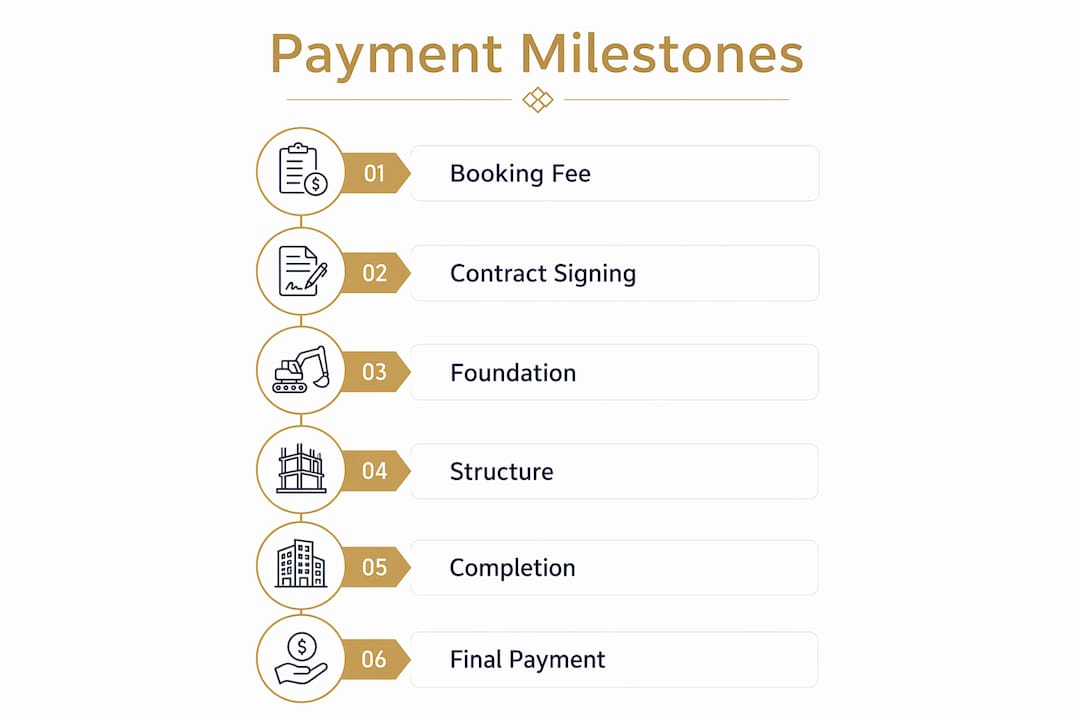
A progressive payment schedule divides the total cost of a property or construction project into smaller, milestone-based installments rather than one lump sum. Each payment is triggered when a specific phase of work is certified as complete, so you only pay for what has actually been built. This structure is standard in construction and real estate, and it protects both buyers and contractors by keeping money tied directly to progress.
Key benefits at a glance:
- Payments align with verified construction milestones
- Buyers preserve cash flow during the build period
- Contractors receive steady funding as work advances
- Transparency reduces the risk of disputes
- Neither party carries the full financial burden upfront
How a progressive payment schedule breaks down by milestone
The most detailed real-world example comes from Singapore's Progressive Payment Scheme (PPS), which the Urban Redevelopment Authority mandates for all new-launch condominiums. The milestone percentages are fixed by law under the Housing Developers Rules, so every licensed developer follows the same schedule.
| Milestone | % of Purchase Price | Typical Timing |
|---|---|---|
| Booking fee (OTP) | 5% | — |
| Sign Sale & Purchase Agreement | 15% | Within a few weeks of OTP |
| Foundation completed | 10% | several months after start |
| Reinforced concrete framework | 10% | following foundation |
| Partition walls | 5% | later months along timeline |
| Roofing / ceiling | 5% | continuing timeline |
| Doors, windows, wiring, plumbing | 5% | continuing timeline |
| Car parks, roads, and drains | 5% | nearing project completion |
| Temporary Occupation Permit (TOP) | 25% | towards end of construction |
| Certificate of Statutory Completion (CSC) | 15% | after TOP |
Residential renovation projects follow a structured payment approach with a deposit, intermediate payments for major and finishing works, and a final payment upon completion. Exact percentages vary depending on project size, but the staged principle applies.
One timing detail buyers often miss: stamp duties fall outside the staged schedule entirely. In Singapore, Buyer's Stamp Duty and any Additional Buyer's Stamp Duty are due within a short period after signing the Sale & Purchase Agreement, requiring separate cash planning.
Advantages and risks worth knowing before you sign
Staged payments reduce financial risk by ensuring each payment is proportional to work completed. Buyers get assurance that money only moves when progress is verified. Contractors get predictable cash inflows rather than waiting until project handover.

The risks are real, though. Slow milestone approvals are the most common problem. When a sign-off is delayed, the contractor's cash flow stalls while labor and material costs keep running. Retention holdbacks of a small percentage of contract value, sometimes withheld months after completion, compound the pressure. Solutions include negotiating lower retention percentages, building a cash buffer, and arranging short-term financing to cover gaps between milestone payments.
For buyers of new-launch condos, the risk runs the other direction. Monthly mortgage installments start small at the foundation stage and ramp up with every subsequent drawdown. The TOP payment alone triggers a significant portion of the purchase price. Planning your budget against the peak installment at CSC, not the early foundation-stage figure, is the financially sound approach.
Pro Tip: Before signing any contract, agree in writing on exactly what "milestone complete" means for each stage, including who verifies it and within how many days payment must follow. Vague definitions are where most payment disputes begin.
Experts consistently emphasize upfront clarity on milestone deliverables, verification methods, and payment conditions as the single most effective way to prevent disputes.
How to manage and check your payment schedule online
Most buyers and contractors today track their installment plan through a digital portal or mobile app rather than paper statements. Here is how to stay on top of it:
- Log in to your developer or lender portal. New-launch buyers in Singapore can view their current milestone status, upcoming payment notices, and disbursement history through their bank's online platform.
- Set payment due date alerts. Each milestone payment is typically due within 14 days of the developer's notice. Missing that window can trigger late payment charges.
- Update your payment method proactively. If your bank account or CPF details change, update them before the next milestone notice arrives, not after.
- Download payment summaries. Keep a running record of each disbursement for tax and legal purposes, especially for the final CSC payment.
- Use a digital wallet approach for renovation projects. Platforms that hold the full project value upfront and release funds on milestone completion minimize disputes and give both parties real-time visibility.
For renovation contracts specifically, a digital escrow or staged-payment platform lets clients see exactly which stage is funded and what must happen before the next release. That transparency tends to reduce payment friction far more than traditional invoicing.
Best practices for negotiating your staged payment plan
Negotiating a staged payment plan is mostly about protecting yourself before work starts, not after a problem surfaces.

Get every milestone defined in writing with a concrete "definition of done." "Foundation complete" is not a milestone definition. "Foundation poured, inspected, and certified by a licensed engineer" is. The more specific the language, the faster disputes resolve.
Align payment amounts with actual cost timing. If a contractor needs to purchase materials at the start of stage two, the stage one payment should cover that outlay. A payment schedule that front-loads the client's risk or back-loads the contractor's costs creates friction at every stage.
Push for a final payment large enough to matter. A 5% completion payment gives a contractor almost no incentive to return for a walkthrough. A 15–25% final payment keeps both parties engaged through handover.
For new-launch condo buyers, the milestone percentages are fixed by law and non-negotiable. What you can negotiate is the legal fee structure with your conveyancing lawyer and the loan package terms with your bank, both of which affect your total cost across the build period. Reviewing the Aurea-sgcondo payment timeline before committing gives you a clear picture of what each stage requires in cash, CPF, and loan drawdowns.
Key Takeaways
A progressive payment schedule ties every payment to a verified milestone, protecting both buyers and contractors from front-loaded financial risk.
| Point | Details |
|---|---|
| Milestone-based structure | Each payment releases only when a specific construction phase is certified complete. |
| Singapore PPS has multiple stages | PPS milestones are: 5% at booking, 15% at Sale & Purchase, then staged 10% and 5% payments for each phase, 25% at TOP, and 15% at CSC, fixed by the Housing Developers Rules. |
| Stamp duty sits outside the schedule | BSD and ABSD are due within 14 days of signing the S&P Agreement, requiring separate cash. |
| TOP triggers the largest single payment | The Temporary Occupation Permit stage calls for 25% of the purchase price at once. |
| Define milestones in writing | Vague completion criteria are the primary cause of staged payment disputes. |