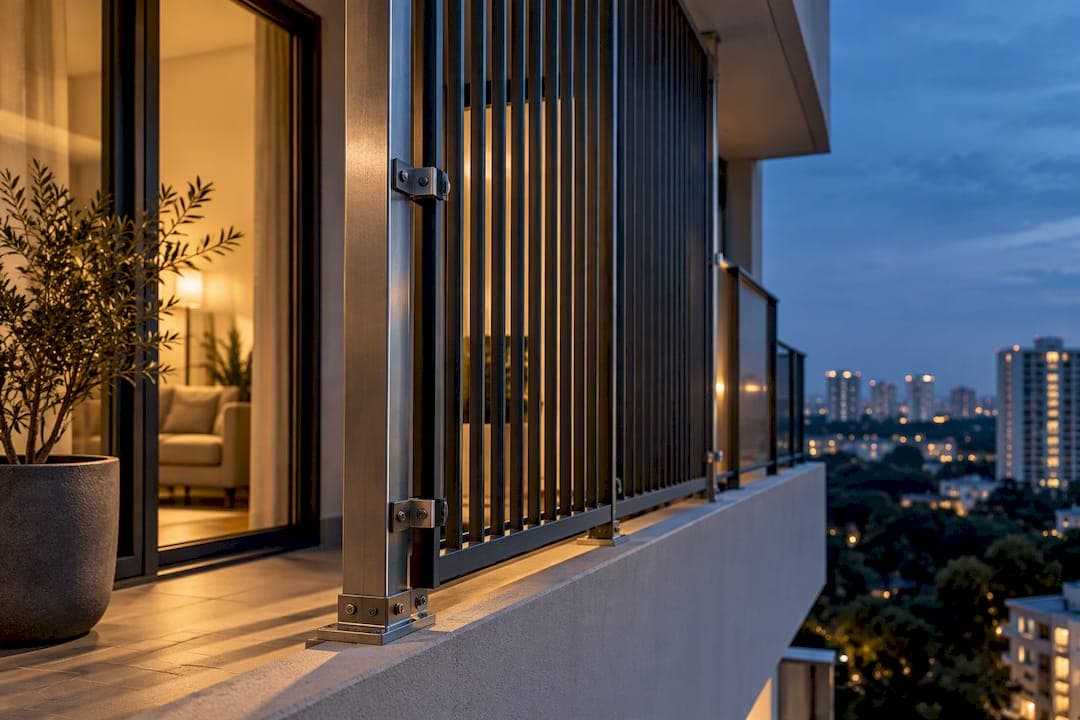
Permanent glazing or walls that seal a balcony shut are not allowed in Singapore, whether you own an HDB flat or a private condo unit. Retractable, porous screens or zip blinds that fold away and let air through are the accepted route for most homes. Before you buy or install anything, confirm whether HDB, your Management Corporation Strata Title (MCST), or the Urban Redevelopment Authority (URA) governs your particular unit, because the paperwork and the person you call differ.
TL;DR:
- Balconies must maintain at least 40% continuous perimeter openings and use retractable, porous screens that allow air flow when closed, according to URA rules.
- Enclosing balconies with fixed glass or solid panels can result in losing the outdoor classification, triggering GFA penalties and rejection of enclosure requests.
- HDB owners must verify flat type and follow specific renovation guidelines, applying for permits for structural works and avoiding fully blocking wind or light.
- Condo owners need to obtain written approval from the MCST, ensuring screens match approved drawings and materials to prevent enforcement actions.
- Installing non-compliant enclosures can lead to legal removal orders, with tribunals measuring actual gaps and risks escalating if approvals are skipped or documentation is incomplete.
Table of Contents
- URA Rules and the Balcony Incentive Scheme
- What HDB Owners Need to Check Before Installing Anything
- How Condo Owners Get MCST Approval
- Which Screening Options Actually Pass Regulatory Muster
- When SCDF, BCA, or a Qualified Person Must Sign Off
- Step-by-Step: Getting Approval Without a Redo
- What Happens When Owners Skip Approval
- What Buyers Should Check Before Signing
- Sources
- FAQ
URA Rules and the Balcony Incentive Scheme
The Urban Redevelopment Authority classifies balconies as semi-outdoor spaces, which influences associated rules and restrictions. A balcony must keep a continuous perimeter opening of at least 40%, and any screen you add has to retract fully and let air move through even when closed.
The Balcony Incentive Scheme (DC18-07) ties this to floor area rules. Developers get bonus gross floor area for including balconies, but that bonus comes with strings attached:
- Balconies must be reasonably wide to function as outdoor spaces
- Total balcony area is limited in proportion to the unit's nett internal area
- Developers may receive a bonus gross floor area allowance for qualifying balconies
Seal a balcony with glass or fixed panels and URA can treat it as converted internal floor space, which pushes your unit over its approved gross floor area. That's not a paperwork technicality. It's the reason so many enclosure requests get rejected outright. Every development application must include an approved screen design, and developers are required to disclose the "not to be enclosed" condition to buyers through Form 36 notices and show-unit mockups.
What HDB Owners Need to Check Before Installing Anything
HDB applies a similar logic but with its own paperwork trail. Glass, PVC, or any material that fully blocks wind, rain, and light is not allowed at balconies covered by this rule. Blinds are fine if they're porous and retract completely, per HDB's renovation guidelines.
Here's the practical sequence for HDB flat owners:
- Check your flat type and completion date. Rules differ between older blocks, DBSS projects, and newer BTO flats, so don't assume your neighbor's approval applies to you.
- Consult My HDB and the specific renovation factsheet for your block before buying materials.
- Apply for a renovation permit if the work touches structural elements, and confirm whether a BCA-registered contractor or a Professional Engineer is required.
- Watch the awning projection threshold. Awnings beyond 1.4 meters often need a Qualified Person's sign-off and possibly SCDF review.
- Check with your Town Council. Some estates layer on their own restrictions beyond HDB's baseline rules.
Skipping step one is the most common mistake. What passed inspection in a block completed in 2005 might not fly in a 2022 handover.
How Condo Owners Get MCST Approval
Condominium owners face a different gatekeeper: the Management Corporation Strata Title. Your first move isn't calling a contractor, it's finding the approved balcony-screen drawing that was submitted when the development got its planning approval. That document is often the single most useful piece of paper you can get your hands on before installing anything.
The workflow generally runs like this:
- Check your development's house rules and any existing approved screen specifications on file with the MCST.
- Submit a formal application with drawings, material specs, and manufacturer details for the proposed screen.
- Wait for written approval before any installation begins. Verbal go-aheads from a managing agent don't count.
- Keep a copy of the approval alongside your unit's title documents for future resale.
MCSTs commonly reject applications over façade mismatch (a screen color or style that clashes with the building's exterior), unapproved materials, or safety concerns tied to fire escape routes. If your MCST rules checklist research shows the building already has developer-approved screens listed in its by-laws, your job is simpler: match the spec exactly rather than proposing something new.
Some developers pre-install approved screens at handover or offer them as an option at the Option to Purchase stage. If yours did, check the fine print before you touch anything.
Which Screening Options Actually Pass Regulatory Muster
Function matters more than what a product is called. A "premium blind" that doesn't retract fully or lets almost no air through will fail the same test as a cheap one.
- Zip or Ziptrak-style retractable blinds tend to pass because they're designed to roll away completely and leave the opening genuinely unobstructed.
- Fixed glass curtains or near-sealing glazing systems carry the highest regulatory risk. Even small residual gaps have been challenged in enforcement cases, and pairing this with double glazing considerations for noise control doesn't change the porosity test URA applies.
- Awnings and rigid covers are usually fine at modest projections, but anything beyond the standard threshold triggers fire-rating checks and possibly structural sign-off.
Pro Tip: Before you pay a deposit on any screen system, ask the vendor for written evidence, not marketing copy, that the product fully retracts and meets the ventilation test. A glossy brochure claiming "breathable design" means nothing to a Strata Titles Board reviewer measuring the actual gap in millimeters.
When SCDF, BCA, or a Qualified Person Must Sign Off
Balcony work touches fire safety and structural integrity, and those two concerns belong to different agencies. The Singapore Civil Defence Force reviews fire separation, smoke movement, and means of escape. Certain façade alterations and larger awnings require SCDF plan approval or a fire-safety certificate under the Fire Code.
The Building and Construction Authority, or a Qualified Person acting on its behalf, checks structural loading and whether your proposed screen or awning affects the building's design certification.
These approvals aren't interchangeable, and one doesn't imply the other.
- Keep every written clearance, not just the final "approved" email.
- Expect technical agencies and your MCST to request drawings, material data sheets, and load calculations for anything beyond a simple retractable blind.
- A PE(Civil) endorsement is typically required once you exceed standard awning projection limits.
Step-by-Step: Getting Approval Without a Redo
Enclosure disputes almost always trace back to skipped documentation, not bad intentions. Follow this sequence and you avoid most of the trouble.
- Identify your governing authority. HDB flat or condo unit changes everything downstream, including which office you call first.
- Locate the approved screen drawing. For condos, this sits with the development application file (and often the MCST). For HDB, check the renovation factsheet tied to your flat type.
- Prepare your submission. Drawings, material specs, and manufacturer porosity ratings go to the MCST or HDB. Engage a Qualified Person if the work is structural or the awning exceeds standard projection.
- Wait for every written approval. MCST, HDB, SCDF, or BCA, depending on scope, before a single screw goes into the wall. Photograph the balcony before and after.
- Maintain the record. Keep the QP certification and approval letters with your property documents. Future buyers, and their lawyers, will ask.
The waterproofing and installation standards HDB publishes call for a 150mm membrane upturn around sanitary stacks and a minimum parapet height of 1000mm, details easy to miss if you're focused only on the screen itself.
What Happens When Owners Skip Approval
Enforcement isn't hypothetical. A Strata Titles Board decision-gd.pdf) examined installed glass curtains that were effectively non-porous and found them to be an unlawful enclosure. The board ordered removal and treated the alteration as an increase in gross floor area under the Building Maintenance and Strata Management Act.
That case pattern repeats: a resident installs something that looks retractable but doesn't fully open, a neighbor or the MCST objects, and the tribunal measures the actual gap rather than trusting the product name.
- MCSTs can pursue removal through a resolution process requiring substantial owner consent, sometimes cited around 90%.
- Refusal to comply can escalate to court enforcement.
- The safest position is a written MCST or HDB approval plus, where structural work is involved, a QP report on file.
Preferring the developer's originally approved design over a custom vendor pitch removes most of this risk before it starts.
What Buyers Should Check Before Signing
Ask to see the actual installed screen in the show unit, not a rendering, and request the approved drawing that goes with it. If the sales team can't produce one, treat that as a warning sign, not a formality.

Developers are required to note that a balcony is "not to be enclosed except with approved screens" on Form 36, and some offer pre-installed screens through a side letter at the Option to Purchase stage. Ask directly whether that option exists before you sign, and compare it against the showflat checklist points worth verifying on any visit. It's a five-minute question that can save months of dispute later.
At Aurea, unit layouts and balcony treatments follow the approved development plans filed with URA, which is the detail worth confirming for any new launch you're considering, not just this one.
— Velisa
This article is general information, not a substitute for advice from a qualified lawyer. Consult a qualified legal professional about your own circumstances before acting on anything here.
Sources
FAQ
Can I Enclose My Balcony in Singapore?
Not with permanent walls or fixed glass panels if your balcony is approved as semi-outdoor space. Retractable, porous screens that fully open and preserve ventilation are generally the accepted alternative for both HDB and condo units.
Is a Balcony Included in Gross Floor Area?
Balconies built under the Balcony Incentive Scheme get bonus gross floor area treatment, but enclosing one can cause URA to reassess it as regular internal floor space. That reassessment is what triggers most GFA compliance disputes over enclosed balconies.
Can I Cover My Apartment Balcony?
Open-sided covers over a balcony may not need URA planning permission on their own, but you still need MCST consent for condos or an HDB renovation permit, and larger awnings can require SCDF or BCA involvement depending on projection and structure.
Can You Barbecue on a Condo Balcony in Singapore?
Barbecuing rules come from your MCST's house rules and fire safety regulations, not from balcony enclosure guidelines directly. Most strata developments restrict or ban open-flame cooking on balconies for fire-safety reasons, so check your specific development's by-laws before setting anything up.