You cannot buy a condo in Singapore to run short-term Airbnb-style stays. The Urban Redevelopment Authority (URA) bans stays under three consecutive months at private residential properties, full stop, and it has fined operators millions of dollars for breaking that rule. If you're weighing a purchase, the real questions are tax exposure, purchase mechanics, and what lawful rental income actually looks like.
TL;DR:
- Short-term Airbnb rentals are illegal in Singapore for any stay under three months, with enforcement fines reaching over S$1.27 million for violations.
- Buyers should account for significant stamp duty costs, with foreign investors potentially facing ABSD rates up to 60%, creating a tax gap of over S$1 million for a $2 million property.
- Agency verbal rental income promises are not legally binding; formal written confirmation and legal review are essential before signing purchase agreements.
- Income from long-term rentals is legal and can justify condo ownership, while short-term stays are explicitly prohibited by law.
Table of Contents
- What URA and Singapore Law Say About Short-Term Stays
- How BSD and ABSD Change Your Upfront Cost
- What Do You Check Before Signing an OTP?
- Can Rental Income Justify Buying a Condo?
- Due Diligence Checklist Before You Commit
- Who Actually Fits an Aurea Purchase?
- Ready to Look at Aurea's Unit Options?
- Sources
- FAQ
What URA and Singapore Law Say About Short-Term Stays
Singapore treats short-term accommodation as a legal category, not a marketing term. Under URA's short-term accommodation guidance, any stay shorter than three consecutive months at a private residential property is prohibited, regardless of whether the host lists on a booking platform, hires a property manager, or calls it a "corporate stay."
The rule exists to protect residential character in condos and landed estates. URA reviewed this policy through public consultation and confirmed it would maintain the status quo, finding broad support for keeping the minimum-stay threshold rather than loosening it for tourism demand.
Enforcement isn't theoretical.
Enforcement snapshot: In September 2025, URA announced that six individuals running an unauthorized short-term accommodation operation across 31 properties were convicted and fined a combined S$1.27 million.
A few things worth underlining before you buy anything:
- The minimum-stay rule applies to the property itself, not just the person advertising it.
- Appointing a management company or "co-hosting" service does not create a legal exemption.
- Getting sign-off from your Management Corporation Strata Title (MCST) council does not override URA's rule. MCST by-laws can restrict use further, but they cannot legalize what URA already bans.
How BSD and ABSD Change Your Upfront Cost
Every buyer pays Buyer's Stamp Duty (BSD). Some buyers also pay Additional Buyer's Stamp Duty (ABSD), and the difference between those two groups can swing your entry cost by hundreds of thousands of dollars.
IRAS's BSD schedule) has applied progressive bands since February 15, 2023, calculated on whichever is higher: the purchase price or the property's market value.
- 1% on the first $180,000
- 2% on the next $180,000
- 3% on the next $640,000
- 4% on the next $500,000
- 5% on the next $1,500,000
- 6% on anything remaining
ABSD sits on top of that, and it's where buyer profile matters most. IRAS's ABSD table sets rates at 0% for a Singapore Citizen buying a first home, rising to 20% on a second property, while a foreign buyer pays 60% on any residential purchase and an entity buying residential property pays 65%.
Statistic callout: A foreign investor and a Singapore Citizen buying the identical $2 million unit for the first time can face a tax gap north of $1 million once ABSD is added. That's the number that should shape your budget before you shape your floor plan.
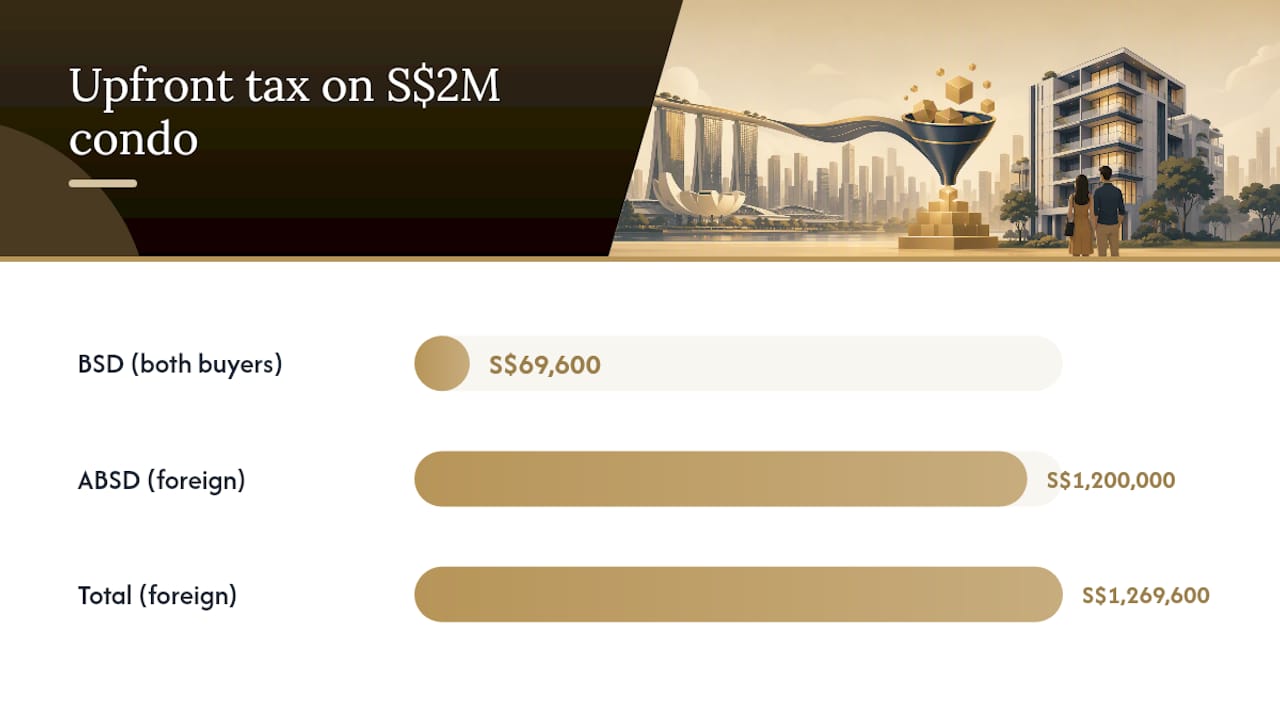
Run your own numbers against a worked stamp duty breakdown and confirm your exact profile with a property lawyer or tax adviser. ABSD rules also shift based on citizenship treaties and entity structure, so don't assume last year's rate still applies.
What Do You Check Before Signing an OTP?
New-launch purchases move fast, and the paperwork matters more than the showflat. CEA's buyer checklist for uncompleted private residential properties exists precisely because buyers sign Option to Purchase (OTP) agreements under time pressure.
- Get a conveyancing lawyer to review the OTP and Sale and Purchase (S&P) Agreement before you sign anything, not after.
- Confirm the payment schedule against the project's construction milestones.
- Check the expected Temporary Occupation Permit (TOP) date and what happens if it slips.
- Review defects liability terms and how long you have to report issues after handover.
- Note the Seller's Stamp Duty (SSD) triggers if you plan to sell before the holding period ends.
- Flag any rental-use claims made verbally during marketing and ask for them in writing.
Pro Tip: If a sales representative mentions expected rental income during a showflat visit, ask them to put it in writing. Verbal promises about yield have no standing once your lawyer reviews the S&P agreement, and CEA's own guidance treats rental projections as separate from legal representations.
For a stage-by-stage view of what to expect between OTP and key collection, a new-launch purchase timeline is worth reading alongside your checklist.
Can Rental Income Justify Buying a Condo?
Short-term rental income cannot justify a condo purchase in Singapore, because the activity generating that income is illegal for private residential property. URA has been explicit that short-term accommodation demand does not change its position, and neither a listing platform's terms of service nor a co-hosting agreement changes the law underneath it.
That doesn't mean condo ownership can't produce rental income. It means the income has to come from something legal.
- Long-term tenancy (3 months or more): the standard route for private condos, and the one most owner-investors in Singapore already use.
- Serviced apartments: a separate licensed category with its own operator framework, distinct from buying a residential unit to sublet.
- Licensed commercial accommodation: hotels and gazetted short-stay operators fall under different zoning and licensing entirely, not residential condo ownership.
Pro Tip: Model your yield using a 3-month-minimum tenancy market, not a nightly rate. Subtract property tax, MCST maintenance fees, agent commission, and a realistic vacancy allowance before you decide whether the numbers work.
If you're set on short-stay hospitality as a business rather than condo ownership, that's a different asset class with its own licensing path. Some markets abroad, like Spain's Costa Blanca, license residential units for tourist stays under a specific regime. Singapore has chosen not to build that same pathway into private residential zoning, and there's no indication it plans to.
Due Diligence Checklist Before You Commit
A condo purchase in Singapore involves more than checking the floor plan. Run through these before you sign.
- Read the MCST by-laws in full and confirm nothing in the sales pitch contradicts them, especially around subletting or minimum-stay periods.
- Ask for any rental-income representation in writing, then have your lawyer check it against URA's renting property guidance, which also covers occupancy caps and the narrow 90-square-meter registration pathway for higher occupancy.
- Verify the unit's registered size and layout against approved plans, not marketing floor plans, during a showflat visit.
- Confirm the legally relevant purchase date using your S&P agreement or URA/INLIS records, not a portal listing date, since SSD timing depends on it.
- Keep every developer disclosure document. If a dispute arises later, these are what your lawyer will reference first.
For a deeper look at what happens when owners get this wrong, condo subletting enforcement cases are worth a read before you assume a workaround exists.
Who Actually Fits an Aurea Purchase?
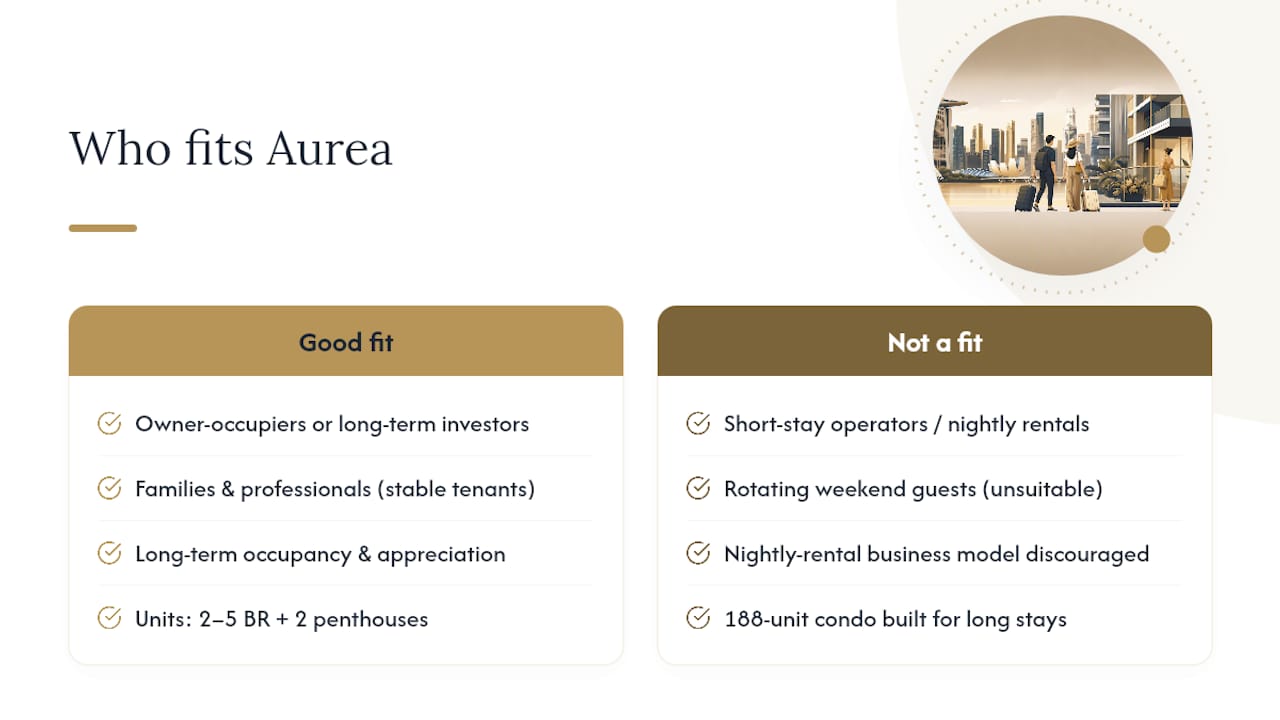
Aurea-sgcondo was built for owner-occupiers and long-term investors, not short-stay operators. At 802 Beach Road, its 188 units, spanning 2 to 5 bedrooms plus two penthouses, sit within walking distance of multiple MRT lines, with a link bridge to The Golden Mile and resort-style amenities across four levels.
That combination points toward stable, long-term tenant demand, families and professionals who want a home base near transit, not a rotating door of weekend guests. If your investment thesis depends on nightly rentals, this isn't the property type or the legal environment to build it on. If it depends on steady occupancy and long-term appreciation, the fundamentals line up better.
— Velisa
Ready to Look at Aurea's Unit Options?
Aurea-sgcondo is the direct alternative to chasing a short-term rental strategy that Singapore law won't allow: a new-launch condo at 802 Beach Road built for owner-occupation and long-term tenancy demand, not nightly turnover.
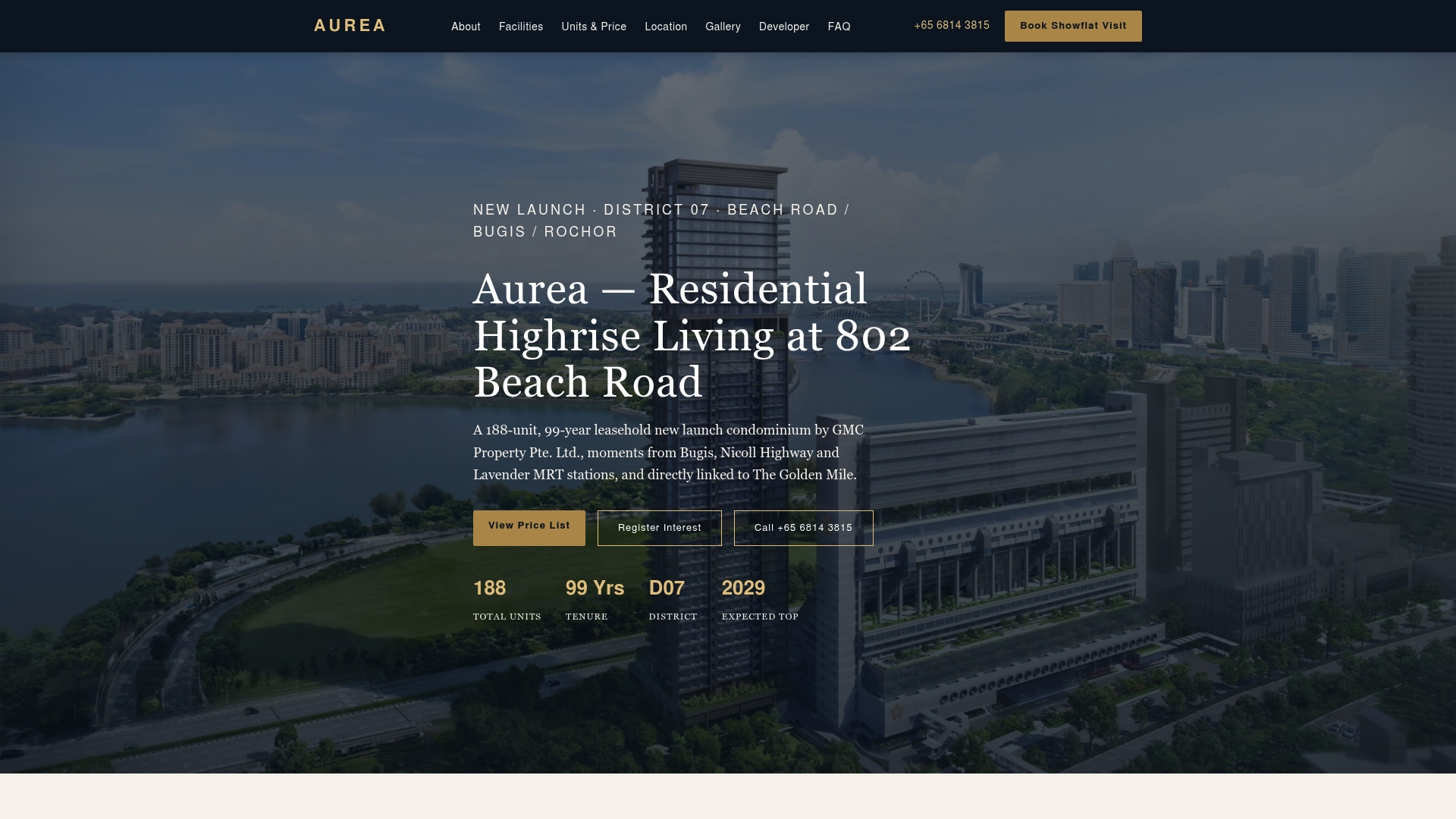
Two-bedroom, three-bedroom, and four-bedroom units, including premium layouts and penthouses, are available with pricing details provided directly by the developer. Before you commit to any unit, work through the CEA buyer checklist, get a conveyancing lawyer to review your OTP, and confirm your BSD and ABSD exposure based on your actual buyer profile. Then reach out to the Aurea sales team for the full project pack, floor plans, and legal clarifications on your specific purchase scenario.
This article is general information, not a substitute for advice from a qualified financial advisor. Consult a qualified financial professional about your own circumstances before acting on anything here.
Sources
FAQ
Can I Airbnb My Condo in Singapore?
No. URA prohibits stays under three consecutive months at private residential properties, and enforcement in September 2025 resulted in fines totaling S$1.27 million for one unauthorized operation.
What Is the Minimum Rental Period for a Singapore Condo?
Three consecutive months, as set by URA's short-term accommodation policy. This applies whether you rent directly, through an agent, or via a property manager.
Does ABSD Apply if I Already Own a Property?
Yes, and the rate depends on your profile. IRAS applies 20% ABSD to a Singapore Citizen's second residential property, with higher rates for foreign buyers and entities.
How Much Does an Aurea Unit Cost?
Two-bedroom units range from 1,770,000 to 2,075,800 SGD, three-bedroom units from 2,639,900 to 3,058,600 SGD, and four-bedroom units from 4,080,510 to 4,512,990 SGD. Pricing for the 4-bedroom premium layout, 5-bedroom units, and penthouses is available directly from Aurea-sgcondo.
What Should I Ask Before Signing an OTP?
Confirm the payment schedule, expected TOP date, defects liability terms, and any SSD triggers, and have a conveyancing lawyer review the OTP and S&P agreement before signing.