
An MRT premium condo is worth paying for when the station, the line, and your total acquisition cost all line up with what you actually need—whether that is a short commute or strong rental demand. Before you commit, verify the walking route on the LTA rail network page, pull comparable transactions from URA, and run your Additional Buyer's Stamp Duty scenario through IRAS. Developments like Aurea at Beach Road illustrate how a project near multiple stations gets positioned and priced.
TL;DR:
- Proximity to multiple MRT lines and interchange stations adds more value than raw walking distance alone, especially for practical travel benefits.
- Confirm the actual walking route, station type, and nearby supply pipeline to accurately assess whether a unit truly benefits from MRT proximity.
- Market conditions and upcoming supply can dilute or negate the premium typically associated with living near an MRT station over time.
- New MRT lines generate price anticipation before opening, but actual appreciation depends on construction progress and ridership, not just announcements.
- Rental demand is the most direct financial benefit for investors, while owner-occupiers prioritize shelter and convenience, influencing how they value proximity.
Table of Contents
- Top considerations when buying a premium condo near an MRT
- What the MRT premium actually means and why distance bands matter
- Market data buyers must check before assuming a premium exists
- How to validate a listing's MRT claim and calculate total acquisition cost
- Publisher example: how Aurea positions MRT connectivity
- Examples of premium condos near MRT stations worth studying
- New launch versus resale differences across MRT corridors
- How future MRT lines and upgrades affect premium condo values
- Case studies of price appreciation linked to MRT proximity
- How the MRT premium plays out differently for owner-occupiers versus investors
- Common misconceptions about the MRT premium
- How MRT connectivity shapes rental demand and yields
- Three practical rules of thumb before paying an MRT premium
- Aurea: a nearby option that fits the checklist
- Sources
- FAQ
Top considerations when buying a premium condo near an MRT
Not every unit billed as "near MRT" delivers the same convenience, and the difference often comes down to details agents gloss over. Run through this order of priority before you shortlist anything.
- Confirm the exact station entrance and walk the route yourself, ideally at peak hour, since a "5-minute walk" on a brochure can mean a longer trek once you account for traffic lights and uncovered stretches.
- Check whether the station is an interchange or sits on a single line, because transfer-free access to the Downtown Core or Orchard Road adds more practical value than raw distance.
- Look at the unit's tenure and mix, whether it's a 2-bedroom or a penthouse, and cross-check upcoming supply in the same micro-market through URA's pipeline data.
- Assess unit-level factors: floor level, layout efficiency, orientation, and monthly maintenance fees, since these affect livability and resale appeal as much as the MRT tag does.
- Model your full transaction cost, including Additional Buyer's Stamp Duty (ABSD) and Buyer's Stamp Duty (BSD), remembering that ABSD is charged on whichever is higher: your purchase price or the property's market value).
Pro Tip: Bring a phone timer to every viewing and clock the walk from the unit's lobby to the actual paid-fare gate, not just the station name on the map.
What the MRT premium actually means and why distance bands matter
An "MRT premium" describes the extra price buyers pay for a unit within comfortable walking distance of a station, typically inside 500 meters, with a smaller and less consistent effect stretching out to the 500 meter to 1 kilometer band. The premium is not uniform: it depends heavily on submarket, line, and whether the station is an interchange.
- Core Central Region (CCR) projects near major interchanges often hold value better than outlying stations on a single line.
- Rest of Central Region (RCR) and Outside Central Region (OCR) projects can carry a smaller or even negative premium if broader market conditions weaken.
- Interchange stations offer a practical travel-time edge because they cut out a transfer, which matters more to daily commuters than headline distance.
In URA's Q2 2026 release, the Core Central Region price index rose 2.0% quarter-on-quarter while the Rest of Central Region fell 1.4% and Outside Central Region dipped 0.2%, showing that location and submarket dynamics can outweigh a simple "near MRT" label. Pipeline supply in the same corridor can also erode a premium over time, so proximity alone never guarantees appreciation.
Market data buyers must check before assuming a premium exists
Before assuming any station adds value to a listing, check the numbers that actually move prices. URA's second quarter 2026 statistics show overall private residential prices up 0.5% quarter-on-quarter, with sharp regional divergence, and 42,472 private residential units had planning approval at the end of Q2 2026, with 15,810 of those still unsold. That volume of unsold pipeline supply matters because it can soften how much of a premium any single MRT-linked project can sustain, especially if several developments in the same corridor complete around the same window.
On the transit side, the LTA rail network spans more than 170 stations across six MRT lines and about 240 kilometers, and it is worth distinguishing stations that are operating today from those still under construction or only planned.
How to validate a listing's MRT claim and calculate total acquisition cost
Treat every "near MRT" claim as something you verify, not something you accept from a floor plan.
- Confirm the station location and the sheltered walking route using LTA's system map, then walk it yourself before making an offer.
- Pull URA transaction comparables for the exact micro-market and unit type so you know what similar units near the same station have actually sold for, not just asking prices.
- Run your ABSD and BSD scenarios using IRAS's official guidance, since your buyer profile, whether Singaporean, permanent resident, foreigner, or entity, changes the math significantly.
- Factor in monthly maintenance fees, expected completion dates for nearby competing supply, and realistic rental demand for the unit type you are considering.
Pro Tip: Bring a printed checklist to every viewing covering walking time, interchange status, comparable transaction prices, and your ABSD tier, so no single factor gets overlooked in the moment.
A short toolkit helps here: LTA's map for station verification, URA's transaction search for pricing history, and IRAS's stamp duty tables for cost modeling. Treating these as three separate checks, rather than trusting a single brochure claim, catches most of the gaps between marketing and reality.
Publisher example: how Aurea positions MRT connectivity
Aurea, a 188-unit development at 802 Beach Road developed by GMC Property Pte. Ltd., illustrates how a premium project markets proximity to multiple MRT stations alongside resort-style amenities spread across four levels.
- The project offers 2 to 5-bedroom layouts plus two penthouses, aimed at both families needing space and professionals wanting a compact city base.
- A link bridge to The Golden Mile is part of its stated connectivity, alongside its position near several MRT lines.
- Larger unit types, such as the 4-bedroom and 5-bedroom layouts, tend to suit families prioritizing space and amenities, while smaller layouts may draw professionals and investors focused on rentability.
- The development is slated for completion in 2029, which buyers should weigh against the current pipeline supply timeline in the surrounding area.
Examples of premium condos near MRT stations worth studying
Looking at how existing premium developments are positioned near MRT stations helps buyers calibrate what a genuine premium looks like versus marketing language. Projects in the Beach Road and Golden Mile corridor, for instance, are often marketed around proximity to multiple lines rather than a single station, which is a distinct value proposition from a project sitting directly above one interchange.
Aurea's positioning near Beach Road, with its stated access to multiple MRT stations and a link bridge to The Golden Mile, is a useful case study in how developers frame connectivity claims. Buyers evaluating any similar project should ask the same questions: which stations are within genuine walking distance, whether any of them are interchanges, and whether the sheltered route claims hold up on an actual site visit.
Beyond any single project, the broader lesson is that "premium condos near MRT" as a category spans a wide range of submarkets, from CCR developments near major interchanges to OCR projects near newer, less connected lines. The premium each commands varies with the line, the interchange status, and the surrounding supply pipeline, which is why URA transaction comparables matter more than a generic "near MRT" label on a listing.
New launch versus resale differences across MRT corridors
New launch and resale units near the same MRT line often behave differently, and the gap widens depending on which corridor you're looking at. A new launch typically prices in a premium for its completion timeline and warranty status, while a resale unit's price already reflects years of actual commute experience from residents, which can validate or undercut the marketed convenience.
Along corridors with heavier pipeline supply, new launches face more direct competition from units completing in similar windows, which can cap how much of an MRT premium a single project can sustain. Resale units in an established building near a long-operating interchange station, by contrast, often carry a track record of price stability tied to genuine, tested convenience rather than a rendering.
For buyers, this means a new launch near a station still under construction carries more uncertainty: the line could open later than planned, or nearby supply could increase faster than demand. A resale unit near an operating interchange offers less growth story but more certainty of what pricing already reflects. Checking URA's transaction history for both new sale and resale prices in the same postal sector is the most direct way to see whether the corridor's premium is holding, growing, or fading.
How future MRT lines and upgrades affect premium condo values
Announced MRT extensions and new lines tend to generate anticipatory price movement well before a station opens, and confirmed lines matter more than proposed. Buyers should always confirm a station's actual status through LTA rather than assuming a line mentioned in a news article or a sales brochure is confirmed and funded.
The practical effect on values usually plays out in stages: land near a planned station sees early speculative interest, prices firm further once construction is visibly underway, and the most tangible re-rating tends to happen close to or after the line actually opens and ridership proves the connectivity claim. Because this process spans years, a unit purchased purely on the promise of a future line carries real timing risk, especially if completion dates slip.
This is also where pipeline supply data becomes relevant again. If several developments cluster around a single planned station anticipating the same uplift, the eventual premium gets divided among more units rather than concentrated in one project, which is one reason URA's supply figures are worth checking alongside any transit announcement before you factor a future line into your offer price.
Case studies of price appreciation linked to MRT proximity
Price movements tied to MRT proximity are easiest to see when you compare the same postal sector before and after a line opens, using URA's transaction data rather than anecdotal reports. Broadly, the historical pattern across Singapore has been that units within the closer distance bands near new stations tend to see stronger relative price support than comparable units farther away, particularly once actual ridership demonstrates the commute time savings.
That said, URA's Q2 2026 flash estimate shows this effect is not uniform across the market: non-landed private residential prices moved only marginally in aggregate for the quarter, even as CCR prices rose 2.0%, which confirms that submarket conditions can outweigh MRT proximity in any given quarter. A case study approach only works when you isolate for line, interchange status, and unit type, since bundling all "near MRT" sales together hides more than it reveals.
The practical lesson for a buyer today is to look at how a specific postal sector's transaction prices moved over multiple quarters, not just one data point, and to weigh that against how much new supply entered the same sector over the same period. A premium that held steady through a supply wave is a stronger signal than one measured in a single quarter of thin transaction volume.

How the MRT premium plays out differently for owner-occupiers versus investors
Owner-occupiers and investors read the same MRT premium very differently, and conflating the two groups leads to bad advice. An owner-occupier is typically paying for a daily convenience: a shorter, sheltered walk to work, a direct line to their children's school, or simply less time spent commuting. For that buyer, a single-line station with a genuinely short and covered walk can matter more than an interchange three stops further out.
An investor, by contrast, is underwriting rentability and total cost of ownership. Tenants often value interchange access and direct lines to the Central Business District or major employment nodes more than owner-occupiers do, since tenants are frequently transient professionals optimizing for commute time above all else. That makes interchange stations and multi-line access a stronger driver of rental demand than of owner-occupier satisfaction.
The ABSD calculation compounds this divide. A Singaporean buying a first home faces one ABSD tier, while a Singapore permanent resident, a foreigner, or an entity purchasing the same unit faces a materially different one under IRAS's published ABSD structure, which changes whether paying a premium for MRT proximity makes financial sense at all for that specific buyer profile.
Common misconceptions about the MRT premium
The biggest misconception is treating "near MRT" as a single, uniform feature rather than a measurable one. A listing describing a unit as "near MRT" without specifying the exact station, the walking route, or whether that route is sheltered is giving you a marketing claim, not a fact you can act on.
A second misconception is assuming distance alone determines value. A unit 400 meters from a single-line station on the outer edge of a line often commands less of a premium than a unit 700 meters from a major interchange, because interchange access and line destinations matter more to both owner-occupiers and tenants than raw meters.
A third misconception is assuming an MRT premium is permanent. As URA's pipeline data shows, new supply completing in the same corridor can dilute a premium over time, and regional price divergence means a premium that held in one quarter can compress in another. Buyers who treat MRT proximity as a one-time checkbox, rather than an ongoing factor to monitor against supply and transaction data, tend to overpay relative to what the location actually delivers over a holding period.
How MRT connectivity shapes rental demand and yields
For investors, MRT connectivity's clearest financial impact shows up in rental demand rather than headline resale price. Tenants, particularly working professionals without a car, tend to prioritize commute time and line directness when choosing a rental unit, which makes a short, sheltered walk to an interchange station a genuine driver of faster leasing and lower vacancy.
That demand effect does not automatically translate into a higher yield, though. A premium condo near a well-connected station often carries a higher purchase price and higher monthly maintenance fees, which can compress the yield percentage even if the rent itself is strong in absolute terms. Investors should calculate expected yield using actual comparable rental transactions in the same micro-market rather than assuming MRT proximity alone justifies a premium purchase price.
Pipeline supply matters here too. A wave of new units completing near the same station in the same period can increase rental competition faster than tenant demand grows, softening achievable rents even where the location itself remains genuinely convenient. Checking recent rental transaction data for the specific postal sector, alongside the unit count still under construction nearby, gives a more reliable yield estimate than relying on the MRT label alone.

Three practical rules of thumb before paying an MRT premium
Owner-occupiers should prioritize comfort: a sheltered link and interchange access outweigh raw distance. Investors should prioritize rentability and total cost, since tenants often value line connections more than owner-occupiers do. Whichever camp you're in, always run your ABSD scenario before you commit, since your buyer profile alone can change whether the premium makes financial sense.
— Velisa
Aurea: a nearby option that fits the checklist
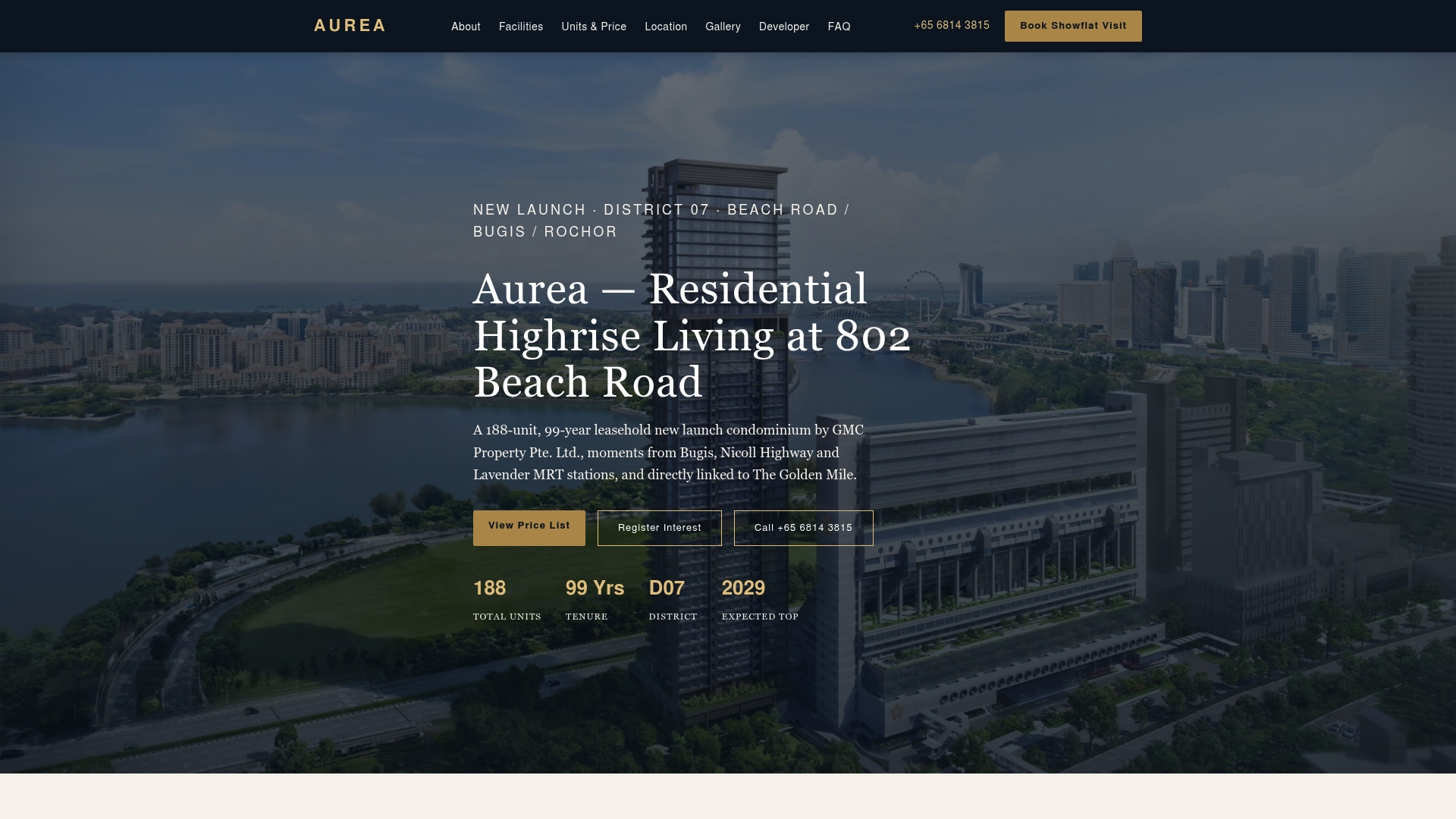
If the checklist above appeals to you but you'd rather skip months of comparing listings, Aurea's 188 units at 802 Beach Road are built around the same criteria: multiple MRT lines within reach, a covered link bridge to The Golden Mile, and resort-style amenities spread across four levels so daily convenience doesn't stop at the front door.
- Families and professionals wanting space can look at the 4 Bedroom or 4 Bedroom Premium layouts, with exact pricing listed on the Aurea landing page.
- Investors or smaller households may prefer the 2 Bedroom or 3 Bedroom units, with pricing details available on the Aurea landing page.
- At a viewing, ask specifically about the sheltered walking route to nearby stations and the realistic travel time to interchanges, not just the straight-line distance.
View floor plans and unit availability, or speak with the sales team, at the Aurea project page.
Sources
- Release of 2nd Quarter 2026 real estate statistics | Urban Redevelopment Authority (URA)
- Rail network | Land Transport Authority (LTA)
This article is general information, not a substitute for advice from a qualified financial advisor. Consult a qualified financial professional about your own circumstances before acting on anything here.
FAQ
What are some condos located near Singapore MRT stations?
Many premium developments across Singapore market themselves around proximity to one or more MRT lines, and Aurea at 802 Beach Road is one example, citing access to multiple stations and a link bridge to The Golden Mile. The strength of any such claim depends on the exact walking route and whether the station is an interchange, which buyers should verify through LTA's rail network resources rather than brochure copy alone.
Which HDB or condo launches sit beside an MRT line?
New launches are frequently positioned near MRT lines because developers actively seek sites within the closer distance bands to command a premium. Buyers should check each specific launch against URA's transaction data and LTA's station maps rather than assuming every "MRT-linked" launch delivers the same commute advantage.
Which condo will perform best by 2026?
No single condo can be reliably named as a top performer, since price movement depends on submarket, supply pipeline, and line connectivity rather than any one feature.
Is there a new condo near Tanah Merah MRT station?
This article does not cover developments specific to the Tanah Merah area, and any claim about a project there should be verified directly through URA's project listings or LTA's station information. Buyers interested in that corridor should check current planning approvals and transaction data for that exact postal sector before assuming a launch is planned.
How much does an Aurea unit cost?
Aurea's published pricing ranges from about 1.77 million SGD for a 2 Bedroom up to about 5.7 million SGD for a 4 Bedroom Premium unit, with 5 Bedroom and Penthouse pricing available on request. Exact pricing by unit type is listed on the Aurea project page.