
A Joint Borrower Sole Proprietor (JBSP) mortgage lets a parent co-sign the loan while the adult child holds the property title alone. Parents use this most often when a child's salary can't carry the 55% TDSR ceiling on their own but the family wants to avoid the Additional Buyer's Stamp Duty hit that comes with joint ownership. The trade-off is real: the parent carries full legal liability for the debt without owning a square foot of the unit.
- The upside: combined income raises the loan quantum under MAS TDSR rules, and ABSD is assessed only on the child as sole legal owner.
- The cost: the parent is jointly and severally liable for the full loan, gets zero ownership stake, and cannot touch CPF Ordinary Account funds since IRAS rules tie CPF usage to registered owners. A project like Aurea at Beach Road is a realistic example of where this structure gets used, given its mix of larger family units.
Table of Contents
- What Is a JBSP Property in Singapore and How Does It Work?
- Does JBSP Avoid ABSD, and Who Can Use CPF for It?
- How Much More Can You Borrow With a Parent as Co-Borrower?
- Which Banks in Singapore Offer JBSP Mortgages?
- What Are the Risks for the Parent Co-Borrower?
- How Do You Set Up a JBSP Mortgage Step by Step?
- JBSP vs Joint Ownership vs Sole Purchase: Which Wins Where?
- JBSP for New Launches: What to Watch at a Project Like Aurea
- How Do You Remove a Parent From a JBSP Loan Later?
- A Publisher's Note on Using JBSP Responsibly
- Thinking About Financing a Unit at Aurea?
- Frequently Asked Questions About JBSP Property in Singapore
- Sources
What Is a JBSP Property in Singapore and How Does It Work?
JBSP splits two roles that normally sit with the same person: the borrower (who signs the mortgage and answers for repayment) and the proprietor (who appears on the title deed and legally owns the home). A parent can be added purely as borrower, boosting the household income the bank counts, while the child alone owns the unit.
Banks allow this because it widens their pool of affordability without complicating title. Practical knock-on effects worth knowing upfront:
- CPF usage stays restricted to whoever is on the title, not whoever is on the loan.
- Estate planning gets messier since the parent's liability doesn't disappear if they pass away before the loan is settled.
- ABSD is calculated against the owner's existing property count, not the co-borrower's.
- The parent's own future borrowing capacity takes a TDSR hit for as long as they stay on the loan.
Does JBSP Avoid ABSD, and Who Can Use CPF for It?
Stamp duty in Singapore is assessed against whoever holds legal title, not whoever signs the loan. A parent who already owns a property but co-borrows under JBSP without appearing on the new title doesn't add to their own property count for ABSD purposes. The child, as sole owner, gets assessed on their own profile only.
CPF rules follow title, not the mortgage. Only the registered owner can draw from their CPF Ordinary Account for the downpayment or monthly installments. A co-borrowing parent left off the deed has no CPF access to this purchase, full stop.
JBSP cannot be used to finance an HDB flat purchase. HDB's ownership and eligibility framework requires that borrowers and owners align, which structurally rules out the borrower-owner split JBSP depends on. This applies only to private property, including new launches and resale condos.
How Much More Can You Borrow With a Parent as Co-Borrower?
MAS caps total monthly debt obligations at 55% of gross monthly income under TDSR. Add a parent's income to the equation and that ceiling rises with it, sometimes enough to bridge a meaningful shortfall.
Take a child earning $6,000 a month with no other debt, eyeing a $1.5 million condo, while understanding why Singapore has no capital gains tax could influence their long-term investment strategy. That likely leaves a gap of $500,000 or more against the purchase price once the loan-to-value cap and downpayment are factored in.
One catch that trips up families every time: banks generally apply loan tenure based on the oldest borrower's age, not the youngest. A 60-year-old parent on the loan can shrink the maximum tenure dramatically, which raises monthly installments even as it solves the income problem.
Which Banks in Singapore Offer JBSP Mortgages?
DBS, OCBC, and UOB are the three lenders most commonly referenced in the Singapore market for JBSP-style arrangements, though product availability shifts and not every bank markets it under the same name. Confirm current terms with a mortgage broker before you commit to a purchase timeline around it.
- Most lenders cap the number of borrowers on a single loan, typically at two or three.
- Loan tenure is usually capped using the oldest borrower's age against retirement-age assumptions, per MAS guidance.
- Loan-to-value limits follow standard private property rules regardless of the JBSP structure.
JBSP isn't available for HDB flats at all. HDB's eligibility framework ties financing schemes to owner-occupier and family nucleus rules that don't accommodate a non-owner co-borrower, so this route only applies to private condos and landed property.
What Are the Risks for the Parent Co-Borrower?
Joint-and-several liability is the sharpest edge of a JBSP loan. If the child stops paying, the bank can pursue the parent for the entire outstanding balance, not a proportional share, regardless of the fact that the parent's name never touched the title.
That liability also eats into the parent's own TDSR the whole time they're on the loan, which can quietly block them from refinancing their own home or qualifying for another property purchase later. Legal advisers consistently flag that families underestimate how long this exposure lasts, especially on loans with 25 to 30-year tenures.
Because the co-borrower carries the debt without any ownership claim, independent legal and financial advice before signing is not optional. It's the only way to make sure everyone understands what happens on default, on sale, or on the parent's passing.
Pro Tip: Put the family's intentions in writing, even informally, alongside the mortgage paperwork. A simple side letter stating who actually pays the installments, and what happens if the child wants to sell early, prevents disputes that formal loan documents don't address.
How Do You Set Up a JBSP Mortgage Step by Step?
- Get a preliminary affordability check from a broker using combined incomes.
- Confirm with the specific lender that they accept a JBSP structure for the property type you're eyeing.
- Gather identity and income documents for both borrowers, including payslips, tax notices, and CPF statements.
- Engage a conveyancing lawyer to prepare title and mortgage documents reflecting the borrower-owner split.
- For new launches, confirm JBSP acceptance with the bank before exercising the Option to Purchase.
Expect legal and conveyancing fees in the low thousands of dollars, plus valuation fees and any applicable stamp duties on the transaction. Broker fees, where charged, are usually built into the loan package rather than billed separately.
JBSP vs Joint Ownership vs Sole Purchase: Which Wins Where?
The three structures split tax, CPF access, and liability very differently, and there's no single winner. Comparing them side by side against a gift or trust arrangement makes the trade-offs clearer than reading about JBSP in isolation.
| Structure | ABSD basis | CPF access | Who's liable |
|---|---|---|---|
| JBSP | Assessed on titled owner only | Only titled owner can use CPF | Parent and child jointly liable |
| Joint ownership | Assessed on both owners' profiles | Both owners can use CPF | Both owners liable, both hold title |
| Sole purchase (child only) | Assessed on child only | Child's CPF only | Child solely liable |
Joint ownership often triggers higher ABSD if the parent already owns property, since ABSD stacks against the parent's existing count. Sole purchase avoids that ABSD exposure entirely but leaves the child needing to qualify for the full loan alone.
JBSP for New Launches: What to Watch at a Project Like Aurea
New launches add timing pressure that resale purchases don't. A project like Aurea at 802 Beach Road, with 2 to 5 bedroom layouts and penthouses, is exactly the kind of premium unit mix where a parent's income boost under JBSP can be the difference between qualifying and not.
- Confirm JBSP acceptance with your bank before booking, not after.
- Check the developer's payment schedule against when your loan approval actually lands.
- Build in a financing contingency period before exercising the Option to Purchase.
Pro Tip: Get written, not verbal, confirmation from the bank that they'll approve JBSP for the specific unit before you put down a booking fee. Verbal assurances from a loan officer aren't binding if underwriting later says no.
How Do You Remove a Parent From a JBSP Loan Later?
Most families treat JBSP as a bridge, not a permanent fixture, planning to refinance once the child's income can carry the loan solo.
- Monitor the child's income growth annually against the standalone TDSR threshold.
- Approach the lender for a refinance assessment once the child likely qualifies alone.
- Budget for legal and valuation fees tied to the refinancing process.
Selling the property or substituting a different co-borrower are the other common exits, though both carry their own costs and timing headaches. Whichever path you pick, start planning it before the parent needs fresh borrowing capacity for their own future purchases.
Combining a parent's income under JBSP can close a real borrowing gap, but it makes the parent fully liable for a debt they will never own.
| Point | Details |
|---|---|
| Define the split early | Confirm who's the borrower and who's the titled owner before applying, in writing. |
| Check ABSD basis | ABSD is assessed on the legal owner's title, not the co-borrower's income contribution. |
| CPF follows title | Only the registered owner can use CPF OA funds for downpayment or installments. |
| Plan the exit upfront | Set a target timeline to refinance the parent off the loan once the child qualifies alone. |
| Consider new-launch options | Projects like Aurea, with larger unit layouts, are common cases where JBSP bridges an affordability gap. |
A Publisher's Note on Using JBSP Responsibly
JBSP is a useful tool, not a shortcut around due diligence. The families who do well with it treat the parent's exit as part of the plan from day one, not an afterthought once the child's career takes off. Get independent legal and financial advice before signing anything, and revisit the plan yearly.
Thinking About Financing a Unit at Aurea?
If you're weighing a JBSP structure to help a child qualify for a larger unit, Aurea's 2 to 5 bedroom layouts and penthouses at 802 Beach Road give families real flexibility to size the purchase around combined household income rather than one salary alone.

The development sits within reach of multiple MRT stations and links directly to The Golden Mile, with resort-style amenities across four levels for residents who want city living without leaving the building for daily leisure. If JBSP financing is part of your plan, get your bank's written acceptance sorted before booking, then reach out to the Aurea sales team to check current unit availability and arrange a financing consultation ahead of exercising any Option to Purchase.
Frequently Asked Questions About JBSP Property in Singapore
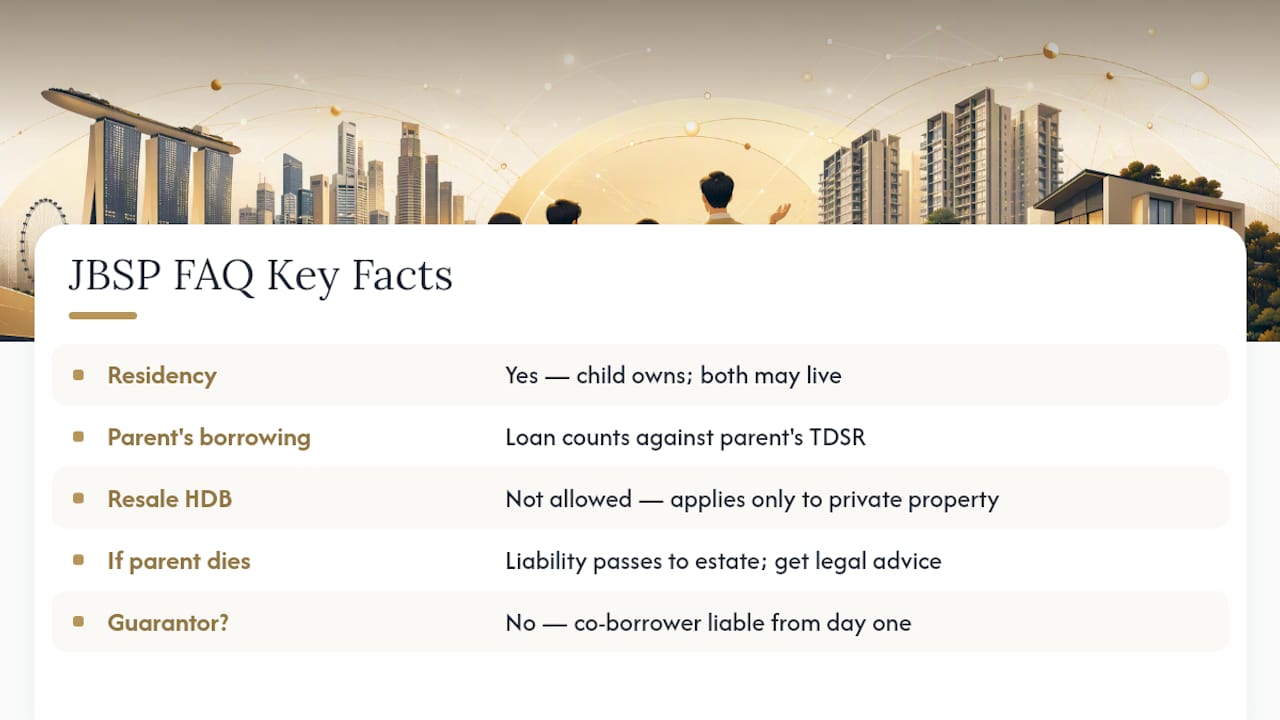
Can a parent and child both live in a JBSP property? Yes. JBSP only affects the loan and title structure, not who's allowed to reside in the unit. The child owns it and both can live there under standard occupancy rules.
Does JBSP affect the parent's ability to buy another property later? Yes. The JBSP loan counts against the parent's own TDSR for as long as they remain a co-borrower, which can reduce how much they can borrow for a separate purchase.
Can JBSP be used for a resale HDB flat? No. HDB's ownership and eligibility rules don't accommodate the borrower-owner split JBSP requires, so it applies only to private property.
What happens to the JBSP loan if the parent passes away? The liability generally passes to the parent's estate, which is why estate planning and independent legal advice matter before signing on as a co-borrower.
Is JBSP the same as a guarantor loan? No. A guarantor typically only becomes liable if the primary borrower defaults, while a JBSP co-borrower is jointly and severally liable for the debt from day one, per general JBSP mechanics.
This article is general information, not a substitute for advice from a qualified financial advisor. Consult a qualified financial professional about your own circumstances before acting on anything here.
Sources
- Guidelines on the application of TDSR for property loans (MAS)
- Joint Borrower Sole Proprietor guidance and legal notes (The Cooper Way)
- JBSP mortgage case study for expats (Liquid Expat Mortgages)